India Predictive Maintenance Market Size & Growth Rate (2026-2032)
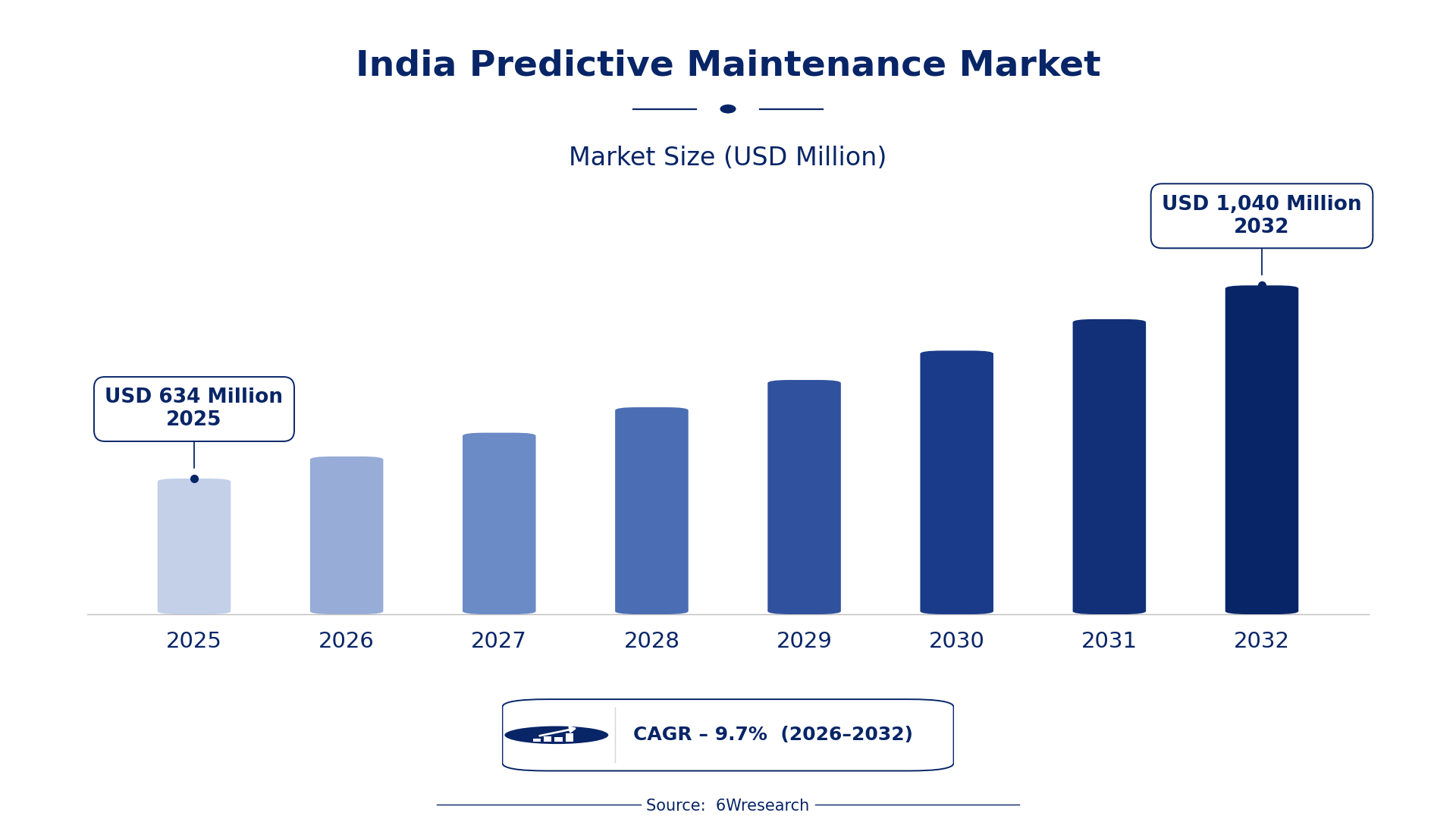
The India Predictive Maintenance Market was estimated at USD 634 Million in 2025 and is projected to reach USD 1040 Million by 2032, growing at a CAGR of 9.7% from 2026 to 2032.
India Predictive Maintenance Market Synopsis
The India Predictive Maintenance Market is witnessing a surge as companies strive to enhance operational efficiency. Industries across manufacturing, energy, and logistics are increasingly adopting predictive maintenance solutions to mitigate unplanned downtime and reduce maintenance costs.
By harnessing data analytics and machine learning, organizations can foresee equipment failures, allowing for timely interventions. This proactive approach not only optimizes machinery performance but also enhances competitiveness in a rapidly evolving industrial sector.
India Predictive Maintenance Market Year-wise Growth Rate and Key Drivers
This graph illustrates the annual growth rates of the India Predictive Maintenance Market from 2021 to 2032, highlighting a steady upward trajectory and projected expansion over the forecast period.
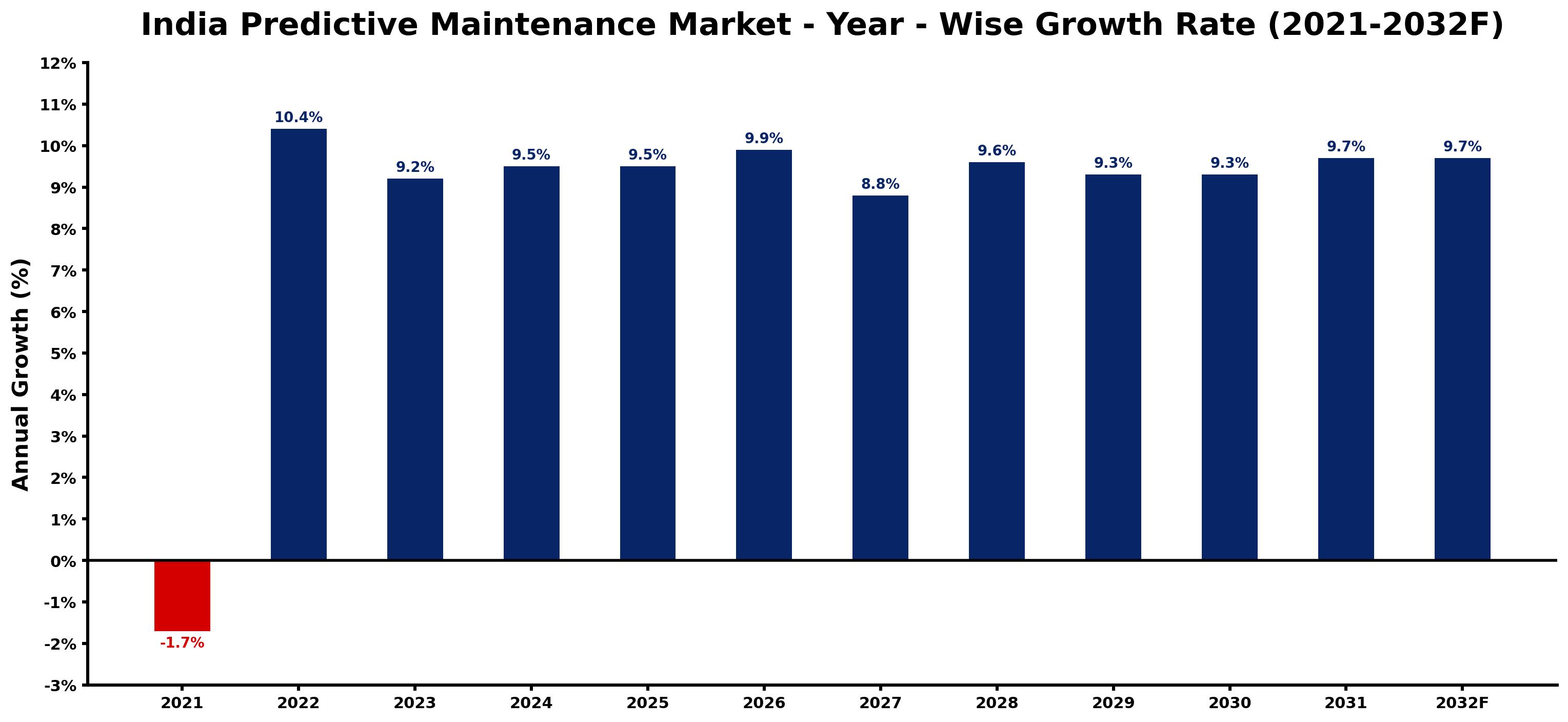
The table below presents the year‑wise growth rates along with the key drivers influencing the market
| Year | Growth Rate | Major Drivers |
| 2021 | -1.7% | Delayed infrastructure projects stalled technology adoption in India. |
| 2022 | 10.4% | Government push for manufacturing competitiveness via SANSAD plan |
| 2023 | 9.2% | Increase in adoption of IoT sensors by factories |
| 2024 | 9.5% | Rising need for efficiency in Indian automotive sector |
| 2025 | 9.5% | Boost from Make in India manufacturing initiatives |
| 2026 | 9.9% | Growing focus on asset management in oil industry |
| 2027 | 8.8% | Telecom sector investing in advanced maintenance technologies |
| 2028 | 9.6% | Adoption of AI-driven tools in logistics optimization |
| 2029 | 9.3% | Emerging industry 4.0 trends fueling maintenance solutions |
| 2030 | 9.3% | Regulatory standards enforcing preventive maintenance protocols |
| 2031 | 9.7% | Increased funding for smart-city predictive maintenance projects |
| 2032 | 9.7% | Demand from renewable energy sectors for predictive analytics |
Note: Market size estimations and growth projections presented in this report are based on 6Wresearch's proprietary forecasting methodology, utilizing the latest available industry data, government publications, and primary research inputs.
India Predictive Maintenance Market Key Takeaways
Below are some of the specific key takeaways from the market, including:
- Rising demand for operational efficiency drives market growth.
- Data analytics and machine learning are crucial for effective predictive maintenance.
- Industries are focusing on minimizing equipment downtime and maintenance costs.
- COVID-19 accelerated the adoption of remote monitoring solutions.
- Key players are innovating with IoT technologies to enhance service delivery.
Evaluation of Restraints in India Predictive Maintenance Market
Despite the growth potential, the India Predictive Maintenance Market faces notable constraints. A significant challenge is the difficulty in acquiring real-time sensor data from diverse industrial equipment. This data is vital for accurate failure prediction, yet many organizations struggle with data integration and processing.
on top of that, ensuring high accuracy while minimizing false alarms is a critical concern. Companies often grapple with the balance between maintenance costs and operational downtime, complicating the optimization of maintenance schedules.
India Predictive Maintenance Market Trends
Several trends are shaping the India Predictive Maintenance Market. The integration of IoT technologies is becoming standard, enabling real-time data collection and analysis. Organizations are increasingly adopting cloud-based predictive maintenance solutions for scalability and flexibility.
Another trend is the growing focus on sustainability, as industries seek to minimize waste and energy consumption through more efficient maintenance practices. Additionally, the rise of AI-driven analytics is enhancing predictive capabilities, making it a vital tool for future maintenance strategies.
India Predictive Maintenance Market Opportunities
The market is ripe with opportunities for growth and investment. As industries shift towards digital transformation, there is a growing demand for advanced predictive maintenance solutions. Companies that can offer tailored solutions addressing specific industry needs will find a welcoming environment.
on top of that, the potential for expanding into untapped sectors, such as agriculture and transportation, presents lucrative avenues. Investment in R&D for innovative predictive maintenance technologies can also drive competitive advantage.
Government Initiatives in the India Predictive Maintenance Market
Government policies are increasingly shaping the direction of the India Predictive Maintenance Market. The emphasis on industrial digitization and infrastructure development is critical, as policymakers recognize the importance of predictive maintenance in enhancing productivity and economic growth.
- A national initiative launched in early 2023 aims to improve digital infrastructure across manufacturing sectors.
- Currently, an ongoing program focuses on subsidizing IoT technologies for small and medium enterprises to facilitate predictive maintenance adoption.
- A planned framework for regulatory standards in predictive maintenance is expected to roll out by 2025, ensuring safety and compliance.
- Recent efforts include collaborations between public and private sectors to develop training programs aimed at upskilling workers in predictive maintenance technologies.
Future Insights of the India Predictive Maintenance Market
Looking ahead, the India Predictive Maintenance Market is set to expand significantly between 2026 and 2032. As industries embrace digital transformation, the reliance on predictive maintenance solutions will only grow. The integration of advanced analytics and machine learning is expected to evolve, offering deeper insights and more accurate predictions.
on top of that, with the increasing focus on sustainability and cost reduction, predictive maintenance will be viewed as an essential strategy for operational excellence. Companies that invest in innovation will likely lead the charge in this evolving market.
India Predictive Maintenance Market Latest Developments
In the past year, the India Predictive Maintenance Market has seen considerable activity as businesses adapt to new operational realities. The emphasis on remote monitoring and data-driven decision-making has intensified, prompting companies to explore advanced predictive maintenance solutions actively.
- A significant rollout of a cloud-based predictive maintenance platform was completed in late 2023, enabling real-time monitoring for various industries.
- Ongoing partnerships between technology vendors and manufacturers aim to integrate AI capabilities into existing maintenance frameworks, enhancing predictive accuracy.
- A major technology vendor is set to launch a new predictive analytics tool aimed at the energy sector by mid-2024.
- An initiative that began in early 2023 focuses on developing industry-specific predictive maintenance standards to improve reliability.
India Predictive Maintenance Market - Key Attractiveness of the Report
- 10 Years of Market Numbers
- Historical Data Starting from 2022 to 2025
- Base Year: 2025
- Forecast Data until 2032
- Key Performance Indicators Impacting the Market
- Major Upcoming Developments and Projects
Key Highlights of the Report:
- India Predictive Maintenance Market Outlook
- Market Size of India Predictive Maintenance Market, 2025
- Forecast of India Predictive Maintenance Market, 2032
- Historical Data and Forecast of India Predictive Maintenance Revenues & Volume for the Period 2022-2032F
- India Predictive Maintenance Market Trend Evolution
- India Predictive Maintenance Market Drivers and Challenges
- India Predictive Maintenance Price Trends
- India Predictive Maintenance Porter's Five Forces
- India Predictive Maintenance Industry Life Cycle
- Historical Data and Forecast of India Predictive Maintenance Market Revenues & Volume By Component for the Period 2022-2032F
- Historical Data and Forecast of India Predictive Maintenance Market Revenues & Volume By Solutions for the Period 2022-2032F
- Historical Data and Forecast of India Predictive Maintenance Market Revenues & Volume By Services for the Period 2022-2032F
- Historical Data and Forecast of India Predictive Maintenance Market Revenues & Volume By Organization Size for the Period 2022-2032F
- Historical Data and Forecast of India Predictive Maintenance Market Revenues & Volume By Large Enterprises for the Period 2022-2032F
- Historical Data and Forecast of India Predictive Maintenance Market Revenues & Volume By SME for the Period 2022-2032F
- Historical Data and Forecast of India Predictive Maintenance Market Revenues & Volume By Deployment Mode for the Period 2022-2032F
- Historical Data and Forecast of India Predictive Maintenance Market Revenues & Volume By On-premises for the Period 2022-2032F
- Historical Data and Forecast of India Predictive Maintenance Market Revenues & Volume By Cloud for the Period 2022-2032F
- Historical Data and Forecast of India Predictive Maintenance Market Revenues & Volume By Vertical for the Period 2022-2032F
- Historical Data and Forecast of India Predictive Maintenance Market Revenues & Volume By Government and Defense for the Period 2022-2032F
- Historical Data and Forecast of India Predictive Maintenance Market Revenues & Volume By Manufacturing for the Period 2022-2032F
- Historical Data and Forecast of India Predictive Maintenance Market Revenues & Volume By Energy and Utilities for the Period 2022-2032F
- Historical Data and Forecast of India Predictive Maintenance Market Revenues & Volume By Transportation and Logistics for the Period 2022-2032F
- Historical Data and Forecast of India Predictive Maintenance Market Revenues & Volume By Healthcare and Life Sciences for the Period 2022-2032F
- India Predictive Maintenance Import Export Trade Statistics
- Market Opportunity Assessment By Component
- Market Opportunity Assessment By Organization Size
- Market Opportunity Assessment By Deployment Mode
- Market Opportunity Assessment By Vertical
- India Predictive Maintenance Top Companies Market Share
- India Predictive Maintenance Competitive Benchmarking By Technical and Operational Parameters
- India Predictive Maintenance Company Profiles
- India Predictive Maintenance Key Strategic Recommendations






































