India Quality and Lifecycle Management Software Market Size & Growth Rate (2026-2032)
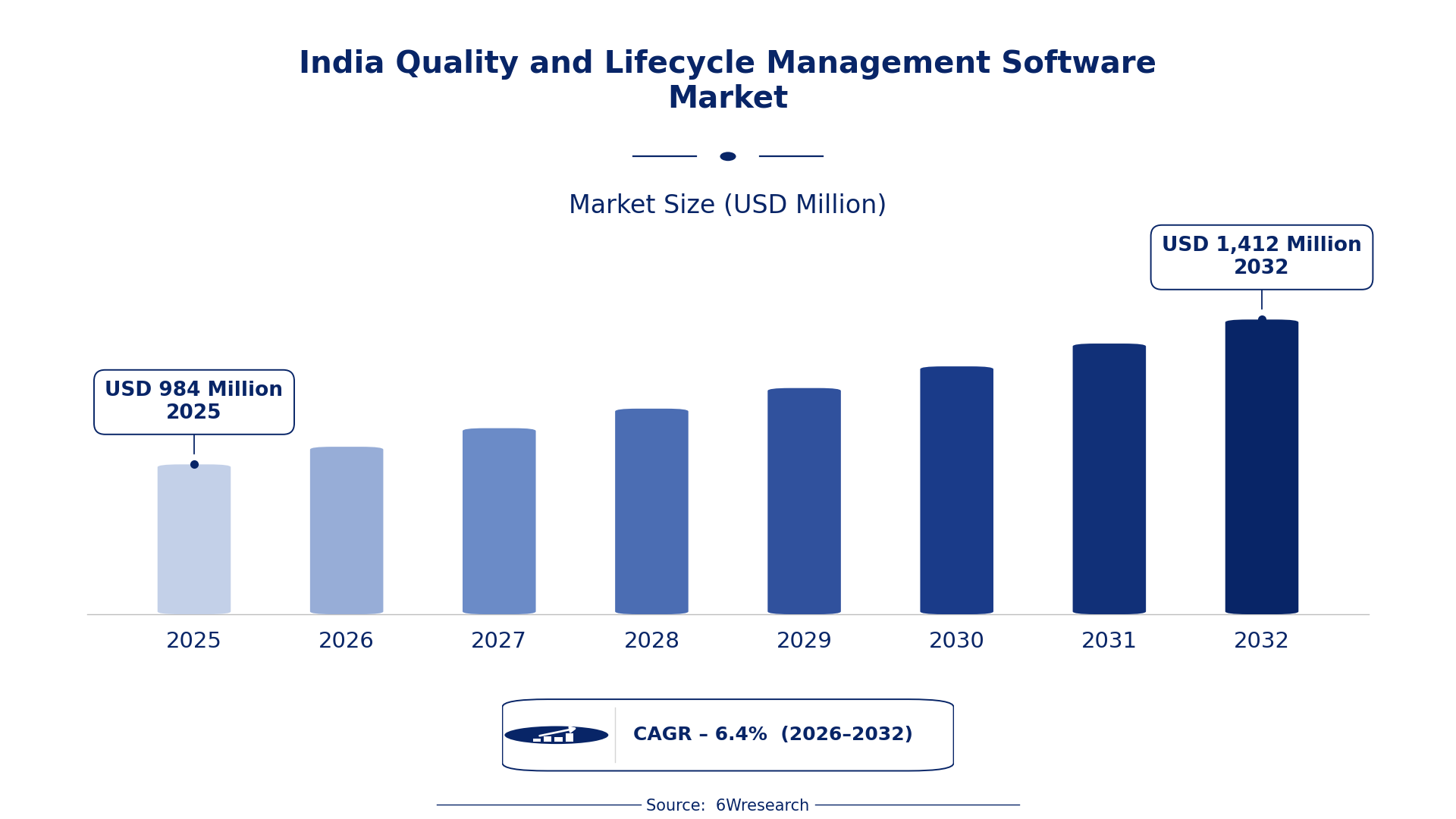
The India Quality and Lifecycle Management Software Market was estimated at USD 984 Million in 2025 and is projected to reach USD 1412 Million by 2032, growing at a CAGR of 6.4% from 2026 to 2032.
India Quality and Lifecycle Management Software Market Synopsis
The demand for Quality and Lifecycle Management (QLM) software in India is surging as industries prioritize regulatory compliance and product excellence. This software plays a critical role in sectors like pharmaceuticals, automotive, and manufacturing, where quality assurance is non-negotiable.
As Indian companies navigate a competitive global market, the adoption of QLM solutions has become more than a trend; it’s a strategic imperative. Businesses are leveraging these technologies to optimize product development cycles and enhance quality management, ultimately driving efficiency and profitability.
India Quality and Lifecycle Management Software Market Year-wise Growth Rate and Key Drivers
This graph illustrates the annual growth rates of the India Quality and Lifecycle Management Software Market from 2021 to 2032, highlighting a steady upward trajectory and projected expansion over the forecast period.
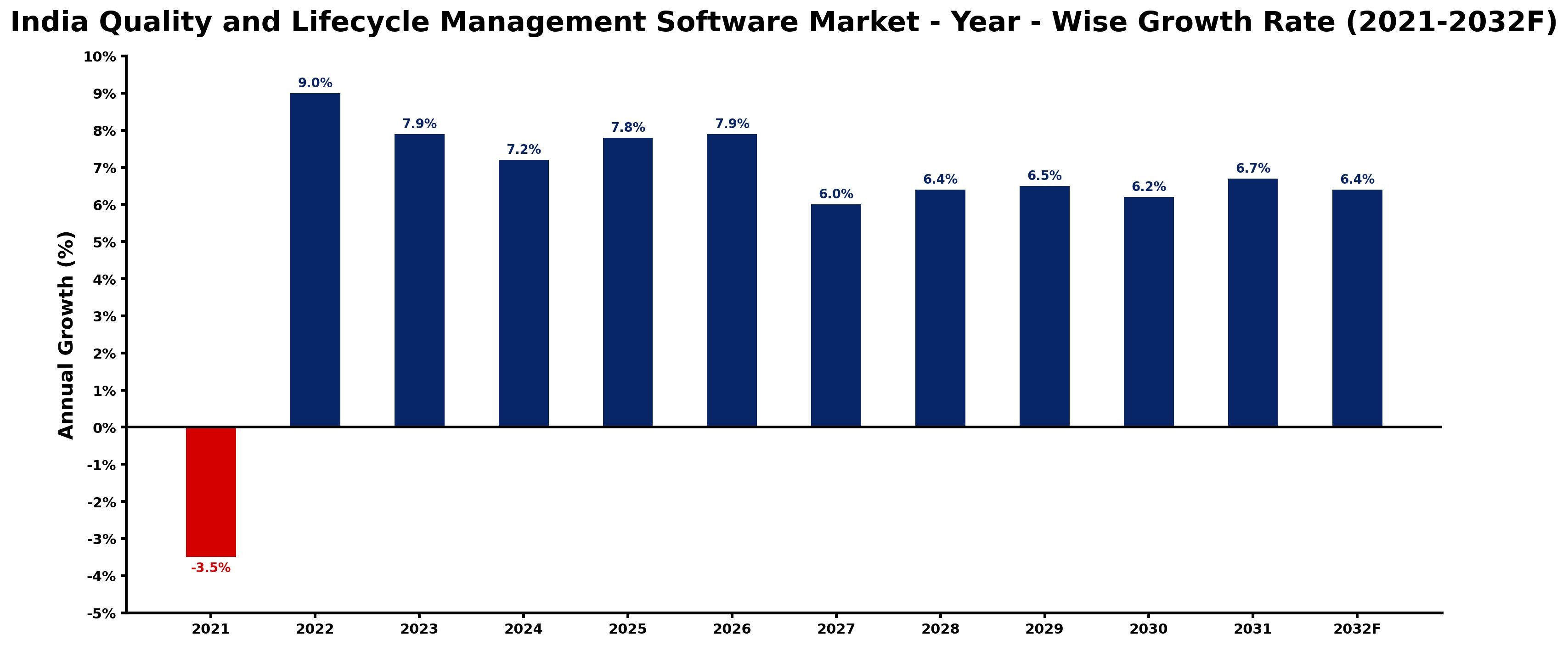
The table below presents the year‑wise growth rates along with the key drivers influencing the market
| Year | Growth Rate | Major Drivers |
| 2021 | -3.5% | Delayed digital transformation initiatives in Indian enterprises. |
| 2022 | 9.0% | Implementation of Digital India driving software lifecycle management. |
| 2023 | 7.9% | Government procurement policies increasing reliance on quality software. |
| 2024 | 7.2% | Growth in e-commerce requiring enhanced product lifecycle solutions. |
| 2025 | 7.8% | Manufacturing sector adopting AI for quality assurance improvements. |
| 2026 | 7.9% | Increased use of analytics for quality control in production. |
| 2027 | 6.0% | Boost from railways digitization necessitating robust management systems. |
| 2028 | 6.4% | Emergence of fintech firms pushing quality assurance innovations. |
| 2029 | 6.5% | Automotive sector transformation requiring advanced compliance management tools. |
| 2030 | 6.2% | Healthcare digitization necessitating lifecycle management compliance solutions. |
| 2031 | 6.7% | Rising investments in smart manufacturing enhancing software adoption. |
| 2032 | 6.4% | Growth in pharmaceuticals leading to demand for quality oversight. |
Note: Market size estimations and growth projections presented in this report are based on 6Wresearch's proprietary forecasting methodology, utilizing the latest available industry data, government publications, and primary research inputs.
India Quality and Lifecycle Management Software Market Key Takeaways
Below are some of the specific key takeaways from the market, including:
- The market is witnessing a robust shift towards digital solutions for quality management.
- Companies are focusing on compliance with international quality standards.
- There is a notable increase in investment from the pharmaceutical and manufacturing sectors.
- Remote working trends have accelerated the need for efficient lifecycle management tools.
- Data security and privacy are becoming paramount as companies adopt these solutions.
Evaluation of Restraints in India Quality and Lifecycle Management Software Market
Despite the growth potential, the India Quality and Lifecycle Management Software Market faces several constraints that can impede its expansion. One of the most pressing issues is the challenge of ensuring robust data security, particularly given the increasing reliance on digital platforms. Companies often grapple with the need to protect sensitive information while complying with stringent regulations. Additionally, inconsistent network infrastructure across various regions in India complicates access to cloud-based solutions, hindering seamless data synchronization and real-time decision-making. Addressing these challenges will be crucial for companies looking to fully capitalize on the benefits of QLM software.
India Quality and Lifecycle Management Software Market Trends
Several trends are shaping the India Quality and Lifecycle Management Software Market. The integration of artificial intelligence and machine learning into QLM solutions is gaining traction, enabling companies to predict quality issues before they arise. on top of that, the shift towards cloud-based solutions is making quality management more accessible and cost-effective for organizations of all sizes. The push for sustainability is also influencing product lifecycle strategies, as companies seek to minimize environmental impact while ensuring quality.
India Quality and Lifecycle Management Software Market Opportunities
The landscape is ripe for growth, particularly for firms that focus on innovative features like real-time analytics and mobile accessibility. As regulatory pressures mount, companies that offer tailored compliance solutions will find ample opportunities. on top of that, there's a growing market for training and consultancy services to help organizations effectively implement QLM solutions. The increasing globalization of Indian companies also suggests a rising need for software that can support international quality standards.
Government Initiatives in the India Quality and Lifecycle Management Software Market
Government policy is actively shaping the Quality and Lifecycle Management Software Market in India, reflecting a commitment to enhancing industry standards and regulatory compliance. Recent initiatives aim to foster innovation and ensure that Indian products meet global benchmarks. By establishing a supportive regulatory framework, the government is encouraging businesses to adopt advanced QLM solutions that drive quality and efficiency.
- A national quality assurance initiative launched in early 2023, focusing on enhancing product safety standards across industries.
- Current efforts are underway to establish a regulatory framework that mandates digital quality management tools for manufacturers by 2025.
- A planned public-private partnership expected to roll out by mid-2026 aims to improve access to quality management resources for SMEs.
- Ongoing workshops and training programs initiated by government bodies to educate businesses about the benefits of QLM software.
Future Insights of the India Quality and Lifecycle Management Software Market
Looking ahead to 2026-2032, the India Quality and Lifecycle Management Software Market is expected to evolve significantly. With an increasing focus on digital transformation, businesses will likely seek more integrated and user-friendly solutions. The rise in remote work will further drive demand for cloud-based QLM tools. As companies continue to prioritize quality and compliance, investments in advanced analytics and AI-driven solutions will be critical to staying competitive. This market is on the cusp of substantial growth, with opportunities for innovation at every turn.
India Quality and Lifecycle Management Software Market Latest Developments
In the past year, the India Quality and Lifecycle Management Software Market has seen several noteworthy developments as companies adapt to evolving demands. The push for digital solutions has led to a surge in partnerships between software vendors and industry leaders to enhance product offerings. There’s a clear trend toward integrating advanced technologies like AI to improve operational efficiency and quality assurance.
- A leading technology vendor launched a new QLM solution in Q1 2025, integrating real-time analytics features to enhance decision-making capabilities.
- An initiative that began in mid-2025 is currently underway to roll out a comprehensive training program for quality managers across various sectors.
- Upcoming collaborations are planned between software companies and regulatory bodies to streamline compliance processes by late 2026.
- Recent enhancements in cloud capabilities were announced in Q3 2025, allowing for improved data security and user accessibility.
India Quality and Lifecycle Management Software Market - Key Attractiveness of the Report
- 10 Years of Market Numbers
- Historical Data Starting from 2022 to 2025
- Base Year: 2025
- Forecast Data until 2032
- Key Performance Indicators Impacting the Market
- Major Upcoming Developments and Projects
Key Highlights of the Report:
- India Quality and Lifecycle Management Software Market Outlook
- Market Size of India Quality and Lifecycle Management Software Market, 2025
- Forecast of India Quality and Lifecycle Management Software Market, 2032
- Historical Data and Forecast of India Quality and Lifecycle Management Software Revenues & Volume for the Period 2022-2032F
- India Quality and Lifecycle Management Software Market Trend Evolution
- India Quality and Lifecycle Management Software Market Drivers and Challenges
- India Quality and Lifecycle Management Software Price Trends
- India Quality and Lifecycle Management Software Porter's Five Forces
- India Quality and Lifecycle Management Software Industry Life Cycle
- Historical Data and Forecast of India Quality and Lifecycle Management Software Market Revenues & Volume By Solutions for the Period 2022-2032F
- Historical Data and Forecast of India Quality and Lifecycle Management Software Market Revenues & Volume By Bill of Material (BOM) Management for the Period 2022-2032F
- Historical Data and Forecast of India Quality and Lifecycle Management Software Market Revenues & Volume By Document and Product Data Management for the Period 2022-2032F
- Historical Data and Forecast of India Quality and Lifecycle Management Software Market Revenues & Volume By Quality Management for the Period 2022-2032F
- Historical Data and Forecast of India Quality and Lifecycle Management Software Market Revenues & Volume By Change Management for the Period 2022-2032F
- Historical Data and Forecast of India Quality and Lifecycle Management Software Market Revenues & Volume By Cost Management for the Period 2022-2032F
- Historical Data and Forecast of India Quality and Lifecycle Management Software Market Revenues & Volume By Governance and Compliance Management for the Period 2022-2032F
- Historical Data and Forecast of India Quality and Lifecycle Management Software Market Revenues & Volume By Lifecycle Analytics Management for the Period 2022-2032F
- Historical Data and Forecast of India Bill of Material (BOM) Management Quality and Lifecycle Management Software Market Revenues & Volume By Other Solutions for the Period 2022-2032F
- Historical Data and Forecast of India Quality and Lifecycle Management Software Market Revenues & Volume By Deployment Modes for the Period 2022-2032F
- Historical Data and Forecast of India Quality and Lifecycle Management Software Market Revenues & Volume By Cloud for the Period 2022-2032F
- Historical Data and Forecast of India Quality and Lifecycle Management Software Market Revenues & Volume By On-Premises for the Period 2022-2032F
- Historical Data and Forecast of India Quality and Lifecycle Management Software Market Revenues & Volume By Organization Size for the Period 2022-2032F
- Historical Data and Forecast of India Quality and Lifecycle Management Software Market Revenues & Volume By Small and Medium-sized Enterprises for the Period 2022-2032F
- Historical Data and Forecast of India Quality and Lifecycle Management Software Market Revenues & Volume By Large Enterprises for the Period 2022-2032F
- Historical Data and Forecast of India Quality and Lifecycle Management Software Market Revenues & Volume By Verticals for the Period 2022-2032F
- Historical Data and Forecast of India Quality and Lifecycle Management Software Market Revenues & Volume By Aerospace & Defense for the Period 2022-2032F
- Historical Data and Forecast of India Quality and Lifecycle Management Software Market Revenues & Volume By Automotive & Transport for the Period 2022-2032F
- Historical Data and Forecast of India Quality and Lifecycle Management Software Market Revenues & Volume By Consumer Goods & Retail for the Period 2022-2032F
- Historical Data and Forecast of India Quality and Lifecycle Management Software Market Revenues & Volume By Healthcare & Lifesciences for the Period 2022-2032F
- Historical Data and Forecast of India Quality and Lifecycle Management Software Market Revenues & Volume By Industrial Manufacturing for the Period 2022-2032F
- Historical Data and Forecast of India Quality and Lifecycle Management Software Market Revenues & Volume By IT & Telecom for the Period 2022-2032F
- India Quality and Lifecycle Management Software Import Export Trade Statistics
- Market Opportunity Assessment By Solutions
- Market Opportunity Assessment By Deployment Modes
- Market Opportunity Assessment By Organization Size
- Market Opportunity Assessment By Verticals
- India Quality and Lifecycle Management Software Top Companies Market Share
- India Quality and Lifecycle Management Software Competitive Benchmarking By Technical and Operational Parameters
- India Quality and Lifecycle Management Software Company Profiles
- India Quality and Lifecycle Management Software Key Strategic Recommendations






































