India Quantum Cryptography Market Size & Growth Rate (2026-2032)
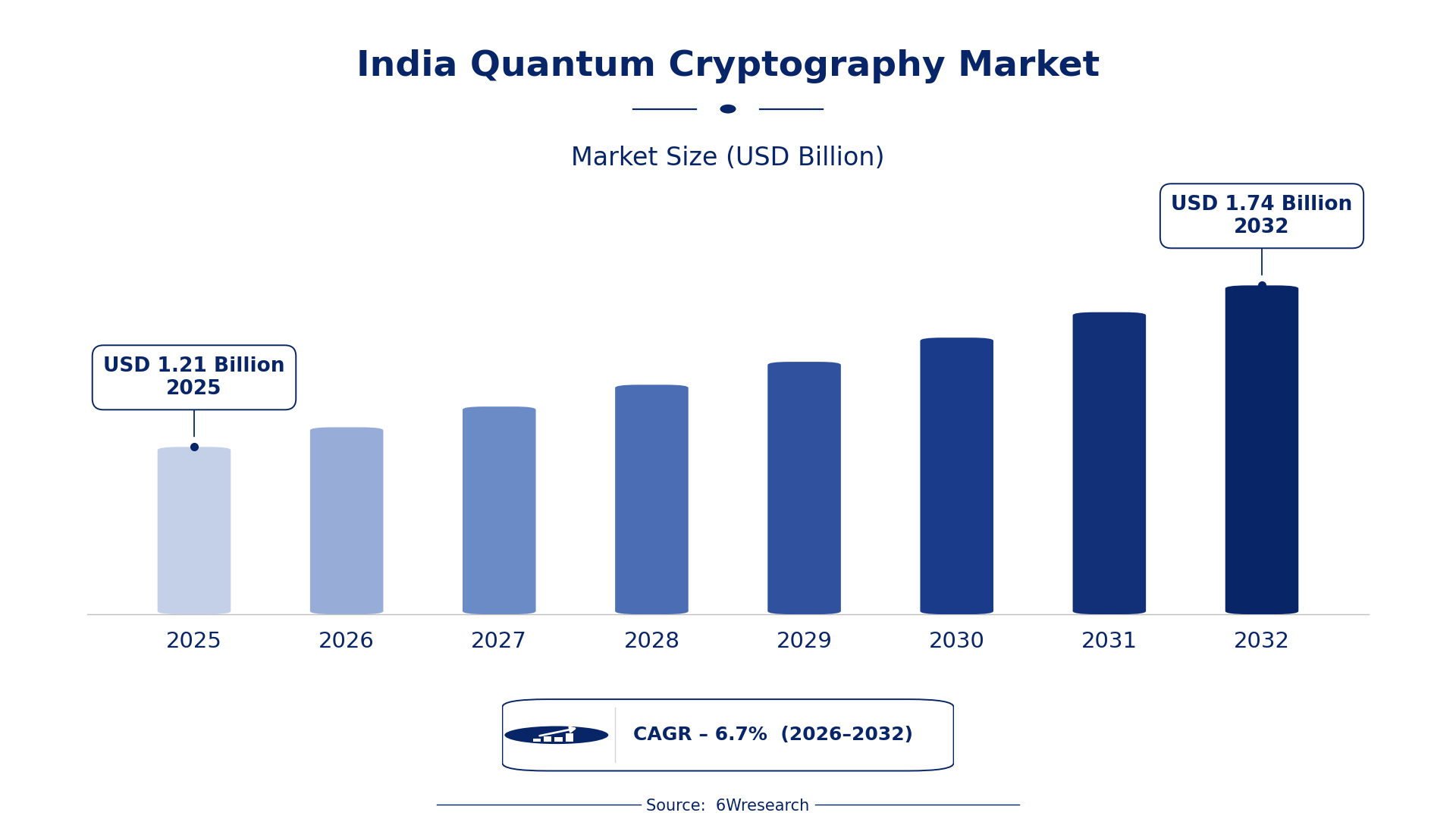
The India Quantum Cryptography Market was estimated at USD 1213 Million in 2025 and is projected to reach USD 1740 Million by 2032, growing at a CAGR of 6.7% from 2026 to 2032.
India Quantum Cryptography Market Synopsis
The India Quantum Cryptography market is at a critical juncture. While it has garnered attention due to heightened awareness of quantum computing threats, the true potential is just beginning to unfold. Organizations that traditionally relied on conventional encryption methods are now actively seeking quantum-resistant solutions to safeguard their data.
As we look ahead, this market is gearing up for significant advancements. The emphasis on unbreakable encryption, particularly in sectors like finance and healthcare, indicates a readiness to invest in robust security measures. This proactive approach marks a shift in the understanding of cryptographic needs in an age defined by quantum technology.
India Quantum Cryptography Market Year-wise Growth Rate and Key Drivers
This graph illustrates the annual growth rates of the India Quantum Cryptography Market from 2021 to 2032, highlighting a steady upward trajectory and projected expansion over the forecast period.
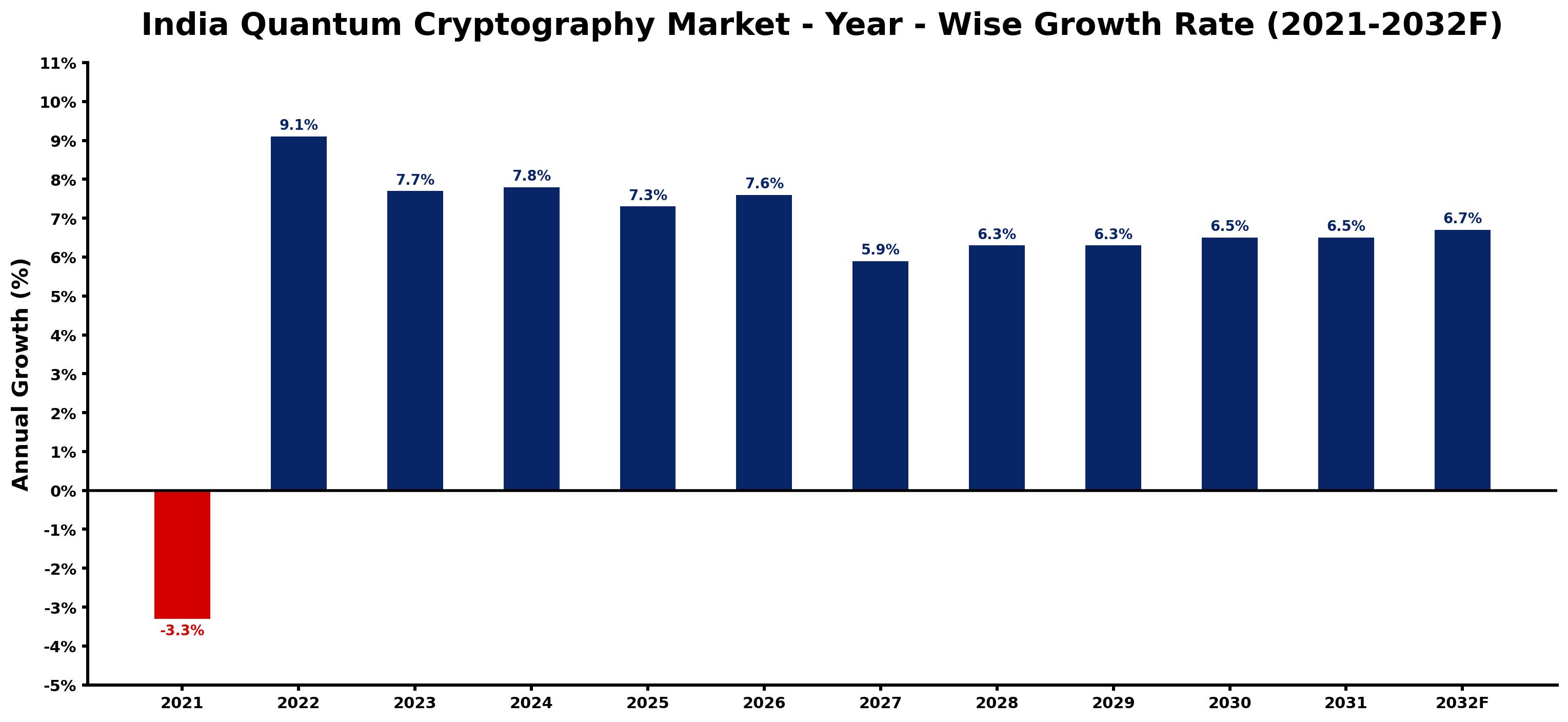
The table below presents the year‑wise growth rates along with the key drivers influencing the market
| Year | Growth Rate | Major Drivers |
| 2021 | -3.3% | Lack of government investment in quantum research initiatives. |
| 2022 | 9.1% | Launch of India’s Quantum Mission by Department of Science. |
| 2023 | 7.7% | Government incentives for secure quantum communication startups. |
| 2024 | 7.8% | Collaboration with global firms for quantum research funding. |
| 2025 | 7.3% | Increased investments in quantum infrastructure by Tech Mahindra. |
| 2026 | 7.6% | New cybersecurity regulations mandating advanced encryption technologies. |
| 2027 | 5.9% | Growing public sector interest in secure government communications. |
| 2028 | 6.3% | Rising threats of cyber attacks boosting security awareness. |
| 2029 | 6.3% | Increased awareness of quantum risks in telecommunications sector. |
| 2030 | 6.5% | Development of indigenous quantum cryptography solutions by IISc. |
| 2031 | 6.5% | Partnerships with international bodies for quantum safety standards. |
| 2032 | 6.7% | Government support for quantum startups through incubator programs. |
Note: Market size estimations and growth projections presented in this report are based on 6Wresearch's proprietary forecasting methodology, utilizing the latest available industry data, government publications, and primary research inputs.
India Quantum Cryptography Market Key Takeaways
Below are some of the specific key takeaways from the market, including:
- The increasing threat posed by quantum computing is a major driver for the adoption of quantum cryptography solutions.
- Industries managing sensitive data are prioritizing investment in quantum-resistant encryption methods to enhance security.
- The lack of expertise and infrastructure in quantum cryptography presents challenges for organizations in India.
- Government initiatives focused on data security are expected to propel the market forward.
- COVID-19 has accelerated the demand for secure communication channels, particularly in healthcare and finance sectors.
Evaluation of Restraints in India Quantum Cryptography Market
One of the primary obstacles hindering the growth of the India Quantum Cryptography market is the high cost associated with implementing quantum-resistant encryption solutions. For many organizations, the initial investment can be daunting, especially in a market still grappling with budget constraints. on top of that, the complexity involved in integrating these advanced systems often results in resistance to change, as companies are already accustomed to existing encryption protocols. The scarcity of professionals with expertise in quantum cryptography further complicates the adoption process, leaving many organizations vulnerable to emerging threats.
India Quantum Cryptography Market Trends
There are several noteworthy trends shaping the India Quantum Cryptography market. First, as quantum computing technology evolves, there is a growing emphasis on creating encryption methods that can withstand its capabilities. Companies are investing in research and development to create solutions that not only counter current threats but also anticipate future advancements in quantum computing.
Another trend is the collaborative efforts between government agencies and private sector players aimed at establishing a secure digital infrastructure. This collaboration underscores a shared commitment to enhancing national security through advanced cryptographic technologies.
India Quantum Cryptography Market Opportunities
The opportunities within the India Quantum Cryptography market are particularly pronounced. Organizations that handle vast amounts of sensitive data are on the lookout for innovative solutions to mitigate the risk posed by quantum threats. Additionally, as businesses increasingly recognize the need to future-proof their security frameworks, there is a substantial potential for growth in demand for quantum cryptography services.
on top of that, partnerships between educational institutions and industry players can foster the necessary talent pool to bridge the expertise gap. This collaboration will not only enhance the skill set available within the country but also drive innovation in cryptographic technologies.
Government Initiatives in the India Quantum Cryptography Market
Government involvement is crucial in shaping the India Quantum Cryptography market. The Indian government has prioritized digital security as a key area of focus, leading to initiatives that aim to bolster the country’s cybersecurity framework. Through regulatory measures and funding for technological advancements, the government is setting the stage for the adoption of quantum cryptography.
- A national cybersecurity strategy introduced in 2024 emphasizes the development of quantum cryptography capabilities among critical sectors.
- Currently ongoing is a public-private partnership initiative that aims to facilitate research in quantum encryption technologies.
- A planned programme expected to launch in 2025 will provide grants to startups innovating in quantum cryptography solutions.
- Regulatory frameworks are being established to encourage the integration of advanced encryption methodologies in financial services.
- Training programmes for professionals in quantum technologies are set to commence in late 2025, aimed at creating a skilled workforce.
Future Insights of the India Quantum Cryptography Market
Looking ahead to the 2026-2032 period, the India Quantum Cryptography market is expected to witness robust growth driven by escalating cyber threats and the escalating adoption of quantum technologies. As organizations become increasingly aware of the vulnerabilities posed by traditional encryption, demand for quantum-resistant solutions will only intensify. The continuous advancements in quantum research and development will likely lead to the emergence of innovative products tailored to meet specific industry needs. Consequently, the focus on creating secure communication channels will remain a priority across various sectors, reinforcing the critical importance of this market in safeguarding data.
India Quantum Cryptography Market Latest Developments
In the last 12-14 months, the India Quantum Cryptography market has seen notable advancements as organizations adapt to the rapidly evolving threat landscape. With increasing recognition of the necessity for enhanced security measures, several initiatives have been launched to accelerate the adoption of quantum encryption technologies.
- A major technology vendor announced the rollout of a new quantum encryption solution aimed at financial institutions, beginning in early 2025 and completed by late 2025.
- In mid-2025, a leading regional operator initiated a project to integrate quantum cryptography into its existing communication networks, which is currently underway.
- A startup specializing in quantum technologies secured funding in Q3 2025 to develop innovative encryption algorithms tailored for healthcare data.
- Currently ongoing is a research initiative in collaboration with a prominent university to explore the applications of quantum key distribution in government communications.
- Plans for a national conference focusing on quantum technologies are expected to be announced for the second half of 2026, aimed at fostering dialogue among industry leaders.
India Quantum Cryptography Market - Key Attractiveness of the Report
- 10 Years of Market Numbers
- Historical Data Starting from 2022 to 2025
- Base Year: 2025
- Forecast Data until 2032
- Key Performance Indicators Impacting the Market
- Major Upcoming Developments and Projects
Key Highlights of the Report:
- India Quantum Cryptography Market Outlook
- Market Size of India Quantum Cryptography Market, 2025
- Forecast of India Quantum Cryptography Market, 2032
- Historical Data and Forecast of India Quantum Cryptography Revenues & Volume for the Period 2022-2032F
- India Quantum Cryptography Market Trend Evolution
- India Quantum Cryptography Market Drivers and Challenges
- India Quantum Cryptography Price Trends
- India Quantum Cryptography Porter's Five Forces
- India Quantum Cryptography Industry Life Cycle
- Historical Data and Forecast of India Quantum Cryptography Market Revenues & Volume By Component for the Period 2022-2032F
- Historical Data and Forecast of India Quantum Cryptography Market Revenues & Volume By Solutions for the Period 2022-2032F
- Historical Data and Forecast of India Quantum Cryptography Market Revenues & Volume By Services for the Period 2022-2032F
- Historical Data and Forecast of India Quantum Cryptography Market Revenues & Volume By Services for the Period 2022-2032F
- Historical Data and Forecast of India Quantum Cryptography Market Revenues & Volume By Consulting for the Period 2022-2032F
- Historical Data and Forecast of India Quantum Cryptography Market Revenues & Volume By Advisory for the Period 2022-2032F
- Historical Data and Forecast of India Quantum Cryptography Market Revenues & Volume By Deployment for the Period 2022-2032F
- Historical Data and Forecast of India Quantum Cryptography Market Revenues & Volume By Integration for the Period 2022-2032F
- Historical Data and Forecast of India Quantum Cryptography Market Revenues & Volume By Support for the Period 2022-2032F
- Historical Data and Forecast of India Quantum Cryptography Market Revenues & Volume By Maintenance for the Period 2022-2032F
- Historical Data and Forecast of India Quantum Cryptography Market Revenues & Volume By Security Type for the Period 2022-2032F
- Historical Data and Forecast of India Quantum Cryptography Market Revenues & Volume By Network for the Period 2022-2032F
- Historical Data and Forecast of India Quantum Cryptography Market Revenues & Volume By Application Security for the Period 2022-2032F
- Historical Data and Forecast of India Quantum Cryptography Market Revenues & Volume By Vertical for the Period 2022-2032F
- Historical Data and Forecast of India Quantum Cryptography Market Revenues & Volume By Government and defense for the Period 2022-2032F
- Historical Data and Forecast of India Quantum Cryptography Market Revenues & Volume By BFSI for the Period 2022-2032F
- Historical Data and Forecast of India Quantum Cryptography Market Revenues & Volume By Retail for the Period 2022-2032F
- Historical Data and Forecast of India Quantum Cryptography Market Revenues & Volume By Healthcare for the Period 2022-2032F
- Historical Data and Forecast of India Quantum Cryptography Market Revenues & Volume By Automotive for the Period 2022-2032F
- Historical Data and Forecast of India Quantum Cryptography Market Revenues & Volume By Others (telecom, energy and utilities, logistics, and education) for the Period 2022-2032F
- India Quantum Cryptography Import Export Trade Statistics
- Market Opportunity Assessment By Component
- Market Opportunity Assessment By Services
- Market Opportunity Assessment By Security Type
- Market Opportunity Assessment By Vertical
- India Quantum Cryptography Top Companies Market Share
- India Quantum Cryptography Competitive Benchmarking By Technical and Operational Parameters
- India Quantum Cryptography Company Profiles
- India Quantum Cryptography Key Strategic Recommendations






































