India Radioactive Waste Management Market Size, Share & Growth Rate
The India Radioactive Waste Management Market was estimated at USD 856 Million in 2025 and is projected to reach USD 1233 Million by 2032, growing at a CAGR of 5.4% from 2026 to 2032. This growth trajectory is fundamentally driven by substantial investments in advanced decontamination and decommissioning technologies, as well as enhanced practices for the safe handling and transportation of hazardous materials. Coupled with increased governmental focus on manufacturing across sectors and growing awareness of public health risks associated with radiation exposure, the market is well-positioned for robust expansion.
India Radioactive Waste Management Market Growth Rate Analysis (2021-2032)
The Indian radioactive waste management market experienced contrasting dynamics over the past few years. After a decline of 3.0% in 2021, the sector rebounded notably with a growth of 9.4% in 2022, driven by increased investments in nuclear energy and heightened regulatory frameworks emphasizing safety. Continued expansion was observed in 2023 and 2024, with growth rates of 8.1% and 7.4%, respectively, as technological advancements and infrastructure upgrades facilitated more efficient waste management solutions. However, a slight tapering to 6.1% by 2032 suggests maturation in the market. This sustained interest reflects not only a growing consumer demand for clean energy but also robust government policies supporting energy transition initiatives.
India Radioactive Waste Management Market Year-wise Growth Rate and Key Drivers
This graph highlights how the India Radioactive Waste Management Market has steadily grown over the past five years, supported by major growth factors.
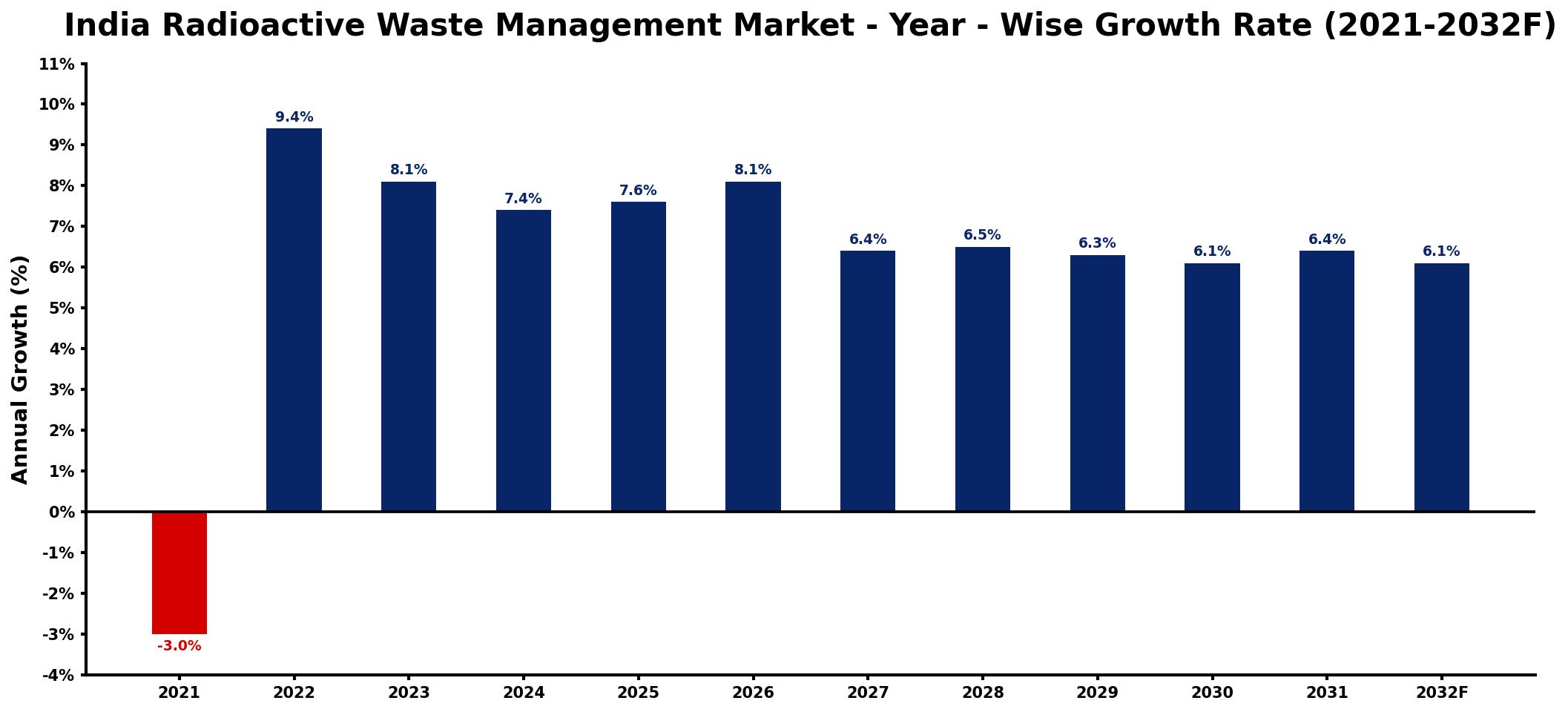
The table below presents the year‑wise growth rates along with the key drivers influencing the market
| Year | Growth Rate | Major Drivers |
| 2021 | -3.0% | decreased investments in infrastructure projects |
| 2022 | 9.4% | increased regulatory compliance requirements |
| 2023 | 8.1% | growing public awareness initiatives |
| 2024 | 7.4% | expansion of renewable energy sector |
| 2025 | 7.6% | rising demand for energy security |
| 2026 | 8.1% | advancements in disposal technologies |
| 2027 | 6.4% | increased collaboration with international bodies |
| 2028 | 6.5% | growing population and urbanization trends |
| 2029 | 6.3% | enhanced focus on sustainable practices |
| 2030 | 6.1% | development of new recycling methods |
| 2031 | 6.4% | rising investment in clean technologies |
| 2032 | 6.1% | stronger distribution network expansion |
Note: Market size estimations and growth projections presented in this report are based on 6Wresearch's proprietary forecasting methodology, utilizing the latest available industry data, government publications, and primary research inputs.
India Radioactive Waste Management Market Synopsis
The India Radioactive Waste Management Market has experienced considerable momentum in recent years, catalyzed by legislative measures and a heightened awareness of safety protocols. As we move forward, however, the focus will likely shift towards developing specialized infrastructure tailored to the varying needs of waste treatment and disposal, which is essential for future growth.
Current dynamics reveal an increasing reliance on medical and industrial sectors to ensure safe disposal methods, marking a significant departure from traditional handling practices. This shift not only highlights the urgency for advanced solutions but also underscores the need for skilled personnel within the industry to meet rising demands.
India Radioactive Waste Management Market Key Takeaways
- Investment in advanced decontamination technologies is rapidly gaining traction.
- Government initiatives are pivotal in shaping the regulatory landscape and operational practices.
- Growing awareness of radiation exposure is increasing demand for skilled professionals.
- Healthcare sectors are adopting safer disposal methods to manage radioactive waste.
- Infrastructure development focused on storage and treatment facilities is crucial for market growth.
Evaluation of Restraints in India Radioactive Waste Management Market
Despite its growth potential, the India Radioactive Waste Management Market faces several restraints that could limit its advancement. Chief among these are the stringent regulatory frameworks that can complicate operational processes, along with the high costs associated with implementing advanced waste management technologies. Furthermore, there is a notable skill gap in the workforce that poses challenges for the sector, particularly in handling complex waste management systems and complying with international safety standards.
India Radioactive Waste Management Market Trends
Emerging trends indicate a shift towards automation and advanced monitoring systems in radioactive waste management. Increasingly, stakeholders are focusing on integrating IoT and AI technologies to enhance safety, efficiency, and compliance in waste handling processes. Additionally, theres a growing emphasis on sustainable practices, compelling organizations to rethink disposal strategies in favor of eco-friendly options.
India Radioactive Waste Management Market Opportunities
The market presents genuine growth opportunities, particularly in sectors such as healthcare, where the demand for innovative waste management solutions is rising. Investment in specialized storage and disposal facilities is set to increase, as these infrastructures are critical in managing the growing volumes of radioactive materials. Additionally, public-private partnerships may provide the necessary funding and resources to develop new technologies and practices, enhancing the overall landscape of radioactive waste management in India.
Government Initiatives in the India Radioactive Waste Management Market
The Indian government has initiated several policies aimed at bolstering the radioactive waste management framework. These include funding for research and development of new technologies, as well as incentives for organizations that adhere to international standards in waste handling. Furthermore, government programs focused on increasing public awareness and training personnel are fundamental to creating a skilled workforce capable of managing radioactive materials responsibly.
Future Insights of the India Radioactive Waste Management Market
Looking ahead to the 2026-2032 period, the India Radioactive Waste Management Market is expected to evolve significantly, driven by ongoing investments in technology and infrastructure. The integration of advanced waste management systems will likely become a cornerstone of industry practice, ensuring that health and safety remain a priority. Furthermore, as regulatory frameworks become more sophisticated, companies that adapt quickly will find themselves well-positioned to capitalize on emerging opportunities.
India Radioactive Waste Management Market Latest Developments (2025 - 2026)
Recent developments in the India Radioactive Waste Management Market reflect a trend towards collaboration between various sectors. Notably, there has been an increase in initiatives aimed at improving the regulatory framework governing radioactive waste disposal. These efforts include a focus on creating comprehensive strategies for waste classification and management, which are critical for aligning local practices with international standards.
India Radioactive Waste Management Market - Key Attractiveness of the Report
- 10 Years of Market Numbers
- Historical Data Starting from 2022 to 2025
- Base Year: 2025
- Forecast Data until 2032
- Key Performance Indicators Impacting the Market
- Major Upcoming Developments and Projects
Key Highlights of the Report:
- India Radioactive Waste Management Market Outlook
- Market Size of India Radioactive Waste Management Market, 2025
- Forecast of India Radioactive Waste Management Market, 2032
- Historical Data and Forecast of India Radioactive Waste Management Revenues & Volume for the Period 2022-2032F
- India Radioactive Waste Management Market Trend Evolution
- India Radioactive Waste Management Market Drivers and Challenges
- India Radioactive Waste Management Price Trends
- India Radioactive Waste Management Porter's Five Forces
- India Radioactive Waste Management Industry Life Cycle
- Historical Data and Forecast of India Radioactive Waste Management Market Revenues & Volume By Type for the Period 2022-2032F
- Historical Data and Forecast of India Radioactive Waste Management Market Revenues & Volume By Exempt Waste and Very Low-Level Waste(VLLW) for the Period 2022-2032F
- Historical Data and Forecast of India Radioactive Waste Management Market Revenues & Volume By Low-Level Waste(LLW) for the Period 2022-2032F
- Historical Data and Forecast of India Radioactive Waste Management Market Revenues & Volume By Intermediate-Level Waste(ILW) for the Period 2022-2032F
- Historical Data and Forecast of India Radioactive Waste Management Market Revenues & Volume By High-Level Waste(HLW) for the Period 2022-2032F
- Historical Data and Forecast of India Radioactive Waste Management Market Revenues & Volume By Application for the Period 2022-2032F
- Historical Data and Forecast of India Radioactive Waste Management Market Revenues & Volume By Industrial for the Period 2022-2032F
- Historical Data and Forecast of India Radioactive Waste Management Market Revenues & Volume By Utility for the Period 2022-2032F
- India Radioactive Waste Management Import Export Trade Statistics
- Market Opportunity Assessment By Type
- Market Opportunity Assessment By Application
- India Radioactive Waste Management Top Companies Market Share
- India Radioactive Waste Management Competitive Benchmarking By Technical and Operational Parameters
- India Radioactive Waste Management Company Profiles
- India Radioactive Waste Management Key Strategic Recommendations






































