India Recycling Equipment & Machinery Market Summary
The india recycling equipment & machinery market was estimated at USD 1028 Million in 2025 and is projected to reach USD 1481 Million by 2032, growing at a CAGR of 7.8% from 2026 to 2032.
India Recycling Equipment & Machinery Market Year-wise Growth Rate and Key Drivers
This graph highlights how the India Recycling Equipment & Machinery Market has steadily grown over the past five years, supported by major growth factors.
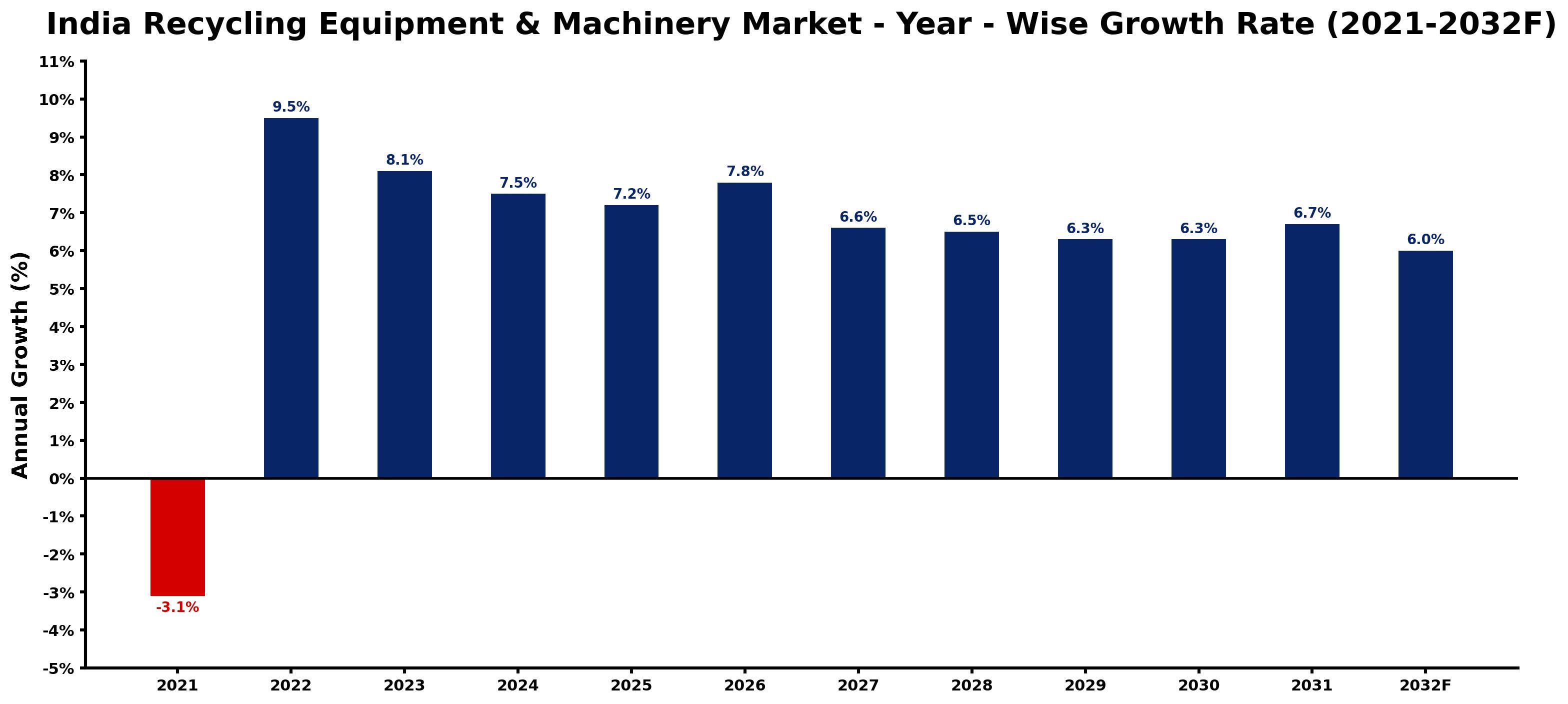
The table below presents the year wise growth rates along with the key drivers influencing the market
| Year | Growth Rate | Major Drivers |
| 2021 | -3.1% | Supply chain disruptions hindered manufacturing capabilities, leading to delayed project implementations and diminished market activity. |
| 2022 | 9.5% | Corporate social responsibility strategies shifted focus towards sustainable waste solutions and innovation. |
| 2023 | 8.1% | Rising urbanization necessitated enhanced waste management infrastructure across metropolitan areas. |
| 2024 | 7.5% | Technological improvements in recycling processes reduced operational costs and improved efficiency. |
| 2025 | 7.2% | Public awareness campaigns emphasized the importance of recycling, influencing consumer behavior positively. |
| 2026 | 7.8% | Partnerships between private firms and government bodies fostered new recycling initiatives and funding. |
| 2027 | 6.6% | Emerging startups introduced innovative recycling equipment tailored to local waste streams and needs. |
| 2028 | 6.5% | Investment in smart waste management systems integrated IoT solutions for improved monitoring. |
| 2029 | 6.3% | Recycling rates in key sectors, such as e-waste, significantly impacted machinery demand. |
| 2030 | 6.3% | Global supply chain disruptions highlighted the need for localized recycling capabilities and resilience. |
| 2031 | 6.7% | Market dynamics shifted as manufacturers began incorporating recycled materials into product lines. |
| 2032 | 6.0% | Consumer preferences increasingly favored brands committed to sustainable practices and recycling. |
Note - Market size estimations and growth projections presented in this report are based on 6Wresearch's advanced forecasting approach, validated with industry datasets as of June 2026.
India Recycling Equipment & Machinery Market Synopsis
The India Recycling Equipment Machinery Market is projected to reach 7.8% and witness significant growth during the forecast period (2026-2032). The market was valued at USD 539.23 million in 2025 and is anticipated to escalate to USD 897.1 million by 2031, marking a robust compound annual growth rate (CAGR) of 7.8%. Key drivers of growth include heightened public awareness regarding waste management, stringent government regulations surrounding the disposal of hazardous materials, and an increasing demand for recycled materials across various end-use industries.
India Recycling Equipment & Machinery Market Growth Drivers
Several factors are instrumental in driving the growth of the India Recycling Equipment & Machinery Market. These include:
- Increasing awareness regarding waste management is significantly influencing the market. Government initiatives aimed at promoting effective waste management practices have led to a greater emphasis on recycling. Local municipalities engage in campaigns to educate the public about the importance of proper waste disposal and recycling methods, resulting in greater adoption of recyclable materials.
- The imposition of stringent regulations by government authorities further boosts market growth. Regulatory bodies, like the Central Pollution Control Board (CPCB), enforce guidelines for the processing and disposal of hazardous materials, such as plastic waste and electronic scraps. This regulatory landscape compels industries to invest in advanced recycling technologies.
- An upsurge in industrialization is contributing to increased waste generation. As industries expand and diversify, the amounts of waste produced, particularly hazardous waste, are on the rise. This trend augments the demand for efficient recycling equipment and machinery to handle the escalating waste.
- Growing demand for recycled materials across various sectors is another critical growth driver. Industries are increasingly relying on recycled inputs to meet their sustainability goals, driving the need for advanced recycling solutions.
- The advent of technology in recycling processes is enhancing operational efficiency and reducing costs. Innovations such as automated sorting and processing technology are gaining traction, offering compelling reasons for industries to invest in recycling machinery.
India Recycling Equipment & Machinery Market Challenges and Restraints
Despite the promising growth prospects, the India Recycling Equipment & Machinery Market faces several challenges. These include:
- The high initial costs associated with the installation of advanced recycling equipment can deter many manufacturers from making investments. Many companies weigh the potential benefits against the costs, leading to hesitance in adopting recycling technologies.
- Limited technological awareness and expertise in handling advanced recycling machinery can restrict market penetration. Many industries may lack the necessary skills for effective operation and maintenance, leading to sub-optimal utilization of equipment.
- The fluctuating prices of raw materials, including recycled content, can impact profitability for businesses invested in recycling. Economic shifts can affect the demand and supply stability in the recycling sector.
- Inadequate infrastructure for recycling in various regions can impede market growth. Many areas lack the necessary facilities and logistical support for efficient waste collection, sorting, and recycling.
- Public resistance against waste management initiatives can be an impediment. While awareness is growing, some communities still demonstrate reluctance towards adopting recycling practices due to misinformation or lack of incentives.
India Recycling Equipment & Machinery Market Trends and Opportunities
Several trends are emerging in the India Recycling Equipment & Machinery Market indicating potential opportunities for growth. These include:
- The rising demand for green technologies in manufacturing processes is notable. Industries, particularly in the automotive sector, are under pressure to reduce their carbon footprint and promote eco-friendly practices. This trend creates opportunities for advanced recycling technologies that enhance resource efficiency.
- The integration of digital technologies, such as IoT and AI, into recycling processes is becoming more prevalent. These technologies streamline operations, improve tracking of materials, and enhance overall efficiency in recycling operations.
- Collaborations between private entities and government organizations are increasing as they seek to tackle waste management challenges collectively. Such partnerships encourage innovation and investment in recycling technologies.
- Growing global demand for high-quality recycled materials presents a vast market opportunity. Various industries are sourcing recycled materials for manufacturing processes, thereby driving investments in recycling machinery.
- There is a noticeable shift towards the circular economy model among businesses. Corporations are focusing on sustainable practices, which include integrating recycling into their supply chains, creating further demand for efficient recycling equipment.
India Recycling Equipment & Machinery Market Government Investment and Initiatives
The Indian government is actively engaged in promoting the recycling sector through various policies and initiatives. Investments are being directed towards enhancing recycling infrastructure, which is essential for effective waste management. The government has established programs aimed at incentivizing recycling processes and technologies. Public spending has also been focused on improving facilities for waste collection and recycling across metropolitan and rural areas. Furthermore, the government is collaborating with non-governmental organizations and private entities to create comprehensive waste management strategies that include education and infrastructure development. Notably, policies emphasizing the reduction of single-use plastics and the promotion of sustainable materials are driving growth in the India Recycling Equipment & Machinery Market.
India Recycling Equipment & Machinery Market Latest Developments (May 2025 - June 2026)
In the recent period from May 2025 to June 2026, the India Recycling Equipment & Machinery Market has seen various developments that highlight its dynamic nature. There has been an increase in local government initiatives aimed at enhancing public awareness around recycling, resulting in improved recycling rates. Local municipalities are implementing new regulations focused on increasing the efficiency of waste collection systems and promoting sustainable practices in urban development. Additionally, technological advancements in recycling machinery are being showcased through industry exhibitions, reflecting the innovation that is helping to propel the market forward. The integration of artificial intelligence in recycling sorting processes is gaining traction, and companies are seeking partnerships to enhance their operational capabilities. These trends indicate a proactive approach to addressing recycling challenges in India, ultimately fostering a more sustainable environment.
India Recycling Equipment & Machinery Market - Key Attractiveness of the Report
- 10 Years of Market Numbers
- Historical Data Starting from 2022 to 2025
- Base Year: 2025
- Forecast Data until 2032
- Key Performance Indicators Impacting the Market
- Major Upcoming Developments and Projects
Key Highlights of the Report:
- India Recycling Equipment & Machinery Market Outlook
- Market Size of India Recycling Equipment & Machinery Market, 2025
- Forecast of India Recycling Equipment & Machinery Market, 2032
- Historical Data and Forecast of India Recycling Equipment & Machinery Revenues & Volume for the Period 2022-2032F
- India Recycling Equipment & Machinery Market Trend Evolution
- India Recycling Equipment & Machinery Market Drivers and Challenges
- India Recycling Equipment & Machinery Price Trends
- India Recycling Equipment & Machinery Porter's Five Forces
- India Recycling Equipment & Machinery Industry Life Cycle
- Historical Data and Forecast of India Recycling Equipment & Machinery Market Revenues & Volume By Machine Types for the Period 2022-2032F
- Historical Data and Forecast of India Recycling Equipment & Machinery Market Revenues & Volume By Baler presses for the Period 2022-2032F
- Historical Data and Forecast of India Recycling Equipment & Machinery Market Revenues & Volume By Shredders for the Period 2022-2032F
- Historical Data and Forecast of India Recycling Equipment & Machinery Market Revenues & Volume By Shears for the Period 2022-2032F
- Historical Data and Forecast of India Recycling Equipment & Machinery Market Revenues & Volume By Agglomerates for the Period 2022-2032F
- Historical Data and Forecast of India Recycling Equipment & Machinery Market Revenues & Volume By Extruders for the Period 2022-2032F
- Historical Data and Forecast of India Recycling Equipment & Machinery Market Revenues & Volume By Processed Materials for the Period 2022-2032F
- Historical Data and Forecast of India Recycling Equipment & Machinery Market Revenues & Volume By Plastic for the Period 2022-2032F
- Historical Data and Forecast of India Recycling Equipment & Machinery Market Revenues & Volume By Ferrous & Non-ferrous for the Period 2022-2032F
- Historical Data and Forecast of India Recycling Equipment & Machinery Market Revenues & Volume By Wood, Paper & Cardboard for the Period 2022-2032F
- Historical Data and Forecast of India Recycling Equipment & Machinery Market Revenues & Volume By Rubber for the Period 2022-2032F
- Historical Data and Forecast of India Recycling Equipment & Machinery Market Revenues & Volume By Others for the Period 2022-2032F
- India Recycling Equipment & Machinery Import Export Trade Statistics
- Market Opportunity Assessment By Machine Types
- Market Opportunity Assessment By Processed Materials
- India Recycling Equipment & Machinery Top Companies Market Share
- India Recycling Equipment & Machinery Competitive Benchmarking By Technical and Operational Parameters
- India Recycling Equipment & Machinery Company Profiles
- India Recycling Equipment & Machinery Key Strategic Recommendations






































