India Retail Industry Market Size, Share & Growth Rate
The India Retail Industry Market was estimated at USD 566 Million in 2025 and is projected to reach USD 938 Million by 2032, growing at a CAGR of 7.5% from 2026 to 2032. This robust growth trajectory is largely driven by the expanding middle class, urbanization, and a significant shift toward e-commerce platforms. The evolving shopping preferences among consumers, coupled with supportive government initiatives, further bolster this upward momentum.
India Retail Industry Market Year-wise Growth Rate and Key Drivers
This graph highlights how the India Retail Industry Market has steadily grown over the years, supported by major growth factors.
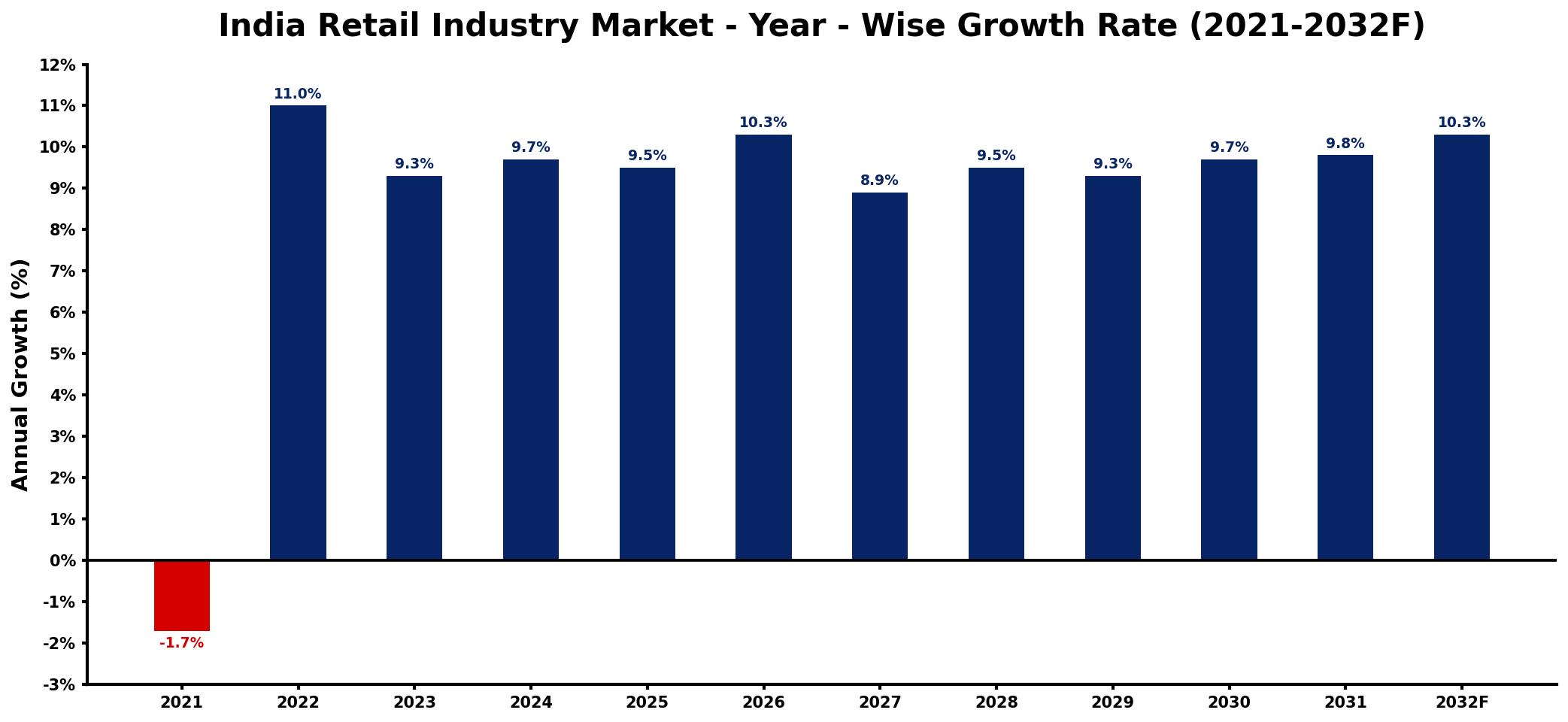
The table below presents the year‑wise growth rates along with the key drivers influencing the market
| Year | Growth Rate | Major Drivers |
| 2021 | -1.7% | reduced consumer spending patterns |
| 2022 | 11.0% | increased online shopping adoption |
| 2023 | 9.3% | growing demand for convenience |
| 2024 | 9.7% | rising procurement volume requirements |
| 2025 | 9.5% | rising disposable income levels |
| 2026 | 10.3% | enhanced logistics and distribution |
| 2027 | 8.9% | increased brand loyalty initiatives |
| 2028 | 9.5% | growth in experiential shopping |
| 2029 | 9.3% | adoption of sustainable practices |
| 2030 | 9.7% | strengthening underlying market demand |
| 2031 | 9.8% | expansion of omnichannel strategies |
| 2032 | 10.3% | increased focus on personalization |
Note: Market size estimations and growth projections presented in this report are based on 6Wresearch's proprietary forecasting methodology, utilizing the latest available industry data, government publications, and primary research inputs.
India Retail Industry Market Synopsis
The strongest force shaping the India Retail Industry Market is the rapid rise of e-commerce, which continues to revolutionize traditional shopping behaviors. Consumers are increasingly turning to online platforms for convenience and variety, compelling retailers to innovate and adapt.
Urbanization and changing demographics also play a critical role in transforming the retail landscape. As cities expand and disposable incomes rise, there is an increasing demand for diverse retail options, which retailers are eager to meet through both physical stores and online channels.
India Retail Industry Market Key Takeaways
- The retail sector is significantly shaped by the growing middle class and urbanization trends.
- E-commerce is becoming a dominant force, changing traditional retail dynamics.
- Government policies aimed at infrastructure improvement are enhancing the business environment.
- Investments in logistics and supply chain efficiency are crucial for retailers to thrive.
- Adaptation to digital trends and omnichannel strategies is essential for sustained competitiveness.
Evaluation of Restraints in India Retail Industry Market
Despite the positive outlook, several restraints challenge the growth of the India Retail Industry. The competition between brick-and-mortar stores and e-commerce platforms creates a fragmented landscape where customer loyalty is difficult to secure. Supply chain disruptions pose operational challenges, particularly in a post-pandemic world where logistics must be optimized. Furthermore, many retailers struggle to implement the necessary technology investments that enhance customer experiences while keeping costs manageable. Consequently, a strategic focus on innovation and adaptability is paramount for retailers aiming to navigate these complexities effectively.
India Retail Industry Market Trends
Key trends are emerging in the India Retail Industry, reflecting both technological advancements and changing consumer behavior. A significant trend is the integration of artificial intelligence (AI) and data analytics, enabling retailers to offer personalized shopping experiences. Additionally, the rise of sustainability as a consumer priority is prompting brands to adopt eco-friendly practices and products. Social commerce, where social media platforms are used as sales channels, is also gaining traction, particularly among younger consumers. Together, these trends are reshaping the retail environment, making it more responsive to consumer demands.
India Retail Industry Market Opportunities
The India Retail Industry holds promising growth opportunities driven by several factors. Expansion into tier II and III cities offers significant potential, as emerging urban centers show increasing consumer spending capabilities. Retailers can also capitalize on the growing popularity of omnichannel shopping experiences, blending online and offline strategies to enhance customer engagement. Furthermore, focusing on niche markets and product categories that align with consumer interests, such as organic products and local craftsmanship, can yield substantial returns on investment.
Government Initiatives in the India Retail Industry Market
The Indian government has implemented various initiatives aimed at fostering the growth of the retail sector. Policies designed to enhance infrastructure, such as logistics hubs and transportation networks, significantly improve accessibility for both consumers and businesses. Additionally, initiatives promoting ease of doing business, including simplified licensing processes and tax reforms, support retail investment. Programs that encourage digital adoption among traditional retailers are also pivotal, as they help businesses transition smoothly into the evolving digital marketplace.
Future Insights of the India Retail Industry Market
Looking forward to the period from 2026 to 2032, the India Retail Industry is expected to continue its upward trajectory, driven by evolving consumer needs and ongoing technological advancements. The integration of AI and machine learning in retail operations will enhance customer engagement and streamline supply chains. Furthermore, as consumers become more health-conscious and eco-aware, retailers will likely respond by offering a broader range of sustainable and healthy products. The convergence of physical and digital retail experiences will redefine shopping, resulting in a holistic and immersive consumer journey.
India Retail Industry Market Latest Developments (2025 - 2026)
Recent developments in the India Retail Industry reflect a concerted effort towards recovery and innovation post-pandemic. Retailers are increasingly investing in enhancing their e-commerce platforms and adopting omnichannel strategies to cater to a diverse customer base. The emphasis on safety and hygiene measures remains significant as consumer preferences shift toward brands that prioritize these elements. Additionally, many retailers are exploring partnerships with tech companies to leverage cutting-edge technology and improve operational efficiency.
India Retail Industry Market - Key Attractiveness of the Report
- 10 Years of Market Numbers
- Historical Data Starting from 2022 to 2025
- Base Year: 2025
- Forecast Data until 2032
- Key Performance Indicators Impacting the Market
- Major Upcoming Developments and Projects
Key Highlights of the Report:
- India Retail Industry Market Outlook
- Market Size of India Retail Industry Market, 2025
- Forecast of India Retail Industry Market, 2032
- Historical Data and Forecast of India Retail Industry Revenues & Volume for the Period 2022-2032F
- India Retail Industry Market Trend Evolution
- India Retail Industry Market Drivers and Challenges
- India Retail Industry Price Trends
- India Retail Industry Porter's Five Forces
- India Retail Industry Industry Life Cycle
- Historical Data and Forecast of India Retail Industry Market Revenues & Volume By Product for the Period 2022-2032F
- Historical Data and Forecast of India Retail Industry Market Revenues & Volume By Food and Beverages for the Period 2022-2032F
- Historical Data and Forecast of India Retail Industry Market Revenues & Volume By Personal and Household Care for the Period 2022-2032F
- Historical Data and Forecast of India Retail Industry Market Revenues & Volume By Apparel, Footwear, and Accessories for the Period 2022-2032F
- Historical Data and Forecast of India Retail Industry Market Revenues & Volume By Furniture, Toys, and Hobby for the Period 2022-2032F
- Historical Data and Forecast of India Retail Industry Market Revenues & Volume By Electronic and Household Appliances for the Period 2022-2032F
- Historical Data and Forecast of India Retail Industry Market Revenues & Volume By Other Products for the Period 2022-2032F
- Historical Data and Forecast of India Retail Industry Market Revenues & Volume By Distribution Channel for the Period 2022-2032F
- Historical Data and Forecast of India Retail Industry Market Revenues & Volume By Supermarkets/Hypermarkets for the Period 2022-2032F
- Historical Data and Forecast of India Retail Industry Market Revenues & Volume By Convenience Stores for the Period 2022-2032F
- Historical Data and Forecast of India Retail Industry Market Revenues & Volume By Department Stores for the Period 2022-2032F
- Historical Data and Forecast of India Retail Industry Market Revenues & Volume By Specialty Stores for the Period 2022-2032F
- Historical Data and Forecast of India Retail Industry Market Revenues & Volume By Online for the Period 2022-2032F
- Historical Data and Forecast of India Retail Industry Market Revenues & Volume By Other Distribution Channels for the Period 2022-2032F
- India Retail Industry Import Export Trade Statistics
- Market Opportunity Assessment By Product
- Market Opportunity Assessment By Distribution Channel
- India Retail Industry Top Companies Market Share
- India Retail Industry Competitive Benchmarking By Technical and Operational Parameters
- India Retail Industry Company Profiles
- India Retail Industry Key Strategic Recommendations






































