India Revolvers Market Size, Share & Growth Rate
The India Revolvers Market was estimated at USD 1047 Million in 2025 and is projected to reach USD 1693 Million by 2032, growing at a CAGR of 7.1% from 2026 to 2032. This growth trajectory is primarily driven by the increasing demand for personal security firearms and the expansion of law enforcement agencies seeking reliable weapons for modern policing. Additionally, the focus on indigenous manufacturing has fostered an environment conducive to investment and innovation within the sector.
India Revolvers Market Year-wise Growth Rate and Key Drivers
This graph highlights how the India Revolvers Market has steadily grown over the years, supported by major growth factors.
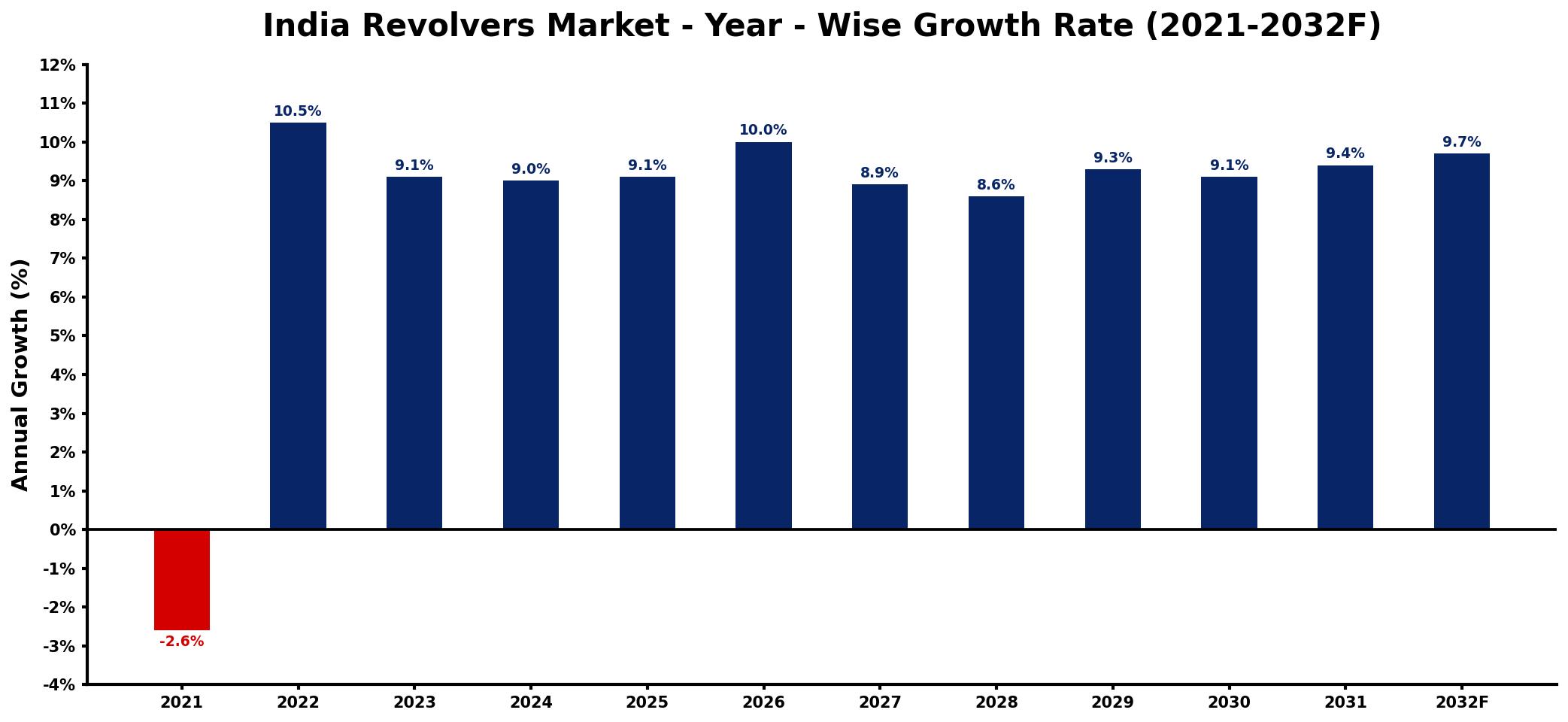
The table below presents the year‑wise growth rates along with the key drivers influencing the market
| Year | Growth Rate | Major Drivers |
| 2021 | -2.6% | decreased consumer confidence levels |
| 2022 | 10.5% | increased urban security investments |
| 2023 | 9.1% | growing interest in personal safety |
| 2024 | 9.0% | expansion of outdoor recreational activities |
| 2025 | 9.1% | rising demand for self-defense training |
| 2026 | 10.0% | enhanced distribution network efficiency |
| 2027 | 8.9% | growing trend in outdoor sports |
| 2028 | 8.6% | increased focus on law enforcement |
| 2029 | 9.3% | rising export shipment volumes |
| 2030 | 9.1% | growing awareness of personal protection |
| 2031 | 9.4% | increased investment in safety technology |
| 2032 | 9.7% | rising popularity of shooting sports |
Note: Market size estimations and growth projections presented in this report are based on 6Wresearch's proprietary forecasting methodology, utilizing the latest available industry data, government publications, and primary research inputs.
India Revolvers Market Synopsis
The increasing emphasis on personal safety is the strongest force shaping the India revolvers market. As urbanization accelerates and security concerns rise, individuals are more inclined to acquire revolvers for self-defense, contributing to the market's growth. Furthermore, law enforcement agencies are adopting revolvers as standard issue firearms, driven by the need for compact and effective solutions in close-quarters scenarios.
Indigenous defense manufacturing has emerged as a pivotal trend in the India revolvers market. This initiative not only bolsters domestic production capabilities but also enhances self-sufficiency in arms manufacturing. However, the sector is also navigating challenges linked to stringent regulations, influencing procurement processes and impacting market access for new manufacturers.
India Revolvers Market Key Takeaways
- The market is anticipated to grow significantly due to rising personal security needs and law enforcement requirements.
- Indigenous manufacturing initiatives are driving advancements in technology and production capacities.
- Procurement challenges may hinder new entrants but create opportunities for established players to strengthen their market positions.
- Public perception and regulatory scrutiny around firearm safety are critical factors influencing market dynamics.
- The interplay between evolving security threats and modernization demands presents both challenges and opportunities for market players.
Evaluation of Restraints in India Revolvers Market
The India revolvers market contends with several notable restraints that could impede growth. Stringent regulations on arms procurement for law enforcement agencies often create obstacles for new entrants attempting to establish themselves in the market. Furthermore, the complex selection processes employed by government entities can delay procurement timelines, thereby affecting overall market accessibility. The necessity for firearms to evolve in response to changing security threats adds pressure to manufacturers to innovate continually, balancing modernization with compliance to safety standards. Public concerns over violence and the implications of firearm access further complicate market expansion, necessitating strategic approaches to address societal perceptions of revolvers.
India Revolvers Market Trends
Current trends in the India revolvers market reveal an increasing consumer preference for compact and lightweight firearms, aligning with modern demands for personal protection. Additionally, advancements in technology are driving the development of revolvers equipped with enhanced safety features and improved ergonomics. The focus on smart firearms that integrate safety mechanisms is becoming more pronounced, reflecting a growing recognition of responsible firearm ownership. Moreover, collaborations between domestic manufacturers and international brands are likely to accelerate the introduction of innovative products into the Indian market.
India Revolvers Market Opportunities
Significant opportunities exist within the India revolvers market, particularly for companies willing to invest in research and development. The government's push for indigenous manufacturing opens pathways for innovation and the introduction of advanced technologies tailored to local needs. Additionally, there is a burgeoning market for licensed civilian ownership, providing an avenue for sales growth. Strategic partnerships with law enforcement agencies can also enhance market penetration, creating avenues for tailored solutions that cater to the unique requirements of security forces.
Government Initiatives in the India Revolvers Market
The Indian government has implemented various initiatives aimed at bolstering domestic defense manufacturing, which has a direct impact on the revolvers market. Policies promoting 'Make in India' encourage local production of arms, thereby supporting the growth of the revolvers segment. Additionally, public spending on defense modernization provides opportunities for manufacturers to cater to the evolving needs of law enforcement agencies and security personnel. These initiatives are designed to enhance self-reliance in defense and security, thereby shaping the future of the revolvers market.
Future Insights of the India Revolvers Market
Looking ahead to 2026-2032, the India revolvers market is poised for robust growth, driven by both personal defense needs and law enforcement requirements. The increasing urban population, alongside rising security threats, is likely to sustain demand for compact firearms. Additionally, ongoing advancements in technology and manufacturing processes will enhance product offerings, making revolvers more appealing to both civilians and security personnel. With a regulatory environment that encourages innovation and production, the market is set to expand in both breadth and depth.
India Revolvers Market Latest Developments (2025 - 2026)
Recent developments in the India revolvers market highlight a shift towards modernization, with various manufacturers emphasizing innovation in product design and safety features. Industry leaders are engaging in collaborations aimed at enhancing production capabilities while also responding to the growing demand for responsible firearm ownership. Additionally, regulatory adjustments are being considered to streamline procurement processes for law enforcement, which could further stimulate market activity.
India Revolvers Market - Key Attractiveness of the Report
- 10 Years of Market Numbers
- Historical Data Starting from 2022 to 2025
- Base Year: 2025
- Forecast Data until 2032
- Key Performance Indicators Impacting the Market
- Major Upcoming Developments and Projects
Key Highlights of the Report:
- India Revolvers Market Outlook
- Market Size of India Revolvers Market, 2025
- Forecast of India Revolvers Market, 2032
- Historical Data and Forecast of India Revolvers Revenues & Volume for the Period 2022-2032F
- India Revolvers Market Trend Evolution
- India Revolvers Market Drivers and Challenges
- India Revolvers Price Trends
- India Revolvers Porter's Five Forces
- India Revolvers Industry Life Cycle
- Historical Data and Forecast of India Revolvers Market Revenues & Volume By Product Type for the Period 2022-2032F
- Historical Data and Forecast of India Revolvers Market Revenues & Volume By Semi Automatic Revolvers for the Period 2022-2032F
- Historical Data and Forecast of India Revolvers Market Revenues & Volume By Single and Double Action Revolvers for the Period 2022-2032F
- Historical Data and Forecast of India Revolvers Market Revenues & Volume By Applications for the Period 2022-2032F
- Historical Data and Forecast of India Revolvers Market Revenues & Volume By Civil for the Period 2022-2032F
- Historical Data and Forecast of India Revolvers Market Revenues & Volume By Military for the Period 2022-2032F
- India Revolvers Import Export Trade Statistics
- Market Opportunity Assessment By Product Type
- Market Opportunity Assessment By Applications
- India Revolvers Top Companies Market Share
- India Revolvers Competitive Benchmarking By Technical and Operational Parameters
- India Revolvers Company Profiles
- India Revolvers Key Strategic Recommendations






































