India Salon Service Market Size, Share & Growth Rate
The India Salon Service Market was estimated at USD 363 Million in 2025 and is projected to reach USD 521 Million by 2032, growing at a CAGR of 5.3% from 2026 to 2032. This growth trajectory reflects a broader trend of increasing consumer interest in personal grooming and wellness, especially in urban centers. With evolving beauty standards and a rising disposable income, the demand for professional salon services is only expected to amplify in the coming years.
India Salon Service Market Year-wise Growth Rate and Key Drivers
This graph highlights how the India Salon Service Market has steadily grown over the years, supported by major growth factors.
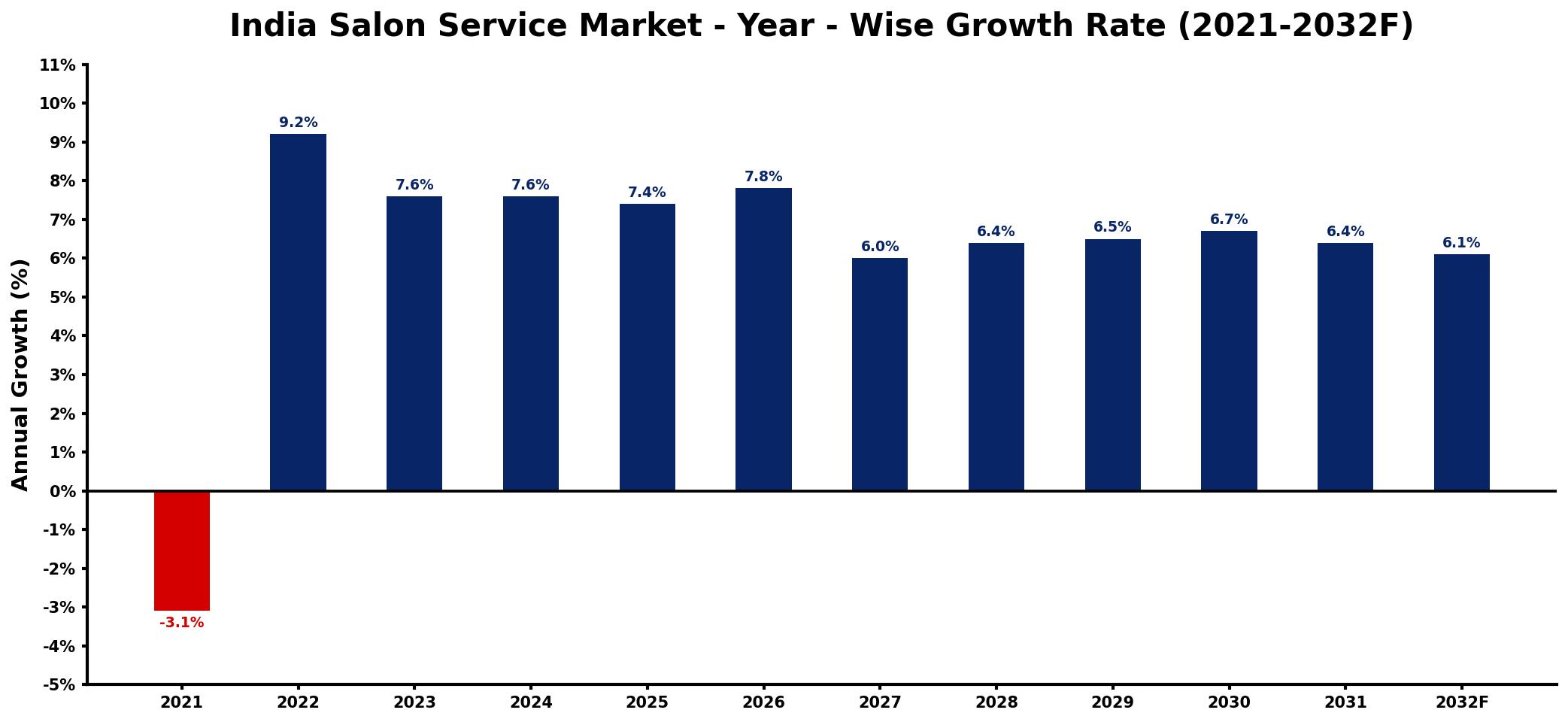
The table below presents the year‑wise growth rates along with the key drivers influencing the market
| Year | Growth Rate | Major Drivers |
| 2021 | -3.1% | falling export shipment volumes |
| 2022 | 9.2% | Rise in disposable income levels |
| 2023 | 7.6% | Increased demand for grooming products |
| 2024 | 7.6% | growing regional consumption patterns |
| 2025 | 7.4% | Growing popularity of personal care |
| 2026 | 7.8% | Surge in digital marketing initiatives |
| 2027 | 6.0% | Emergence of eco-friendly products |
| 2028 | 6.4% | Increased focus on self-care routines |
| 2029 | 6.5% | Growth in influencer marketing strategies |
| 2030 | 6.7% | Rising trend of customized experiences |
| 2031 | 6.4% | Enhancement in customer loyalty programs |
| 2032 | 6.1% | Development of advanced technology solutions |
Note: Market size estimations and growth projections presented in this report are based on 6Wresearch's proprietary forecasting methodology, utilizing the latest available industry data, government publications, and primary research inputs.
India Salon Service Market Synopsis
The India salon service market is witnessing a vibrant transformation, fueled by an urban populace that is increasingly beauty-conscious. Salon services, ranging from hairstyling to holistic wellness treatments, have become integral to the lifestyle of many Indians, especially in metropolitan areas. As consumers seek out premium experiences, the demand for specialized services continues to grow.
As the market evolves, the rise of wedding-related beauty services and increasing media influence play pivotal roles in shaping consumer choices. The ongoing shift toward luxury and unisex salons reflects changing societal norms, making it imperative for service providers to adapt to varied customer preferences and expectations.
India Salon Service Market Key Takeaways
- The salon service market is projected to grow significantly, driven by increased consumer spending on beauty services.
- Urbanization and changing lifestyles are contributing to the rising demand for a diverse range of salon offerings.
- Technological advancements in beauty treatments are enhancing service quality and customer satisfaction.
- The impact of social media and celebrity culture is heightening consumer engagement with salon brands.
- Post-pandemic recovery has prompted salons to focus more on hygiene and personalized services.
Evaluation of Restraints in India Salon Service Market
Despite its promising growth, the India salon service market faces notable constraints. The lingering effects of the Covid-19 pandemic have forced salon operators to recalibrate their business models, necessitating a focus on safety protocols and customer reassurance. Moreover, the competition from unorganized sectors poses a challenge for established salons, as price wars and service differentiation become increasingly critical. Recruiting and retaining skilled professionals continues to be a significant hurdle, impacting the overall service experience and market sustainability.
India Salon Service Market Trends
Several trends are currently shaping the India salon service market landscape. The adoption of technology, such as booking apps and digital payment solutions, is enhancing customer convenience and streamlining operations. There is also a noticeable rise in unisex salons, catering to a broader demographic, which is fostering inclusivity within the beauty industry. Additionally, organic and cruelty-free products are gaining traction as consumers become more aware of ethical beauty practices, pushing salons to adapt their service offerings.
India Salon Service Market Opportunities
The India salon service market is ripe with opportunities for growth and investment. The rising disposable income and evolving beauty standards among the middle class present a significant potential customer base. As wedding culture continues to flourish, specialized services tailored for bridal packages can lead to substantial revenue growth. Furthermore, the expansion of premium and luxury salon chains is opening new avenues for service diversification, creating an environment conducive to innovative beauty solutions.
Government Initiatives in the India Salon Service Market
Government initiatives aimed at promoting entrepreneurship and small businesses can significantly benefit the India salon service market. Various programs and incentives encourage the establishment of skill development centers, fostering a pool of trained professionals. Public spending on health and wellness awareness campaigns indirectly supports the beauty industry by emphasizing self-care and grooming, thereby enhancing consumer interest in salon services. Moreover, the focus on hygiene standards post-pandemic aligns with government efforts to ensure safe business practices within the sector.
Future Insights of the India Salon Service Market
Looking forward to the period from 2026 to 2032, the India salon service market is poised for substantial evolution. As consumer preferences shift towards personalized and experiential services, salons that embrace innovation will likely thrive. The growth in urbanization will further bolster demand, leading to the establishment of more salon chains in emerging areas. Additionally, the integration of advanced technologies and sustainable practices will define the future of the market, ensuring that it remains competitive and appealing to the increasingly discerning customer base.
India Salon Service Market Latest Developments (2025 - 2026)
The salon service market is currently navigating a dynamic landscape, with many establishments enhancing their service protocols in response to evolving consumer expectations. Innovations in service delivery, including online consultations and customized beauty packages, have become prevalent. Furthermore, a noticeable shift towards eco-friendly products and sustainable practices is shaping industry standards as salons strive to appeal to environmentally conscious clientele.
India Salon Service Market - Key Attractiveness of the Report
- 10 Years of Market Numbers
- Historical Data Starting from 2022 to 2025
- Base Year: 2025
- Forecast Data until 2032
- Key Performance Indicators Impacting the Market
- Major Upcoming Developments and Projects
Key Highlights of the Report:
- India Salon Service Market Outlook
- Market Size of India Salon Service Market, 2025
- Forecast of India Salon Service Market, 2032
- Historical Data and Forecast of India Salon Service Revenues & Volume for the Period 2022-2032F
- India Salon Service Market Trend Evolution
- India Salon Service Market Drivers and Challenges
- India Salon Service Price Trends
- India Salon Service Porter's Five Forces
- India Salon Service Industry Life Cycle
- Historical Data and Forecast of India Salon Service Market Revenues & Volume By Service Type for the Period 2022-2032F
- Historical Data and Forecast of India Salon Service Market Revenues & Volume By Hair for the Period 2022-2032F
- Historical Data and Forecast of India Salon Service Market Revenues & Volume By Skin for the Period 2022-2032F
- Historical Data and Forecast of India Salon Service Market Revenues & Volume By Foot for the Period 2022-2032F
- Historical Data and Forecast of India Salon Service Market Revenues & Volume By Nails for the Period 2022-2032F
- Historical Data and Forecast of India Salon Service Market Revenues & Volume By Gender for the Period 2022-2032F
- Historical Data and Forecast of India Salon Service Market Revenues & Volume By Men for the Period 2022-2032F
- Historical Data and Forecast of India Salon Service Market Revenues & Volume By Women for the Period 2022-2032F
- Historical Data and Forecast of India Salon Service Market Revenues & Volume By Services Taken for the Period 2022-2032F
- Historical Data and Forecast of India Salon Service Market Revenues & Volume By Single for the Period 2022-2032F
- Historical Data and Forecast of India Salon Service Market Revenues & Volume By Multiple for the Period 2022-2032F
- India Salon Service Import Export Trade Statistics
- Market Opportunity Assessment By Service Type
- Market Opportunity Assessment By Gender
- Market Opportunity Assessment By Services Taken
- India Salon Service Top Companies Market Share
- India Salon Service Competitive Benchmarking By Technical and Operational Parameters
- India Salon Service Company Profiles
- India Salon Service Key Strategic Recommendations






































