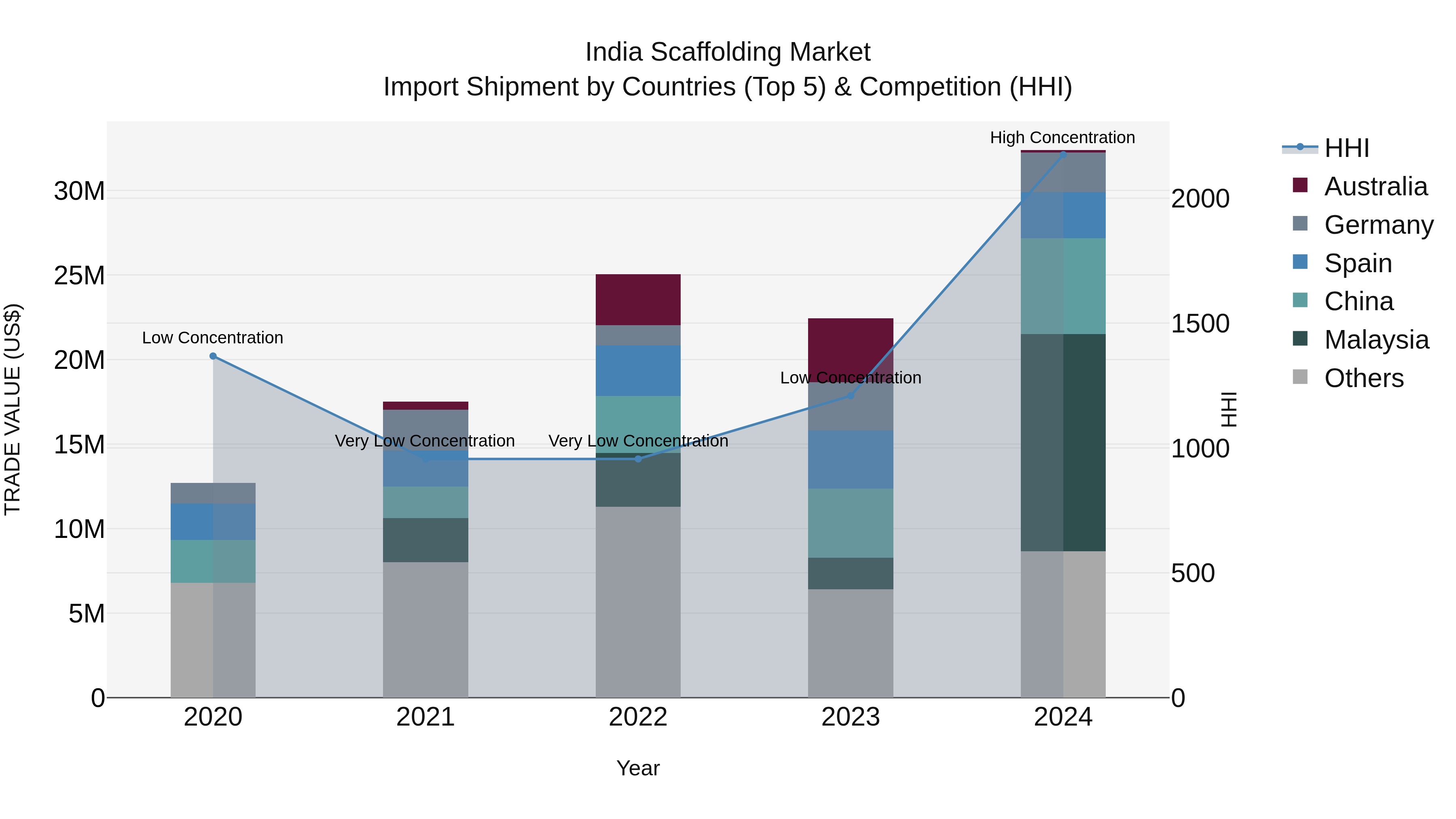
India Scaffolding Market Top 5 Importing Countries and Market Competition (HHI) Analysis
India`s scaffolding import market saw significant growth in 2024, with Malaysia, China, Austria, India, and Spain emerging as the top exporting countries. The market concentration, as measured by the HHI, increased from low to high in just a year, indicating a shift towards a more competitive landscape. The impressive compound annual growth rate (CAGR) of 26.35% from 2020 to 2024 demonstrates the growing demand for scaffolding in India. Moreover, the remarkable growth rate of 44.27% from 2023 to 2024 highlights the rapid expansion and opportunities in the market for both domestic and international suppliers.
India Scaffolding Market Growth Rate
According to 6Wresearch internal database and industry insights, the India Scaffolding Market is projected to grow at a compound annual growth rate (CAGR) of 7.8% during the forecast period from 2026 to 2032.
Topics Covered in the India Scaffolding Market Report
The India Scaffolding Market report thoroughly covers the market by type, material, and end user. It provides a detailed and unbiased analysis of ongoing market trends, opportunities, challenges, and market drivers, helping stakeholders align strategies with current and future market dynamics.
India Scaffolding Market Highlights
| Report Name | India Scaffolding Market |
| Forecast Period | 2026–2032 |
| CAGR | 7.8% |
| Growing Sector | Construction & Infrastructure |
India Scaffolding Market Synopsis
The India scaffolding market growth has been steady across the country. Factors such as real estate development, a surge in construction activities, and infrastructure projects such as bridges, roads, and smart cities are supporting the robust growth of the market. Additionally, industrial corridor development and government programs like “Housing for All” and metro rail expansion are propelling demand for safe and efficient scaffolding systems. Moreover, the shifting of producers from traditional bamboo scaffolding to durable metal-based systems, as they provide more safety and efficiency, further supports the growth of the market.
Evaluation of Growth Drivers in the India Scaffolding Market
Below are some prominent drivers and their impact on the India Scaffolding Market dynamics:
| Drivers | Primary Segment Affected | Why It Matters (Evidence) |
| Growth in Infrastructure Development | By End User (Commercial, Industrial, Residential) | Large-scale government and private infrastructure projects are increasing demand for scaffolding. |
| Safety & Compliance Requirements | By Type (Supported, Suspended, Rolling) | The demand for reliable scaffonlding solutions is high in the market due to strict safety norms applied in construction activities. |
| Preference for Lightweight Materials | By Material (Aluminum) | Aluminum scaffolding has a high demand due to its ease of use, mobility, and resistance to corrosion. |
| Urbanization and Real Estate Expansion | By End User (Residential, Commercial) | Expansion in the real estate sector are driving the need for scaffolding in large-scale residential/commercial developments. |
| Industrial Growth and Infrastructure Projects | By End User (Industrial) | The scaffolding’s demand is increasing due to ongoing industrial construction activities, such as power plants and factories. |
The India Scaffolding Market is projected to grow at a CAGR of 7.8% from 2026 to 2032. Several key drivers are driving the robust growth of the India scaffolding market. Key drivers such as increasing awareness around construction worker safety and rapid urbanisation are propelling the demand for a safe scaffold system. Furthermore, the rising need for modular, faster and reusable scaffolding systems is another driver supporting the steady growth of the market. Moreover, the widespread usage of scaffolding in renovation, building maintenance, and heritage restoration projects is also contributing to the market growth across the country.
Restraints in the India Scaffolding Market
Below mentioned are some major restraints and their influence on the India Scaffolding Market dynamics:
| Restraints | Primary Segment Affected | What This Means (Evidence) |
| High Initial Costs | By Type (Supported, Suspended, Rolling) | The high cost of scaffolding equipment, especially for high-quality materials, could deter some smaller construction firms. |
| Uneven Availability of Raw Materials | By Material (Wood, Steel) | There are changes in raw material prices, which can affect production costs. |
| Lack of Skilled Workers | By End User (Commercial, Residential) | Lack of trained workers can hamper market growth, especially in rural areas. |
| Storage and Maintenance Challenges | By Type (All Types) | The storage and maintenance of scaffolding systems can be challenging due to space constraints. |
| Regulatory and Compliance Challenges | By Material (Aluminum, Steel) | Following local and international construction safety regulations can result in higher operating costs. |
Challenges in the India Scaffolding Market
The India scaffolding market faces several challenges even with the steady growth. The fluctuating prices of raw materials such as steel and aluminium, which affect the production and procurement costs, are the major challenge impacting the market growth. Additionally, issues such as limited awareness of safety norms in smaller projects and the lack of skilled labour for assembling advanced scaffolding systems further pose hurdles to the market growth. Moreover, dominance of unorganised players and lack of standardisation often limit the adoption of advanced solutions and also hamper the robust growth of the market across the country.
India Scaffolding Market Trends
Below are some major trends that change the dynamics of the India Scaffolding Market:
- Premiumization of Scaffolding Products: There is a growing trend towards the use of premium scaffolding solutions such as aluminum scaffolding due to its lighter weight, ease of use, and long-lasting durability.
- Technological Advancements: The adoption of innovative scaffolding systems that include modular components and quick-installation designs is gaining traction, reducing assembly time and enhancing overall site productivity.
- Growth in Green Building Construction: The demand for scaffolding solutions that match eco-friendly and energy-efficient designs is increasing. This growth is due to the rise of green building initiatives and sustainable construction practices.
Major Investment Opportunities in the India Scaffolding Market
Here are some major investment opportunities that are estimated to increase the India Scaffolding Market share:
- Increasing Expansion of Local Manufacturing: There are opportunities for new investors in setting up local manufacturing units for scaffolding materials, especially aluminum and steel scaffolding, to reduce dependence on imports and better manage cost volatility.
- Product Diversification: Making innovations in scaffolding product types, such as providing adjustable or customizable scaffolding solutions that can meet specific construction needs. These innovations can create open up new corridors for investment.
- A Rise of Digital Sales and Online Platforms: The rise of online retail platforms presents an opportunity for companies to expand their reach by offering scaffolding products and services online, especially targeting smaller construction firms and contractors.
Top 5 Leading Players in the India Scaffolding Market
Below is the list of prominent companies leading the India Scaffolding Market:
1. PERI India Pvt Ltd
| Company Name | PERI India Pvt Ltd |
|---|---|
| Established Year | 1998 |
| Headquarters | Pune, India |
| Official Website | Click Here |
PERI India is a leading provider of scaffolding and formwork solutions, offering advanced scaffolding systems for residential, commercial, and industrial construction projects.
2. GKN Hoeganaes India Ltd
| Company Name | GKN Hoeganaes India Ltd |
|---|---|
| Established Year | 1999 |
| Headquarters | Mumbai, India |
| Official Website | - |
GKN Hoeganaes specializes in scaffolding systems, offering a variety of products for both large-scale infrastructure projects and smaller residential applications.
3. Altrad Services India
| Company Name | Altrad Services India |
|---|---|
| Established Year | 2007 |
| Headquarters | Mumbai, India |
| Official Website | Click Here |
Altrad Services India offers high-quality scaffolding solutions with a strong emphasis on safety and efficiency for the construction and industrial sectors.
4. Harsco Infrastructure India
| Company Name | Harsco Infrastructure India |
|---|---|
| Established Year | 1992 |
| Headquarters | Bangalore, India |
| Official Website | - |
Harsco Infrastructure provides scaffolding products and services, specializing in heavy-duty scaffolding for industrial and construction applications.
5. ULMA Formwork Systems Pvt. Ltd
| Company Name | ULMA Formwork Systems Pvt. Ltd |
|---|---|
| Established Year | 2010 |
| Headquarters | Pune, India |
| Official Website | Click Here |
ULMA Formwork Systems is known for its high-quality scaffolding solutions, specializing in advanced formwork and scaffolding systems for large-scale projects.
Government Regulations Introduced in the India Scaffolding Market
As per Indian government data, here are some major regulations that are taken to support the India scaffolding market growth. The government regulates through the Building and Other Construction Workers (BOCW) Act, implements safety regulations to make sure scaffolding systems address defined safety and quality parameters, supporting the responsible growth of the market. Along with these, the Bureau of Indian Standards (BIS) sets various technical standards for scaffolding construction and materials. Overall, these rules & regulations aim to protect workers and standardise practices.
Future Insights of the India Scaffolding Market
The future outlook for the India Scaffolding Market appears promising, which is backed by the rapid development of infrastructure and rising residential construction in the country. The demand for advanced scaffolding systems, especially those made from lightweight, durable materials like aluminum, is likely to increase, with increased focus on safety standards and the push for more efficient and sustainable construction practices. Besides that, the market will benefit from expanding government infrastructure projects and the continued push towards modernization in the Indian construction sector.
Market Segmentation Analysis
The report offers a comprehensive study of the following market segments and their leading categories:
Supported Scaffolding to Dominate the Market – By Type
According to Mansi Kaushik, Senior Research Analyst at 6Wresearch, Supported Scaffolding dominates the India scaffolding market, driven by its widespread use in both residential and commercial construction due to its stability, ease of installation, and cost-effectiveness.
Construction to Dominate the Market – By End User
Construction holds the largest India scaffoldings market share, driven by rapid urbanisation, government-backed infrastructure projects, and the booming residential and commercial real estate sectors. Large-scale developments such as highways, smart cities, and industrial zones rely heavily on scaffolding systems.
Key Attractiveness of the Report
- 10 Years of Market Numbers
- Historical Data Starting from 2022 to 2025
- Base Year: 2025
- Forecast Data until 2032
- Key Performance Indicators Impacting the Market
- Major Upcoming Developments and Projects
Key Highlights of the Report:
- India Scaffolding Market Outlook
- Market Size of India Scaffolding Market, 2025
- Forecast of India Scaffolding Market, 2032
- Historical Data and Forecast of India Scaffolding Revenues & Volume for the Period 2022-2032
- India Scaffolding Market Trend Evolution
- India Scaffolding Market Drivers and Challenges
- India Scaffolding Price Trends
- India Scaffolding Porter's Five Forces
- India Scaffolding Industry Life Cycle
- Historical Data and Forecast of India Scaffolding Market Revenues & Volume By Type for the Period 2022-2032
- Historical Data and Forecast of India Scaffolding Market Revenues & Volume By Supported Scaffolding for the Period 2022-2032
- Historical Data and Forecast of India Scaffolding Market Revenues & Volume By Suspended Scaffolding for the Period 2022-2032
- Historical Data and Forecast of India Scaffolding Market Revenues & Volume By Rolling Scaffolding for the Period 2022-2032
- Historical Data and Forecast of India Scaffolding Market Revenues & Volume By Material for the Period 2022-2032
- Historical Data and Forecast of India Scaffolding Market Revenues & Volume By Aluminum for the Period 2022-2032
- Historical Data and Forecast of India Scaffolding Market Revenues & Volume By Wood for the Period 2022-2032
- Historical Data and Forecast of India Scaffolding Market Revenues & Volume By Steel for the Period 2022-2032
- Historical Data and Forecast of India Scaffolding Market Revenues & Volume By End User for the Period 2022-2032
- Historical Data and Forecast of India Scaffolding Market Revenues & Volume By Residential for the Period 2022-2032
- Historical Data and Forecast of India Scaffolding Market Revenues & Volume By Commercial for the Period 2022-2032
- Historical Data and Forecast of India Scaffolding Market Revenues & Volume By Industrial for the Period 2022-2032
- India Scaffolding Import Export Trade Statistics
- Market Opportunity Assessment By Type
- Market Opportunity Assessment By Material
- Market Opportunity Assessment By End User
- India Scaffolding Top Companies Market Share
- India Scaffolding Competitive Benchmarking By Technical and Operational Parameters
- India Scaffolding Company Profiles
- India Scaffolding Key Strategic Recommendations
Market Covered
The Market report covers a detailed analysis of the following market segments:
By Type
- Supported Scaffolding
- Suspended Scaffolding
- Rolling Scaffolding
By Material
- Aluminum
- Wood
- Steel
By End User
- Residential
- Commercial
- Industrial






































