India Service Virtualization Market Size & Growth Rate (2026-2032)
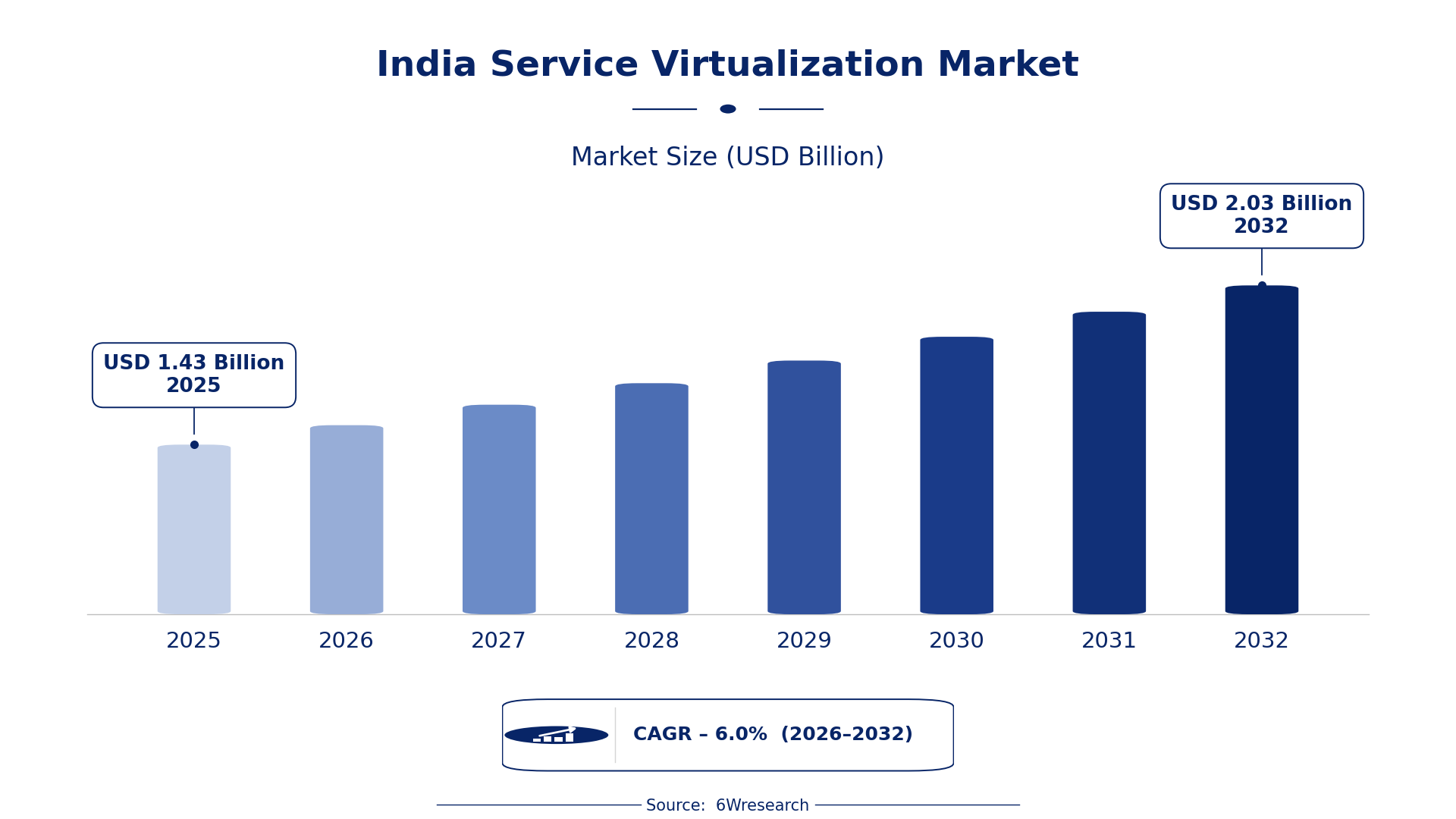
The India Service Virtualization Market was estimated at USD 1425 Million in 2025 and is projected to reach USD 2027 Million by 2032, growing at a CAGR of 6.0% from 2026 to 2032.
India Service Virtualization Market Synopsis
The adoption of service virtualization in India is accelerating, significantly impacting software development and testing practices. This shift is largely driven by the pressing need for organizations to deliver high-quality software at an unprecedented pace, where traditional methods no longer suffice.
Service virtualization empowers development teams to simulate unavailable components, enabling smoother testing and integration processes. As agile and DevOps methodologies gain traction, the importance of this technology becomes ever clearer, paving the way for enhanced productivity and innovation.
India Service Virtualization Market Year-wise Growth Rate and Key Drivers
This graph illustrates the annual growth rates of the India Service Virtualization Market from 2021 to 2032, highlighting a steady upward trajectory and projected expansion over the forecast period.
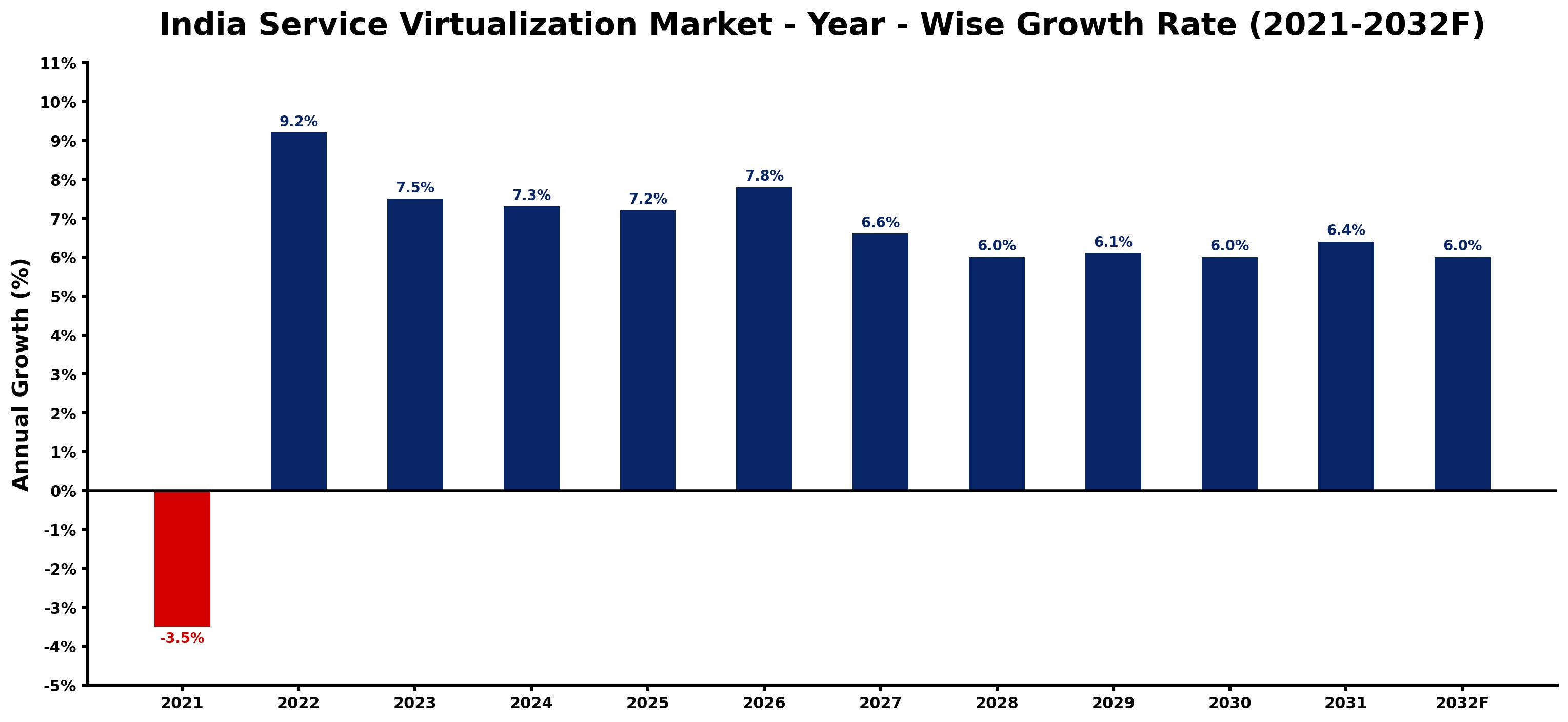
The table below presents the year‑wise growth rates along with the key drivers influencing the market
| Year | Growth Rate | Major Drivers |
| 2021 | -3.5% | COVID-19 restrictions hampered service deployment and adoption. |
| 2022 | 9.2% | Increased investment in cloud adoption by Indian enterprises. |
| 2023 | 7.5% | Emergence of cybersecurity regulations heightening testing requirements. |
| 2024 | 7.3% | Government initiatives promoting digital transformation across industries. |
| 2025 | 7.2% | Boost in software development outsourcing to India. |
| 2026 | 7.8% | Rise in mobile application developments requiring virtualization tools. |
| 2027 | 6.6% | Demand for scalable testing solutions in fintech startups. |
| 2028 | 6.0% | Surge in IoT applications needing service simulation. |
| 2029 | 6.1% | Growing AI integration necessitating advanced testing frameworks. |
| 2030 | 6.0% | Increased training programs focusing on virtualization technologies. |
| 2031 | 6.4% | Adoption of microservices architecture by local software firms. |
| 2032 | 6.0% | Regulatory compliance driving investment in virtualization solutions. |
Note: Market size estimations and growth projections presented in this report are based on 6Wresearch's proprietary forecasting methodology, utilizing the latest available industry data, government publications, and primary research inputs.
India Service Virtualization Market Key Takeaways
Below are some of the specific key takeaways from the market, including:
- The market is experiencing a robust shift towards agile and DevOps practices, making service virtualization essential.
- Complexity in software systems drives the need for reliable testing solutions, bolstered by service virtualization capabilities.
- Cloud-based applications are significantly influencing the demand for comprehensive testing environments.
- Cost-saving opportunities arise from reduced infrastructure requirements through the use of virtualization technologies.
- AI integration is enhancing the functionality and efficiency of service virtualization tools.
Evaluation of Restraints in India Service Virtualization Market
Challenges persist in the India Service Virtualization Market, primarily around the intricacies of accurately emulating complex systems. Organizations often find it daunting to ensure that virtualized services closely mirror the behavior of their real counterparts. Additionally, integrating service virtualization tools within existing IT frameworks can prove cumbersome, leading to potential delays in adoption.
India Service Virtualization Market Trends
A notable trend is the shift towards integrating AI capabilities with service virtualization tools, which enhances predictive analytics and automates testing processes. Increasingly, organizations are recognizing the necessity of continuous testing, driving demand for virtualization tools that support real-time insights. Furthermore, as businesses transition towards microservices architectures, the importance of service virtualization grows in enabling seamless communication among services.
India Service Virtualization Market Opportunities
The market is ripe with opportunities, particularly for vendors who can offer innovative solutions that address specific industry needs. As companies continue to transition to cloud-based platforms, the potential for service virtualization tools to facilitate this shift becomes increasingly vital. Additionally, organizations seeking to optimize their software development lifecycle can benefit significantly from investment in virtualization technologies, presenting a lucrative market for providers.
Government Initiatives in the India Service Virtualization Market
The Indian government is actively promoting digital transformation, which significantly impacts the Service Virtualization Market. Through policies aimed at fostering innovation and technology adoption, the government is creating a conducive environment for the growth of service virtualization. These initiatives reflect a commitment to enhancing the software development ecosystem and reducing barriers for businesses.
- A recently completed initiative involved a national digital infrastructure upgrade program that improved connectivity and accessibility for technology firms.
- Current efforts include a public sector project that seeks to integrate advanced testing frameworks across government software applications.
- Upcoming plans feature a regulatory framework expected to standardize practices in virtualization, fostering better compliance across sectors.
- Ongoing support for innovation hubs is enhancing research in virtualization technologies among Indian startups.
- Policy updates are aimed at incentivizing investment in R&D for software testing and development tools.
Future Insights of the India Service Virtualization Market
Looking ahead to 2026-2032, the India Service Virtualization Market is expected to thrive as businesses increasingly prioritize speed and quality in software delivery. The convergence of virtualization with emerging technologies like AI and machine learning will further refine testing processes and enhance application performance. As organizations adopt more complex architectures, the reliance on service virtualization for effective development will only intensify, shaping a vibrant future for this sector.
India Service Virtualization Market Latest Developments
In the past year, the India Service Virtualization Market has witnessed a flurry of activity as organizations scramble to optimize their software development processes. The rise of remote work and cloud-based solutions has only amplified the urgency for advanced testing technologies. Companies are increasingly investing in virtualization tools that cater to their evolving needs.
- A leading technology vendor launched a new service virtualization platform in early 2025, aimed at simplifying the testing process for cloud applications.
- An initiative that began in mid-2025 is focusing on enhancing service virtualization capabilities through AI integration.
- A major regional operator is currently underway with a project aimed at creating a comprehensive testing framework that utilizes virtualization technologies.
- Plans are being finalized for a public-private partnership expected to enhance the infrastructure supporting virtualization services by late 2026.
- Several technology firms have announced collaborations aimed at developing standardized solutions for service virtualization, which are set to roll out in 2026.
India Service Virtualization Market - Key Attractiveness of the Report
- 10 Years of Market Numbers
- Historical Data Starting from 2022 to 2025
- Base Year: 2025
- Forecast Data until 2032
- Key Performance Indicators Impacting the Market
- Major Upcoming Developments and Projects
Key Highlights of the Report:
- India Service Virtualization Market Outlook
- Market Size of India Service Virtualization Market, 2025
- Forecast of India Service Virtualization Market, 2032
- Historical Data and Forecast of India Service Virtualization Revenues & Volume for the Period 2022-2032F
- India Service Virtualization Market Trend Evolution
- India Service Virtualization Market Drivers and Challenges
- India Service Virtualization Price Trends
- India Service Virtualization Porter's Five Forces
- India Service Virtualization Industry Life Cycle
- Historical Data and Forecast of India Service Virtualization Market Revenues & Volume By Component for the Period 2022-2032F
- Historical Data and Forecast of India Service Virtualization Market Revenues & Volume By Software/Tools for the Period 2022-2032F
- Historical Data and Forecast of India Service Virtualization Market Revenues & Volume By Services for the Period 2022-2032F
- Historical Data and Forecast of India Service Virtualization Market Revenues & Volume By Deployment Type for the Period 2022-2032F
- Historical Data and Forecast of India Service Virtualization Market Revenues & Volume By On-Premises for the Period 2022-2032F
- Historical Data and Forecast of India Service Virtualization Market Revenues & Volume By Cloud for the Period 2022-2032F
- Historical Data and Forecast of India Service Virtualization Market Revenues & Volume By Verticals for the Period 2022-2032F
- Historical Data and Forecast of India Service Virtualization Market Revenues & Volume By IT Services for the Period 2022-2032F
- Historical Data and Forecast of India Service Virtualization Market Revenues & Volume By Telecommunication for the Period 2022-2032F
- Historical Data and Forecast of India Service Virtualization Market Revenues & Volume By BFSI for the Period 2022-2032F
- Historical Data and Forecast of India Service Virtualization Market Revenues & Volume By Retail and eCommerce for the Period 2022-2032F
- Historical Data and Forecast of India Service Virtualization Market Revenues & Volume By Media and Entertainment for the Period 2022-2032F
- Historical Data and Forecast of India Service Virtualization Market Revenues & Volume By Healthcare for the Period 2022-2032F
- Historical Data and Forecast of India Service Virtualization Market Revenues & Volume By Automotive for the Period 2022-2032F
- Historical Data and Forecast of India Service Virtualization Market Revenues & Volume By Others for the Period 2022-2032F
- Historical Data and Forecast of India Service Virtualization Market Revenues & Volume By s for the Period 2022-2032F
- India Service Virtualization Import Export Trade Statistics
- Market Opportunity Assessment By Component
- Market Opportunity Assessment By Deployment Type
- Market Opportunity Assessment By Verticals
- Market Opportunity Assessment By s
- India Service Virtualization Top Companies Market Share
- India Service Virtualization Competitive Benchmarking By Technical and Operational Parameters
- India Service Virtualization Company Profiles
- India Service Virtualization Key Strategic Recommendations






































