India Smart Kitchen Appliances Market Size, Share & Growth Rate
The India Smart Kitchen Appliances Market was estimated at USD 491 Million in 2025 and is projected to reach USD 775 Million by 2032, growing at a CAGR of 6.7% from 2026 to 2032. This upward trajectory is driven by increasing digitalization and rising disposable incomes, allowing more consumers to invest in advanced kitchen technologies. As urban households adapt to smart home trends and the integration of AI in appliances becomes commonplace, demand is expected to surge further.
India Smart Kitchen Appliances Market Year-wise Growth Rate and Key Drivers
This graph highlights how the India Smart Kitchen Appliances Market has steadily grown over the years, supported by major growth factors.
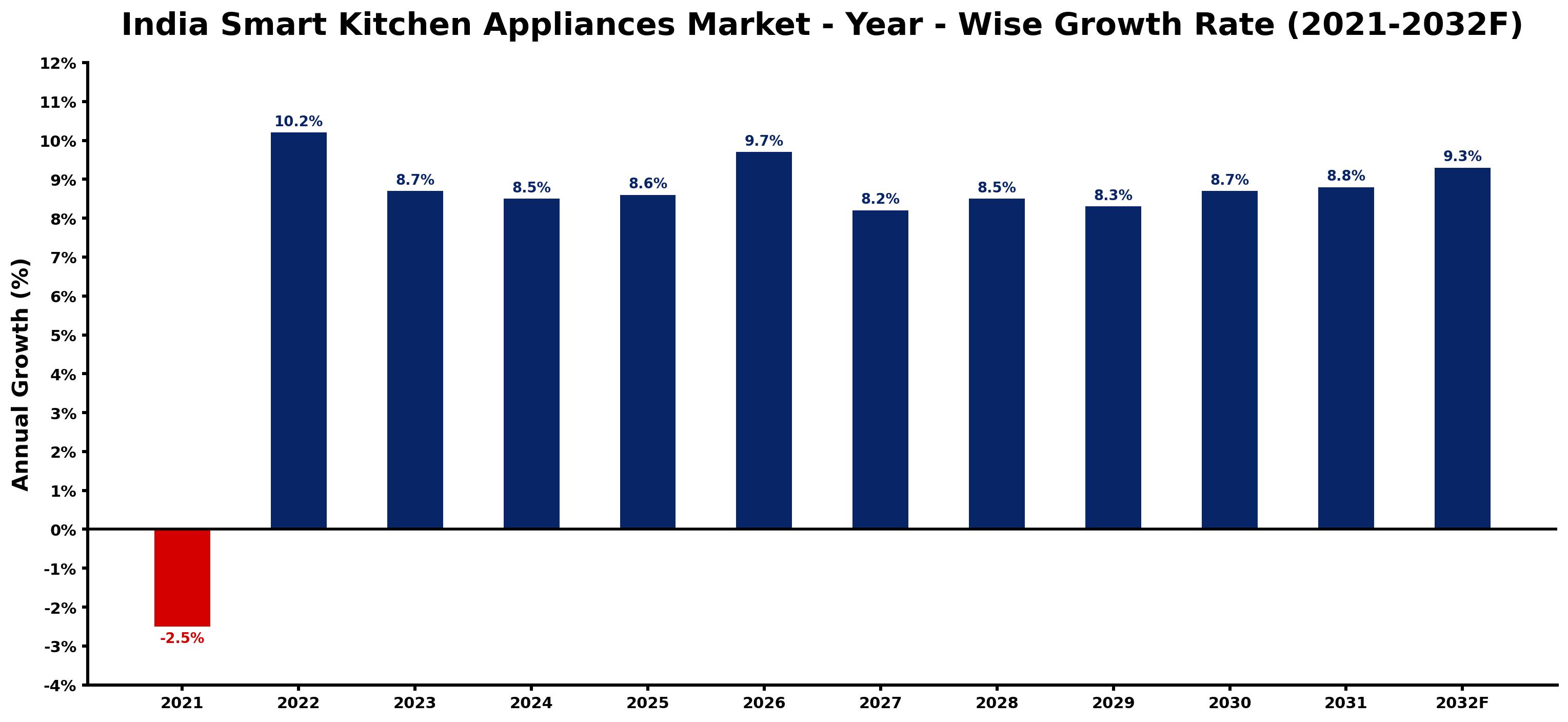
The table below presents the year‑wise growth rates along with the key drivers influencing the market
| Year | Growth Rate | Major Drivers |
| 2021 | -2.5% | Increasing smart city development projects |
| 2022 | 10.2% | Rising electricity demand across industries |
| 2023 | 8.7% | Growing urbanization and commercial development |
| 2024 | 8.5% | Expansion of manufacturing activities |
| 2025 | 8.6% | Expansion of commercial construction activities |
| 2026 | 9.7% | Increasing adoption of advanced technologies |
| 2027 | 8.2% | Expansion of commercial construction activities |
| 2028 | 8.5% | Rising electricity demand across industries |
| 2029 | 8.3% | Expansion of transportation and logistics networks |
| 2030 | 8.7% | Rapid growth in telecom and data center sectors |
| 2031 | 8.8% | Increasing adoption of advanced technologies |
| 2032 | 9.3% | Rising electricity demand across industries |
Note - Market size estimations and growth projections presented in this report are based on 6Wresearch’s advanced forecasting approach, validated with industry datasets as of June 2026.
India Smart Kitchen Appliances Market Synopsis
The strongest force shaping the India Smart Kitchen Appliances Market today is the rapid digitalization coupled with rising consumer awareness regarding smart home technologies. Urban consumers are increasingly drawn to appliances that not only enhance convenience but also contribute to energy efficiency and time savings in their daily lives.
Moreover, government initiatives promoting technological adoption through subsidies and incentives are fostering market growth. The integration of AI and IoT within kitchen appliances is particularly noteworthy, offering users enhanced functionalities that appeal across various demographic segments.
India Smart Kitchen Appliances Market Key Takeaways
- Significant growth is expected in the market, driven by urbanization and technological adoption.
- High disposable incomes among consumers are enhancing the market for premium smart kitchen products.
- AI and IoT integration are revolutionizing user experiences, making appliances more intuitive and effective.
- Government initiatives are providing necessary support to boost market penetration and accessibility.
- Online sales are gaining momentum, aided by increased digital penetration and e-commerce growth.
Evaluation of Restraints in India Smart Kitchen Appliances Market
Despite the promising outlook, certain restraints are limiting market growth. The high prices associated with smart kitchen appliances present a significant barrier for many potential consumers, particularly in non-urban areas where disposable incomes may not support such expenditures. Additionally, a prevailing lack of consumer education regarding the benefits and functionalities of these appliances leads to slower adoption rates. Finally, product availability is limited outside metropolitan areas, further stifling wider acceptance in diverse demographics.
India Smart Kitchen Appliances Market Trends
Current trends in the India Smart Kitchen Appliances Market highlight a growing adoption of voice control technologies, simplifying user interactions. As manufacturers increasingly embed this feature, it opens doors for a more intuitive user experience, making appliances accessible to tech novices as well. Additionally, the integration of IoT is reshaping how consumers engage with their kitchen devices, as remote monitoring and automation become commonplace, enabling personalized cooking and energy management.
India Smart Kitchen Appliances Market Opportunities
Significant growth opportunities lie in expanding product availability and enhancing consumer education initiatives. Companies can tap into underserved markets in tier-2 and tier-3 cities, where demand for smart kitchen appliances is beginning to emerge as urban lifestyles expand. Furthermore, the potential for innovation in eco-friendly and energy-efficient appliances provides a fertile ground for investment and development, appealing to environmentally conscious consumers.
Government Initiatives in the India Smart Kitchen Appliances Market
The Indian government is actively promoting smart home technologies through various incentives, including subsidies and tax breaks for manufacturers and consumers alike. Public spending on digital infrastructure is also gaining momentum, facilitating increased internet connectivity which is vital for IoT-enabled appliances. These measures are designed to bolster domestic production and encourage the adoption of smart technologies, ultimately contributing to the country's broader digital economy goals.
Future Insights of the India Smart Kitchen Appliances Market
Looking ahead to 2026-2032, the India Smart Kitchen Appliances Market is poised for substantial growth, driven by continuous technological advancements and increased consumer readiness to invest in smart home solutions. The expansion of IoT capabilities, coupled with enhanced connectivity and user-friendly interfaces, will further elevate the market's attractiveness. As manufacturers innovate to cater to a broader audience and lower barriers to entry, the potential for mass adoption grows, shaping a dynamic and competitive landscape.
India Smart Kitchen Appliances Market Latest Developments (May 2025 - June 2026)
Recent developments in the India Smart Kitchen Appliances Market indicate a strong emphasis on innovation and sustainability. Manufacturers are increasingly focusing on integrating AI capabilities and energy-efficient technologies into their products. Moreover, there is a notable shift towards enhancing the online shopping experience, with brands investing in e-commerce platforms to better reach tech-savvy consumers. Collaborative partnerships for research and development are also on the rise, reflecting an industry-wide commitment to expanding technological frontiers.
India Smart Kitchen Appliances Market - Key Attractiveness of the Report
- 10 Years of Market Numbers
- Historical Data Starting from 2022 to 2025
- Base Year: 2025
- Forecast Data until 2032
- Key Performance Indicators Impacting the Market
- Major Upcoming Developments and Projects
Key Highlights of the Report:
- India Smart Kitchen Appliances Market Outlook
- Market Size of India Smart Kitchen Appliances Market, 2025
- Forecast of India Smart Kitchen Appliances Market, 2032
- Historical Data and Forecast of India Smart Kitchen Appliances Revenues & Volume for the Period 2022-2032F
- India Smart Kitchen Appliances Market Trend Evolution
- India Smart Kitchen Appliances Market Drivers and Challenges
- India Smart Kitchen Appliances Price Trends
- India Smart Kitchen Appliances Porter's Five Forces
- India Smart Kitchen Appliances Industry Life Cycle
- Historical Data and Forecast of India Smart Kitchen Appliances Market Revenues & Volume By Products for the Period 2022-2032F
- Historical Data and Forecast of India Smart Kitchen Appliances Market Revenues & Volume By Smart Refrigerators for the Period 2022-2032F
- Historical Data and Forecast of India Smart Kitchen Appliances Market Revenues & Volume By Smart Cookware and Cooktops for the Period 2022-2032F
- Historical Data and Forecast of India Smart Kitchen Appliances Market Revenues & Volume By Smart Ovens for the Period 2022-2032F
- Historical Data and Forecast of India Smart Kitchen Appliances Market Revenues & Volume By Other for the Period 2022-2032F
- Historical Data and Forecast of India Smart Kitchen Appliances Market Revenues & Volume By Applications for the Period 2022-2032F
- Historical Data and Forecast of India Smart Kitchen Appliances Market Revenues & Volume By Residential for the Period 2022-2032F
- Historical Data and Forecast of India Smart Kitchen Appliances Market Revenues & Volume By Commercial for the Period 2022-2032F
- India Smart Kitchen Appliances Import Export Trade Statistics
- Market Opportunity Assessment By Products
- Market Opportunity Assessment By Applications
- India Smart Kitchen Appliances Top Companies Market Share
- India Smart Kitchen Appliances Competitive Benchmarking By Technical and Operational Parameters
- India Smart Kitchen Appliances Company Profiles
- India Smart Kitchen Appliances Key Strategic Recommendations






































