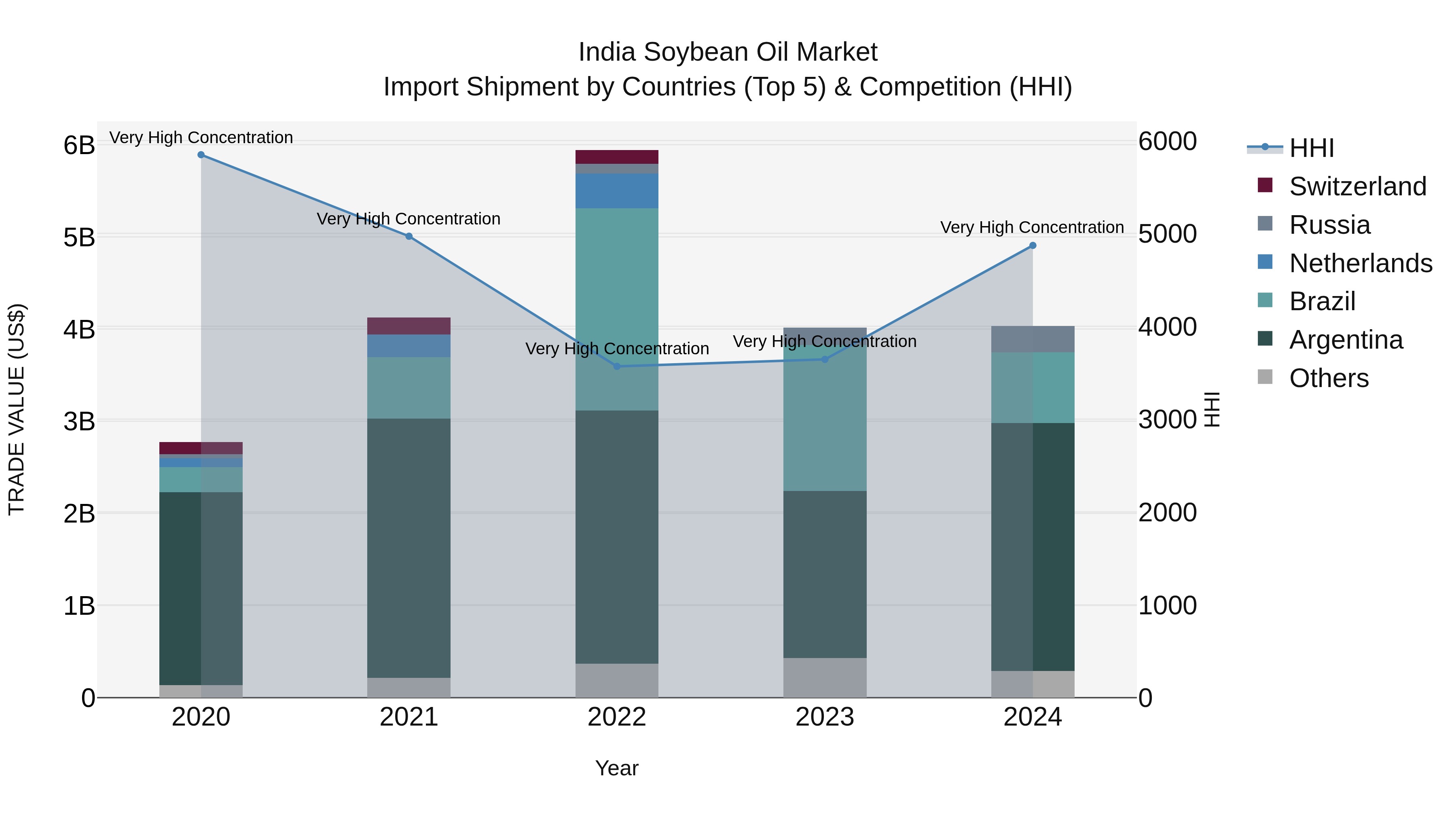
India Soybean Oil Market Top 5 Importing Countries and Market Competition (HHI) Analysis
India`s soybean oil import market in 2024 continued to be dominated by key exporting countries such as Argentina, Brazil, Russia, Paraguay, and Iraq. The high Herfindahl-Hirschman Index (HHI) indicates a concentrated market structure. With a strong compound annual growth rate (CAGR) of 9.81% from 2020 to 2024, the industry shows resilience and potential for further expansion. Despite a slight slowdown with a growth rate of 0.5% from 2023 to 2024, the consistent demand for soybean oil in India highlights the importance of these imports in meeting domestic consumption needs.
India Soybean Oil Market Growth Rate
According to 6Wresearch internal database and industry insights, the India Soybean Oil Market is projected to grow at a compound annual growth rate (CAGR) of 11% during the forecast period (2026-2032).
Topics Covered in the India Soybean Oil Market Report
The India Soybean Oil Market report thoroughly covers the market by End-Use. The market report provides an unbiased and detailed analysis of ongoing market trends, opportunities/high growth areas, and market drivers, which help stakeholders devise and align their market strategies according to the current and future market dynamics.
India Soybean Oil Market Highlights
| Report Name | India Soybean Oil Market |
| Forecast period | 2026-2032 |
| CAGR | 11% |
| Growing Sector | Food Processing & Retail |
India Soybean Oil Market Synopsis
The Market will experience a significant rise because of rising awareness about the positive aspects of consuming it, including low cholesterol and heart-related benefits. Increased urbanisation and improved retail networks will also contribute to a greater demand for soybean oil. Moreover, there will be an increase in the domestic production of soybean oil. The India Soybean Oil Market Growth will continue to be fuelled by these trends, along with investments in improved extraction technologies and distribution channels.
Evaluation of Growth Drivers in the India Soybean Oil Market
Below mentioned are some prominent drivers and their influence on the market dynamics:
| Drivers | Primary Segments Affected | Why it Matters (Evidence) |
| Health Benefits of Soybean Oil | All Types, Food Processing | Health-conscious consumers increasingly prefer soybean oil for its heart-health benefits and lower cholesterol content. |
| Rising Demand from Food Processing | All Types, Food Industry | Increase in processed food demand boosts soybean oil consumption, especially in snacks, cooking oils, and packaged products. |
| Retail Distribution Growth | All Forms, Retail | Availability of soybean oil in stores and online platforms becomes easier for consumers. |
| Growing Domestic Production | Raw Material, Oil Extraction | Better cultivation methods and agricultural policies will help improve soybean production, thus increasing its oil production. |
| Urbanization Growth | All Forms, Food Processing | With an increase in urban populations, the demand for processed foods rises, leading to the use of soybean oil in the processing industry. |
India Soybean Oil Market is expected to grow at the CAGR of 11% during the forecast period of 2026-2032. Growth is driven by the increasing preference for healthier cooking oils, rising demand in food processing, and growth in retail distribution channels. Further, the expanding domestic production of soybeans and increased awareness of health benefits are expected to support market development, benefiting both manufacturers and consumers and making soybean oil a key ingredient in the Indian food industry.
Evaluation of Restraints in the India Soybean Oil Market
Below mentioned are some major restraints and their influence on the market dynamics:
| Restraints | Primary Segments Affected | What This Means (Evidence) |
| High Prices of Raw Materials | Raw Materials, Oil Extraction | Fluctuations in raw material prices affect the cost of soybean oil, limiting affordability for low-income consumers. |
| Other Vegetable Oils' Competition | All Kinds, Food Sector | Other vegetable oils such as sunflower oil and palm oil compete strongly with soybean oil. |
| Poor Rural Awareness | All Kinds, Retail | Small awareness of the nutritional value of soybean oil among rural consumers is a barrier to its usage in such locations. |
| Shelf Life of Soybean Oil | All Kinds, Retail | The poor shelf life of soybean oil leads to wastage and reduced availability in the retail market. |
| Disruption of Supply Chains | Raw Materials, Soybean Oil Production | Global disruptions of supply chains influence the availability and price of soybean oil production. |
India Soybean Oil Market Challenges
Despite its substantial growth in the market, the India Soybean Oil Industry has many obstacles including the volatility of raw material costs, rivalry from other types of vegetable oils, and a lack of knowledge about the health benefits of soybean oil among rural consumers. In addition, supply chain issues and the short shelf life of soybean oil have been impeding the development of the industry. However, despite the existence of these hurdles, it is possible to overcome them through advancements in the extraction process and better supply chain management.
India Soybean Oil Market Trends
Important trends for analyzing the India Soybean Oil Market include:
- Health-Oriented Oil Consumption Trends: People are more inclined towards health-oriented oils such as soybean oil because of the positive effects it can have on their heart health.
- Online Purchase Trends for Oil Products: With the increase in the popularity of online retailing platforms, the consumption of soybean oil is increasing as it is easier to purchase online.
- Soybean Oil Blend Innovations: Soybean oil is being blended with other oils for creating different blends that could cater to the needs of various customers.
- Production Sustainability: The growing focus on the production of soybeans through sustainable farming practices is expected to improve the efficiency of soybean production.
Investment Opportunities in the India Soybean Oil Market
The following are some of the notable investment opportunities in the India Soybean Oil Market:
- Oil Extraction Technology Development: Development and improvement in oil extraction technologies in order to increase oil yield and improve its quality at lower costs.
- Processing Units Expansion: Opening new soybean oil processing facilities to address the rising demands from the food processing industry.
- Retail Networks Establishment: Wider coverage of soybean oil through retail sales using e-commerce and modern retail channels.
- Sustainable Soybean Farming Technologies Development: Research in sustainable soybean farming technologies.
Top 5 Leading Players in the India Soybean Oil Market
Some leading players operating in the India Soybean Oil Market include:
Ruchi Soya Industries Ltd.
| Company Name | Ruchi Soya Industries Ltd. |
| Established Year | 1986 |
| Headquarters | Indore, India |
| Official Website | - |
Ruchi Soya is a major producer and distributor of soybean oil, catering to both urban and rural markets with an emphasis on health-conscious oils.
Adani Wilmar Limited
| Company Name | Adani Wilmar Limited |
| Established Year | 1999 |
| Headquarters | Ahmedabad, India |
| Official Website | - |
Adani Wilmar offers a wide range of edible oils, including soybean oil, to the Indian market, focusing on quality and consumer trust.
Bajaj Oils
| Company Name | Bajaj Oils |
| Established Year | 1957 |
| Headquarters | Mumbai, India |
| Official Website | Click Here |
Bajaj Oils is one of the leading brands in the edible oil industry in India, providing high-quality soybean oil to consumers.
Cargill India
| Company Name | Cargill India |
| Established Year | 2000 |
| Headquarters | Gurgaon, India |
| Official Website | Click Here |
Cargill India produces and markets a range of edible oils, including soybean oil, promoting sustainable practices in its production processes.
Mahakosh Soybean Oil
| Company Name | Mahakosh Soybean Oil |
| Established Year | 1997 |
| Headquarters | Indore, India |
| Official Website | - |
Mahakosh is a trusted producer of high-quality soybean oil, recognized for its purity and health benefits in cooking applications.
Government Regulations Introduced in the India Soybean Oil Market
According to Indian Government Data, There have been various policies formulated to increase the production and accessibility of soybean oil. In 2021, the government launched the National Edible Oils Mission that seeks to increase the production of oils in the country, decrease the reliance on foreign sources, and enhance the processing of the oil. Moreover, the government has put measures to ensure that there is adequate provision of agricultural inputs to encourage more production of soybeans.
Future Insights of the India Soybean Oil Market
The outlook for the India Soybean Oil Market is optimistic due to increasing demand from the food processing industry, rising awareness about health benefits, and enhanced production capabilities. Improved retail distribution channels, especially through e-commerce platforms, will increase accessibility. As the government tries to boost the domestic production through subsidizing the farmers, the market will sustain its steady growth and provide affordable and quality soybean oil for all citizens of the country.
Market Segmentation Analysis
The report offers a comprehensive study of the subsequent market segments and their leading categories:
Food to dominate the Market- By End-Use
According to Vishnu, Senior Research Analyst, 6Wresearch, The Food segment dominates the India Soybean Oil Market Share, driven by growing consumer preference for soybean oil as a healthier cooking oil. The rising demand for processed foods also contributes to the growth of this segment.
Key Attractiveness of the Report
- 10 Years of Market Numbers.
- Historical Data Starting from 2022 to 2025.
- Base Year: 2025.
- Forecast Data until 2032.
- Key Performance Indicators Impacting the Market.
- Major Upcoming Developments and Projects.
Key Highlights of the Report:
- India Soybean Oil Market Outlook
- Market Size of India Soybean Oil Market, 2025
- Forecast of India Soybean Oil Market, 2032
- Historical Data and Forecast of India Soybean Oil Revenues & Volume for the Period 2022-2032
- India Soybean Oil Market Trend Evolution
- India Soybean Oil Market Drivers and Challenges
- India Soybean Oil Price Trends
- India Soybean Oil Porter's Five Forces
- India Soybean Oil Industry Life Cycle
- Historical Data and Forecast of India Soybean Oil Market Revenues & Volume By End-Use for the Period 2022-2032
- Historical Data and Forecast of India Soybean Oil Market Revenues & Volume By Food for the Period 2022-2032
- Historical Data and Forecast of India Soybean Oil Market Revenues & Volume By Feed for the Period 2022-2032
- Historical Data and Forecast of India Soybean Oil Market Revenues & Volume By Industrial for the Period 2022-2032
- India Soybean Oil Import Export Trade Statistics
- Market Opportunity Assessment By End-Use
- India Soybean Oil Top Companies Market Share
- India Soybean Oil Competitive Benchmarking By Technical and Operational Parameters
- India Soybean Oil Company Profiles
- India Soybean Oil Key Strategic Recommendations
Market Covered
The report offers a comprehensive study of the subsequent market segments:
By End-Use
- Food
- Feed
- Industrial






































