Global Soybean Oil Market Highlights
| Market Size (2025) | USD 63 Billion |
| Forecast Size (2032) | USD 83 Billion |
| CAGR | 4.00% |
| Base Year | 2025 |
| Forecast Period | 2026-2032 |
| Largest Region | North America |
| Fastest Growing Region | Asia |
| Largest Segment | Food |
| Fastest Growing Segment | Industrial |
| Leading Companies | Cargill, Archer Daniels Midland, Bunge, Wilmar International, Louis Dreyfus Company |
Global Soybean Oil Market Size & Growth Rate (2026-2032)
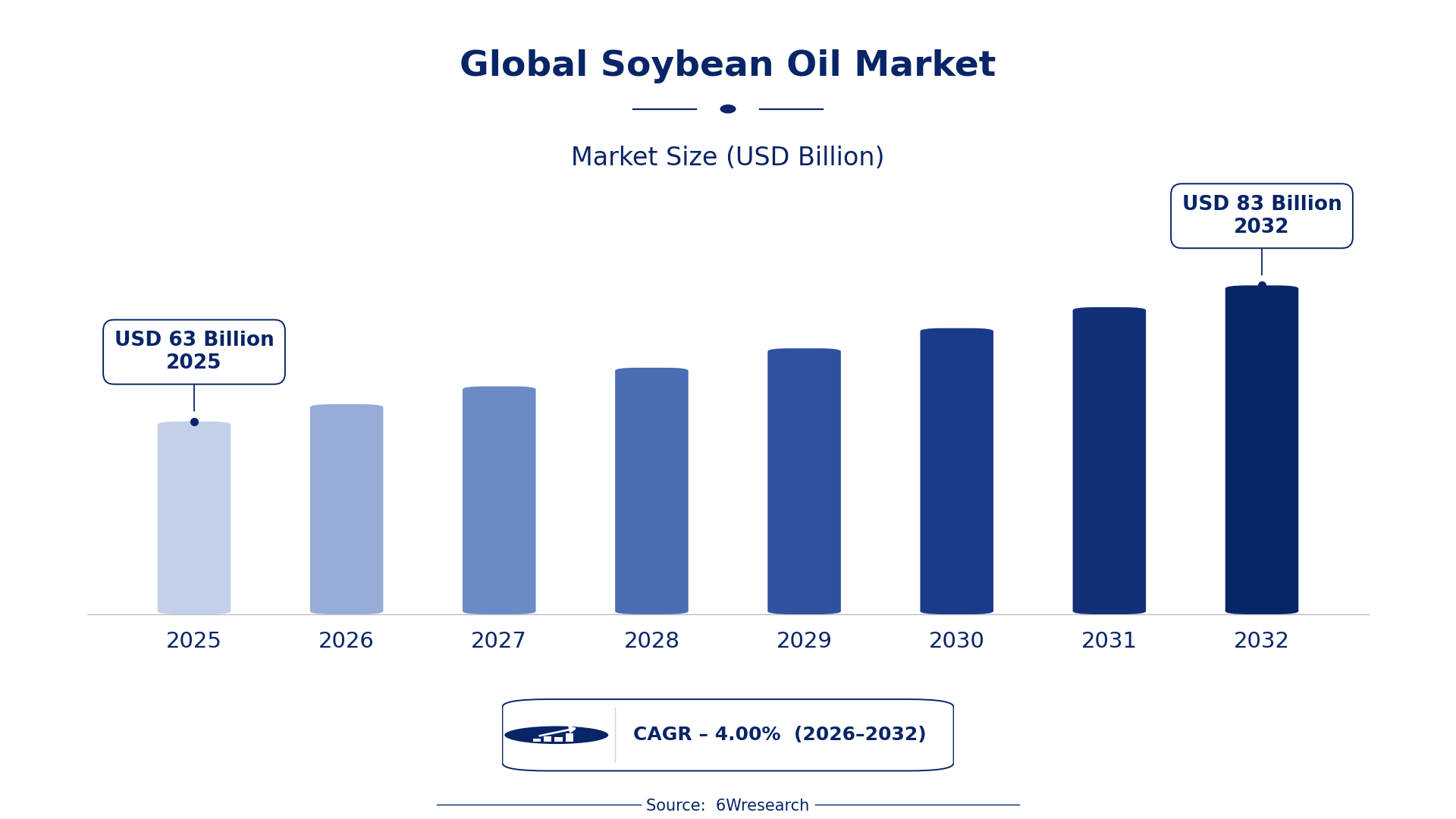
The Global Soybean Oil Market was estimated at USD 63 Billion in 2025 and is projected to reach USD 83 Billion by 2032, growing at a CAGR of 4.00% from 2026 to 2032.
Global Soybean Oil Market Synopsis
In recent years, the Global Soybean Oil Market has exhibited transformative shifts influenced by both consumer preferences and regulatory frameworks. Increased health consciousness is driving demand for soybean oil, favored for its unsaturated fats, making it a staple in culinary applications. The rising proliferation of plant-based diets is also notable, pushing soy products further into mainstream consumption.
Moreover, geopolitical tensions and trade policies have altered the supply chain dynamics, impacting production and export capabilities. Countries like the United States remain critical players as major producers and exporters, while emerging markets in Asia and Africa create new growth avenues. This competitive landscape necessitates strategic positioning by key players in the Global Soybean Oil Market.
Global Soybean Oil Market Year-wise Growth Rate and Key Drivers
This graph illustrates the annual growth rates of the Global Soybean Oil Market from 2022 to 2032, highlighting a steady upward trajectory and projected expansion over the forecast period.
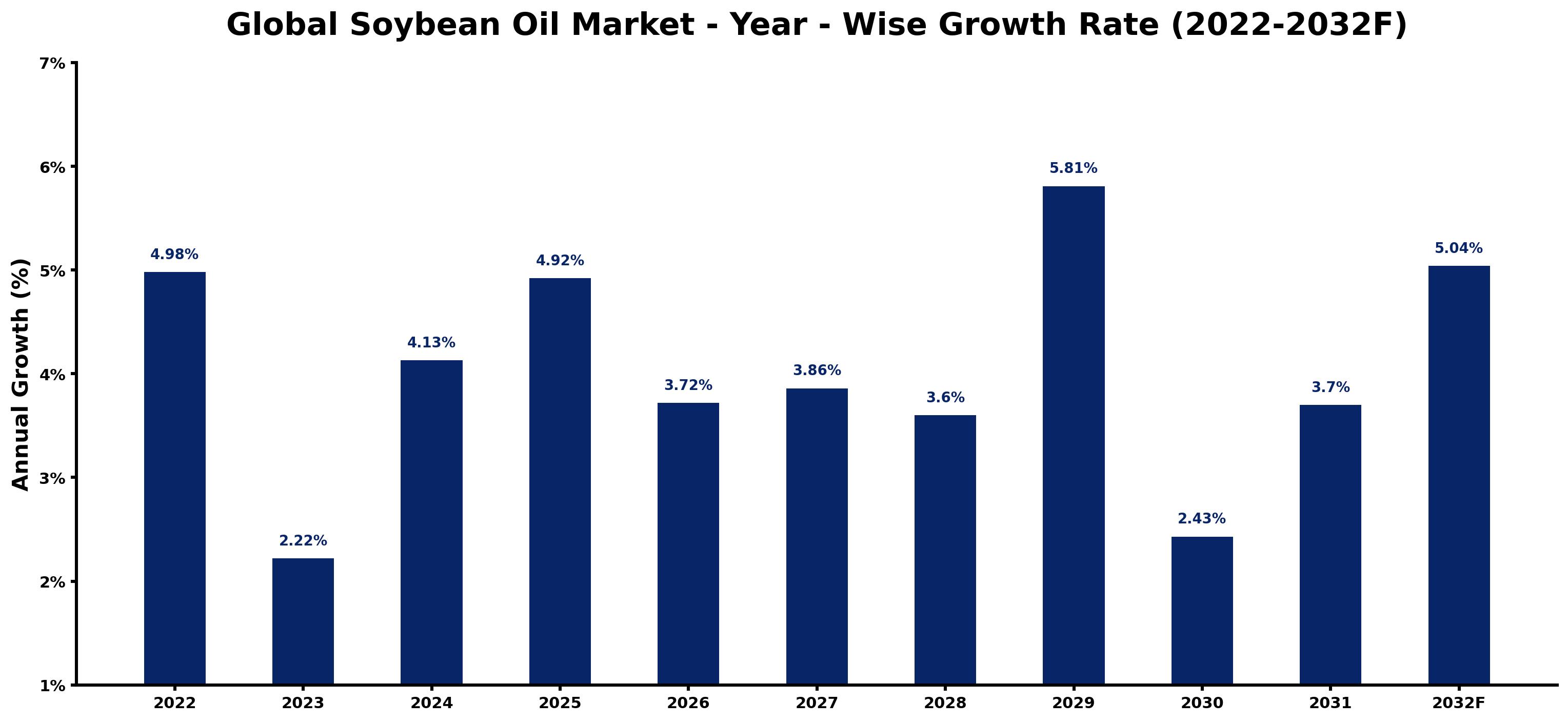
The table below presents the year‑wise growth rates along with the key drivers influencing the market
| Year | Growth Rate (%) | Major Drivers |
| 2022 | 4.98 | Consumer preferences for healthier oils increase the appeal of soybean oil alternatives. |
| 2023 | 2.22 | Food manufacturers increasingly focus on sourcing sustainable soybean oil amid market shifts. |
| 2024 | 4.13 | Advancing seed technology enables higher crop yields and improved soybean oil extraction. |
| 2025 | 4.92 | Rising raw material costs for traditional oils push consumers towards soybean oil options. |
| 2026 | 3.72 | As agricultural workers adopt precision farming techniques, soybean oil production gains efficiency. |
| 2027 | 3.86 | Investors in agribusiness begin prioritizing companies focused on sustainable soybean oil production. |
| 2028 | 3.6 | A shift toward enhanced supply chain traceability informs consumer confidence in soybean oil quality. |
| 2029 | 5.81 | Geographic expansion of soybean oil offerings enhances market reach for leading producers. |
| 2030 | 2.43 | Manufacturers enhance sustainability initiatives, creating greater demand for responsibly sourced soybean oil. |
| 2031 | 3.7 | In the North American market, regulatory changes promote transparency in soybean oil labeling. |
| 2032 | 5.04 | Rising health consciousness among consumers drives a greater shift towards soybean oil adoption. |
Note - Market size estimations and growth projections presented in this report are based on 6Wresearch's proprietary research methodology, combining internal industry data, secondary research, and primary validation, updated periodically to reflect current market conditions. As markets evolve rapidly, figures for certain industries may vary slightly and are intended as informed estimates rather than absolute figures. For the most current market sizing, we recommend validating figures with a 6Wresearch analyst.
Global Soybean Oil Market Key Takeaways
Below are some of the specific key takeaways from the market, including:
- As of 2025, the food segment accounts for approximately 60% of the total market share.
- The industrial segment is expected to grow at a robust CAGR of 5.5% from 2026 to 2032, fueled by demand from biodiesel production.
- Cargill's recent investment of USD 300 million in expanding its soybean processing capabilities reflects its strategy to strengthen market presence in North America.
- According to recent analyses, the Asia-Pacific region is anticipated to contribute nearly 40% of the overall growth in the coming years, driven largely by urbanization and dietary shifts.
- The shift towards environmentally sustainable packaging for soybean oil products will shape industry players' strategies moving forward.
Evaluation of Restraints in Global Soybean Oil Market
The Global Soybean Oil Market faces various restraints that threaten growth and stability. Fluctuating soybean prices are a major concern; in 2022, soybean prices reached an average of USD 14 per bushel, influencing oil margins substantially. For example, adverse weather events causing supply disruptions can exacerbate these fluctuations, impacting overall production costs. Furthermore, environmental regulations regarding deforestation and land use are imposing challenges on soybean cultivation, limiting capacity expansions while pressuring producers to adopt sustainable practices.
Global Soybean Oil Market Trends
Several notable trends are shaping the Global Soybean Oil Market. First, the integration of technology in production processes is revolutionizing efficiency; for instance, companies are adopting precision agriculture techniques to optimize soy yield and resource management. A particular example is Archer Daniels Midland's use of satellite data to improve crop performance, promising sustainable growth. Another trend is growing consumer interest in ethical sourcing; brands that can transparently trace their sourcing practices are seeing increased market uptake, as seen with Bunge's recently launched line of sustainably processed oils. These technology and consumer behavior shifts present tangible operational adjustments that many in the industry must embrace to stay competitive.
Global Soybean Oil Market Opportunities
The Global Soybean Oil Market is poised for substantial opportunities in the coming years, particularly in the biofuels sector. For instance, the increasing adoption of biodiesel across Europe, which is projected to reach a market size of USD 20 billion in 2027, represents a significant revenue stream for soybean oil producers. Additionally, the food processing industry's shift towards healthier cooking oils creates space for innovative soybean oil products, such as fortified oils targeting specific health benefits. Partnerships between soybean oil processors and food manufacturers can enhance product visibility and consumer reach, further unlocking revenue potential.
Global Soybean Oil Market by End-Use
The food segment leads the Global Soybean Oil Market with a commanding approximate share of 60% in 2025. However, the industrial segment is recognized as the fastest-growing, enjoying a CAGR of 5.5% from 2026 to 2032. This growth is predominantly driven by rising biodiesel production and alternative uses of soybean oil in various manufacturing processes, catering to industries that require environmentally friendly production capabilities. The increasing regulatory pressure to reduce carbon emissions fuels this demand, making industrial applications critical for future growth.
Global Soybean Oil Market by Region
North America stands as the largest region for the Global Soybean Oil Market, accounting for approximately 45% share in 2025. This is primarily due to the United States' substantial role as both a producer and exporter of soybean oil. On the contrary, the Asia-Pacific region is the fastest-growing, projected to have a remarkable CAGR of 6.0% from 2026 to 2032. The rapid urbanization and shifting dietary patterns in countries like India and China are key factors driving this growth, as more consumers are integrating soybean oil into their daily cooking practices, thus expanding its market reach.
Government Initiatives in the Global Soybean Oil Market
Government policies play a crucial role in shaping the regulatory and operational environment within the Global Soybean Oil Market. These initiatives often support production, sustainability efforts, and consumer safety standards, impacting every facet of the industry from cultivation to distribution.
- United States Department of Agriculture (USDA) - Crop Insurance Program; 2023. This program provides financial stability for soybean farmers, enabling them to invest in improved agricultural technologies that lead to better production outcomes.
- European Commission - Common Agricultural Policy revisions; 2024. These revisions aim to enhance sustainability in farming practices, which affects the production methods of soybean oil in member states.
- Brazilian Ministry of Agriculture - Soybean Export Expansion Plan; 2022. This plan encourages the export of soybean oil by providing subsidies and reducing tariffs, supporting Brazil's position as a leading exporter.
- Ministry of Agriculture, China - Sustainable Soybean Development Initiative; 2025. This upcoming initiative will focus on sustainable farming practices, expecting to alter cultivation methods and impact overall production.
Future Insights of the Global Soybean Oil Market
The Global Soybean Oil Market is anticipated to undergo substantial structural changes driven by emerging technologies and shifting consumer preferences. As the demand for biodiesel rises, key investments in this sector, particularly from companies like Cargill which are enhancing processing capabilities, are expected to reshape supply chains. Furthermore, the shift towards more sustainable cultivation practices will likely force producers to innovate continuously, aligning with consumer interest in environmentally friendly products. Expect investment in research and development to significantly increase, focusing on optimizing yields and integrating digital agriculture techniques through 2032.
Global Soybean Oil Market Latest Developments
Recent developments showcase how major players in the Global Soybean Oil Market are strategically positioning themselves to capture growth opportunities. These actions reflect their commitment to enhancing market presence and sustainability.
- In early 2023, Archer Daniels Midland announced plans to invest USD 100 million in sustainable soy processing initiatives, enhancing its operational efficiency and improving yield quality.
- Wilmar International is expanding its supply chain capabilities by forging partnerships with local farmers, aimed at boosting production by late 2024, addressing local demand more effectively.
- Recently, Bunge launched a line of specialized soybean oils targeted towards the health-conscious consumer market, set for distribution across North America in mid-2023.
- Louis Dreyfus Company is actively acquiring land in Brazil to enhance soybean cultivation practices, with plans to finalize transactions by 2025, ensuring better control over supply chains.
Global Soybean Oil Market Key Players and Industry Positioning
The competitive structure of the Global Soybean Oil Market is moderately consolidated, with leading companies leveraging scale and technological advancements to maintain market dominance. Each key player adopts distinct strategies focusing on specific areas such as sustainability, regional presence, and innovation, reinforcing their competitive positioning.
| Leading Company | Core Strength | Strategic Focus |
|---|---|---|
| Cargill | Extensive supply chain and large operational footprint | Sustainable practices and processed oil lines expansion |
| Archer Daniels Midland | Technological integration in production | Optimizing processing capabilities through R&D |
| Bunge | Diversity in product offerings | Health-oriented product development |
| Wilmar International | Strong regional partnerships and connections | Local sourcing for better integration |
| Louis Dreyfus Company | Vertical integration in supply chain | Land acquisition for improved soybean cultivation |
As the Global Soybean Oil Market evolves, understanding these companies' unique positions will be crucial for assessing competitive advantages and market opportunities.
Key Attractiveness of the Report
- 10 Years of Market Numbers
- Historical Data Starting from 2022 to 2025
- Base Year: 2025
- Forecast Data until 2032
- Key Performance Indicators Impacting the Market
- Major Upcoming Developments and Projects
Key Highlights of the Report:
- Global Soybean Oil Market Outlook
- Market Size of Global Soybean Oil Market, 2025
- Forecast of Global Soybean Oil Market, 2032
- Historical Data and Forecast of Global Soybean Oil Revenues & Volume for the Period 2022-2032
- Global Soybean Oil Market Trend Evolution
- Global Soybean Oil Market Drivers and Challenges
- Global Soybean Oil Price Trends
- Global Soybean Oil Porter's Five Forces
- Global Soybean Oil Industry Life Cycle
- Historical Data and Forecast of Global Soybean Oil Market Revenues & Volume
- Historical Data and Forecast of Global Soybean Oil Market Revenues & Volume By End-Use for the Period 2022-2032
- Historical Data and Forecast of Global Soybean Oil Market Revenues & Volume By Food for the Period 2022-2032
- Historical Data and Forecast of Global Soybean Oil Market Revenues & Volume By Feed for the Period 2022-2032
- Historical Data and Forecast of Global Soybean Oil Market Revenues & Volume By Industrial for the Period 2022-2032
- Historical Data and Forecast of North America Soybean Oil Market Revenues & Volume By End-Use for the Period 2022-2032
- Historical Data and Forecast of North America Soybean Oil Market Revenues & Volume By Food for the Period 2022-2032
- Historical Data and Forecast of North America Soybean Oil Market Revenues & Volume By Feed for the Period 2022-2032
- Historical Data and Forecast of North America Soybean Oil Market Revenues & Volume By Industrial for the Period 2022-2032
- Historical Data and Forecast of United States of America Soybean Oil Market Revenues & Volume for the Period 2022-2032
- Historical Data and Forecast of Canada Soybean Oil Market Revenues & Volume for the Period 2022-2032
- Historical Data and Forecast of Rest of North America Soybean Oil Market Revenues & Volume for the Period 2022-2032
- Historical Data and Forecast of Latin America (LATAM) Soybean Oil Market Revenues & Volume By End-Use for the Period 2022-2032
- Historical Data and Forecast of Latin America (LATAM) Soybean Oil Market Revenues & Volume By Food for the Period 2022-2032
- Historical Data and Forecast of Latin America (LATAM) Soybean Oil Market Revenues & Volume By Feed for the Period 2022-2032
- Historical Data and Forecast of Latin America (LATAM) Soybean Oil Market Revenues & Volume By Industrial for the Period 2022-2032
- Historical Data and Forecast of Brazil Soybean Oil Market Revenues & Volume for the Period 2022-2032
- Historical Data and Forecast of Mexico Soybean Oil Market Revenues & Volume for the Period 2022-2032
- Historical Data and Forecast of Argentina Soybean Oil Market Revenues & Volume for the Period 2022-2032
- Historical Data and Forecast of Rest of LATAM Soybean Oil Market Revenues & Volume for the Period 2022-2032
- Historical Data and Forecast of Asia Soybean Oil Market Revenues & Volume By End-Use for the Period 2022-2032
- Historical Data and Forecast of Asia Soybean Oil Market Revenues & Volume By Food for the Period 2022-2032
- Historical Data and Forecast of Asia Soybean Oil Market Revenues & Volume By Feed for the Period 2022-2032
- Historical Data and Forecast of Asia Soybean Oil Market Revenues & Volume By Industrial for the Period 2022-2032
- Historical Data and Forecast of China Soybean Oil Market Revenues & Volume for the Period 2022-2032
- Historical Data and Forecast of India Soybean Oil Market Revenues & Volume for the Period 2022-2032
- Historical Data and Forecast of Japan Soybean Oil Market Revenues & Volume for the Period 2022-2032
- Historical Data and Forecast of Rest of Asia Soybean Oil Market Revenues & Volume for the Period 2022-2032
- Historical Data and Forecast of Africa Soybean Oil Market Revenues & Volume By End-Use for the Period 2022-2032
- Historical Data and Forecast of Africa Soybean Oil Market Revenues & Volume By Food for the Period 2022-2032
- Historical Data and Forecast of Africa Soybean Oil Market Revenues & Volume By Feed for the Period 2022-2032
- Historical Data and Forecast of Africa Soybean Oil Market Revenues & Volume By Industrial for the Period 2022-2032
- Historical Data and Forecast of South Africa Soybean Oil Market Revenues & Volume for the Period 2022-2032
- Historical Data and Forecast of Nigeria Soybean Oil Market Revenues & Volume for the Period 2022-2032
- Historical Data and Forecast of Egypt Soybean Oil Market Revenues & Volume for the Period 2022-2032
- Historical Data and Forecast of Rest of Africa Soybean Oil Market Revenues & Volume for the Period 2022-2032
- Historical Data and Forecast of Europe Soybean Oil Market Revenues & Volume By End-Use for the Period 2022-2032
- Historical Data and Forecast of Europe Soybean Oil Market Revenues & Volume By Food for the Period 2022-2032
- Historical Data and Forecast of Europe Soybean Oil Market Revenues & Volume By Feed for the Period 2022-2032
- Historical Data and Forecast of Europe Soybean Oil Market Revenues & Volume By Industrial for the Period 2022-2032
- Historical Data and Forecast of United Kingdom Soybean Oil Market Revenues & Volume for the Period 2022-2032
- Historical Data and Forecast of France Soybean Oil Market Revenues & Volume for the Period 2022-2032
- Historical Data and Forecast of Germany Soybean Oil Market Revenues & Volume for the Period 2022-2032
- Historical Data and Forecast of Rest of Europe Soybean Oil Market Revenues & Volume for the Period 2022-2032
- Historical Data and Forecast of Middle East Soybean Oil Market Revenues & Volume By End-Use for the Period 2022-2032
- Historical Data and Forecast of Middle East Soybean Oil Market Revenues & Volume By Food for the Period 2022-2032
- Historical Data and Forecast of Middle East Soybean Oil Market Revenues & Volume By Feed for the Period 2022-2032
- Historical Data and Forecast of Middle East Soybean Oil Market Revenues & Volume By Industrial for the Period 2022-2032
- Historical Data and Forecast of Saudi Arabia Soybean Oil Market Revenues & Volume for the Period 2022-2032
- Historical Data and Forecast of UAE Soybean Oil Market Revenues & Volume for the Period 2022-2032
- Historical Data and Forecast of Turkey Soybean Oil Market Revenues & Volume for the Period 2022-2032
- Historical Data and Forecast of Rest of Middle East Soybean Oil Market Revenues & Volume for the Period 2022-2032
- Global Soybean Oil Market - Key Performance Indicators
- Global Soybean Oil Market - Import Export Trade Statistics
- Global Soybean Oil Market - Opportunity Assessment By Countries
- Global Soybean Oil Market - Opportunity Assessment By End-Use
- 0
- Global Soybean Oil Market - Top Companies Market Share
- Global Soybean Oil Market - Top Companies Profiles
- Global Soybean Oil Market - Comparison of Players in Technical and Operating Parameters
- Global Soybean Oil Market - Strategic Recommendations
Markets Covered
The Global Soybean Oil Market report provides a detailed analysis of the following market segments:
By Regions and Countries:
- North America
- Europe
- LATAM
- Middle East
- Asia
- Africa
By End-Use:
- Food
- Feed
- Industrial






































