India Stuffed Toys Market Size, Share & Growth Rate
The India Stuffed Toys Market was estimated at USD 1305 Million in 2025 and is projected to reach USD 1866 Million by 2032, growing at a CAGR of 5.2% from 2026 to 2032. This upward trajectory is driven by a burgeoning population of children and young adults, combined with shifting consumer preferences favoring interactive and educational plush toys. Increased disposable incomes in urban areas and the rising popularity of e-commerce platforms further fuel demand for these products, making India a vibrant hub for stuffed toy sales.
India Stuffed Toys Market Year-wise Growth Rate and Key Drivers
This graph highlights how the India Stuffed Toys Market has steadily grown over the years, supported by major growth factors.
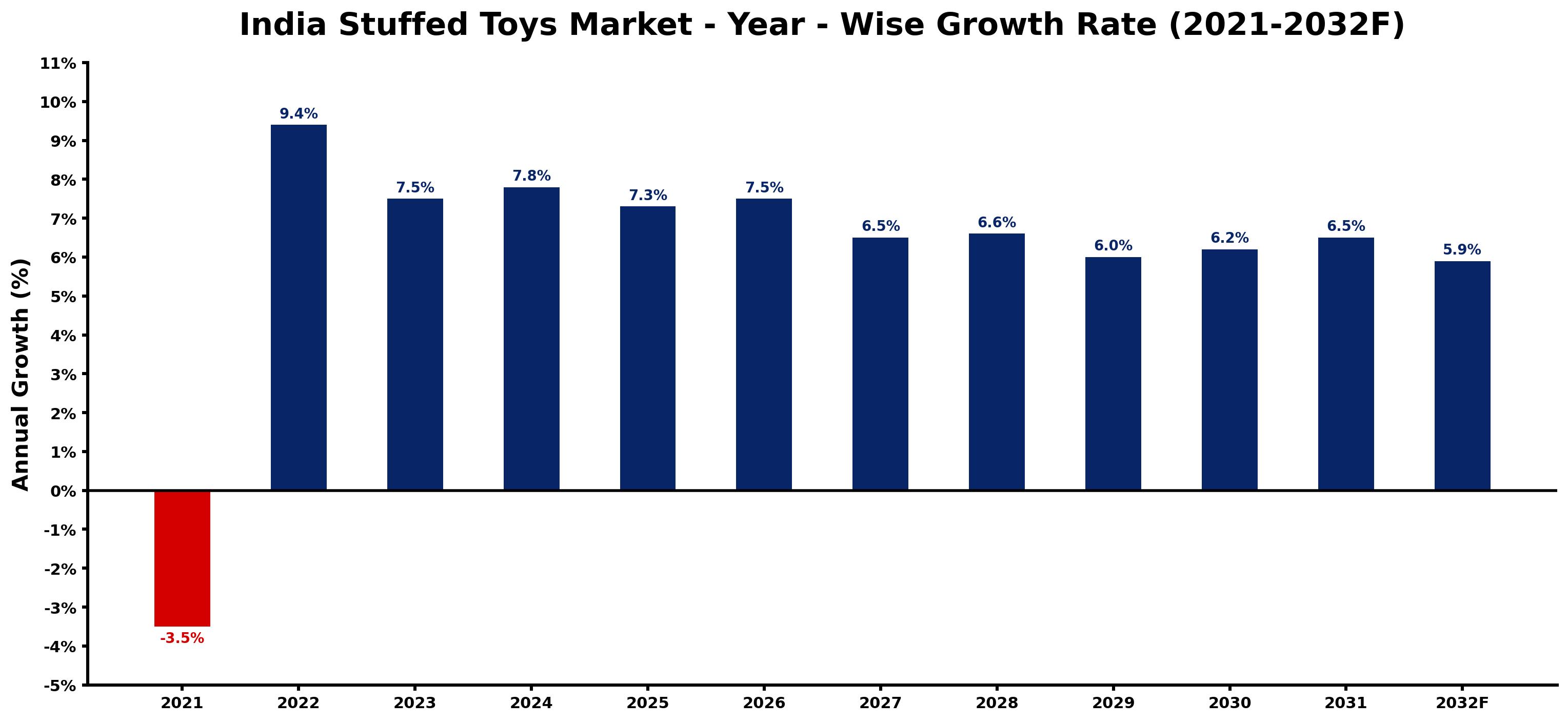
The table below presents the year‑wise growth rates along with the key drivers influencing the market
| Year | Growth Rate | Major Drivers |
| 2021 | -3.5% | Expansion of commercial construction activities |
| 2022 | 9.4% | Growing urbanization and commercial development |
| 2023 | 7.5% | Growing renewable energy integration projects |
| 2024 | 7.8% | Expansion of commercial construction activities |
| 2025 | 7.3% | Increasing smart city development projects |
| 2026 | 7.5% | Increasing industrial infrastructure investments |
| 2027 | 6.5% | Growing urbanization and commercial development |
| 2028 | 6.6% | Growing renewable energy integration projects |
| 2029 | 6.0% | Increasing smart city development projects |
| 2030 | 6.2% | Increasing industrial automation investments |
| 2031 | 6.5% | Rising electricity demand across industries |
| 2032 | 5.9% | Rising electricity demand across industries |
Note - Market size estimations and growth projections presented in this report are based on 6Wresearch’s advanced forecasting approach, validated with industry datasets as of June 2026.
India Stuffed Toys Market Synopsis
The most significant force shaping the India Stuffed Toys Market right now is the growing preference for plush toys as a form of affordable entertainment. As families seek engaging ways to spend quality time together, plush toys that combine safety with interactive features have become increasingly popular, appealing to both children and their parents.
Furthermore, the expansion of e-commerce platforms has revolutionized how consumers access stuffed toys, allowing a diverse range of products to reach buyers conveniently. This shift not only enhances consumer choice but also encourages brand loyalty, as international brands gain traction in the Indian market.
India Stuffed Toys Market Key Takeaways
- The market is driven by rising consumer preferences for educational and interactive stuffed toys.
- E-commerce platforms are significantly expanding the reach of stuffed toy brands to diverse demographics.
- Increasing disposable incomes in urban centers are facilitating higher spending on quality toys.
- The trend toward incorporating technology in toys is appealing to tech-savvy parents and children alike.
- Counterfeit products pose a substantial risk, affecting the market's integrity and sales potential.
Evaluation of Restraints in India Stuffed Toys Market
Despite the promising growth, the India Stuffed Toys Market faces several constraints. A major concern is the prevalence of counterfeit products, which undermine brand loyalty and can lead to safety issues for consumers. These knock-offs often appear on prominent online retail platforms, complicating the purchasing process for consumers who may inadvertently opt for substandard alternatives. Additionally, some manufacturers prioritize cost reduction over quality, sometimes using non-certified components in their products, posing health risks to children. Such practices can ultimately hamper the market's long-term growth if not addressed adequately.
India Stuffed Toys Market Trends
Several trends are currently shaping the demand for stuffed toys in India. There is a notable shift towards plush toys integrated with modern technology, such as IoT and AI, enabling features like voice interaction and remote operation. This technological advancement not only enhances playtime but also serves educational purposes, introducing young minds to foundational concepts in science and mathematics. Additionally, the demand for ethically produced and sustainable toys is rising, with consumers increasingly seeking options that align with their values.
India Stuffed Toys Market Opportunities
The market presents numerous opportunities for growth and investment. As e-commerce continues to dominate retail, companies that optimize their online presence and engage in targeted marketing will likely reap significant rewards. The trend towards technologically advanced toys also invites innovation; businesses that invest in research and development to create interactive and educational plush toys will find a receptive audience. Lastly, the potential for localized production and unique cultural themes can further tap into the Indian consumer's desire for relatable and meaningful products.
Government Initiatives in the India Stuffed Toys Market
The Indian government has been implementing various initiatives to boost the manufacturing sector, which positively impacts the stuffed toys market. Programs promoting "Make in India" encourage local production, thereby reducing dependency on imports. Furthermore, policies aimed at enhancing safety standards for children's products are fostering a more regulated environment, which is vital for ensuring consumer confidence and market integrity. Investment in technology and skill development initiatives in the toy sector is also anticipated to drive innovation and growth.
Future Insights of the India Stuffed Toys Market
Looking ahead to the period from 2026 to 2032, the India Stuffed Toys Market is expected to continue its robust growth trajectory. The fusion of technology with traditional play will likely remain a significant driver, as parents increasingly seek toys that not only entertain but also educate. The expansion of digital sales channels will also facilitate greater access to diverse products, catering to an evolving consumer base. As safety and quality standards become more stringent, brands that prioritize these aspects will emerge as leaders in the market.
India Stuffed Toys Market Latest Developments (May 2025 - June 2026)
In recent months, the stuffed toys market in India has seen a notable increase in brand collaborations focused on creating unique product lines that blend entertainment with education. Several brands are innovating by incorporating eco-friendly materials, responding to consumer demand for sustainable options. Additionally, the rise of social media marketing strategies has reshaped how companies engage with consumers, driving higher visibility and sales through targeted campaigns.
India Stuffed Toys Market - Key Attractiveness of the Report
- 10 Years of Market Numbers
- Historical Data Starting from 2022 to 2025
- Base Year: 2025
- Forecast Data until 2032
- Key Performance Indicators Impacting the Market
- Major Upcoming Developments and Projects
Key Highlights of the Report:
- India Stuffed Toys Market Outlook
- Market Size of India Stuffed Toys Market, 2025
- Forecast of India Stuffed Toys Market, 2032
- Historical Data and Forecast of India Stuffed Toys Revenues & Volume for the Period 2022-2032F
- India Stuffed Toys Market Trend Evolution
- India Stuffed Toys Market Drivers and Challenges
- India Stuffed Toys Price Trends
- India Stuffed Toys Porter's Five Forces
- India Stuffed Toys Industry Life Cycle
- Historical Data and Forecast of India Stuffed Toys Market Revenues & Volume By Product Type for the Period 2022-2032F
- Historical Data and Forecast of India Stuffed Toys Market Revenues & Volume By Cartoon Characters for the Period 2022-2032F
- Historical Data and Forecast of India Stuffed Toys Market Revenues & Volume By Animals for the Period 2022-2032F
- Historical Data and Forecast of India Stuffed Toys Market Revenues & Volume By Dolls for the Period 2022-2032F
- Historical Data and Forecast of India Stuffed Toys Market Revenues & Volume By Playsets for the Period 2022-2032F
- Historical Data and Forecast of India Stuffed Toys Market Revenues & Volume By Others for the Period 2022-2032F
- Historical Data and Forecast of India Stuffed Toys Market Revenues & Volume By Raw Material for the Period 2022-2032F
- Historical Data and Forecast of India Stuffed Toys Market Revenues & Volume By Pellets for the Period 2022-2032F
- Historical Data and Forecast of India Stuffed Toys Market Revenues & Volume By Fabric for the Period 2022-2032F
- Historical Data and Forecast of India Stuffed Toys Market Revenues & Volume By Bamboo for the Period 2022-2032F
- Historical Data and Forecast of India Stuffed Toys Market Revenues & Volume By Others for the Period 2022-2032F
- India Stuffed Toys Import Export Trade Statistics
- Market Opportunity Assessment By Product Type
- Market Opportunity Assessment By Raw Material
- India Stuffed Toys Top Companies Market Share
- India Stuffed Toys Competitive Benchmarking By Technical and Operational Parameters
- India Stuffed Toys Company Profiles
- India Stuffed Toys Key Strategic Recommendations






































