India Sulphate Resistant Cement Market Size, Share & Growth Rate
The India Sulphate Resistant Cement Market was estimated at USD 666 Million in 2025 and is projected to reach USD 954 Million by 2032, growing at a CAGR of 5.3% from 2026 to 2032. This growth trajectory is propelled by the relentless expansion of infrastructure projects across the country, alongside an increasing reliance on durable concrete structures in various civil engineering applications. The heightened need for waterproofing, particularly in sulfate-rich regions, has further underscored the significance of sulphate resistant cements in construction, thereby catalyzing market growth.
India Sulphate Resistant Cement Market Year-wise Growth Rate and Key Drivers
This graph highlights how the India Sulphate Resistant Cement Market has steadily grown over the years, supported by major growth factors.
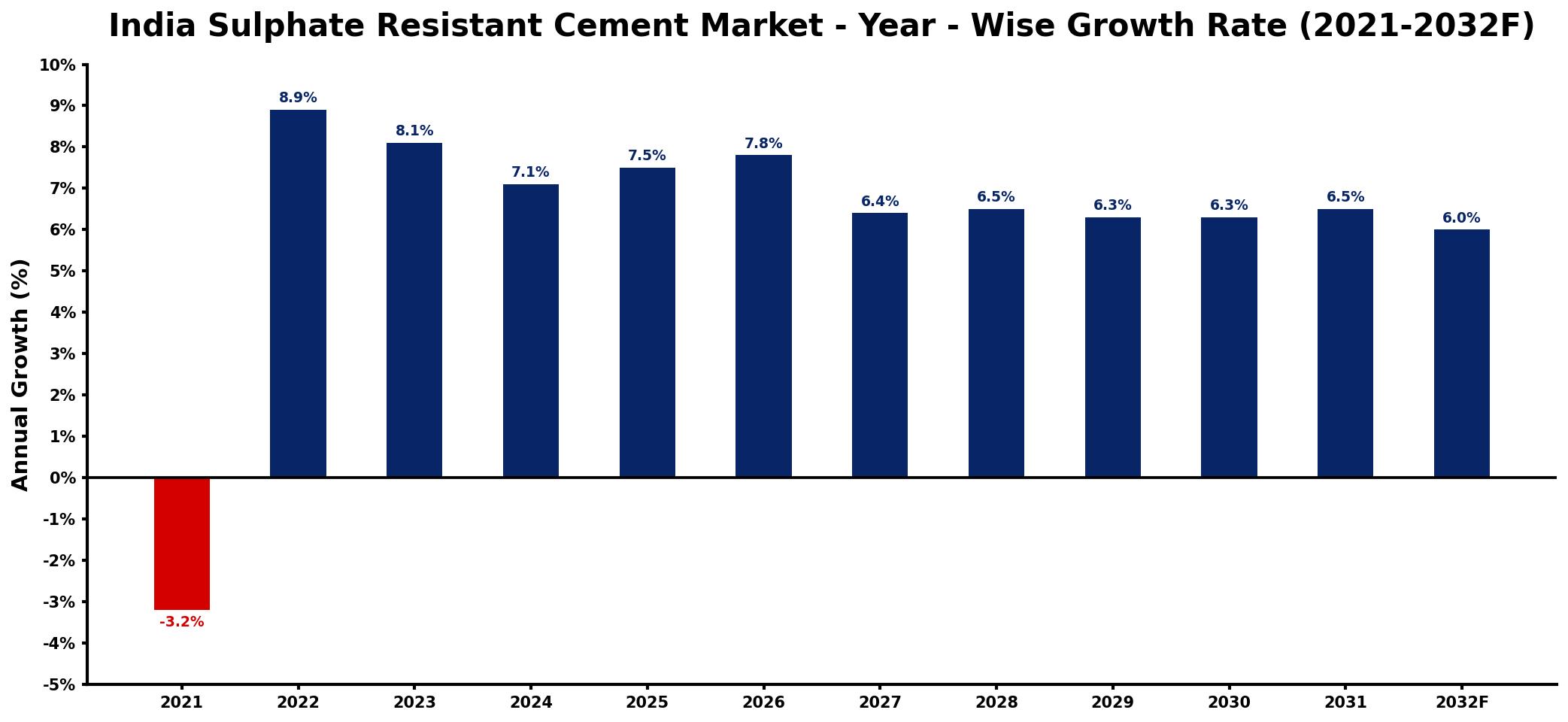
The table below presents the year‑wise growth rates along with the key drivers influencing the market
| Year | Growth Rate | Major Drivers |
| 2021 | -3.2% | Construction activity slowed down significantly |
| 2022 | 8.9% | Infrastructure projects gained momentum |
| 2023 | 8.1% | Government investments in housing initiatives |
| 2024 | 7.1% | Rising urbanization and population growth |
| 2025 | 7.5% | Increased demand from commercial sector |
| 2026 | 7.8% | Sustainable construction practices adopted widely |
| 2027 | 6.4% | stronger distribution network expansion |
| 2028 | 6.5% | Boost in public-private partnership projects |
| 2029 | 6.3% | Growing awareness of environmental impact |
| 2030 | 6.3% | Rising demand for durable structures |
| 2031 | 6.5% | Expansion of smart city initiatives |
| 2032 | 6.0% | Long-term urban development plans implemented |
Note: Market size estimations and growth projections presented in this report are based on 6Wresearch's proprietary forecasting methodology, utilizing the latest available industry data, government publications, and primary research inputs.
India Sulphate Resistant Cement Market Synopsis
The India Sulphate Resistant Cement Market is witnessing a transformative phase, driven by ambitious construction initiatives under government programs and rising urbanization. As cities strive for sustainability and durability in construction, sulphate resistant cement has emerged as a crucial material for projects susceptible to sulfate exposure.
Recent years have seen a notable shift in preferences among construction professionals, with a growing emphasis on materials that offer longevity in challenging environments. This trend is particularly relevant for regions characterized by high sulfate soil content, where traditional cements may fail to meet performance standards.
India Sulphate Resistant Cement Market Key Takeaways
- The market is anticipated to grow from USD 666 Million in 2025 to USD 954 Million by 2032.
- Infrastructure development, spurred by governmental initiatives, is a significant market driver.
- Increased urbanization is leading to a higher demand for durable construction materials.
- Greater awareness of the benefits of sulphate resistant cement is pushing adoption in critical applications.
- Competition from conventional cements presents ongoing challenges that market players must navigate.
Evaluation of Restraints in India Sulphate Resistant Cement Market
Despite its promising growth, the India Sulphate Resistant Cement Market faces several notable restraints. A primary concern is the stiff competition from more cost-effective alternatives, such as ordinary Portland cement (OPC) and Portland pozzolana cement (PPC). This price sensitivity, particularly among contractors, often leads to a preference for cheaper options that may not offer the same long-term benefits. Additionally, the higher production costs associated with sulphate resistant cement, along with limited access to necessary raw materials, can restrict market entry for new players, complicating the competitive landscape.
India Sulphate Resistant Cement Market Trends
Emerging trends within the India Sulphate Resistant Cement Market are largely influenced by technological advancements and evolving construction practices. The integration of eco-friendly manufacturing processes is becoming increasingly common, aligning with global sustainability goals. Furthermore, there is a marked rise in demand for tailored cement formulations that cater to specific project requirements, which signifies a move towards more innovative solutions in cement technology.
India Sulphate Resistant Cement Market Opportunities
The market presents significant opportunities for growth, particularly in the context of Indias ambitious infrastructure agenda. With urban centers expanding and new projects ramping up, there is an increasing need for durable construction materials capable of withstanding challenging environmental conditions. Additionally, leveraging partnerships with governmental bodies and private construction firms can facilitate greater awareness and adoption of sulphate resistant cement, presenting avenues for innovation and investment.
Government Initiatives in the India Sulphate Resistant Cement Market
Government initiatives such as the "Smart Cities Mission" and significant investments in transport and housing infrastructure are pivotal in shaping the sulphate resistant cement market. These programs emphasize the construction of resilient and sustainable urban environments, fostering a favorable atmosphere for high-performance building materials. Public spending on infrastructure development continues to rise, reflecting the government's commitment to enhancing India's urban landscape.
Future Insights of the India Sulphate Resistant Cement Market
Looking ahead to 2026-2032, the India Sulphate Resistant Cement Market is poised for substantial growth driven by ongoing urbanization and infrastructure expansion. As awareness of the long-term benefits of using sulphate resistant cement grows among developers and contractors, we can anticipate a shift towards more widespread adoption. The commitment to sustainability and resilience in construction will likely position sulphate resistant cement as a cornerstone for future developments, particularly in regions vulnerable to sulfate exposure.
India Sulphate Resistant Cement Market Latest Developments (2025 - 2026)
Recent industry developments indicate a proactive approach among manufacturers toward enhancing product offerings and meeting evolving market demands. Innovations focusing on improved formulations and environmentally-friendly production techniques have emerged, as companies strive to align with sustainability trends. Additionally, strategic partnerships between manufacturers and construction firms are being established to drive awareness and application of sulphate resistant cement in key infrastructure projects.
India Sulphate Resistant Cement Market - Key Attractiveness of the Report
- 10 Years of Market Numbers
- Historical Data Starting from 2022 to 2025
- Base Year: 2025
- Forecast Data until 2032
- Key Performance Indicators Impacting the Market
- Major Upcoming Developments and Projects
Key Highlights of the Report:
- India Sulphate Resistant Cement Market Outlook
- Market Size of India Sulphate Resistant Cement Market, 2025
- Forecast of India Sulphate Resistant Cement Market, 2032
- Historical Data and Forecast of India Sulphate Resistant Cement Revenues & Volume for the Period 2022-2032F
- India Sulphate Resistant Cement Market Trend Evolution
- India Sulphate Resistant Cement Market Drivers and Challenges
- India Sulphate Resistant Cement Price Trends
- India Sulphate Resistant Cement Porter's Five Forces
- India Sulphate Resistant Cement Industry Life Cycle
- Historical Data and Forecast of India Sulphate Resistant Cement Market Revenues & Volume By Types for the Period 2022-2032F
- Historical Data and Forecast of India Sulphate Resistant Cement Market Revenues & Volume By C3A Content C3A Content 3%-5% for the Period 2022-2032F
- Historical Data and Forecast of India Sulphate Resistant Cement Market Revenues & Volume By Sulphate Resistant Cement (SRC) for the Period 2022-2032F
- Historical Data and Forecast of India Sulphate Resistant Cement Market Revenues & Volume By Applications for the Period 2022-2032F
- Historical Data and Forecast of India Sulphate Resistant Cement Market Revenues & Volume By Effluent and Drainage Works for the Period 2022-2032F
- Historical Data and Forecast of India Sulphate Resistant Cement Market Revenues & Volume By Coastal Protective Works for the Period 2022-2032F
- Historical Data and Forecast of India Sulphate Resistant Cement Market Revenues & Volume By Road and Bridge Works for the Period 2022-2032F
- Historical Data and Forecast of India Sulphate Resistant Cement Market Revenues & Volume By Others for the Period 2022-2032F
- India Sulphate Resistant Cement Import Export Trade Statistics
- Market Opportunity Assessment By Types
- Market Opportunity Assessment By Applications
- India Sulphate Resistant Cement Top Companies Market Share
- India Sulphate Resistant Cement Competitive Benchmarking By Technical and Operational Parameters
- India Sulphate Resistant Cement Company Profiles
- India Sulphate Resistant Cement Key Strategic Recommendations






































