India Telecom Service Assurance Market Size, Share & Growth Rate
The India Telecom Service Assurance Market was estimated at USD 684 Million in 2025 and is projected to reach USD 980 Million by 2032, growing at a CAGR of 5.3% from 2026 to 2032. This growth is largely driven by the increasing complexity of telecom networks, especially with the rollout of 5G technology and the proliferation of Internet of Things (IoT) devices. Telecom operators are recognizing the urgent need for robust service assurance solutions to enhance customer experiences and maintain competitive service quality amid rising consumer expectations.
India Telecom Service Assurance Market Year-wise Growth Rate and Key Drivers
This graph highlights how the India Telecom Service Assurance Market has steadily grown over the years, supported by major growth factors.
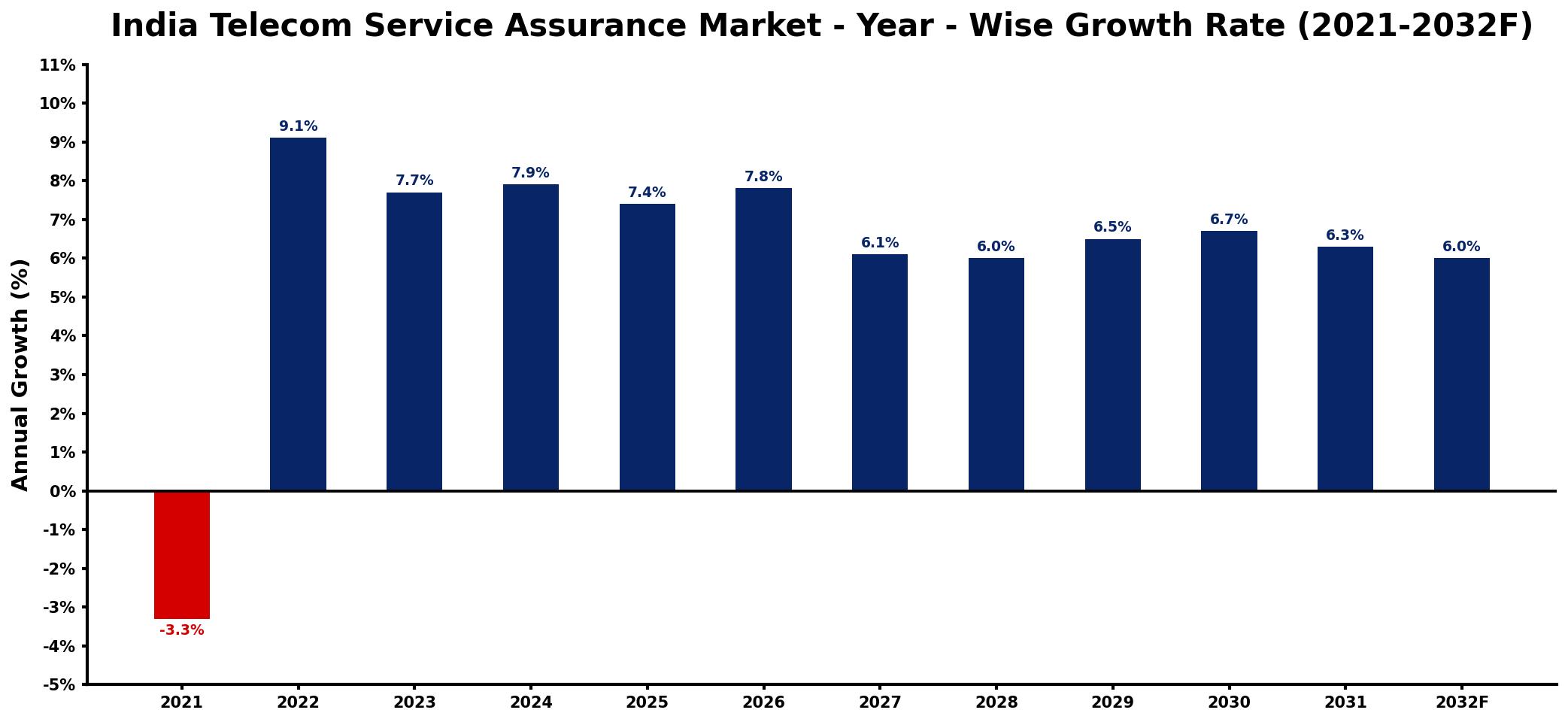
The table below presents the year‑wise growth rates along with the key drivers influencing the market
| Year | Growth Rate | Major Drivers |
| 2021 | -3.3% | decrease in consumer spending trends |
| 2022 | 9.1% | increased mobile data consumption rates |
| 2023 | 7.7% | growth in digital transformation initiatives |
| 2024 | 7.9% | expansion of 5G network infrastructure |
| 2025 | 7.4% | rise in IoT device adoption |
| 2026 | 7.8% | increased investments in cybersecurity |
| 2027 | 6.1% | increased domestic production output |
| 2028 | 6.0% | surge in remote working applications |
| 2029 | 6.5% | enhanced customer experience expectations |
| 2030 | 6.7% | stronger distribution network expansion |
| 2031 | 6.3% | increased demand for edge computing |
| 2032 | 6.0% | growing automotive sector requirements |
Note: Market size estimations and growth projections presented in this report are based on 6Wresearch's proprietary forecasting methodology, utilizing the latest available industry data, government publications, and primary research inputs.
India Telecom Service Assurance Market Synopsis
Recent momentum in the India Telecom Service Assurance Market reflects a sector adapting rapidly to technological advancements. The convergence of new technologies has led to heightened investments in service assurance solutions, with operators striving to meet growing demands for seamless connectivity.
Looking ahead, the market is poised for significant transformation. As service offerings expand and regulatory frameworks evolve, telecom operators will increasingly leverage advanced analytics and AI-driven tools to proactively manage network performance and enhance overall service reliability.
India Telecom Service Assurance Market Key Takeaways
- The market is experiencing robust growth due to technological advancements and increasing consumer demands.
- Telecom operators are focusing on proactive network management and monitoring to enhance service quality.
- 5G deployment and IoT expansion are driving the need for sophisticated service assurance solutions.
- Regulatory compliance is pushing operators to invest in advanced service assurance technologies.
- Investments in artificial intelligence and analytics are becoming integral for operators aiming for competitive advantage.
Evaluation of Restraints in India Telecom Service Assurance Market
Despite the significant growth potential, the India Telecom Service Assurance Market faces several restraints. Chief among these is the challenge of real-time network monitoring, which becomes increasingly difficult as networks become more intricate with advancements like 5G. The scalability of service assurance solutions is also a concern; operators must adapt their systems to accommodate an ever-growing subscriber base and a variety of connected devices. Additionally, as customers demand high-speed, low-latency services, ensuring consistent quality across diverse network conditions presents a complex challenge. Lastly, regulatory compliance adds another layer of complexity, as operators must navigate a landscape filled with evolving standards while maintaining stringent security protocols.
India Telecom Service Assurance Market Trends
Several trends are shaping the India Telecom Service Assurance Market. The increasing integration of artificial intelligence and machine learning is enabling telecom operators to enhance their monitoring and troubleshooting capabilities significantly. Moreover, the emphasis on real-time analytics is transforming how operators perceive and react to network performance issues. Another notable trend is the heightened focus on end-to-end service quality, driven by customer expectations for uninterrupted service and rapid response times.
India Telecom Service Assurance Market Opportunities
Opportunities in the India Telecom Service Assurance Market abound, particularly as operators look to enhance their service offerings amid intensifying competition. The push towards smart cities and connected infrastructure will likely stimulate demand for sophisticated service assurance tools. Additionally, partnerships with technology providers focusing on innovative service assurance solutions present a significant avenue for growth. Investments in next-gen technologies can also help telecom companies differentiate themselves in a crowded market.
Government Initiatives in the India Telecom Service Assurance Market
The Indian government has undertaken various initiatives to bolster the telecommunications sector, enhancing the framework for service assurance. Policies promoting digitalization and smart city development are particularly significant, as they encourage telecom operators to invest in advanced technologies. Furthermore, government programs aimed at improving broadband connectivity aim to strengthen the overall telecommunications infrastructure, creating a more favorable environment for service assurance solutions.
Future Insights of the India Telecom Service Assurance Market
As we project forward to 2026-2032, the India Telecom Service Assurance Market is set to witness substantial evolution. The continuous deployment of 5G technology and a growing IoT ecosystem will necessitate enhanced service assurance measures, prompting telecom operators to invest aggressively in cutting-edge solutions. Furthermore, the demand for ultra-reliable low-latency connectivity will create a significant impetus for innovation, paving the way for the development of new tools and strategies aimed at ensuring network resilience and superior customer experiences.
India Telecom Service Assurance Market Latest Developments (2025 - 2026)
In the recent months, the industry has seen heightened activity as telecom operators ramp up investments in service assurance solutions to keep pace with evolving consumer demands. There have been several strategic collaborations aimed at integrating AI and machine learning into network performance management tools. Additionally, the regulatory landscape is evolving, prompting operators to align their service quality initiatives with new compliance requirements to maintain market competitiveness.
India Telecom Service Assurance Market - Key Attractiveness of the Report
- 10 Years of Market Numbers
- Historical Data Starting from 2022 to 2025
- Base Year: 2025
- Forecast Data until 2032
- Key Performance Indicators Impacting the Market
- Major Upcoming Developments and Projects
The market is estimated at USD 684 Million in 2025, with projections to reach USD 980 Million by 2032, translating to a CAGR of 5.3% from 2026 to 2032.
Key Highlights of the Report:
- India Telecom Service Assurance Market Outlook
- Market Size of India Telecom Service Assurance Market, 2025
- Forecast of India Telecom Service Assurance Market, 2032
- Historical Data and Forecast of India Telecom Service Assurance Revenues & Volume for the Period 2022-2032F
- India Telecom Service Assurance Market Trend Evolution
- India Telecom Service Assurance Market Drivers and Challenges
- India Telecom Service Assurance Price Trends
- India Telecom Service Assurance Porter's Five Forces
- India Telecom Service Assurance Industry Life Cycle
- Historical Data and Forecast of India Telecom Service Assurance Market Revenues & Volume By Component for the Period 2022-2032F
- Historical Data and Forecast of India Telecom Service Assurance Market Revenues & Volume By Solutions (Fault and Event Management, Performance Management, and Quality and Service Management) for the Period 2022-2032F
- Historical Data and Forecast of India Telecom Service Assurance Market Revenues & Volume By Services (Professional, Managed) for the Period 2022-2032F
- Historical Data and Forecast of India Telecom Service Assurance Market Revenues & Volume By Operator Type for the Period 2022-2032F
- Historical Data and Forecast of India Telecom Service Assurance Market Revenues & Volume By Mobile Operator for the Period 2022-2032F
- Historical Data and Forecast of India Telecom Service Assurance Market Revenues & Volume By Fixed Operator for the Period 2022-2032F
- Historical Data and Forecast of India Telecom Service Assurance Market Revenues & Volume By Deployment Type for the Period 2022-2032F
- Historical Data and Forecast of India Telecom Service Assurance Market Revenues & Volume By On-Premises for the Period 2022-2032F
- Historical Data and Forecast of India Telecom Service Assurance Market Revenues & Volume By Cloud for the Period 2022-2032F
- Historical Data and Forecast of India Telecom Service Assurance Market Revenues & Volume By Organization Size for the Period 2022-2032F
- Historical Data and Forecast of India Telecom Service Assurance Market Revenues & Volume By Small and Medium Enterprises for the Period 2022-2032F
- Historical Data and Forecast of India Telecom Service Assurance Market Revenues & Volume By Large Enterprises for the Period 2022-2032F
- India Telecom Service Assurance Import Export Trade Statistics
- Market Opportunity Assessment By Component
- Market Opportunity Assessment By Operator Type
- Market Opportunity Assessment By Deployment Type
- Market Opportunity Assessment By Organization Size
- India Telecom Service Assurance Top Companies Market Share
- India Telecom Service Assurance Competitive Benchmarking By Technical and Operational Parameters
- India Telecom Service Assurance Company Profiles
- India Telecom Service Assurance Key Strategic Recommendations






































