India Time and Attendance Software Market Size, Share & Growth Rate
The India Time and Attendance Software Market was estimated at USD 484 Million in 2025 and is projected to reach USD 693 Million by 2032, growing at a CAGR of 5.3% from 2026 to 2032. This growth trajectory is primarily driven by organizations seeking efficient solutions for tracking employee attendance, scheduling, and leave management. The rising preference for cloud-based solutions is enhancing operational flexibility, allowing businesses to streamline processes and make informed decisions.
India Time and Attendance Software Market Growth Rate Analysis (2021-2032)
The India Time and Attendance Software Market has shown significant recovery following a dip of -3.0% in 2021, largely attributed to the impacts of the COVID-19 pandemic on business operations. In 2022, it rebounded impressively with a growth of 9.4%, driven by increasing digitalization and the need for efficient workforce management solutions. This upward trend is expected to continue, with projected growth rates of 7.4% in 2023 and 7.3% annually through 2025, as organizations increasingly adopt integrated systems for better operational efficiency. Factors such as enhanced consumer demand, technological advancements, and supportive policy frameworks are fostering a conducive environment for sustained growth. As businesses increasingly prioritize employee management strategies, the market is set to thrive amid evolving labor dynamics.
India Time and Attendance Software Market Year-wise Growth Rate and Key Drivers
This graph highlights how the India Time and Attendance Software Market has steadily grown over the past five years, supported by major growth factors.
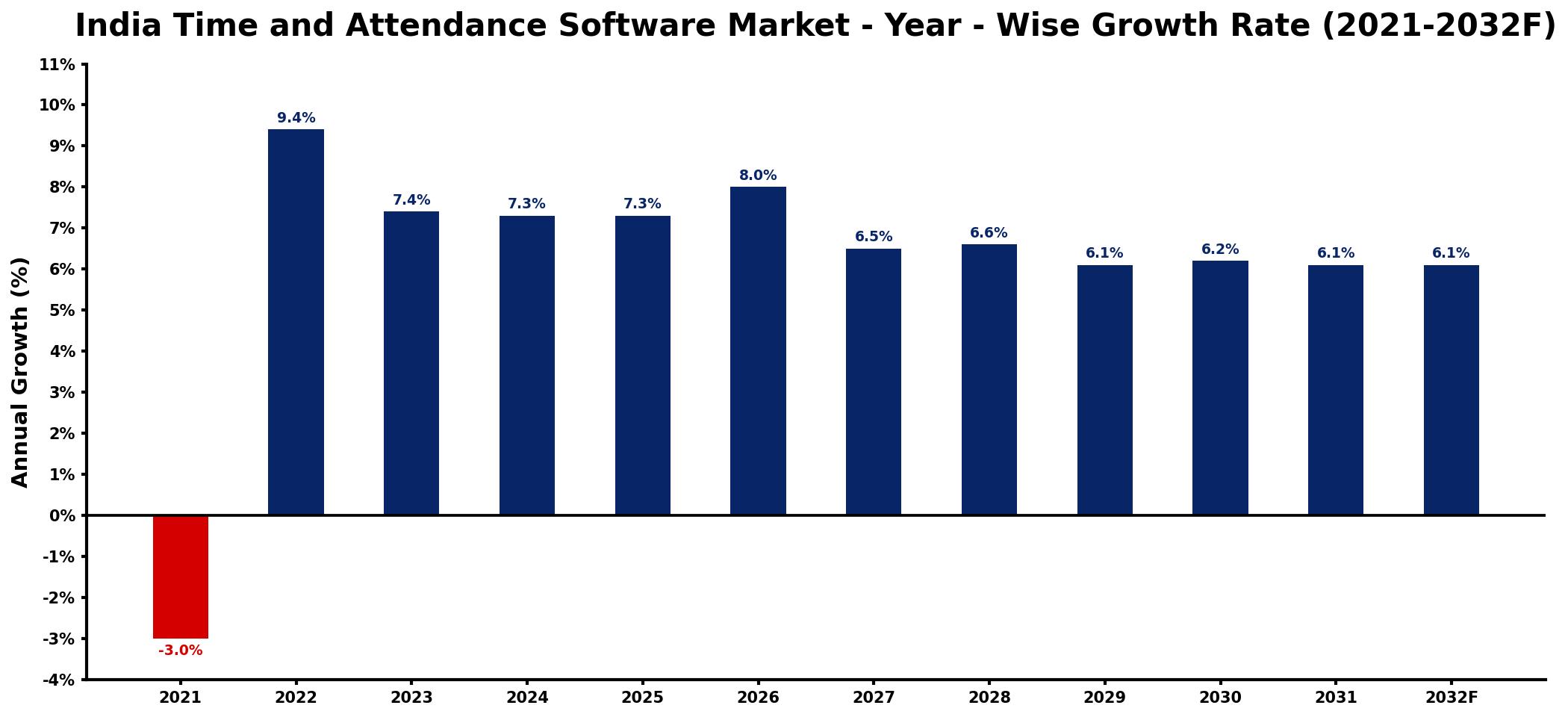
The table below presents the year‑wise growth rates along with the key drivers influencing the market
| Year | Growth Rate | Major Drivers |
| 2021 | -3.0% | Shift towards remote working models |
| 2022 | 9.4% | Rising demand for automation solutions |
| 2023 | 7.4% | Increased focus on labor compliance |
| 2024 | 7.3% | Growing adoption of cloud technologies |
| 2025 | 7.3% | Expansion of workforce management systems |
| 2026 | 8.0% | Investment in digital transformation initiatives |
| 2027 | 6.5% | Emergence of AI-powered analytics |
| 2028 | 6.6% | Focus on employee engagement strategies |
| 2029 | 6.1% | Integration with mobile applications |
| 2030 | 6.2% | strengthening international trade flows |
| 2031 | 6.1% | Enhancements in user experience design |
| 2032 | 6.1% | Adoption of predictive workforce planning |
Note: Market size estimations and growth projections presented in this report are based on 6Wresearch's proprietary forecasting methodology, utilizing the latest available industry data, government publications, and primary research inputs.
India Time and Attendance Software Market Synopsis
In recent years, the India Time and Attendance Software Market has gained significant momentum as organizations increasingly recognize the importance of accurate employee data tracking. However, this burgeoning market faces challenges ahead, particularly concerning the adoption rates among small and medium enterprises. As awareness grows, these businesses are beginning to seek effective solutions to enhance their operational efficiency.
Looking forward, the market is positioned for substantial growth fueled by technological advancements and a rising demand for integrated workforce management solutions. The introduction of user-friendly interfaces and enhanced functionalities is set to drive further adoption, ensuring organizations can fully leverage their human resources.
India Time and Attendance Software Market Key Takeaways
- Growing demand for accurate data tracking is driving the market forward.
- Cloud-based solutions are becoming increasingly popular among businesses of all sizes.
- High implementation costs remain a barrier, particularly for smaller enterprises.
- Focus on employee training is vital for the effective utilization of these software systems.
- Organizations are seeking cost-effective options to optimize their T&A expenditures.
Evaluation of Restraints in India Time and Attendance Software Market
Despite its growth potential, the India Time and Attendance Software Market is hindered by several restraints. High implementation costs pose a significant challenge, particularly for small and medium businesses that may struggle to invest in sophisticated solutions. Furthermore, a lack of awareness about the benefits of such systems prevents many organizations from upgrading their processes. This knowledge gap is critical; addressing it will be essential for broader adoption across various sectors.
India Time and Attendance Software Market Trends
Current trends indicate a growing shift towards automation and integration in time and attendance systems. Organizations are increasingly seeking software that not only tracks attendance but also integrates seamlessly with payroll and HR systems. Additionally, mobile accessibility is becoming a key feature, allowing employees to manage their attendance and leave requests on-the-go, thus enhancing user engagement.
India Time and Attendance Software Market Opportunities
As the demand for efficient time and attendance solutions grows, significant opportunities lie in developing cost-effective software tailored for small and medium-sized enterprises. Furthermore, enhanced analytics capabilities within these platforms can provide organizations with deeper insights into workforce productivity, enabling data-driven decision-making. The rise of remote and hybrid work models also presents a unique opportunity for solutions that cater specifically to tracking attendance in diverse work environments.
Government Initiatives in the India Time and Attendance Software Market
The Indian government has been proactive in promoting digital solutions across various sectors, which bodes well for the Time and Attendance Software Market. Initiatives aimed at enhancing digital infrastructure and encouraging tech adoption in businesses are paving the way for increased investment in such software solutions. By supporting workforce management technology, these initiatives are likely to bolster market growth and facilitate smoother integration of advanced systems in organizations.
Future Insights of the India Time and Attendance Software Market
Looking ahead to the period from 2026 to 2032, the India Time and Attendance Software Market is poised for robust growth. As more organizations embrace digital transformation, the reliance on efficient time and attendance systems will only intensify. Innovations in AI and machine learning will likely enhance the capabilities of these solutions, driving accuracy and operational efficiency. Furthermore, the ongoing demand for flexible work arrangements will necessitate the adoption of sophisticated attendance tracking systems that accommodate various work patterns.
India Time and Attendance Software Market Latest Developments (2025 - 2026)
The industry is witnessing a wave of developments focused on improving user experience and increasing system integration capabilities. Companies are introducing innovative features that leverage real-time data analytics to provide actionable insights into workforce management. Moreover, efforts to enhance mobile functionalities are being prioritized, aligning with the growing trend of remote work and the need for flexible attendance management.
India Time and Attendance Software Market - Key Attractiveness of the Report
- 10 Years of Market Numbers
- Historical Data Starting from 2022 to 2025
- Base Year: 2025
- Forecast Data until 2032
- Key Performance Indicators Impacting the Market
- Major Upcoming Developments and Projects
Key Highlights of the Report:
- India Time and Attendance Software Market Outlook
- Market Size of India Time and Attendance Software Market, 2025
- Forecast of India Time and Attendance Software Market, 2032
- Historical Data and Forecast of India Time and Attendance Software Revenues & Volume for the Period 2022-2032F
- India Time and Attendance Software Market Trend Evolution
- India Time and Attendance Software Market Drivers and Challenges
- India Time and Attendance Software Price Trends
- India Time and Attendance Software Porter's Five Forces
- India Time and Attendance Software Industry Life Cycle
- Historical Data and Forecast of India Time and Attendance Software Market Revenues & Volume By Component for the Period 2022-2032F
- Historical Data and Forecast of India Time and Attendance Software Market Revenues & Volume By Software for the Period 2022-2032F
- Historical Data and Forecast of India Time and Attendance Software Market Revenues & Volume By Services for the Period 2022-2032F
- Historical Data and Forecast of India Time and Attendance Software Market Revenues & Volume By Deployment Mode for the Period 2022-2032F
- Historical Data and Forecast of India Time and Attendance Software Market Revenues & Volume By On-premise for the Period 2022-2032F
- Historical Data and Forecast of India Time and Attendance Software Market Revenues & Volume By Cloud for the Period 2022-2032F
- Historical Data and Forecast of India Time and Attendance Software Market Revenues & Volume By Hybrid for the Period 2022-2032F
- Historical Data and Forecast of India Time and Attendance Software Market Revenues & Volume By Organization Size for the Period 2022-2032F
- Historical Data and Forecast of India Time and Attendance Software Market Revenues & Volume By Large Enterprises for the Period 2022-2032F
- Historical Data and Forecast of India Time and Attendance Software Market Revenues & Volume By SMES for the Period 2022-2032F
- Historical Data and Forecast of India Time and Attendance Software Market Revenues & Volume By Industry Vertical for the Period 2022-2032F
- Historical Data and Forecast of India Time and Attendance Software Market Revenues & Volume By BFSI for the Period 2022-2032F
- Historical Data and Forecast of India Time and Attendance Software Market Revenues & Volume By Manufacturing for the Period 2022-2032F
- Historical Data and Forecast of India Time and Attendance Software Market Revenues & Volume By Healthcare for the Period 2022-2032F
- Historical Data and Forecast of India Time and Attendance Software Market Revenues & Volume By Government for the Period 2022-2032F
- Historical Data and Forecast of India Time and Attendance Software Market Revenues & Volume By Retail & E-commerce for the Period 2022-2032F
- Historical Data and Forecast of India Time and Attendance Software Market Revenues & Volume By IT & Telecom for the Period 2022-2032F
- Historical Data and Forecast of India Time and Attendance Software Market Revenues & Volume By Education for the Period 2022-2032F
- Historical Data and Forecast of India Time and Attendance Software Market Revenues & Volume By Others for the Period 2022-2032F
- India Time and Attendance Software Import Export Trade Statistics
- Market Opportunity Assessment By Component
- Market Opportunity Assessment By Deployment Mode
- Market Opportunity Assessment By Organization Size
- Market Opportunity Assessment By Industry Vertical
- India Time and Attendance Software Top Companies Market Share
- India Time and Attendance Software Competitive Benchmarking By Technical and Operational Parameters
- India Time and Attendance Software Company Profiles
- India Time and Attendance Software Key Strategic Recommendations






































