India Transaction Monitoring Market Size & Growth Rate (2026-2032)
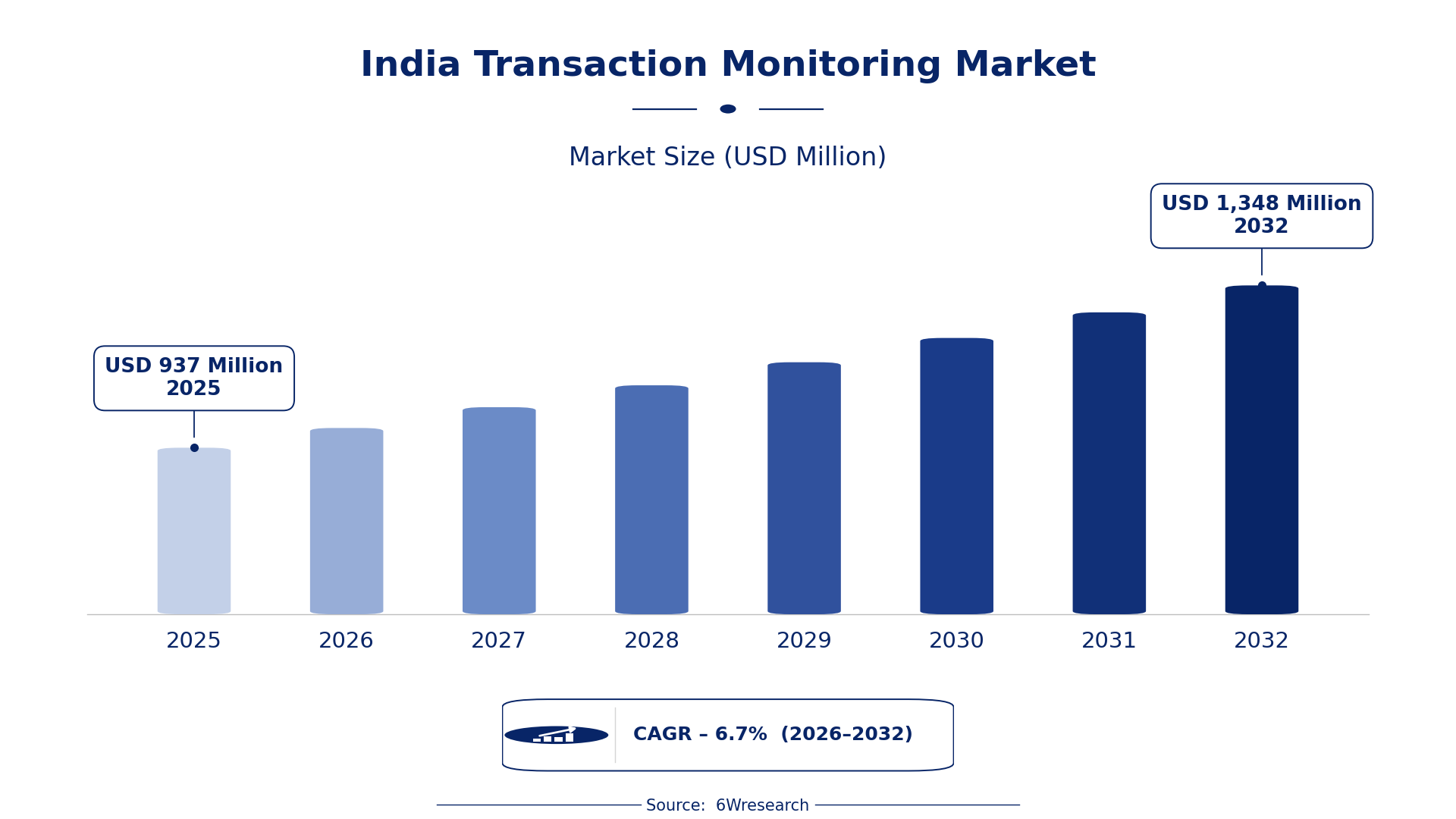
The India Transaction Monitoring Market was estimated at USD 937 Million in 2025 and is projected to reach USD 1348 Million by 2032, growing at a CAGR of 6.7% from 2026 to 2032.
India Transaction Monitoring Market Synopsis
The India Transaction Monitoring Market has recently gained momentum as businesses heighten their focus on detecting fraudulent activities in the face of escalating digital transactions. While the demand for sophisticated monitoring solutions is surging, the market is on an upward trajectory, driven by evolving compliance requirements and technological advancements.
As financial crime becomes increasingly sophisticated, organizations must adapt their strategies. The integration of advanced analytics, artificial intelligence, and machine learning into transaction monitoring systems not only enhances detection capabilities but also addresses the compliance pressures that businesses face today.
India Transaction Monitoring Market Year-wise Growth Rate and Key Drivers
This graph illustrates the annual growth rates of the India Transaction Monitoring Market from 2021 to 2032, highlighting a steady upward trajectory and projected expansion over the forecast period.
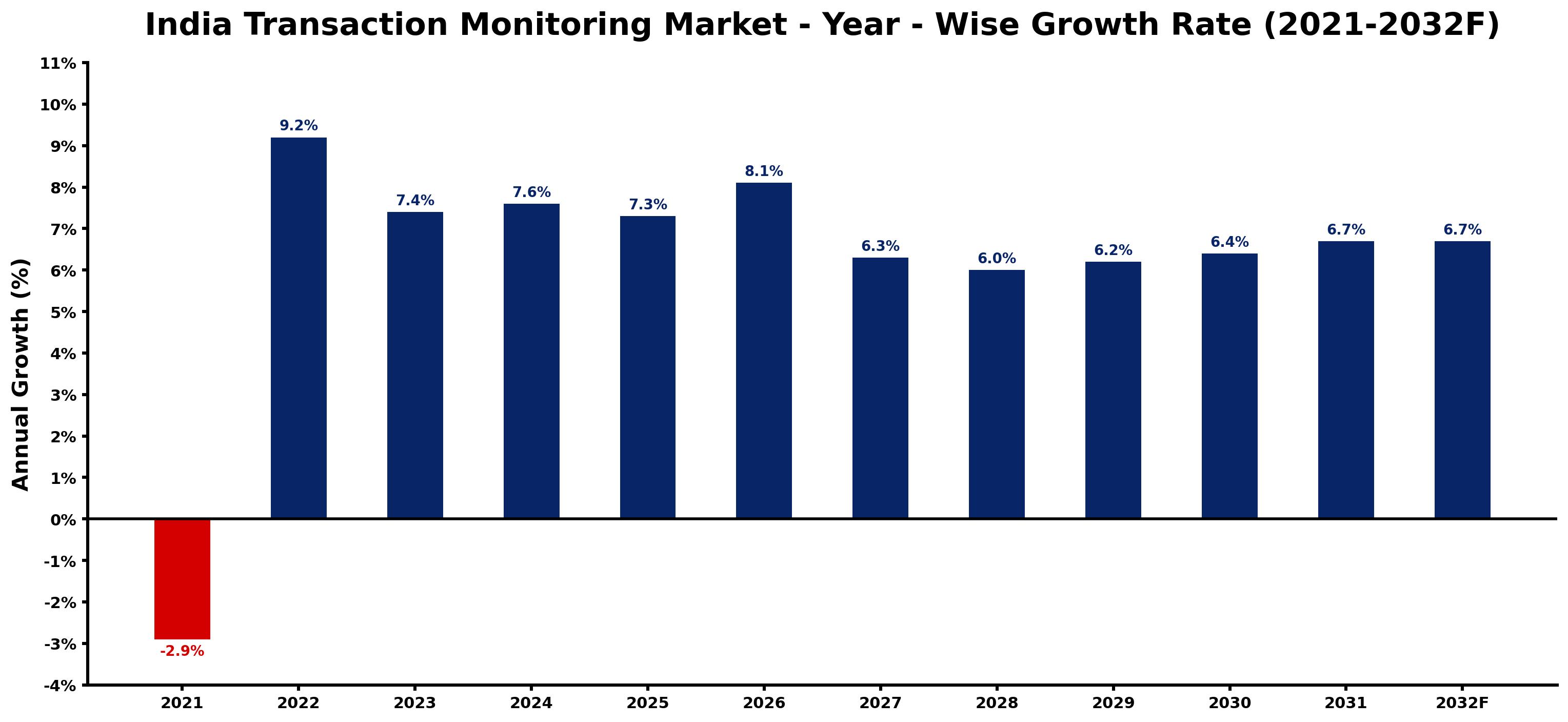
The table below presents the year‑wise growth rates along with the key drivers influencing the market
| Year | Growth Rate | Major Drivers |
| 2021 | -2.9% | RBI regulations delaying transaction monitoring technology adoption. |
| 2022 | 9.2% | RBI's fintech regulations enhance transaction transparency requirements. |
| 2023 | 7.4% | Growth in digital wallets spurs identity verification needs. |
| 2024 | 7.6% | Increase in online fraud cases drives monitoring demand. |
| 2025 | 7.3% | Government KYC policies boost transaction scrutiny mandates. |
| 2026 | 8.1% | Rising investments in anti-money laundering technologies accelerate growth. |
| 2027 | 6.3% | Local banks adopt advanced monitoring tools for compliance. |
| 2028 | 6.0% | Emerging fintech startups increase demand for monitoring solutions. |
| 2029 | 6.2% | Regulatory push for real-time transaction analysis improves safety. |
| 2030 | 6.4% | Adoption of blockchain enhances oversight capabilities in finance. |
| 2031 | 6.7% | Digital transformation in banking necessitates enhanced monitoring. |
| 2032 | 6.7% | Increased cyber threats lead to stricter monitoring frameworks. |
Note: Market size estimations and growth projections presented in this report are based on 6Wresearch's proprietary forecasting methodology, utilizing the latest available industry data, government publications, and primary research inputs.
India Transaction Monitoring Market Key Takeaways
Below are some of the specific key takeaways from the market, including:
- The demand for transaction monitoring solutions is strongly driven by the need to combat financial crime.
- Increased digitization of transactions is amplifying the focus on real-time monitoring systems.
- Compliance requirements from regulatory bodies are shaping technology adoption in the sector.
- Challenges in minimizing false positives remain a critical area for technological advancement.
- Emerging technologies like AI and machine learning are pivotal in enhancing monitoring accuracy.
Evaluation of Restraints in India Transaction Monitoring Market
While the market is thriving, several restraints hinder its full potential. The need for real-time analysis of high transaction volumes poses a significant challenge. Companies are tasked with detecting fraudulent patterns while keeping false positives at a minimum. As financial systems grow more intricate, ensuring the effectiveness of monitoring solutions without overwhelming staff resources complicates matters further. Additionally, the integration of new technologies must be handled carefully to avoid operational disruptions.
India Transaction Monitoring Market Trends
Several trends are shaping the future of the India Transaction Monitoring Market. An increasing reliance on automation is evident, as organizations strive to streamline processes and enhance efficiency. The use of machine learning algorithms is becoming standard in detecting anomalies, thereby reducing the time and effort required for manual reviews. on top of that, the emphasis on regulatory compliance is prompting institutions to invest in comprehensive solutions that provide detailed reporting and analytics.
In tandem, there is a rising focus on consumer protection, which is driving firms to adopt more transparent monitoring practices. This shift not only addresses regulatory demands but also bolsters client trust in financial systems.
India Transaction Monitoring Market Opportunities
Opportunities for growth in this market are abundant, particularly for firms willing to innovate. The increasing demand for customized solutions tailored to specific industries presents a lucrative avenue for vendors. on top of that, as the financial sector continues to expand in India, especially in the fintech realm, there are vast prospects for enhancing transaction monitoring capabilities. Companies that harness emerging technologies to deliver tailored solutions can expect substantial market share gains.
Government Initiatives in the India Transaction Monitoring Market
The Indian government's approach to transaction monitoring is significantly shaping the market. Regulatory agencies are increasingly prioritizing enhanced security measures in financial transactions, thereby fostering an environment conducive to technological adoption. This focus is crucial for protecting against financial crime while simultaneously promoting growth in digital finance.
- A national initiative launched in 2025 aimed at enhancing the cybersecurity framework for financial institutions.
- Currently ongoing is a multi-agency collaboration to streamline compliance processes across various sectors.
- A planned regulatory framework expected to be introduced by 2026 is set to mandate advanced transaction monitoring systems for all financial entities.
- Recent improvements in data sharing protocols between banks and regulatory bodies enhance the monitoring capabilities of institutions.
Future Insights of the India Transaction Monitoring Market
Looking ahead to 2026-2032, the India Transaction Monitoring Market is likely to undergo profound changes driven by technological innovations and heightened regulatory requirements. The trend toward automation and advanced analytics will continue, with businesses seeking more sophisticated tools to address complex financial landscapes. In parallel, regulatory frameworks will become stricter, driving further demand for comprehensive monitoring solutions.
As organizations prioritize risk management and compliance, the emphasis on real-time data processing will likely increase, signaling a future where transaction monitoring becomes an integral component of broader financial strategies.
India Transaction Monitoring Market Latest Developments
In recent months, activity in the India Transaction Monitoring Market has intensified, with various advancements marking the landscape. As institutions adapt to the rapidly changing regulatory environment, many have begun to enhance their monitoring solutions with advanced technologies. This strategic shift reflects a broader trend of integrating artificial intelligence into transaction monitoring systems to improve accuracy and efficiency.
- A leading technology vendor launched a new AI-driven monitoring solution in Q1 2025, aimed at enhancing fraud detection capabilities.
- Several financial institutions are currently ongoing upgrades to their transaction monitoring systems, implementing machine learning algorithms to reduce false positives.
- By mid-2026, a prominent banking group plans to complete a comprehensive review of its compliance protocols, focusing on transaction monitoring improvements.
- In 2025, a major collaborative project between fintech firms and government agencies began, aimed at developing a standardized compliance framework.
India Transaction Monitoring Market - Key Attractiveness of the Report
- 10 Years of Market Numbers
- Historical Data Starting from 2022 to 2025
- Base Year: 2025
- Forecast Data until 2032
- Key Performance Indicators Impacting the Market
- Major Upcoming Developments and Projects
Key Highlights of the Report:
- India Transaction Monitoring Market Outlook
- Market Size of India Transaction Monitoring Market, 2025
- Forecast of India Transaction Monitoring Market, 2032
- Historical Data and Forecast of India Transaction Monitoring Revenues & Volume for the Period 2022-2032F
- India Transaction Monitoring Market Trend Evolution
- India Transaction Monitoring Market Drivers and Challenges
- India Transaction Monitoring Price Trends
- India Transaction Monitoring Porter's Five Forces
- India Transaction Monitoring Industry Life Cycle
- Historical Data and Forecast of India Transaction Monitoring Market Revenues & Volume By Application Area for the Period 2022-2032F
- Historical Data and Forecast of India Transaction Monitoring Market Revenues & Volume By AML for the Period 2022-2032F
- Historical Data and Forecast of India Transaction Monitoring Market Revenues & Volume By FDP for the Period 2022-2032F
- Historical Data and Forecast of India Transaction Monitoring Market Revenues & Volume By Compliance Management for the Period 2022-2032F
- Historical Data and Forecast of India Transaction Monitoring Market Revenues & Volume By Customer Identity Management for the Period 2022-2032F
- Historical Data and Forecast of India Transaction Monitoring Market Revenues & Volume By Component for the Period 2022-2032F
- Historical Data and Forecast of India Transaction Monitoring Market Revenues & Volume By Solution for the Period 2022-2032F
- Historical Data and Forecast of India Transaction Monitoring Market Revenues & Volume By Services for the Period 2022-2032F
- Historical Data and Forecast of India Transaction Monitoring Market Revenues & Volume By Function for the Period 2022-2032F
- Historical Data and Forecast of India Transaction Monitoring Market Revenues & Volume By Case Management for the Period 2022-2032F
- Historical Data and Forecast of India Transaction Monitoring Market Revenues & Volume By KYC/Customer Onboarding for the Period 2022-2032F
- Historical Data and Forecast of India Transaction Monitoring Market Revenues & Volume By Dashboard and Reporting for the Period 2022-2032F
- Historical Data and Forecast of India Transaction Monitoring Market Revenues & Volume By Watch List Screening for the Period 2022-2032F
- Historical Data and Forecast of India Transaction Monitoring Market Revenues & Volume By Deployment Mode for the Period 2022-2032F
- Historical Data and Forecast of India Transaction Monitoring Market Revenues & Volume By On-Premises for the Period 2022-2032F
- Historical Data and Forecast of India Transaction Monitoring Market Revenues & Volume By Cloud for the Period 2022-2032F
- Historical Data and Forecast of India Transaction Monitoring Market Revenues & Volume By Organization Size for the Period 2022-2032F
- Historical Data and Forecast of India Transaction Monitoring Market Revenues & Volume By SMEs for the Period 2022-2032F
- Historical Data and Forecast of India Transaction Monitoring Market Revenues & Volume By Large Enterprises for the Period 2022-2032F
- Historical Data and Forecast of India Transaction Monitoring Market Revenues & Volume By Vertical for the Period 2022-2032F
- Historical Data and Forecast of India Transaction Monitoring Market Revenues & Volume By Banking, Financial Services, and Insurance for the Period 2022-2032F
- Historical Data and Forecast of India Transaction Monitoring Market Revenues & Volume By Government and Defense for the Period 2022-2032F
- Historical Data and Forecast of India Transaction Monitoring Market Revenues & Volume By IT and Telecom for the Period 2022-2032F
- Historical Data and Forecast of India Transaction Monitoring Market Revenues & Volume By Retail for the Period 2022-2032F
- Historical Data and Forecast of India Transaction Monitoring Market Revenues & Volume By Healthcare for the Period 2022-2032F
- Historical Data and Forecast of India Transaction Monitoring Market Revenues & Volume By Energy and Utilities for the Period 2022-2032F
- Historical Data and Forecast of India Transaction Monitoring Market Revenues & Volume By Manufacturing for the Period 2022-2032F
- Historical Data and Forecast of India Transaction Monitoring Market Revenues & Volume By Others for the Period 2022-2032F
- India Transaction Monitoring Import Export Trade Statistics
- Market Opportunity Assessment By Application Area
- Market Opportunity Assessment By Component
- Market Opportunity Assessment By Function
- Market Opportunity Assessment By Deployment Mode
- Market Opportunity Assessment By Organization Size
- Market Opportunity Assessment By Vertical
- India Transaction Monitoring Top Companies Market Share
- India Transaction Monitoring Competitive Benchmarking By Technical and Operational Parameters
- India Transaction Monitoring Company Profiles
- India Transaction Monitoring Key Strategic Recommendations






































