India Tung Oil Market Size, Share & Growth Rate
The India Tung Oil Market was estimated at USD 484 Million in 2025 and is projected to reach USD 691 Million by 2032, growing at a CAGR of 5.2% from 2026 to 2032. This robust growth is primarily driven by the burgeoning demand for wood finishes and coatings, fueled further by the expanding construction sector within the country. As urbanization accelerates, the need for high-quality wood products, particularly in furniture and flooring, is becoming increasingly evident, creating substantial opportunities for tung oil applications.
India Tung Oil Market Growth Rate Analysis (2021-2032)
The India Tung Oil market experienced a noteworthy rebound after facing a contraction of -3.6% in 2021, primarily due to supply chain disruptions and reduced consumer demand during the pandemic. A robust 9.1% growth in 2022 signified a strong recovery as industrial applications and a growing preference for sustainable products drove demand. This trend continued, with growth rates of 8.1% in 2023 and 7.8% projected for 2024, fueled by advancements in green chemistry and increasing investments in wood finishing industries. Despite a gradual deceleration to 6.2% by 2029, the consistent emphasis on infrastructure development and energy transition policies will likely sustain optimism in the sector.
India Tung Oil Market Year-wise Growth Rate and Key Drivers
This graph highlights how the India Tung Oil Market has steadily grown over the past five years, supported by major growth factors.
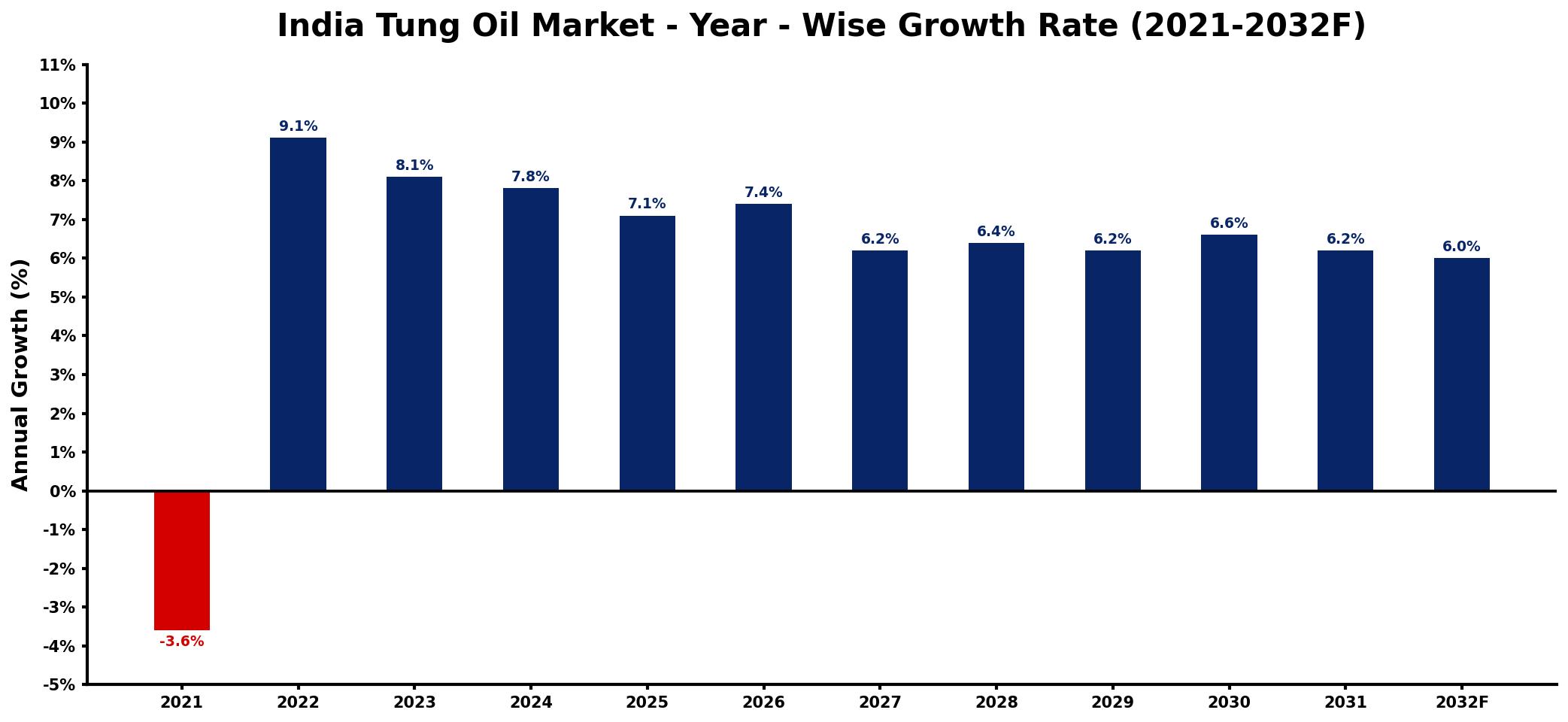
The table below presents the year‑wise growth rates along with the key drivers influencing the market
| Year | Growth Rate | Major Drivers |
| 2021 | -3.6% | decrease in raw material availability |
| 2022 | 9.1% | rise in eco-friendly product demand |
| 2023 | 8.1% | expansion of furniture manufacturing sector |
| 2024 | 7.8% | growth in construction activity levels |
| 2025 | 7.1% | increased consumer awareness initiatives |
| 2026 | 7.4% | surge in home improvement projects |
| 2027 | 6.2% | development of new application markets |
| 2028 | 6.4% | enhanced product distribution networks |
| 2029 | 6.2% | rising popularity of sustainable alternatives |
| 2030 | 6.6% | increase in export opportunities abroad |
| 2031 | 6.2% | growing investments in R&D |
| 2032 | 6.0% | expanding manufacturing base activity |
Note: Market size estimations and growth projections presented in this report are based on 6Wresearch's proprietary forecasting methodology, utilizing the latest available industry data, government publications, and primary research inputs.
India Tung Oil Market Synopsis
Currently, the strongest force shaping the India Tung Oil Market is the rising demand for sustainable wood treatment solutions. Consumers are becoming more conscious of the environmental impact of their choices, driving a shift toward natural oils like tung oil, which offer excellent performance without the harmful effects associated with synthetic alternatives.
Additionally, the construction industry's growth, spurred by government infrastructure initiatives and a booming real estate sector, is pushing the demand for superior wood finishes. As builders and artisans look for durable and aesthetically pleasing options, tung oil emerges as a preferred choice due to its versatility and eco-friendliness.
India Tung Oil Market Key Takeaways
- The market is witnessing significant growth, primarily driven by increased wood finish demand.
- Sustainable building practices and eco-conscious consumerism are shaping market trends.
- High raw material costs and supply chain inefficiencies pose challenges to growth.
- Quality control and standardization remain critical areas for market stakeholders.
- Investment opportunities abound in expanding production and improving storage infrastructure.
Evaluation of Restraints in India Tung Oil Market
Despite its promising growth trajectory, the India Tung Oil Market faces several constraints. The high costs associated with sourcing raw materials significantly impact profit margins, making it difficult for smaller players to enter the market. Additionally, the limited availability of quality tung oil poses a significant challenge, as inconsistent supply hampers manufacturers' ability to meet increasing demand. The lack of robust quality control measures and standardized production practices further complicates the landscape, creating uncertainties regarding product performance and safety.
India Tung Oil Market Trends
As sustainability continues to gain momentum, an emerging trend is the adoption of tung oil in environmentally friendly construction and furniture manufacturing. Innovations in processing technologies are also paving the way for more efficient production methods, enhancing oil quality while reducing costs. Moreover, a shift towards artisanal and handcrafted wooden products is driving demand for natural wood finishes, positioning tung oil as a prime candidate for both traditional and contemporary applications.
India Tung Oil Market Opportunities
The potential for growth within the India Tung Oil Market is vast, particularly for players willing to invest in modern production technologies and efficient supply chain solutions. Opportunities also exist in niche markets, such as the development of specialized finishes for luxury furniture and bespoke woodworking. Furthermore, as awareness of tung oil's benefits spreads, marketing strategies focused on its eco-friendliness can attract a broader consumer base.
Government Initiatives in the India Tung Oil Market
The Indian government is increasingly focusing on sustainable practices and has initiated several programs to promote eco-friendly products, including those derived from natural oils like tung oil. Public spending on infrastructure projects, particularly in housing and urban development, is expected to further boost demand for wood finishes and coatings. Additionally, incentives for green building practices and the promotion of local sourcing can create a favorable environment for the tung oil industry.
Future Insights of the India Tung Oil Market
Looking ahead to the period from 2026 to 2032, the India Tung Oil Market is poised for robust expansion. The confluence of increased urbanization, enhanced consumer awareness regarding sustainability, and a booming construction sector will act as catalysts for growth. The market's evolution will likely depend on the successful navigation of current challenges, including raw material sourcing and quality control, as well as the ability to adapt to changing consumer preferences.
India Tung Oil Market Latest Developments (2025 - 2026)
Recent developments indicate a positive shift in the India Tung Oil Market, with increased collaboration among stakeholders aimed at improving supply chain efficiencies. Additionally, research initiatives focused on enhancing the properties of tung oil and developing new applications in various sectors are underway. The ongoing emphasis on sustainability has led to more organizations exploring tung oil as a viable alternative to synthetic products, aligning market dynamics with environmental goals.
India Tung Oil Market - Key Attractiveness of the Report
- 10 Years of Market Numbers
- Historical Data Starting from 2022 to 2025
- Base Year: 2025
- Forecast Data until 2032
- Key Performance Indicators Impacting the Market
- Major Upcoming Developments and Projects
Key Highlights of the Report:
- India Tung Oil Market Outlook
- Market Size of India Tung Oil Market, 2025
- Forecast of India Tung Oil Market, 2032
- Historical Data and Forecast of India Tung Oil Revenues & Volume for the Period 2022-2032F
- India Tung Oil Market Trend Evolution
- India Tung Oil Market Drivers and Challenges
- India Tung Oil Price Trends
- India Tung Oil Porter's Five Forces
- India Tung Oil Industry Life Cycle
- Historical Data and Forecast of India Tung Oil Market Revenues & Volume By Product Type for the Period 2022-2032F
- Historical Data and Forecast of India Tung Oil Market Revenues & Volume By Raw Tung Oil for the Period 2022-2032F
- Historical Data and Forecast of India Tung Oil Market Revenues & Volume By Boiled Tung Oil for the Period 2022-2032F
- Historical Data and Forecast of India Tung Oil Market Revenues & Volume By Application for the Period 2022-2032F
- Historical Data and Forecast of India Tung Oil Market Revenues & Volume By Wood Finishing for the Period 2022-2032F
- Historical Data and Forecast of India Tung Oil Market Revenues & Volume By Food and Beverage for the Period 2022-2032F
- Historical Data and Forecast of India Tung Oil Market Revenues & Volume By Medicines for the Period 2022-2032F
- Historical Data and Forecast of India Tung Oil Market Revenues & Volume By Others for the Period 2022-2032F
- India Tung Oil Import Export Trade Statistics
- Market Opportunity Assessment By Product Type
- Market Opportunity Assessment By Application
- India Tung Oil Top Companies Market Share
- India Tung Oil Competitive Benchmarking By Technical and Operational Parameters
- India Tung Oil Company Profiles
- India Tung Oil Key Strategic Recommendations






































