India Vehicle Analytics Market Size & Growth Rate (2026-2032)
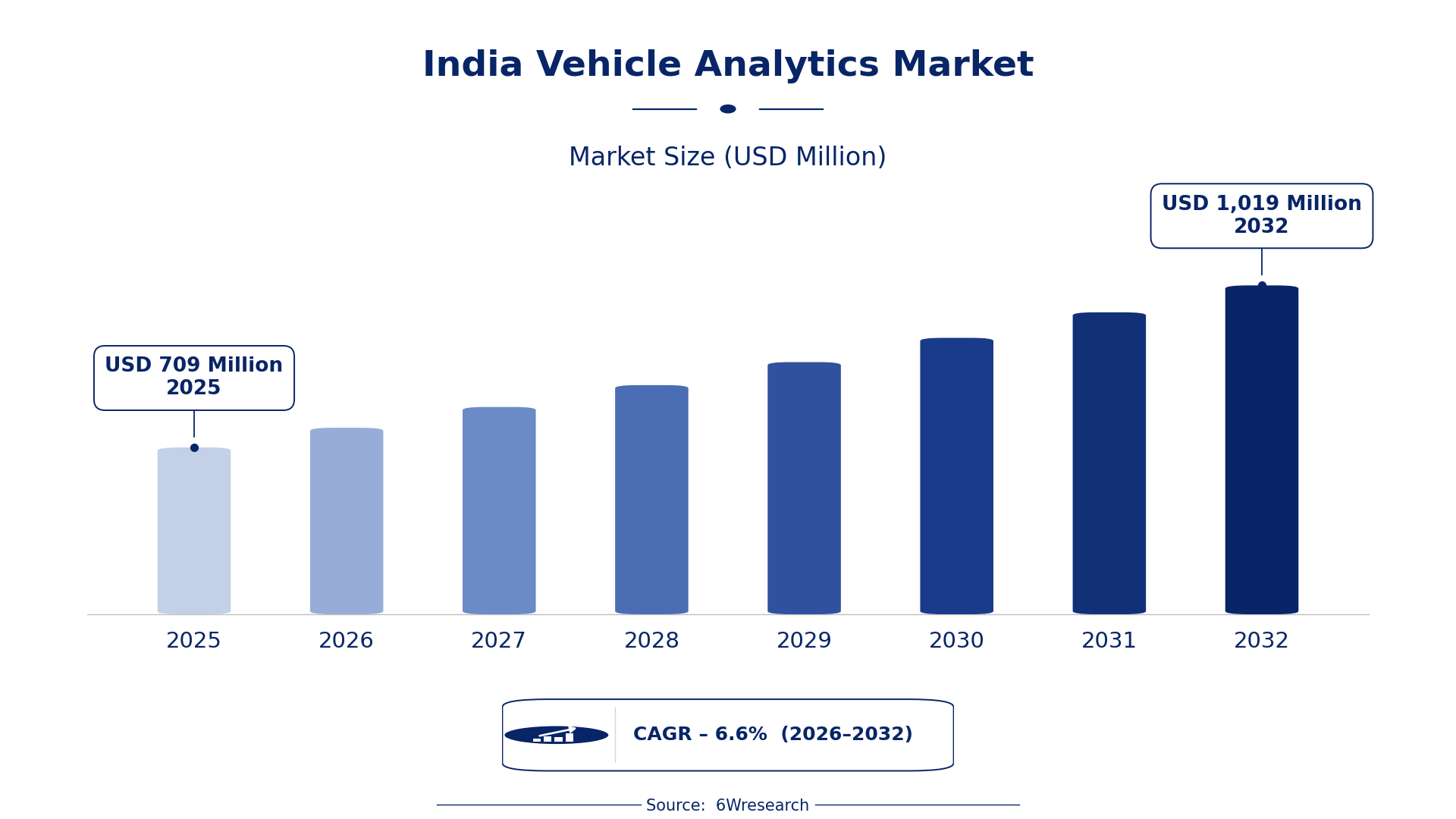
The India Vehicle Analytics Market was estimated at USD 709 Million in 2025 and is projected to reach USD 1019 Million by 2032, growing at a CAGR of 6.6% from 2026 to 2032.
India Vehicle Analytics Market Synopsis
The India Vehicle Analytics Market has shown remarkable momentum in recent years, fueled by the automotive sector's increasing reliance on data analytics. As connected vehicles proliferate, the ability to gather and interpret data is becoming essential for manufacturers and fleet operators alike.
Looking ahead, the market is expected to evolve further, driven by advancements in IoT and telematics technologies. This evolution will not only optimize vehicle performance but also enhance safety measures, making vehicle analytics indispensable for future transportation solutions.
India Vehicle Analytics Market Year-wise Growth Rate and Key Drivers
This graph illustrates the annual growth rates of the India Vehicle Analytics Market from 2021 to 2032, highlighting a steady upward trajectory and projected expansion over the forecast period.
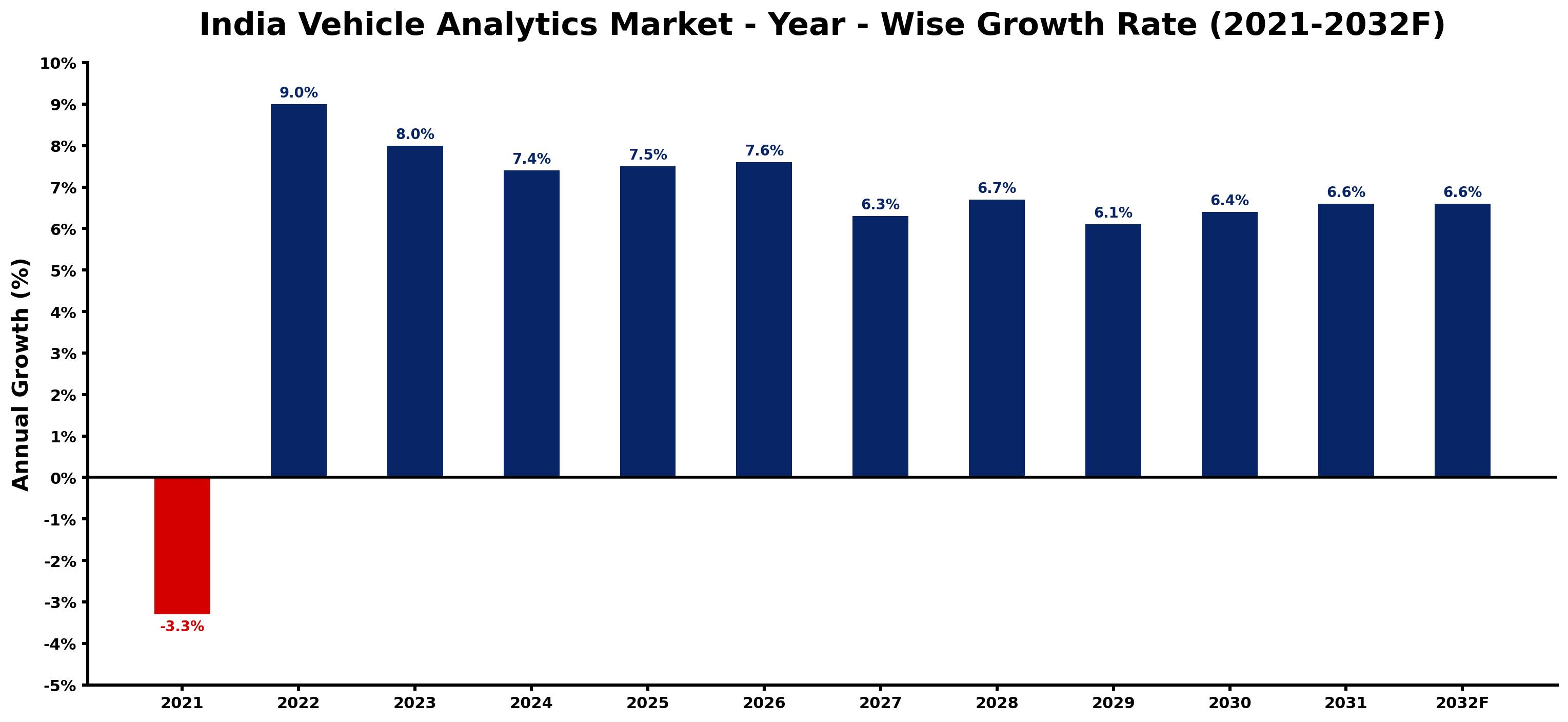
The table below presents the year‑wise growth rates along with the key drivers influencing the market
| Year | Growth Rate | Major Drivers |
| 2021 | -3.3% | Implementation of stricter vehicle emission standards by CPCB |
| 2022 | 9.0% | Government push for electric vehicle data monitoring |
| 2023 | 8.0% | Increased investment in connected vehicle technology initiatives |
| 2024 | 7.4% | Surge in automotive telematics adoption by consumers |
| 2025 | 7.5% | Implementation of stricter road safety regulatory standards |
| 2026 | 7.6% | Growth in smart city transport infrastructure projects |
| 2027 | 6.3% | Emergence of AI-driven predictive maintenance services |
| 2028 | 6.7% | Demand for advanced driver assistance systems increasing |
| 2029 | 6.1% | Rising popularity of subscription-based vehicle services |
| 2030 | 6.4% | Funding for digital infrastructure enhancing vehicle connectivity |
| 2031 | 6.6% | Integration of IoT in vehicle performance analytics |
| 2032 | 6.6% | Focus on sustainability driving vehicle data solutions |
Note: Market size estimations and growth projections presented in this report are based on 6Wresearch's proprietary forecasting methodology, utilizing the latest available industry data, government publications, and primary research inputs.
India Vehicle Analytics Market Key Takeaways
Below are some of the specific key takeaways from the market, including:
- The shift towards connected vehicles is a primary catalyst for market growth.
- Data-driven decision-making is becoming a standard practice across the automotive industry.
- Predictive maintenance and safety analytics are emerging as crucial applications.
- Government support for telematics initiatives is bolstering market expansion.
- Challenges in data security and ethical usage remain significant concerns for stakeholders.
Evaluation of Restraints in India Vehicle Analytics Market
Despite the promising outlook, the India Vehicle Analytics Market grapples with several constraints. Data collection from various vehicle models poses a formidable challenge, often leading to inconsistencies in analysis. on top of that, concerns regarding data security have raised alarms, compelling stakeholders to establish stricter protocols. Real-time data analysis is another hurdle; the complexity of interpreting vast data sets can delay decision-making. Finally, the ethical use of vehicle data remains a contentious issue, as companies strive to balance innovation with consumer privacy.
India Vehicle Analytics Market Trends
The market is witnessing several trends that are shaping its future. The integration of AI in vehicle analytics is paving the way for more sophisticated predictive models, enhancing accuracy in monitoring vehicle health. Additionally, there is a growing emphasis on sustainability; businesses are increasingly utilizing analytics to minimize their carbon footprint through efficient routing and fuel consumption tracking. The demand for real-time monitoring solutions is also on the rise, driven by the need for immediate insights into vehicle performance and safety.
India Vehicle Analytics Market Opportunities
Investors and businesses should look toward the expanding opportunities within the vehicle analytics sector. The ongoing shift towards electric and hybrid vehicles presents new avenues for analytics applications, particularly in battery performance and energy management. Collaborations between automotive manufacturers and tech firms are ripe for exploration, as they can foster innovative solutions tailored to specific market needs. on top of that, the increasing adoption of smart city initiatives will likely drive demand for integrated vehicle analytics systems, creating fertile ground for growth.
Government Initiatives in the India Vehicle Analytics Market
Government policies are significantly influencing the trajectory of the India Vehicle Analytics Market. With a focus on modernization and safety, the regulatory environment is becoming increasingly favorable for analytics adoption in the automotive sector. Public-sector initiatives aimed at improving transportation infrastructure and data standards are crucial in shaping market dynamics.
- A national digital infrastructure upgrade programme recently launched aims to enhance connectivity for vehicle data collection.
- Ongoing efforts include the establishment of data sharing standards among automotive stakeholders to streamline analytics capabilities.
- A planned public-private initiative expects to introduce advanced telematics solutions for public transport by 2026.
- The government is currently rolling out a framework to promote the ethical use of vehicle data, expected to be finalized by early 2026.
Future Insights of the India Vehicle Analytics Market
From 2026 to 2032, the India Vehicle Analytics Market is likely to experience robust advancements. The convergence of AI and IoT technologies will facilitate deeper insights into vehicle operations, leading to enhanced safety protocols and user experiences. As connected vehicles become ubiquitous, the demand for sophisticated analytics tools will surge, making them essential for competitive advantage. Additionally, regulatory support will drive innovation, encouraging companies to invest in advanced analytics capabilities.
India Vehicle Analytics Market Latest Developments
In the past year, the India Vehicle Analytics Market has seen significant activity, reflecting the industry's commitment to harnessing data for improved vehicle management. Companies are increasingly focusing on partnerships and technology upgrades to remain competitive and meet emerging demands.
- A major technology vendor launched an innovative vehicle health monitoring system in Q3 2025, enhancing predictive maintenance capabilities.
- An initiative that began in early 2025 to integrate AI in vehicle analytics is currently underway, promising to improve decision-making speed.
- By mid-2026, a rollout is expected for a nationwide telematics network aimed at streamlining data collection processes across all vehicle types.
- A partnership between a leading automotive manufacturer and a data analytics firm was established in late 2025 to develop advanced driver behavior analytics.
India Vehicle Analytics Market - Key Attractiveness of the Report
- 10 Years of Market Numbers
- Historical Data Starting from 2022 to 2025
- Base Year: 2025
- Forecast Data until 2032
- Key Performance Indicators Impacting the Market
- Major Upcoming Developments and Projects
Key Highlights of the Report:
- India Vehicle Analytics Market Outlook
- Market Size of India Vehicle Analytics Market, 2025
- Forecast of India Vehicle Analytics Market, 2032
- Historical Data and Forecast of India Vehicle Analytics Revenues & Volume for the Period 2022-2032F
- India Vehicle Analytics Market Trend Evolution
- India Vehicle Analytics Market Drivers and Challenges
- India Vehicle Analytics Price Trends
- India Vehicle Analytics Porter's Five Forces
- India Vehicle Analytics Industry Life Cycle
- Historical Data and Forecast of India Vehicle Analytics Market Revenues & Volume By Application for the Period 2022-2032F
- Historical Data and Forecast of India Vehicle Analytics Market Revenues & Volume By Predictive Maintenance for the Period 2022-2032F
- Historical Data and Forecast of India Vehicle Analytics Market Revenues & Volume By Warranty Analytics for the Period 2022-2032F
- Historical Data and Forecast of India Vehicle Analytics Market Revenues & Volume By Traffic Management for the Period 2022-2032F
- Historical Data and Forecast of India Vehicle Analytics Market Revenues & Volume By Safety and Security Management for the Period 2022-2032F
- Historical Data and Forecast of India Vehicle Analytics Market Revenues & Volume By Driver and User Behaviour Analysis for the Period 2022-2032F
- Historical Data and Forecast of India Vehicle Analytics Market Revenues & Volume By Dealer Performance Analysis for the Period 2022-2032F
- Historical Data and Forecast of India Vehicle Analytics Market Revenues & Volume By Infotainment for the Period 2022-2032F
- Historical Data and Forecast of India Predictive Maintenance Vehicle Analytics Market Revenues & Volume By Usage-Based Insurance for the Period 2022-2032F
- Historical Data and Forecast of India Vehicle Analytics Market Revenues & Volume By Component for the Period 2022-2032F
- Historical Data and Forecast of India Vehicle Analytics Market Revenues & Volume By Software for the Period 2022-2032F
- Historical Data and Forecast of India Vehicle Analytics Market Revenues & Volume By Services for the Period 2022-2032F
- Historical Data and Forecast of India Vehicle Analytics Market Revenues & Volume By End-User for the Period 2022-2032F
- Historical Data and Forecast of India Vehicle Analytics Market Revenues & Volume By Original Equipment Manufacturers (OEMs) for the Period 2022-2032F
- Historical Data and Forecast of India Vehicle Analytics Market Revenues & Volume By Service Providers for the Period 2022-2032F
- Historical Data and Forecast of India Vehicle Analytics Market Revenues & Volume By Automotive Dealers for the Period 2022-2032F
- Historical Data and Forecast of India Vehicle Analytics Market Revenues & Volume By Fleet Owners for the Period 2022-2032F
- Historical Data and Forecast of India Vehicle Analytics Market Revenues & Volume By Regulatory Bodies for the Period 2022-2032F
- Historical Data and Forecast of India Vehicle Analytics Market Revenues & Volume By Insurers for the Period 2022-2032F
- Historical Data and Forecast of India Vehicle Analytics Market Revenues & Volume By Deployment Mode for the Period 2022-2032F
- Historical Data and Forecast of India Vehicle Analytics Market Revenues & Volume By On-Premises for the Period 2022-2032F
- Historical Data and Forecast of India Vehicle Analytics Market Revenues & Volume By On-Demand for the Period 2022-2032F
- India Vehicle Analytics Import Export Trade Statistics
- Market Opportunity Assessment By Application
- Market Opportunity Assessment By Component
- Market Opportunity Assessment By End-User
- Market Opportunity Assessment By Deployment Mode
- India Vehicle Analytics Top Companies Market Share
- India Vehicle Analytics Competitive Benchmarking By Technical and Operational Parameters
- India Vehicle Analytics Company Profiles
- India Vehicle Analytics Key Strategic Recommendations






































