India Wall Lamps Market Summary
The india wall lamps market was estimated at USD 822 Million in 2025 and is projected to reach USD 1170 Million by 2032, growing at a CAGR of 7.5% from 2026 to 2032.
India Wall Lamps Market Year-wise Growth Rate and Key Drivers
This graph highlights how the India Wall Lamps Market has steadily grown over the past five years, supported by major growth factors.
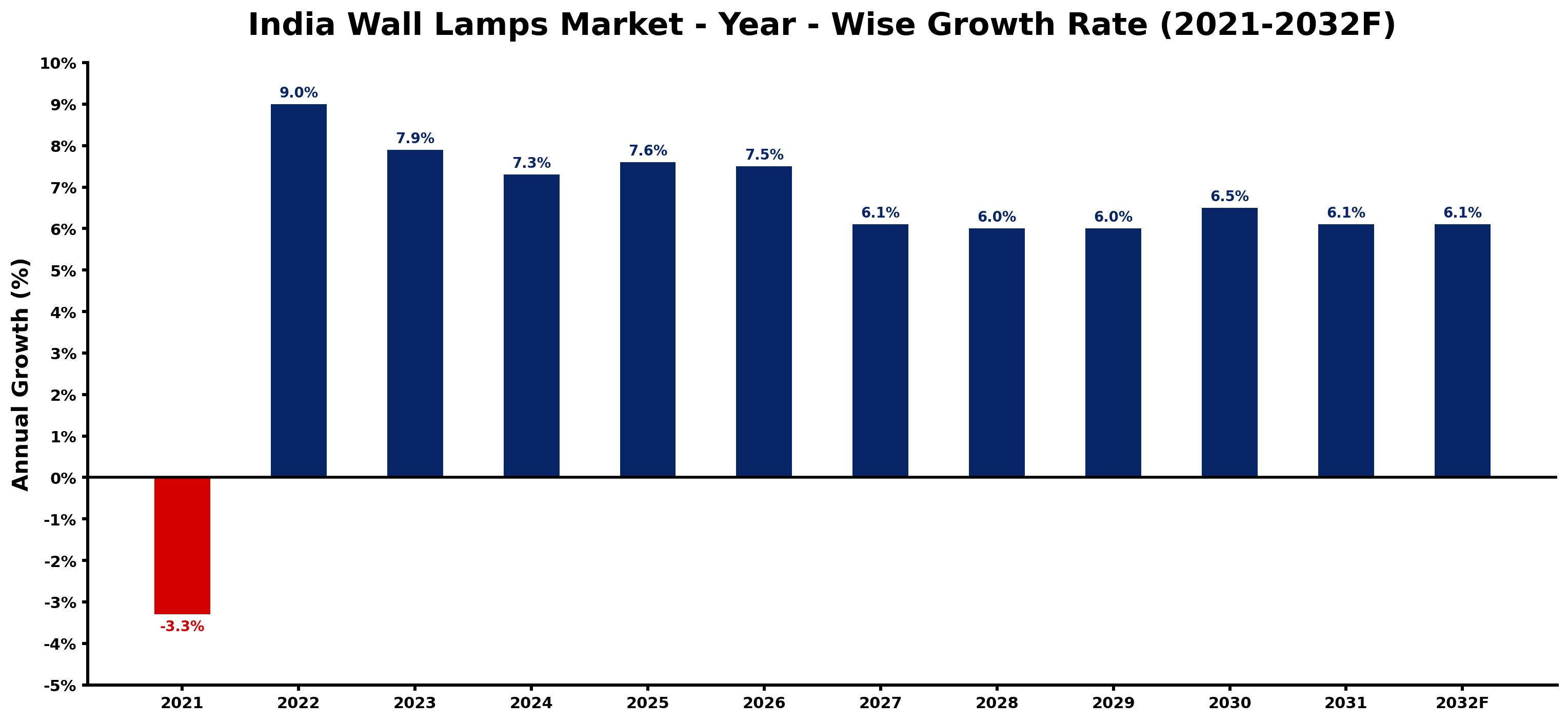
The table below presents the year wise growth rates along with the key drivers influencing the market
| Year | Growth Rate | Major Drivers |
| 2021 | -3.3% | Supply chain disruptions impeded access to essential components, leading to production delays and reduced availability. |
| 2022 | 9.0% | Urbanization trends in tier-2 cities stimulated demand for aesthetically pleasing wall lamps. |
| 2023 | 7.9% | A surge in online home décor shopping led to increased wall lamp sales. |
| 2024 | 7.3% | Integrating smart technology in lamps attracted tech-savvy homeowners and millennials. |
| 2025 | 7.6% | Rising disposable income in urban areas has encouraged luxury lighting purchases. |
| 2026 | 7.5% | Sustainability becomes a focal point, pushing eco-friendly lighting product offerings. |
| 2027 | 6.1% | Interior design trends emphasized minimalism, influencing wall lamp style preferences. |
| 2028 | 6.0% | Collaboration with local artisans enriched the diversity of wall lamp designs. |
| 2029 | 6.0% | The hospitality sector's revival fueled demand for decorative wall lighting solutions. |
| 2030 | 6.5% | Advancements in LED technology lowered operational costs for wall lamp manufacturers. |
| 2031 | 6.1% | Increased awareness of energy efficiency spurred consumer interest in smart lighting. |
| 2032 | 6.1% | Integration of augmented reality in retail enhanced consumer engagement with wall lamps. |
Note - Market size estimations and growth projections presented in this report are based on 6Wresearch's advanced forecasting approach, validated with industry datasets as of June 2026.
India Wall Lamps Market Synopsis
The India Wall Lamps Market is projected to reach 7.5% and witness significant growth during the forecast period (2026-2032). Wall lamps play a crucial role in enhancing the decor of interior spaces while providing essential lighting for specific activities such as reading or studying. The anticipated growth in this market can be attributed to a confluence of factors including increased investments in residential and commercial infrastructure, a shift towards energy-efficient lighting solutions like LED lamps, and ongoing government initiatives aimed at promoting sustainable living practices.
India Wall Lamps Market Growth Drivers
Several pivotal factors are driving the expansion of the India wall lamps market. One of the most significant drivers is the surge in construction activities across both residential and commercial sectors. This growth is heightened by rapid urbanization and industrialization trends throughout the Asia-Pacific region. The Indian government's commitment to infrastructure development is evident; for instance, investments in construction activities are projected to significantly bolster the demand for decorative interior items like wall lamps.
- Residential and commercial sectors are witnessing heightened investment, which in turn boosts the need for aesthetically pleasing and functional lighting solutions.
- As the government promotes programs like "Housing for All," investments are increasing in housing projects, fueling further demand for wall lamps.
- The growing prevalence of energy-efficient lighting, particularly LED technology, is reshaping consumer preferences and encouraging a shift away from traditional lighting sources.
- Technological advancements, such as improved DIY installation techniques and wireless control systems, are enhancing consumer convenience and driving sales.
- Market players are responding to the rising demand for sustainable and eco-friendly options, leading to a broader range of wall lamp designs and functionalities.
India Wall Lamps Market Challenges and Restraints
While the growth prospects for the India wall lamps market are promising, several challenges remain. Chief among these is the high investment cost associated with installation systems and maintenance services. The complexity of conventional wiring systems often deters potential buyers due to the substantial capital required. Additionally, there exists a fragmented marketplace with numerous small-scale manufacturers offering low-priced, yet substandard options, complicating the purchasing decision for consumers.
- The initial capital expenditure for installing wall lamps can deter potential customers, particularly in lower-income segments.
- Consumers may struggle to differentiate between high-quality products and subpar alternatives, leading to financial losses.
- Maintenance services for traditional wall lamps may incur additional costs, creating a barrier for some buyers.
- The presence of counterfeit products in the market undermines consumer trust and can adversely affect overall market growth.
- Changing consumer behaviors around home automation and smart living requires wall lamp manufacturers to innovate constantly, posing an additional challenge to maintain competitive advantage.
India Wall Lamps Market Trends and Opportunities
The India wall lamps market is undergoing a transformation driven by evolving consumer preferences and technological advancements. The increasing inclination towards smart home applications presents an opportunity for market players to incorporate smart lighting systems into their offerings. Additionally, the growing interest in home decor provides an avenue for designers to create unique wall lamp designs that cater to diverse aesthetics.
- Smart wall lamps equipped with connectivity features such as Wi-Fi and Bluetooth are becoming increasingly popular among tech-savvy consumers.
- There is a growing trend towards personalization in home decor, encouraging unique and customizable wall lamp designs.
- Online retail platforms are on the rise, facilitating easier access to a wider variety of wall lamps for consumers.
- Increased awareness of energy conservation is fueling the demand for products that offer lower energy consumption and longer lifespans.
- Collaborations between designers and manufacturers can lead to innovative product lines that appeal to niche markets within the wall lamp segment.
India Wall Lamps Market Government Investment and Initiatives
Government investment plays a crucial role in shaping the landscape of the India wall lamps market. Various initiatives aimed at enhancing overall infrastructure, promoting sustainable building practices, and advancing technological innovations serve to drive the growth of the market.
- The "Housing for All" initiative has stimulated investments in residential construction, resulting in increased demand for interior products, including wall lamps.
- Government policies encouraging the adoption of energy-efficient lighting solutions align with market trends toward LED technology.
- Public spending on infrastructure development is further bolstering investments in decorative lighting fixtures in both commercial and residential spaces.
- Programs aimed at promoting sustainable living practices are encouraging consumers to opt for energy-efficient products, thereby positively impacting the wall lamps market.
- Incentives provided by government bodies for adopting green technologies support the growth of innovative lighting solutions across various segments.
India Wall Lamps Market Latest Developments (May 2025 - June 2026)
Recent developments in the India wall lamps market signal a shift towards advanced technologies and increased sustainability. The period from May 2025 to June 2026 has been marked by an array of innovations aimed at enhancing the consumer experience and addressing energy efficiency. Industry players are increasingly focusing on incorporating smart features into wall lamps, such as voice control and automated brightness adjustments based on ambient light conditions. Additionally, there has been a notable emphasis on eco-friendly materials in product designs, aligning with consumer preferences for sustainable living solutions.
India Wall Lamps Market - Key Attractiveness of the Report
- 10 Years of Market Numbers
- Historical Data Starting from 2022 to 2025
- Base Year: 2025
- Forecast Data until 2032
- Key Performance Indicators Impacting the Market
- Major Upcoming Developments and Projects
Key Highlights of the Report:
- India Wall Lamps Market Outlook
- Market Size of India Wall Lamps Market, 2025
- Forecast of India Wall Lamps Market, 2032
- Historical Data and Forecast of India Wall Lamps Revenues & Volume for the Period 2022-2032F
- India Wall Lamps Market Trend Evolution
- India Wall Lamps Market Drivers and Challenges
- India Wall Lamps Price Trends
- India Wall Lamps Porter's Five Forces
- India Wall Lamps Industry Life Cycle
- Historical Data and Forecast of India Wall Lamps Market Revenues & Volume By Types for the Period 2022-2032F
- Historical Data and Forecast of India Wall Lamps Market Revenues & Volume By Bronze for the Period 2022-2032F
- Historical Data and Forecast of India Wall Lamps Market Revenues & Volume By Plastic for the Period 2022-2032F
- Historical Data and Forecast of India Wall Lamps Market Revenues & Volume By Steel for the Period 2022-2032F
- Historical Data and Forecast of India Wall Lamps Market Revenues & Volume By Wood for the Period 2022-2032F
- Historical Data and Forecast of India Wall Lamps Market Revenues & Volume By Other for the Period 2022-2032F
- Historical Data and Forecast of India Wall Lamps Market Revenues & Volume By Applications for the Period 2022-2032F
- Historical Data and Forecast of India Wall Lamps Market Revenues & Volume By Commercial for the Period 2022-2032F
- Historical Data and Forecast of India Wall Lamps Market Revenues & Volume By Residential for the Period 2022-2032F
- India Wall Lamps Import Export Trade Statistics
- Market Opportunity Assessment By Types
- Market Opportunity Assessment By Applications
- India Wall Lamps Top Companies Market Share
- India Wall Lamps Competitive Benchmarking By Technical and Operational Parameters
- India Wall Lamps Company Profiles
- India Wall Lamps Key Strategic Recommendations






































