India Web Performance Market Size & Growth Rate (2026-2032)
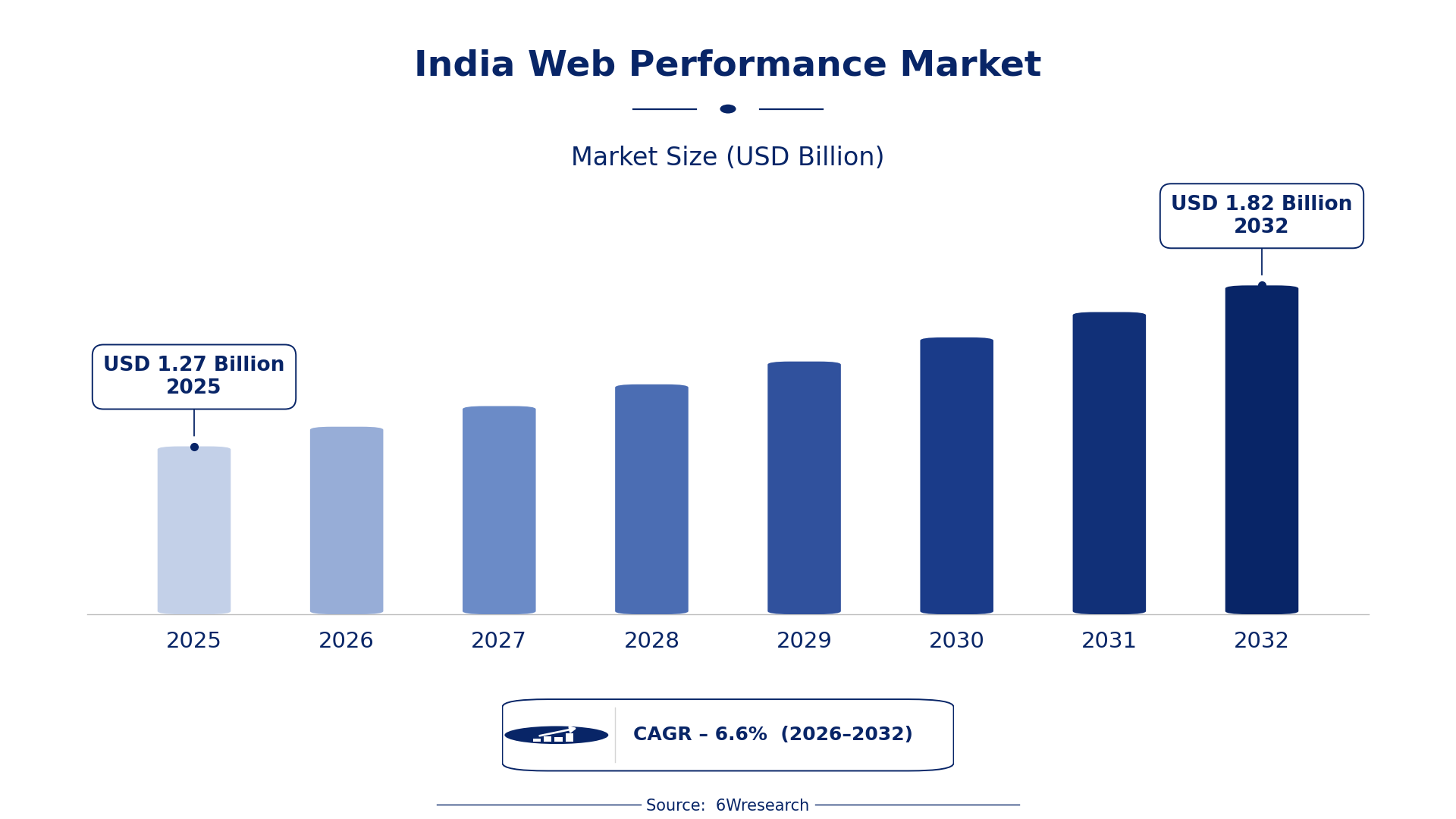
The India Web Performance Market was estimated at USD 1273 Million in 2025 and is projected to reach USD 1822 Million by 2032, growing at a CAGR of 6.6% from 2026 to 2032.
India Web Performance Market Synopsis
The demand for superior web performance solutions in India is rising sharply as businesses recognize the critical nature of website speed and reliability. With a burgeoning e-commerce sector and an increasing number of mobile internet users, the need for content delivery networks, web optimization tools, and performance monitoring applications is at an all-time high.
The competitive landscape is characterized by rapid technological advancements and an emphasis on user experience. Companies are urgently looking for solutions that reduce latency and enhance website accessibility, pushing the web performance market toward innovation and efficiency.
India Web Performance Market Year-wise Growth Rate and Key Drivers
This graph illustrates the annual growth rates of the India Web Performance Market from 2021 to 2032, highlighting a steady upward trajectory and projected expansion over the forecast period.
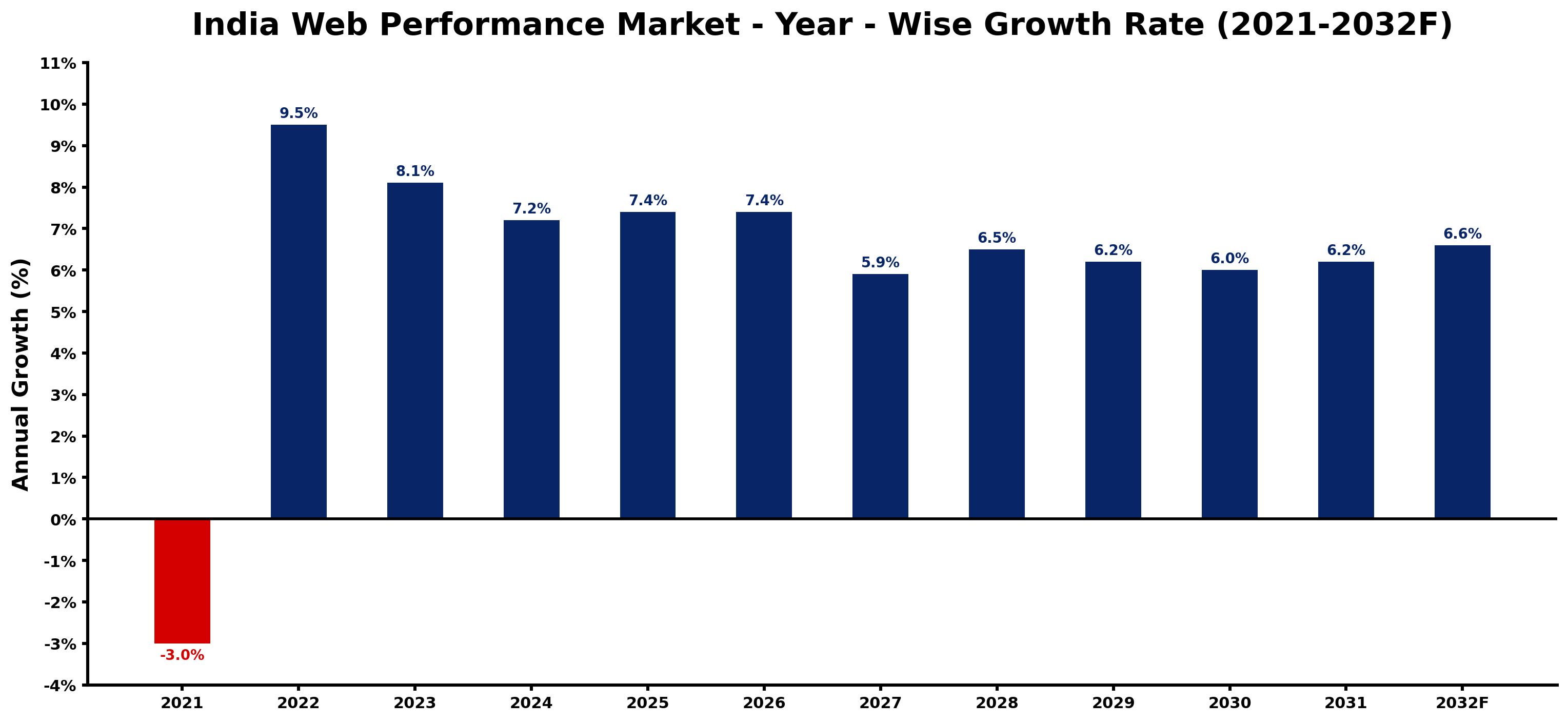
The table below presents the year‑wise growth rates along with the key drivers influencing the market
| Year | Growth Rate | Major Drivers |
| 2021 | -3.0% | COVID-19 lockdowns hampered web infrastructure development in India. |
| 2022 | 9.5% | Growing smartphone penetration enhances online user experience |
| 2023 | 8.1% | Government push for Digital India boosts web performance needs |
| 2024 | 7.2% | E-commerce boom drives demand for faster website loading |
| 2025 | 7.4% | Investment in edge computing reduces latency across regions |
| 2026 | 7.4% | Increased online content consumption prioritizes web optimization |
| 2027 | 5.9% | Adoption of progressive web apps improves user engagement |
| 2028 | 6.5% | Rise in online education necessitates robust web infrastructure |
| 2029 | 6.2% | Digital payment platforms require secure, speedy web solutions |
| 2030 | 6.0% | Social media expansion drives demand for faster sites |
| 2031 | 6.2% | Mobile-first strategy adoption necessitates enhanced web performance |
| 2032 | 6.6% | Government regulations mandate improved website accessibility standards |
Note: Market size estimations and growth projections presented in this report are based on 6Wresearch's proprietary forecasting methodology, utilizing the latest available industry data, government publications, and primary research inputs.
India Web Performance Market Key Takeaways
Below are some of the specific key takeaways from the market, including:
- The market is expected to grow significantly due to increasing online transactions and user expectations for speed.
- Mobile optimization is a central focus, influenced by the expanding mobile user base across India.
- Search engine optimization tactics emphasize website performance to enhance online visibility.
- Organizations are investing in monitoring and analytic tools to drive performance improvements.
- Emerging technologies such as AI are beginning to reshape how web performance solutions are developed and delivered.
Evaluation of Restraints in India Web Performance Market
Despite the growth potential, the India Web Performance market faces significant challenges. Infrastructure gaps, such as inconsistent internet speeds and limited bandwidth in certain regions, create hurdles for optimal performance. Furthermore, organizations often struggle to balance comprehensive web optimization with compatibility across a diverse array of devices and browsers. These issues can undermine user experiences and may result in higher bounce rates, ultimately hindering conversion rates for businesses relying on digital platforms.
India Web Performance Market Trends
Several trends are shaping the India Web Performance market. First, a shift toward artificial intelligence and machine learning is enabling faster performance solutions that are responsive to real-time user behavior. Businesses are increasingly employing A/B testing to optimize content delivery and user interface design based on performance metrics. Furthermore, the rise of cloud-based services continues to drive the adoption of web performance technologies as organizations seek to enhance their agility and scalability.
India Web Performance Market Opportunities
The opportunities for growth in this sector are substantial. With the ongoing digital transformation across industries, companies have a heightened focus on improving user engagement through web performance. Additionally, investment in AI-driven analytics tools offers businesses the chance to fine-tune their online presence dynamically. As businesses strive to remain competitive, the push for faster, more efficient, and responsive web applications provides numerous avenues for new entrants and existing players alike.
Government Initiatives in the India Web Performance Market
Government policies are playing a crucial role in shaping the India Web Performance market. The push for digitalization through initiatives that enhance infrastructure and accessibility is pivotal. Policymakers are focusing on increasing internet penetration and reliability, which directly impacts web performance capabilities across various sectors. This supportive regulatory environment not only encourages investments but also sets standards that drive competition and innovation in the market.
- A recently completed initiative aimed at upgrading broadband infrastructure to improve internet access in rural areas is expected to boost overall web performance capabilities.
- A current government program is working to enhance digital literacy and provide training for businesses on best practices in web performance optimization.
- A planned rollout of a national framework for web performance monitoring is set to take place, expected to standardize quality benchmarks across industries by 2028.
- An initiative currently underway focuses on public-private partnerships to expand data center infrastructure, improving content delivery speeds across urban and semi-urban areas.
Future Insights of the India Web Performance Market
As we look ahead to 2026-2032, the India Web Performance market is positioned for dynamic growth. The increasing adoption of digital technologies by businesses and the constant need for improved user experiences will sustain demand. As web performance becomes a differentiating factor in user retention and customer satisfaction, companies will invest heavily in optimization technologies. This landscape will be marked by continuous innovation, underscored by the rising influence of artificial intelligence and cloud technologies, enhancing the competitive edge for forward-thinking organizations.
India Web Performance Market Latest Developments
Recent developments in the India Web Performance market highlight a flurry of activity as organizations adapt to shifting digital needs. Over the past year, there has been a marked increase in the deployment of advanced web optimization tools, spurred by the need for faster load times and better user engagement metrics. Companies are also launching new initiatives aimed at enhancing their service offerings and maintaining a competitive edge in this vital sector.
- A major technology vendor launched a new suite of web performance solutions in early 2025, focusing on AI-driven optimization tools to help businesses streamline operations.
- An ongoing collaboration between leading web performance companies is currently underway to develop a unified platform for performance analytics, expected to launch in mid-2026.
- A significant partnership was formed in Q4 2025 between key players in the industry to enhance cross-border data exchange protocols aimed at improving web performance reliability.
- A rollout of an innovative content delivery network is planned for early 2026, promising enhanced access speeds across metropolitan regions.
India Web Performance Market - Key Attractiveness of the Report
- 10 Years of Market Numbers
- Historical Data Starting from 2022 to 2025
- Base Year: 2025
- Forecast Data until 2032
- Key Performance Indicators Impacting the Market
- Major Upcoming Developments and Projects
Key Highlights of the Report:
- India Web Performance Market Outlook
- Market Size of India Web Performance Market, 2025
- Forecast of India Web Performance Market, 2032
- Historical Data and Forecast of India Web Performance Revenues & Volume for the Period 2022-2032F
- India Web Performance Market Trend Evolution
- India Web Performance Market Drivers and Challenges
- India Web Performance Price Trends
- India Web Performance Porter's Five Forces
- India Web Performance Industry Life Cycle
- Historical Data and Forecast of India Web Performance Market Revenues & Volume By Component for the Period 2022-2032F
- Historical Data and Forecast of India Web Performance Market Revenues & Volume By Solutions (Web performance monitoring, Web performance optimization, Web performance testing) for the Period 2022-2032F
- Historical Data and Forecast of India Web Performance Market Revenues & Volume By Services (Implementation services, Consulting services, Managed services) for the Period 2022-2032F
- Historical Data and Forecast of India Web Performance Market Revenues & Volume By Organization Size for the Period 2022-2032F
- Historical Data and Forecast of India Web Performance Market Revenues & Volume By SMEs for the Period 2022-2032F
- Historical Data and Forecast of India Web Performance Market Revenues & Volume By Large Enterprises for the Period 2022-2032F
- Historical Data and Forecast of India Web Performance Market Revenues & Volume By Deployment Type for the Period 2022-2032F
- Historical Data and Forecast of India Web Performance Market Revenues & Volume By On-premises for the Period 2022-2032F
- Historical Data and Forecast of India Web Performance Market Revenues & Volume By Cloud for the Period 2022-2032F
- Historical Data and Forecast of India Web Performance Market Revenues & Volume By Vertical for the Period 2022-2032F
- Historical Data and Forecast of India Web Performance Market Revenues & Volume By Telecom and IT for the Period 2022-2032F
- Historical Data and Forecast of India Web Performance Market Revenues & Volume By Government for the Period 2022-2032F
- Historical Data and Forecast of India Web Performance Market Revenues & Volume By Banking, Financial Services, and Insurance (BFSI) for the Period 2022-2032F
- Historical Data and Forecast of India Web Performance Market Revenues & Volume By Automotive for the Period 2022-2032F
- Historical Data and Forecast of India Web Performance Market Revenues & Volume By Logistics and transportation for the Period 2022-2032F
- Historical Data and Forecast of India Web Performance Market Revenues & Volume By Manufacturing for the Period 2022-2032F
- India Web Performance Import Export Trade Statistics
- Market Opportunity Assessment By Component
- Market Opportunity Assessment By Organization Size
- Market Opportunity Assessment By Deployment Type
- Market Opportunity Assessment By Vertical
- India Web Performance Top Companies Market Share
- India Web Performance Competitive Benchmarking By Technical and Operational Parameters
- India Web Performance Company Profiles
- India Web Performance Key Strategic Recommendations






































