India Wool Market Top 5 Importing Countries and Market Competition (HHI) Analysis
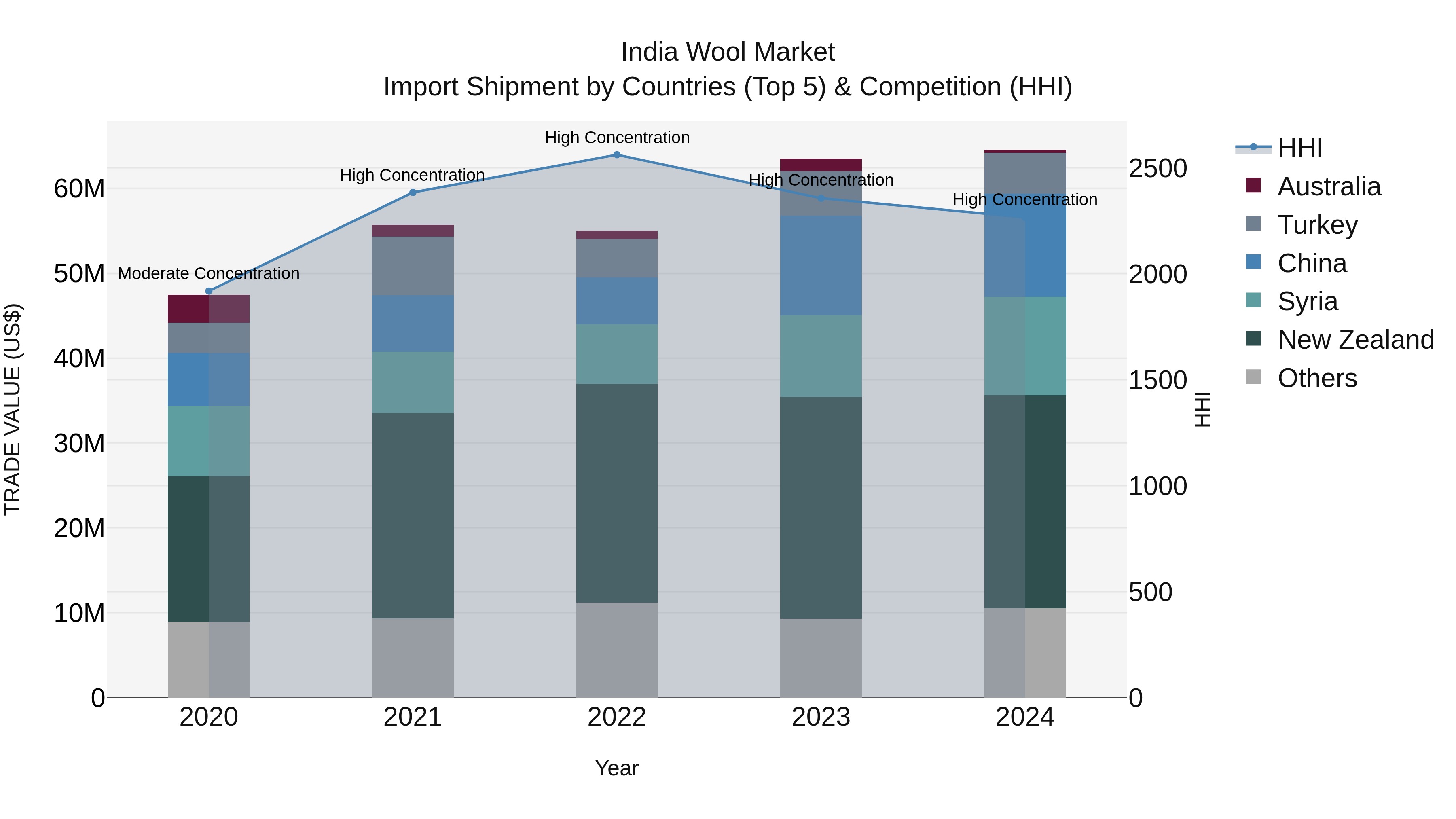
India`s wool import market in 2024 continued to be dominated by key exporting countries such as New Zealand, China, Syria, Turkey, and the UK. The market concentration, as indicated by the Herfindahl-Hirschman Index (HHI), remained high, reflecting the strong presence of these top exporting nations. The compound annual growth rate (CAGR) from 2020 to 2024 stood at a healthy 7.98%, demonstrating sustained growth momentum. Additionally, the growth rate from 2023 to 2024 was recorded at 1.55%, signaling a steady expansion in India`s wool import shipments.
India Wool Market Growth Rate
According to 6Wresearch internal database and industry insights, the India Wool Market is projected to grow at a compound annual growth rate (CAGR) of 5.8% during the forecast period (2026-2032).
Topics Covered in the India Wool Market Report
The India Wool Market report thoroughly covers the market by source, type, and applications. The market report provides an unbiased and detailed analysis of ongoing market trends, opportunities/high growth areas, and market drivers, which help stakeholders devise and align their market strategies according to the current and future market dynamics.
India Wool Market Highlights
| Report Name | India Wool Market |
| Forecast period | 2026-2032 |
| CAGR | 5.8% |
| Growing Sector | Apparels |
India Wool Market Synopsis
India Wool Market is anticipated to witness steady growth due to growing demand for natural and eco-friendly products, as well as the growth of the domestic apparel sector. The growing demand for eco-friendly products is positively influencing the demand for wool products in high-end apparel. Moreover, the government is encouraging sheep farming, which is positively influencing the production capacity of the sector. The sector is benefiting from the growing exports of woolen apparel, which is enhancing the availability of wool products in the market.
Evaluation of Growth Drivers in the India Wool Market
Below are some prominent drivers and their influence on the market dynamics:
| Drivers | Primary Segments Affected | Why it Matters (Evidence) |
| Rising Demand for Sustainable Textiles | Fine Wool; Apparels | Consumers prefer eco-friendly fibers, increasing wool consumption. |
| Growth in Textile Manufacturing | Medium Wool; Apparels | Expanding textile mills boost demand for raw wool materials. |
| Government Support for Sheep Farming | All Types; Others | Subsidies and programs improve wool production and farmer income. |
| Export Growth of Wool Products | Fine Wool; Apparels | Rising exports enhance market revenue and global demand. |
| Expansion of Retail Channels | Medium & Fine Wool; Apparels | Organized retail increases the availability of wool-based products. |
India Wool Market is expected to grow at a CAGR of 5.8% during the forecast period of 2026-2032. The growth in the market is due to increasing demand for sustainable textiles, growth in the apparel industry, and increasing exports of wool-based products. Government initiatives in sheep farming and wool processing are also boosting the supply side of the market. In addition, advancements in textile infrastructure and increasing awareness among consumers regarding eco-friendly products are helping the market for wool-based products.
Evaluation of Restraints in the India Wool Market
Below are some major restraints and their influence on the market dynamics:
| Restraints | Primary Segments Affected | What This Means (Evidence) |
| Limited Domestic Production Quality | Fine Wool; Apparels | Dependence on imports for high-quality wool persists. |
| Price Volatility of Raw Wool | All Types; Apparels & Others | Fluctuating prices impact manufacturers' profit margins. |
| Competition from Synthetic Fibers | Medium Wool; Apparels | Lower cost harms wool. |
| Inadequate Modern Processing Facilities | Coarse Wool; Others | Processing inefficiencies have a negative impact on value addition. |
| Climate Impact on Sheep Farming | All Types; Others | Weather conditions impact sheep farming. |
India Wool Industry Challenges
Despite its consistent growth, the India Wool Industry is facing several operational challenges. One of the main issues is the scarcity of quality wool at home, which requires the industry to rely heavily on imports. Secondly, the traditional methods of rearing sheep and the lack of modern shearing technology contribute to the overall productivity of the wool industry. The changes in the prices of raw materials and the high level of competition from synthetic fibers contribute to the overall market conditions. Furthermore, the climatic conditions and the lack of awareness among farmers contribute to the overall conditions in the wool industry.
India Wool Market Trends
Key trends shaping the India Wool Market Growth include:
- Increasing Preference for Sustainable Fashion: Consumers are actively looking for sustainable fashion clothing materials, thus increasing the demand for wool.
- Adoption of Advanced Wool Processing Technologies: Manufacturers are adopting advanced technology for wool processing, thus improving the quality of wool.
- Growth in Premium Wool Apparel Segment: An increase in disposable income, consumers are looking for premium wool clothing products.
- Expansion of E-commerce Platforms: With the expansion of e-commerce platforms, consumers in different regions are accessing wool products, thus increasing sales for the industry.
Investment Opportunities in the India Wool Market
Key investment prospects in the India Wool Market are:
- Sheep Farming Modernization – Investing in better breeding and shearing technologies can improve the quality and quantity of wool. This can help to reduce import dependence.
- Wool Processing Infrastructure – Creating advanced wool processing facilities can improve efficiency. This can create opportunities for better value addition.
- Premium Apparel Manufacturing – Investing in premium wool-based apparel manufacturing can meet the increasing demand for premium clothing. This is an attractive segment with high profit potential.
- Export-Oriented Wool Products – Creating export-oriented manufacturing facilities can tap into export markets. This can improve revenue streams.
Top 5 Leading Players in the India Wool Market
Some leading players operating in the India Wool Market include:
1. Vardhman Textiles Ltd.
| Company Name | Vardhman Textiles Ltd. |
| Established Year | 1965 |
| Headquarters | Ludhiana, India |
| Official Website | Click Here |
Vardhman Textiles is a major player in India’s textile industry, producing high-quality wool blends and fabrics. The company focuses on innovation, sustainability, and strong supply chain management, catering to both domestic and international markets with premium textile solutions.
2. Raymond Limited
| Company Name | Raymond Limited |
| Established Year | 1925 |
| Headquarters | Mumbai, India |
| Official Website | Click Here |
Raymond Limited is a leading wool fabric manufacturer known for premium suiting materials. The company integrates advanced textile technologies with strong branding, offering high-quality wool products and maintaining a dominant presence in the apparel segment.
3. Donear Industries Ltd.
| Company Name | Donear Industries Ltd. |
| Established Year | 1987 |
| Headquarters | Mumbai, India |
| Official Website | Click Here |
Donear Industries specializes in wool blends and synthetic fabrics, catering to diverse market needs. The company focuses on innovation and affordability, offering a wide range of wool-based textiles for apparel and industrial applications across India.
4. Sutlej Textiles and Industries Ltd.
| Company Name | Sutlej Textiles and Industries Ltd. |
| Established Year | 1934 |
| Headquarters | Ludhiana, India |
| Official Website | Click Here |
Sutlej Textiles produces wool and blended yarns with a strong emphasis on sustainability and quality. The company supports both domestic and export markets, leveraging modern production facilities and a diversified product portfolio.
5. Bhilwara Spinners Ltd.
| Company Name | Bhilwara Spinners Ltd. |
| Established Year | 1980 |
| Headquarters | Bhilwara, India |
| Official Website | Click Here |
Bhilwara Spinners is known for producing wool and blended yarns for global markets. The company emphasizes innovation, efficient manufacturing processes, and export-oriented growth, making it a key contributor to India’s wool textile sector.
Government Regulations Introduced in the India Wool Market
The India’s government has undertaken various steps in order to improve the wool industry. For instance, the Integrated Wool Development Programme has helped improve the quality of sheep and wool. In addition, there have been initiatives aimed at improving textile exports and infrastructure development, which have helped improve the wool industry. The Indian government has encouraged the modernization of wool processing units. This has helped improve the quality of wool in the country. It has also encouraged the development of eco-friendly products, which is in line with global trends. This has helped India compete favorably in the global wool market.
Future Insights of the India Wool Market
India Wool Market Share is expected to grow steadily over the coming years, with increased demand for environmentally friendly products and expansion of the textile industry. As consumers become more aware of environmentally friendly products, there is an increased demand for wool products. The textile industry is also expanding, which is contributing to the growth of the wool industry. The government is supporting sheep farming, and investments are being made in modern technologies to process wool. The e-commerce sector is also expanding, and with increased exports, this industry is expected to grow.
Market Segmentation Analysis
The report offers a comprehensive study of the subsequent market segments and their leading categories.
Fine Wool to Dominate the Market – By Type
According to Mohit, Senior Research Analyst, 6Wresearch, the Fine wool category is expected to dominate the India Wool Market due to its superior quality and growing demand in premium apparel manufacturing. This section is benefiting due to the increase in demand for soft and high-quality products. Moreover, the India Wool Market Growth is supplemented by the increase in exports of high-quality wool garments and improvements in technology for processing these products. In addition, the increase in urbanization and high disposable income is contributing to the market for fine wool products.
Cashmere Wool to Dominate the Market – By Source
Cashmere wool is projected to lead the market due to its premium quality and high demand in luxury apparel. Increasing exports and rising consumer preference for high-end wool products are driving this segment’s growth significantly.
Apparels to Dominate the Market – By Application
The Apparels segment holds the largest share due to rising demand for wool-based clothing. Growth is supported by fashion trends, seasonal demand, and increasing consumer awareness of sustainable textiles.
Key Attractiveness of the Report
- 10 Years of Market Numbers.
- Historical Data Starting from 2022 to 2025.
- Base Year: 2025.
- Forecast Data until 2032.
- Key Performance Indicators Impacting the Market.
- Major Upcoming Developments and Projects.
Key Highlights of the Report:
- India Wool Market Outlook
- Market Size of India Wool Market, 2025
- Forecast of India Wool Market, 2032
- Historical Data and Forecast of India Wool Revenues & Volume for the Period 2022- 2032F
- India Wool Market Trend Evolution
- India Wool Market Drivers and Challenges
- India Wool Price Trends
- India Wool Porter's Five Forces
- India Wool Industry Life Cycle
- Historical Data and Forecast of India Wool Market Revenues & Volume By Source for the Period 2022- 2032F
- Historical Data and Forecast of India Wool Market Revenues & Volume By Merino Wool for the Period 2022- 2032F
- Historical Data and Forecast of India Wool Market Revenues & Volume By Peruvian Highland Wool for the Period 2022- 2032F
- Historical Data and Forecast of India Wool Market Revenues & Volume By Teeswater Wool for the Period 2022- 2032F
- Historical Data and Forecast of India Wool Market Revenues & Volume By Shetland Wool for the Period 2022- 2032F
- Historical Data and Forecast of India Wool Market Revenues & Volume By Cashmere Wool for the Period 2022- 2032F
- Historical Data and Forecast of India Wool Market Revenues & Volume By others for the Period 2022- 2032F
- Historical Data and Forecast of India Wool Market Revenues & Volume By Type for the Period 2022- 2032F
- Historical Data and Forecast of India Wool Market Revenues & Volume By Fine wool ( 25 ) for the Period 2022- 2032F
- Historical Data and Forecast of India Wool Market Revenues & Volume By Medium wool (25 to 35 ) for the Period 2022- 2032F
- Historical Data and Forecast of India Wool Market Revenues & Volume By Coarse wool ( 35 ) for the Period 2022- 2032F
- Historical Data and Forecast of India Wool Market Revenues & Volume By Application for the Period 2022- 2032F
- Historical Data and Forecast of India Wool Market Revenues & Volume By Apparels for the Period 2022- 2032F
- Historical Data and Forecast of India Wool Market Revenues & Volume By Interior Textiles for the Period 2022- 2032F
- India Wool Import Export Trade Statistics
- Market Opportunity Assessment By Source
- Market Opportunity Assessment By Type
- Market Opportunity Assessment By Application
- India Wool Top Companies Market Share
- India Wool Competitive Benchmarking By Technical and Operational Parameters
- India Wool Company Profiles
- India Wool Key Strategic Recommendations
Market Covered
The report offers a comprehensive study of the subsequent market segments:
By Source
- Merino Wool
- Peruvian Highland Wool
- Teeswater Wool
- Shetland Wool
- Cashmere Wool
- Others
By Type
- Fine wool (≤ 25)
- Medium wool (25 to 35)
- Coarse wool (≥ 35)
By Application
- Apparels
- Interior Textiles






































