Indonesia Acoustic Guitar Market Size, Share & Growth Rate
The Indonesia Acoustic Guitar Market was estimated at USD 295 Million in 2025 and is projected to reach USD 392 Million by 2032, growing at a CAGR of 4.1% from 2026 to 2032. This robust growth is primarily fueled by a burgeoning youth demographic eager to learn music, coupled with increased accessibility through online retail platforms. The concerted efforts of established brands to innovate and diversify product offerings also play a significant role in this upward trajectory.
Indonesia Acoustic Guitar Market Year-wise Growth Rate and Key Drivers
This graph highlights how the Indonesia Acoustic Guitar Market has steadily grown over the years, supported by major growth factors.
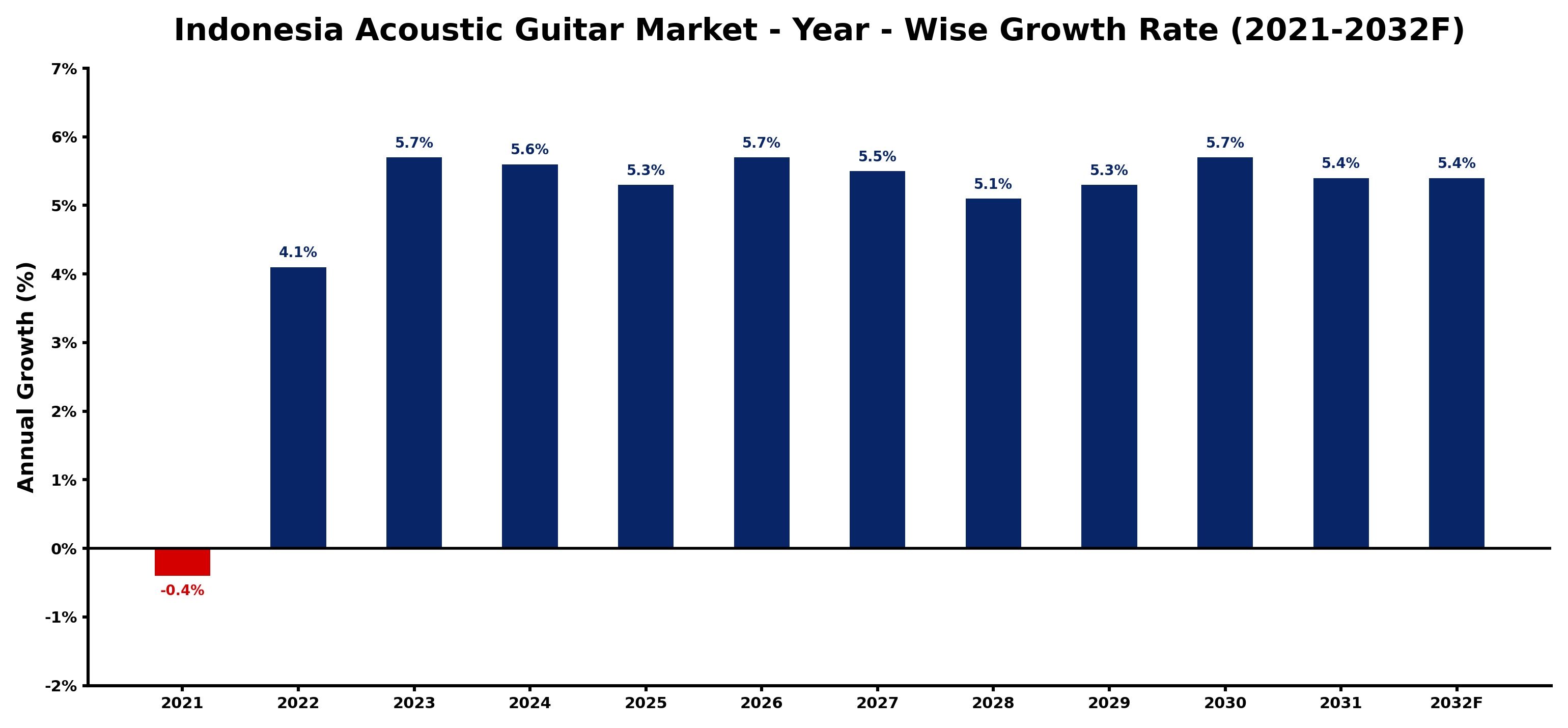
The table below presents the year‑wise growth rates along with the key drivers influencing the market
| Year | Growth Rate | Major Drivers |
| 2021 | -0.4% | Weak consumer spending dampened acoustic guitar manufacturing demand |
| 2022 | 4.1% | Export recovery boosted wood sourcing for acoustic guitar production |
| 2023 | 5.7% | Improved local supply chains boosted acoustic guitar component production efficiency |
| 2024 | 5.6% | Technological upgrades in factories enhanced acoustic guitar assembly efficiency |
| 2025 | 5.3% | Domestic wood supply chain enhancements improved acoustic guitar production efficiency |
| 2026 | 5.7% | Local craftsmanship improvements enhanced acoustic guitar manufacturing output |
| 2027 | 5.5% | Local wood sourcing boosts acoustic guitar manufacturing capacity utilization |
| 2028 | 5.1% | Manufacturing investments boosted local guitar assembly line capabilities |
| 2029 | 5.3% | Local artisan workshops boosted acoustic guitar production capacity significantly |
| 2030 | 5.7% | Modernized woodworking techniques boost acoustic guitar manufacturing precision |
| 2031 | 5.4% | Smart technology adoption streamlines Indonesia's acoustic guitar manufacturing processes |
| 2032 | 5.4% | Increased domestic tourism fuels demand for handcrafted acoustic guitars |
Note - Market size estimations and growth projections presented in this report are based on 6Wresearch's advanced forecasting approach, validated with industry datasets as of June 2026.
Indonesia Acoustic Guitar Market Synopsis
The primary force shaping the Indonesia Acoustic Guitar Market today is the surge in digital retailing. The advent of online music stores has not only made purchasing easier but also intensified competition among retailers, leading to a wider variety of options for consumers. This change is pivotal, as it aligns with the evolving consumer behavior towards e-commerce.
Alongside this, the popularity of acoustic guitars has soared due to their affordability and versatility compared to electric guitars. The introduction of hybrid models allows musicians to explore diverse soundscapes, thereby appealing to both novice players and seasoned professionals. This blend of traditional craftsmanship with modern technology underpins the market's strong growth potential.
Indonesia Acoustic Guitar Market Key Takeaways
- Digital retail is reshaping purchasing behaviors, making acoustic guitars more accessible.
- The rise in youth interest in music is driving significant demand across diverse demographics.
- Hybrid acoustic-electric models are increasingly favored for their versatility in performances.
- Technology advancements enhance user experience and attract new customers to the market.
- Brand loyalty is challenged by the rise of counterfeit products, impacting consumer trust.
Evaluation of Restraints in Indonesia Acoustic Guitar Market
Despite the promising outlook, the Indonesia Acoustic Guitar Market faces notable challenges. The infiltration of counterfeit products poses a significant risk to established brands, potentially eroding consumer trust and brand loyalty. Moreover, many retailers struggle with inadequate customer service, which can discourage potential buyers from making informed purchasing decisions. Additionally, the general lack of awareness regarding the benefits of playing musical instruments further complicates market growth, limiting enthusiasm among first-time buyers.
Indonesia Acoustic Guitar Market Trends
Current trends in the Indonesia Acoustic Guitar Market reveal a shift towards customization and premium features. Consumers increasingly prefer guitars that offer unique aesthetics, such as custom finishes or advanced materials like carbon fiber. Additionally, professional musicians are gravitating towards improved hardware components, including enhanced pickups and higher gauge strings for richer sound quality. The incorporation of digital technology, like Bluetooth connectivity and built-in effects, is also becoming a common expectation among users, illustrating the market's dynamic evolution.
Indonesia Acoustic Guitar Market Opportunities
The future of the Indonesia Acoustic Guitar Market presents numerous growth opportunities. As the demand for music education expands, there exists a ripe market for affordable yet high-quality beginner guitars. Additionally, tapping into the DIY market with kits and customization options can attract hobbyists and aspiring musicians. Leveraging partnerships with online platforms for exclusive launches or promotional offers could further enhance brand visibility and consumer engagement, driving sales growth in the coming years.
Government Initiatives in the Indonesia Acoustic Guitar Market
The Indonesian government has recognized the cultural significance of music and has begun to implement initiatives that support local musicians and artisans. Programs encouraging music education in schools and community centers have emerged, bolstering interest in musical instruments. Furthermore, public spending on arts and culture promotes the music industry, creating a favorable environment for acoustic guitar sales and production.
Future Insights of the Indonesia Acoustic Guitar Market
Looking ahead to 2026-2032, the Indonesia Acoustic Guitar Market is poised for a transformative period driven by a younger generation's enthusiasm for music. As online shopping continues to dominate, companies that can offer a seamless digital experience will likely thrive. Moreover, the growing trend towards sustainable practices in music instrument production could set a new standard, appealing to environmentally conscious consumers. The market's evolution will be characterized by innovation and adaptation, positioning it for sustained growth.
Indonesia Acoustic Guitar Market Latest Developments (May 2025 - June 2026)
Recent developments in the Indonesia Acoustic Guitar Market indicate a heightened focus on digital engagement strategies by various retailers. Companies are launching interactive online campaigns to educate consumers about guitar features and playing techniques, thereby increasing customer engagement. Additionally, innovative product launches are emphasizing customizability and tech integration, reflecting consumer demands for personalized music experiences.
Indonesia Acoustic Guitar Market - Key Attractiveness of the Report
- 10 Years of Market Numbers
- Historical Data Starting from 2022 to 2025
- Base Year: 2025
- Forecast Data until 2032
- Key Performance Indicators Impacting the Market
- Major Upcoming Developments and Projects
Key Highlights of the Report:
- Indonesia Acoustic Guitar Market Outlook
- Market Size of Indonesia Acoustic Guitar Market, 2025
- Forecast of Indonesia Acoustic Guitar Market, 2032
- Historical Data and Forecast of Indonesia Acoustic Guitar Revenues & Volume for the Period 2022-2032F
- Indonesia Acoustic Guitar Market Trend Evolution
- Indonesia Acoustic Guitar Market Drivers and Challenges
- Indonesia Acoustic Guitar Price Trends
- Indonesia Acoustic Guitar Porter's Five Forces
- Indonesia Acoustic Guitar Industry Life Cycle
- Historical Data and Forecast of Indonesia Acoustic Guitar Market Revenues & Volume By Product for the Period 2022-2032F
- Historical Data and Forecast of Indonesia Acoustic Guitar Market Revenues & Volume By Nylon/gut Stringed Guitars for the Period 2022-2032F
- Historical Data and Forecast of Indonesia Acoustic Guitar Market Revenues & Volume By Steel Stringed Guitars for the Period 2022-2032F
- Historical Data and Forecast of Indonesia Acoustic Guitar Market Revenues & Volume By Other for the Period 2022-2032F
- Historical Data and Forecast of Indonesia Acoustic Guitar Market Revenues & Volume By Application for the Period 2022-2032F
- Historical Data and Forecast of Indonesia Acoustic Guitar Market Revenues & Volume By Perform for the Period 2022-2032F
- Historical Data and Forecast of Indonesia Acoustic Guitar Market Revenues & Volume By Teaching for the Period 2022-2032F
- Historical Data and Forecast of Indonesia Acoustic Guitar Market Revenues & Volume By Other for the Period 2022-2032F
- Indonesia Acoustic Guitar Import Export Trade Statistics
- Market Opportunity Assessment By Product
- Market Opportunity Assessment By Application
- Indonesia Acoustic Guitar Top Companies Market Share
- Indonesia Acoustic Guitar Competitive Benchmarking By Technical and Operational Parameters
- Indonesia Acoustic Guitar Company Profiles
- Indonesia Acoustic Guitar Key Strategic Recommendations






































