Indonesia AI in IoT Market Size & Growth Rate (2026-2032)
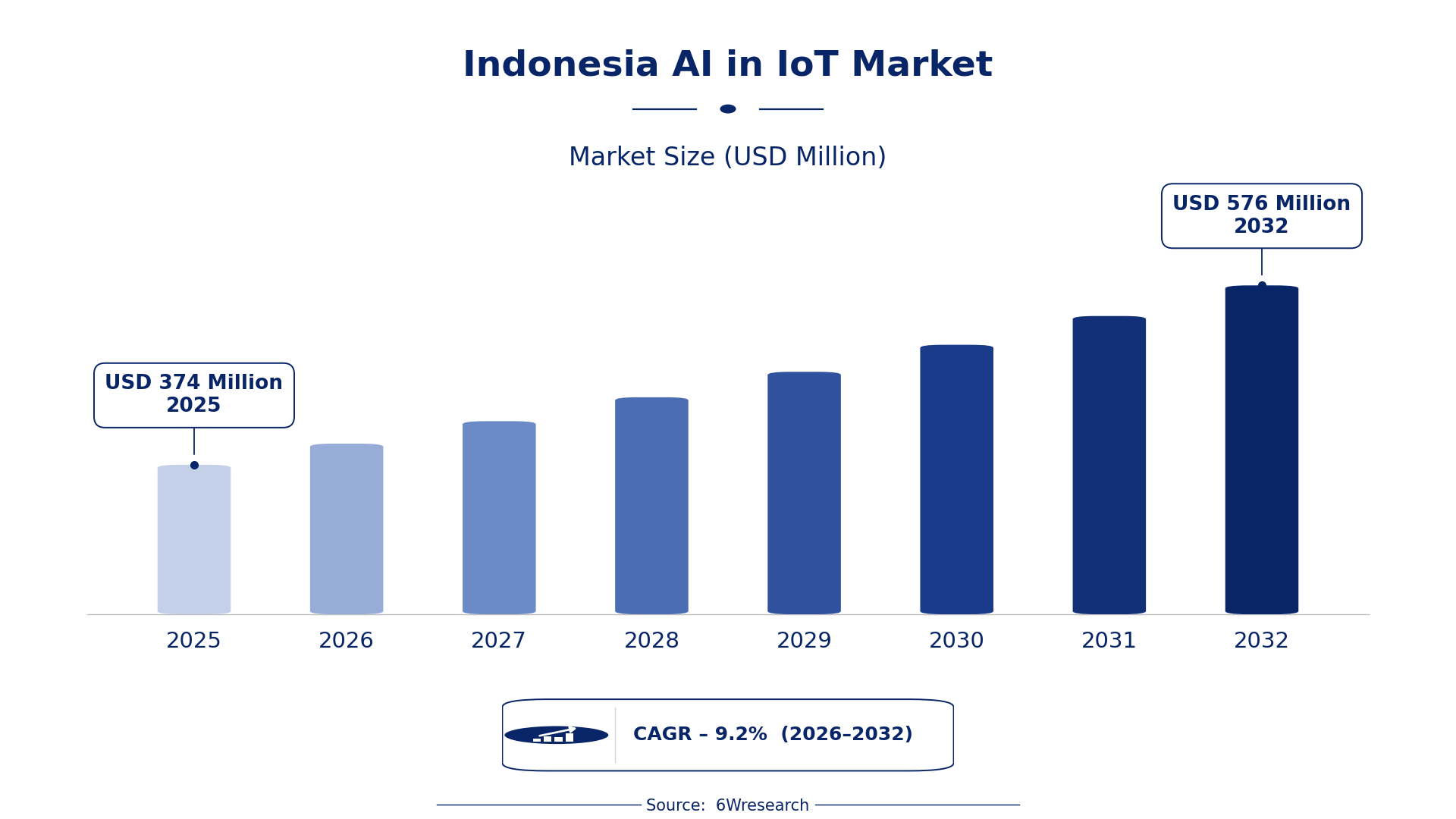
The Indonesia AI in IoT Market was estimated at USD 374 Million in 2025 and is projected to reach USD 576 Million by 2032, growing at a CAGR of 9.2% from 2026 to 2032.
Indonesia AI in IoT Market Synopsis
Indonesia is witnessing a notable integration of artificial intelligence within its Internet of Things framework. This synergy is enhancing operational efficiencies across various sectors, particularly in manufacturing, agriculture, and transportation, where smart devices are increasingly making autonomous data-driven decisions.
As the demand for efficient data processing and predictive analytics intensifies, businesses and government entities are turning to AI in IoT solutions. This trend is reshaping how resources are utilized and services are delivered, highlighting the growing significance of this market segment in Indonesia's economic landscape.
Indonesia AI in IoT Market Year-wise Growth Rate and Key Drivers
This graph illustrates the annual growth rates of the Indonesia AI in IoT Market from 2021 to 2032, highlighting a steady upward trajectory and projected expansion over the forecast period.
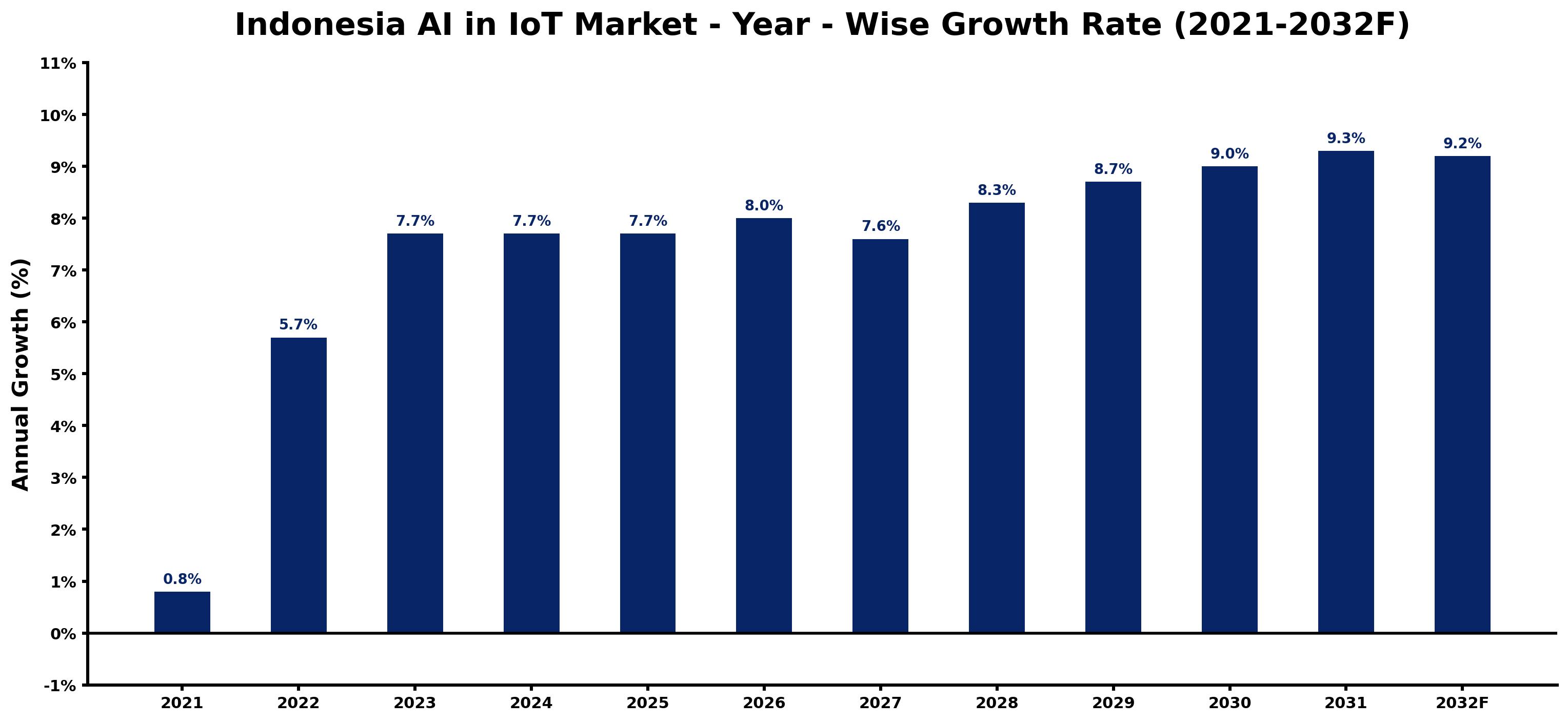
The table below presents the year‑wise growth rates along with the key drivers influencing the market
| Year | Growth Rate | Major Drivers |
| 2021 | 0.8% | Government support for IoT innovation through research grants. |
| 2022 | 5.7% | Increased smartphone penetration driving IoT adoption. |
| 2023 | 7.7% | Boost in AI technology funding by Indonesian startups. |
| 2024 | 7.7% | Launch of Smart City initiative in Jakarta. |
| 2025 | 7.7% | Rise in remote healthcare services leveraging IoT technology. |
| 2026 | 8.0% | Government policy promoting digital transformation across sectors. |
| 2027 | 7.6% | Growing interest in IoT data analytics among businesses. |
| 2028 | 8.3% | Increased manufacturing automation leading to IoT integration. |
| 2029 | 8.7% | Local enterprises investing in IoT cybersecurity solutions. |
| 2030 | 9.0% | Regulatory incentives for smart home technology adoption. |
| 2031 | 9.3% | Public-private partnerships fostering IoT ecosystem development. |
| 2032 | 9.2% | Rising consumer awareness of energy-efficient smart devices. |
Note: Market size estimations and growth projections presented in this report are based on 6Wresearch's proprietary forecasting methodology, utilizing the latest available industry data, government publications, and primary research inputs.
Indonesia AI in IoT Market Key Takeaways
Below are some of the specific key takeaways from the market, including:
- The market is driven by the need for enhanced operational efficiency and predictive analytics.
- Cybersecurity and data privacy concerns present challenges that must be addressed for growth.
- COVID-19 has accelerated the adoption of AI in IoT solutions across various sectors.
- Government initiatives are playing a crucial role in shaping the market dynamics.
- Major players are focusing on developing innovative solutions tailored for Indonesian industries.
Evaluation of Restraints in Indonesia AI in IoT Market
The Indonesia AI in IoT market faces notable restraints that can impede its growth trajectory. A lack of interoperability among diverse IoT devices complicates integration, with varying standards and protocols creating hurdles. Security remains a paramount concern; as cyber threats become more frequent, ensuring the safety of data transmitted through IoT devices is critical. on top of that, the significant upfront costs associated with IoT deployment can deter smaller businesses from adopting these technologies. The necessity for skilled personnel to manage AI and IoT systems adds another layer of complexity, potentially limiting market expansion.
Indonesia AI in IoT Market Trends
Several trends are shaping the Indonesia AI in IoT market. The rise of smart cities is driving demand for integrated AI solutions, enabling better resource management and service delivery. Another trend is the growing focus on predictive maintenance in manufacturing, where AI helps anticipate equipment failures, reducing downtime and maintenance costs. on top of that, advancements in edge computing are fostering real-time data processing, enhancing the effectiveness of AI-driven IoT applications. These trends reflect a broader shift towards digitization and automation across the Indonesian economy.
Indonesia AI in IoT Market Opportunities
Opportunities abound in the Indonesia AI in IoT market, particularly in sectors like agriculture and healthcare. Smart agriculture solutions that utilize AI can optimize crop yields and resource usage, responding directly to the country's agricultural challenges. In healthcare, AI-powered IoT devices can enhance patient monitoring and streamline healthcare delivery. on top of that, public-private partnerships aimed at enhancing digital infrastructure are expected to open new avenues for investment, particularly in urban areas transitioning to smart city models. These opportunities signify a fertile ground for growth and innovation.
Government Initiatives in the Indonesia AI in IoT Market
Government policy is a vital element influencing the trajectory of the AI in IoT market in Indonesia. With a focus on digital transformation, the government is actively promoting initiatives that aim to enhance the country's technological infrastructure. Regulatory frameworks are being developed to ensure data privacy and foster ethical AI practices, which are critical for building trust in these technologies.
- A national digital infrastructure upgrade programme launched in 2023 is aimed at improving connectivity across urban and rural areas.
- A regulatory framework introduced in 2024 mandates data security protocols for IoT devices, addressing privacy concerns.
- A current initiative focuses on developing smart city projects in major urban centers, enhancing urban management through AI and IoT integration.
- Upcoming plans for 2025 include a public-private partnership to boost AI research and development within local universities.
Future Insights of the Indonesia AI in IoT Market
Looking ahead to 2026-2032, the Indonesia AI in IoT market is expected to evolve substantially. The increasing adoption of AI technologies in various sectors will likely lead to more sophisticated applications and use cases. As companies continue to seek competitive advantages through automation and data analytics, the demand for AI-integrated IoT solutions will rise. Government support through policy frameworks and infrastructure development will further accelerate this growth, positioning Indonesia as a key player in the global AI in IoT arena.
Indonesia AI in IoT Market Latest Developments
In the last year, the Indonesia AI in IoT market has seen significant activity, with various initiatives and partnerships emerging. This surge is indicative of the increasing recognition of AI's potential to transform industries and improve efficiency.
- A leading technology vendor launched a new AI-based IoT platform in early 2023, targeting the manufacturing sector to enhance production efficiency.
- A major regional operator is currently implementing an AI-driven smart agriculture solution, which began rollout in mid-2023 and aims to boost crop yields.
- In Q1 2024, a partnership between local universities and tech firms was announced to foster AI research, paving the way for innovative solutions.
- Plans for a nationwide IoT sensor deployment across urban areas are set to begin in late 2024, aimed at enhancing smart city initiatives.
Indonesia AI in IoT Market - Key Attractiveness of the Report
- 10 Years of Market Numbers
- Historical Data Starting from 2022 to 2025
- Base Year: 2025
- Forecast Data until 2032
- Key Performance Indicators Impacting the Market
- Major Upcoming Developments and Projects
Key Highlights of the Report:
- Indonesia AI in IoT Market Outlook
- Market Size of Indonesia AI in IoT Market, 2025
- Forecast of Indonesia AI in IoT Market, 2032
- Historical Data and Forecast of Indonesia AI in IoT Revenues & Volume for the Period 2022-2032F
- Indonesia AI in IoT Market Trend Evolution
- Indonesia AI in IoT Market Drivers and Challenges
- Indonesia AI in IoT Price Trends
- Indonesia AI in IoT Porter's Five Forces
- Indonesia AI in IoT Industry Life Cycle
- Historical Data and Forecast of Indonesia AI in IoT Market Revenues & Volume By Component for the Period 2022-2032F
- Historical Data and Forecast of Indonesia AI in IoT Market Revenues & Volume By Platforms for the Period 2022-2032F
- Historical Data and Forecast of Indonesia AI in IoT Market Revenues & Volume By Software Solutions for the Period 2022-2032F
- Historical Data and Forecast of Indonesia AI in IoT Market Revenues & Volume By Services for the Period 2022-2032F
- Historical Data and Forecast of Indonesia AI in IoT Market Revenues & Volume By Vertical for the Period 2022-2032F
- Historical Data and Forecast of Indonesia AI in IoT Market Revenues & Volume By Manufacturing for the Period 2022-2032F
- Historical Data and Forecast of Indonesia AI in IoT Market Revenues & Volume By Energy and Utilities for the Period 2022-2032F
- Historical Data and Forecast of Indonesia AI in IoT Market Revenues & Volume By Transportation and Mobility for the Period 2022-2032F
- Historical Data and Forecast of Indonesia AI in IoT Market Revenues & Volume By BFSI for the Period 2022-2032F
- Historical Data and Forecast of Indonesia AI in IoT Market Revenues & Volume By Government and Defense for the Period 2022-2032F
- Historical Data and Forecast of Indonesia AI in IoT Market Revenues & Volume By Retail for the Period 2022-2032F
- Historical Data and Forecast of Indonesia AI in IoT Market Revenues & Volume By Healthcare and Life Sciences for the Period 2022-2032F
- Historical Data and Forecast of Indonesia AI in IoT Market Revenues & Volume By Telecom for the Period 2022-2032F
- Historical Data and Forecast of Indonesia AI in IoT Market Revenues & Volume By Technology for the Period 2022-2032F
- Historical Data and Forecast of Indonesia AI in IoT Market Revenues & Volume By ML and Deep Learning for the Period 2022-2032F
- Historical Data and Forecast of Indonesia AI in IoT Market Revenues & Volume By NLP for the Period 2022-2032F
- Indonesia AI in IoT Import Export Trade Statistics
- Market Opportunity Assessment By Component
- Market Opportunity Assessment By Vertical
- Market Opportunity Assessment By Technology
- Indonesia AI in IoT Top Companies Market Share
- Indonesia AI in IoT Competitive Benchmarking By Technical and Operational Parameters
- Indonesia AI in IoT Company Profiles
- Indonesia AI in IoT Key Strategic Recommendations






































