Indonesia Aircraft Electrical Systems Market Size, Share & Growth Rate
The Indonesia Aircraft Electrical Systems Market was estimated at USD 570 Million in 2025 and is projected to reach USD 873 Million by 2032, growing at a CAGR of 6.3% from 2026 to 2032. This upward trajectory can be attributed to the increasing demand for advanced electrical components in modern aircraft, driven by a focus on operational efficiency and fuel savings. Moreover, as the aviation sector in Indonesia continues to expand, the necessity for reliable and sophisticated electrical systems becomes even more critical.
Indonesia Aircraft Electrical Systems Market Year-wise Growth Rate and Key Drivers
This graph highlights how the Indonesia Aircraft Electrical Systems Market has steadily grown over the years, supported by major growth factors.
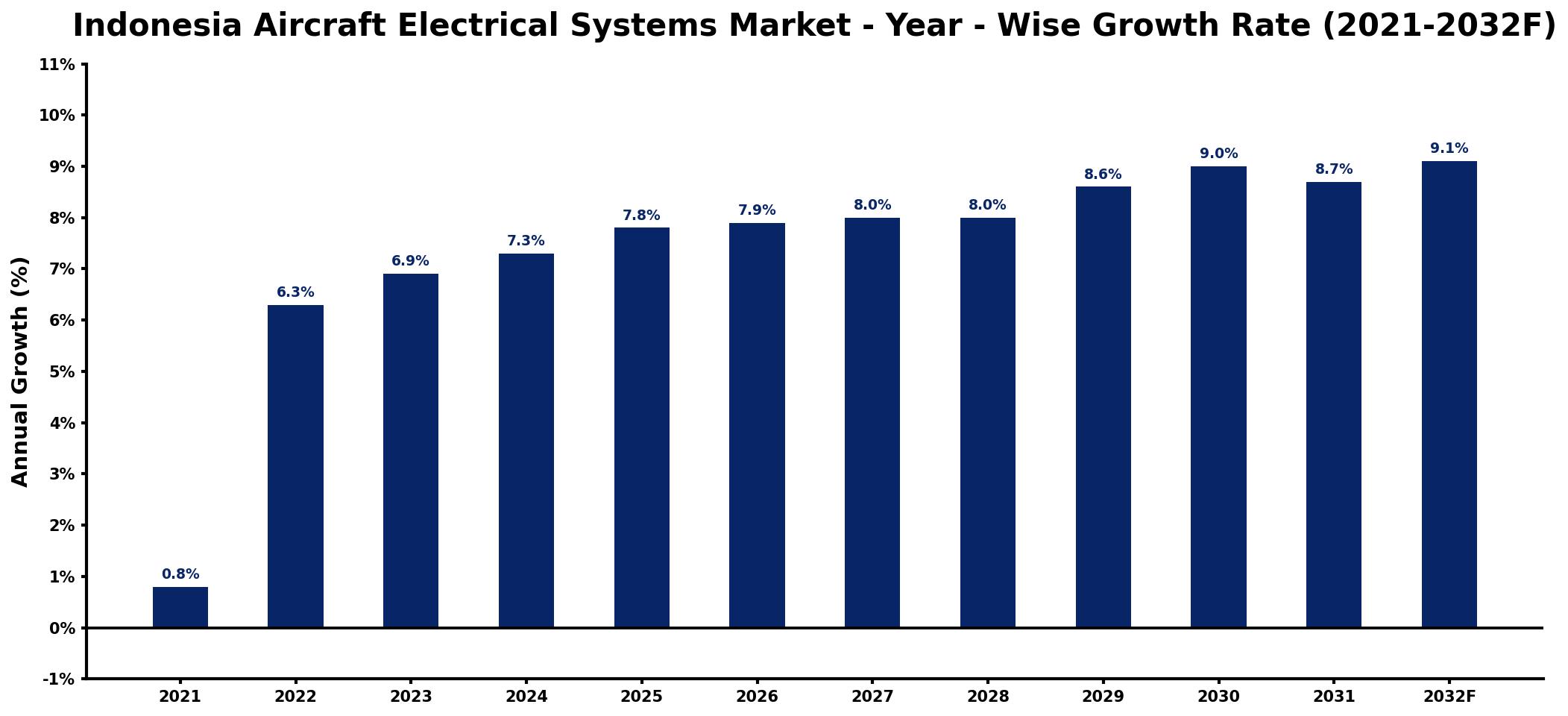
The table below presents the year‑wise growth rates along with the key drivers influencing the market
| Year | Growth Rate | Major Drivers |
| 2021 | 0.8% | Rising demand for aviation services |
| 2022 | 6.3% | Increased investments in infrastructure |
| 2023 | 6.9% | Expansion of regional air travel |
| 2024 | 7.3% | Growth in commercial airline fleets |
| 2025 | 7.8% | Technological advancements in aviation |
| 2026 | 7.9% | Emerging markets boosting travel demand |
| 2027 | 8.0% | Sustainable aviation initiatives gaining traction |
| 2028 | 8.0% | Revival of tourism boosting flights |
| 2029 | 8.6% | Government support for aviation sector |
| 2030 | 9.0% | Enhanced safety regulations driving upgrades |
| 2031 | 8.7% | Global partnerships fostering innovation |
| 2032 | 9.1% | Rising need for modernization initiatives |
Note: Market size estimations and growth projections presented in this report are based on 6Wresearch's proprietary forecasting methodology, utilizing the latest available industry data, government publications, and primary research inputs.
Indonesia Aircraft Electrical Systems Market Synopsis
The integration of advanced electrical components is the strongest force shaping the Indonesia Aircraft Electrical Systems Market. These sophisticated systems are essential for powering critical aircraft functionalities, including avionics, lighting, and communication systems, positioning them at the forefront of modern aviation technology.
As the industry evolves, the increasing focus on fuel efficiency, particularly the growing adoption of electric propulsion systems, is further propelling market expansion. In this context, players in the market are compelled to innovate continually, ensuring that they align with global standards and technological advancements.
Indonesia Aircraft Electrical Systems Market Key Takeaways
- The market is set for robust growth, driven by technological advancements in electrical systems.
- Integration of lightweight materials and components enhances efficiency and performance in aircraft.
- Challenges posed by the necessity for constant upgrades to meet evolving avionics standards.
- Government initiatives aimed at revitalizing the aviation sector may bolster market prospects.
- Growing consumer and airline demand for eco-friendly aircraft solutions supports market development.
Evaluation of Restraints in Indonesia Aircraft Electrical Systems Market
Despite positive growth prospects, the Indonesia Aircraft Electrical Systems Market faces several constraints. The rapid pace of technological advancements in the aviation sector necessitates constant updates and system overhauls, which can lead to substantial costs for airlines. Many Indonesian carriers must allocate significant resources to maintain and upgrade their avionics, potentially diverting funds from other critical operational areas. This financial strain is compounded by the lingering impacts of the COVID-19 pandemic, which led to reduced investments and deferred maintenance for many operators.
Indonesia Aircraft Electrical Systems Market Trends
A notable trend in the Indonesia Aircraft Electrical Systems Market is the shift towards more sustainable solutions. Airlines are increasingly prioritizing lightweight electrical components and systems that improve fuel efficiency. Furthermore, the move towards electric propulsion technologies is not just a trend but a necessary evolution in response to environmental regulations and consumer demand for greener travel options.
Additionally, manufacturers are exploring digitalization in cockpit systems, enhancing data integration and operational efficiency. The use of smart technology in aircraft electrical systems is becoming more prevalent, ensuring that airlines can optimize their fleet operations through real-time data analytics.
Indonesia Aircraft Electrical Systems Market Opportunities
Opportunities for growth in the Indonesia Aircraft Electrical Systems Market are significant, particularly as the regional aviation sector rebounds. Investments in modernizing existing aircraft fleets with advanced electrical systems are expected to rise. Moreover, emerging players with innovative solutions and sustainable technologies will find ample opportunity to carve out market share. The increasing collaboration between local manufacturers and international technology providers is likely to enhance capabilities and drive further innovation in the sector.
Government Initiatives in the Indonesia Aircraft Electrical Systems Market
The Indonesian government has recognized the pivotal role of aviation in national development and is thus implementing policies to bolster the sector. Initiatives aimed at increasing public and private investments in aviation infrastructure are being rolled out. Additionally, incentives for airlines to upgrade their fleet with more efficient systems and to adopt sustainable technologies are increasingly prevalent, reflecting the government's commitment to enhancing the aviation industrys resilience and sustainability.
Future Insights of the Indonesia Aircraft Electrical Systems Market
Looking ahead to the period between 2026 and 2032, the Indonesia Aircraft Electrical Systems Market is poised for substantial evolution. As the aviation industry continues to recover from the impacts of the pandemic, we anticipate an acceleration in the adoption of cutting-edge electrical systems designed to enhance operational efficiency. The combination of rising passenger demand and regulatory push towards greener technologies will further stimulate innovation and investment in this domain, setting the stage for a dynamic and rapidly developing market landscape.
Indonesia Aircraft Electrical Systems Market Latest Developments (2025 - 2026)
Recent developments in the Indonesia Aircraft Electrical Systems Market indicate a concerted effort to embrace advanced technologies. Industry stakeholders are focusing on integrating smart and lightweight electrical systems into new aircraft designs. Partnerships between local firms and global technology providers are becoming more common, aimed at enhancing the local manufacturing capabilities. There is also a growing emphasis on research and development initiatives to explore electric propulsion systems and their integration into the Indonesian aviation landscape.
Indonesia Aircraft Electrical Systems Market - Key Attractiveness of the Report
- 10 Years of Market Numbers
- Historical Data Starting from 2022 to 2025
- Base Year: 2025
- Forecast Data until 2032
- Key Performance Indicators Impacting the Market
- Major Upcoming Developments and Projects
Key Highlights of the Report:
- Indonesia Aircraft Electrical Systems Market Outlook
- Market Size of Indonesia Aircraft Electrical Systems Market, 2025
- Forecast of Indonesia Aircraft Electrical Systems Market, 2032
- Historical Data and Forecast of Indonesia Aircraft Electrical Systems Revenues & Volume for the Period 2022-2032FF
- Indonesia Aircraft Electrical Systems Market Trend Evolution
- Indonesia Aircraft Electrical Systems Market Drivers and Challenges
- Indonesia Aircraft Electrical Systems Price Trends
- Indonesia Aircraft Electrical Systems Porter's Five Forces
- Indonesia Aircraft Electrical Systems Industry Life Cycle
- Historical Data and Forecast of Indonesia Aircraft Electrical Systems Market Revenues & Volume By End User for the Period 2022-2032FF
- Historical Data and Forecast of Indonesia Aircraft Electrical Systems Market Revenues & Volume By OEM for the Period 2022-2032FF
- Historical Data and Forecast of Indonesia Aircraft Electrical Systems Market Revenues & Volume By Aftermarket for the Period 2022-2032FF
- Historical Data and Forecast of Indonesia Aircraft Electrical Systems Market Revenues & Volume By System for the Period 2022-2032FF
- Historical Data and Forecast of Indonesia Aircraft Electrical Systems Market Revenues & Volume By Power Generation for the Period 2022-2032FF
- Historical Data and Forecast of Indonesia Aircraft Electrical Systems Market Revenues & Volume By Power Distribution for the Period 2022-2032FF
- Historical Data and Forecast of Indonesia Aircraft Electrical Systems Market Revenues & Volume By Power Conversion for the Period 2022-2032FF
- Historical Data and Forecast of Indonesia Aircraft Electrical Systems Market Revenues & Volume By Energy Storage for the Period 2022-2032FF
- Historical Data and Forecast of Indonesia Aircraft Electrical Systems Market Revenues & Volume By Component for the Period 2022-2032FF
- Historical Data and Forecast of Indonesia Aircraft Electrical Systems Market Revenues & Volume By Generators for the Period 2022-2032FF
- Historical Data and Forecast of Indonesia Aircraft Electrical Systems Market Revenues & Volume By Conversion Devices for the Period 2022-2032FF
- Historical Data and Forecast of Indonesia Aircraft Electrical Systems Market Revenues & Volume By Distribution Devices for the Period 2022-2032FF
- Historical Data and Forecast of Indonesia Aircraft Electrical Systems Market Revenues & Volume By Battery Management Systems for the Period 2022-2032FF
- Historical Data and Forecast of Indonesia Aircraft Electrical Systems Market Revenues & Volume By Application for the Period 2022-2032FF
- Historical Data and Forecast of Indonesia Aircraft Electrical Systems Market Revenues & Volume By Power Generation Management for the Period 2022-2032FF
- Historical Data and Forecast of Indonesia Aircraft Electrical Systems Market Revenues & Volume By Flight Control & Operation for the Period 2022-2032FF
- Historical Data and Forecast of Indonesia Aircraft Electrical Systems Market Revenues & Volume By Cabin System for the Period 2022-2032FF
- Historical Data and Forecast of Indonesia Aircraft Electrical Systems Market Revenues & Volume By Configuration Management for the Period 2022-2032FF
- Historical Data and Forecast of Indonesia Aircraft Electrical Systems Market Revenues & Volume By Air Pressurization & Conditioning for the Period 2022-2032FF
- Historical Data and Forecast of Indonesia Aircraft Electrical Systems Market Revenues & Volume By Technology for the Period 2022-2032FF
- Historical Data and Forecast of Indonesia Aircraft Electrical Systems Market Revenues & Volume By Conventional for the Period 2022-2032FF
- Historical Data and Forecast of Indonesia Aircraft Electrical Systems Market Revenues & Volume By More Electric for the Period 2022-2032FF
- Historical Data and Forecast of Indonesia Aircraft Electrical Systems Market Revenues & Volume By Electric for the Period 2022-2032FF
- Historical Data and Forecast of Indonesia Aircraft Electrical Systems Market Revenues & Volume By Platform for the Period 2022-2032FF
- Historical Data and Forecast of Indonesia Aircraft Electrical Systems Market Revenues & Volume By Commercial Aviation for the Period 2022-2032FF
- Historical Data and Forecast of Indonesia Aircraft Electrical Systems Market Revenues & Volume By Military Aviation for the Period 2022-2032FF
- Historical Data and Forecast of Indonesia Aircraft Electrical Systems Market Revenues & Volume By Business & General Aviation for the Period 2022-2032FF
- Indonesia Aircraft Electrical Systems Import Export Trade Statistics
- Market Opportunity Assessment By End User
- Market Opportunity Assessment By System
- Market Opportunity Assessment By Component
- Market Opportunity Assessment By Application
- Market Opportunity Assessment By Technology
- Market Opportunity Assessment By Platform
- Indonesia Aircraft Electrical Systems Top Companies Market Share
- Indonesia Aircraft Electrical Systems Competitive Benchmarking By Technical and Operational Parameters
- Indonesia Aircraft Electrical Systems Company Profiles
- Indonesia Aircraft Electrical Systems Key Strategic Recommendations






































