Indonesia Aircraft Hydraulic System Market Size, Share & Growth Rate
The Indonesia Aircraft Hydraulic System Market was estimated at USD 761 Million in 2025 and is projected to reach USD 1166 Million by 2032, growing at a CAGR of 6.3% from 2026 to 2032. This promising trajectory is propelled by the increasing demand for hydraulic systems crucial for operating essential aircraft components, fueled by the expansion of both commercial and military aviation sectors in Indonesia. The rise in air traffic, coupled with the integration of advanced hydraulic technologies, is further amplifying this growth.
Indonesia Aircraft Hydraulic System Market Year-wise Growth Rate and Key Drivers
This graph highlights how the Indonesia Aircraft Hydraulic System Market has steadily grown over the years, supported by major growth factors.
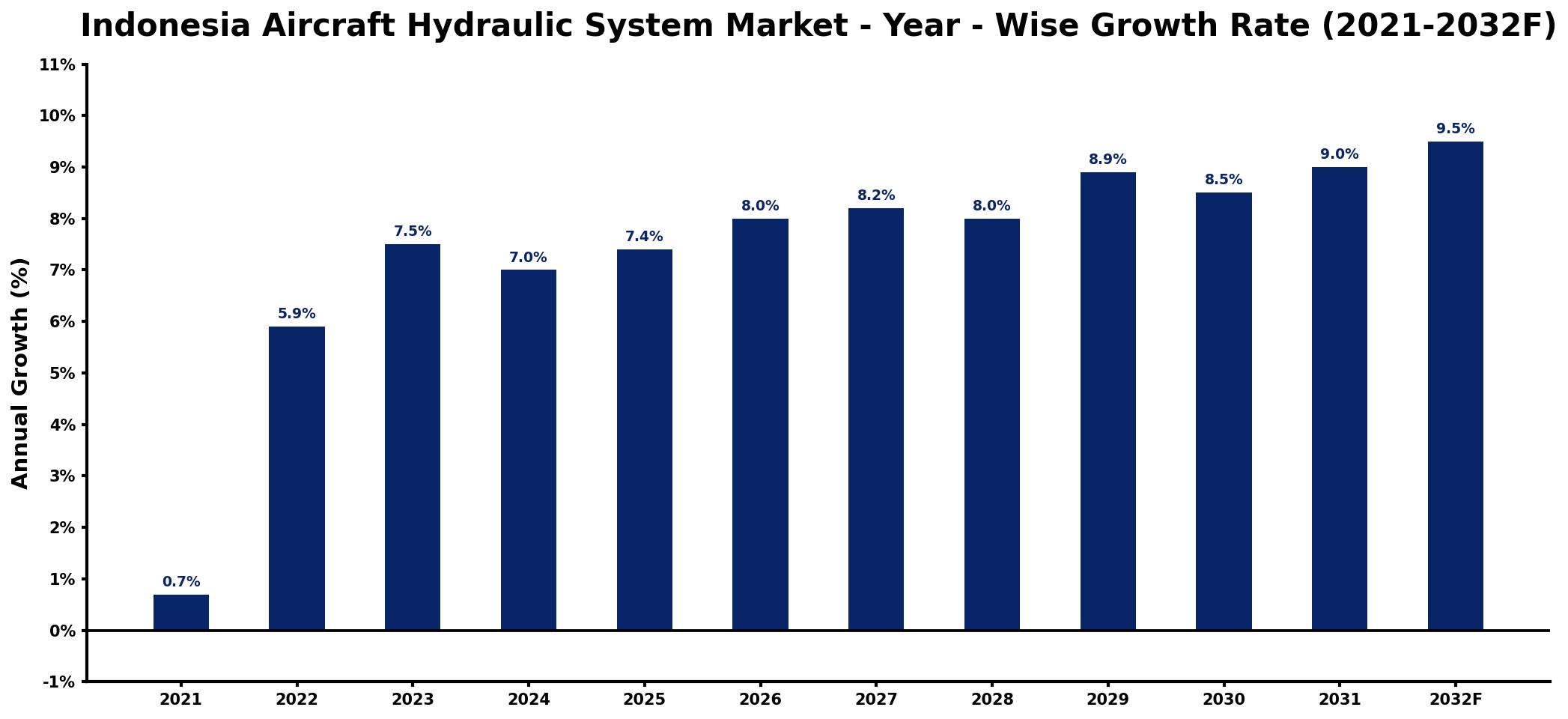
The table below presents the year‑wise growth rates along with the key drivers influencing the market
| Year | Growth Rate | Major Drivers |
| 2021 | 0.7% | Growing demand for transportation services |
| 2022 | 5.9% | Increased investment in aviation sector |
| 2023 | 7.5% | Expansion of regional airline networks |
| 2024 | 7.0% | Rising passenger travel frequency |
| 2025 | 7.4% | Boost in freight transportation needs |
| 2026 | 8.0% | Emerging technologies in maintenance |
| 2027 | 8.2% | Upgrading of existing fleets |
| 2028 | 8.0% | Focus on operational efficiency improvements |
| 2029 | 8.9% | Supportive government aviation policies |
| 2030 | 8.5% | Collaborations with international partners |
| 2031 | 9.0% | Adoption of sustainable practices |
| 2032 | 9.5% | Enhancements in training programs |
Note: Market size estimations and growth projections presented in this report are based on 6Wresearch's proprietary forecasting methodology, utilizing the latest available industry data, government publications, and primary research inputs.
Indonesia Aircraft Hydraulic System Market Synopsis
The aircraft hydraulic system market in Indonesia is at a pivotal moment, driven by a burgeoning fleet of aircraft and a heightened focus on safety and efficiency. With aviation being a key component of the countrys economic development strategy, the need for reliable hydraulic systems is more pronounced than ever.
Recent trends indicate that manufacturers are increasingly investing in lightweight and advanced hydraulic components to meet the demands of modern aircraft. This shift is fostering a more competitive landscape, encouraging innovation and improvement in the reliability and efficiency of hydraulic systems.
Indonesia Aircraft Hydraulic System Market Key Takeaways
- The market is expanding due to the increasing need for efficient hydraulic systems in aviation.
- Technological advancements are leading to the development of lightweight hydraulic components.
- The recovery from COVID-19 is pivotal for market growth, with airlines gradually resuming expansions.
- Challenges remain, including a shortage of skilled labor and technical expertise.
- Government initiatives are set to support infrastructure development in the aviation sector.
Evaluation of Restraints in Indonesia Aircraft Hydraulic System Market
Despite the growth potential, the Indonesia Aircraft Hydraulic System Market faces several critical challenges. A significant restraint is the scarcity of skilled labor and technical expertise within the region. As hydraulic systems become more sophisticated, the demand for professionals who can design, maintain, and troubleshoot these systems intensifies. This labor gap could potentially slow the implementation of new technologies and the expansion of existing operations, placing the industry at a crossroads regarding advancement and maintenance capabilities. Furthermore, fluctuations in the global supply chain and economic uncertainties can also pose hurdles to sustained market growth.
Indonesia Aircraft Hydraulic System Market Trends
A notable trend shaping the Indonesia Aircraft Hydraulic System Market is the shift towards digitalization and smart hydraulic systems. These innovations allow for enhanced monitoring and predictive maintenance, significantly reducing downtime and increasing operational efficiency. Additionally, there is a growing emphasis on sustainability, with manufacturers exploring environmentally friendly materials and practices in hydraulic system design. As the aviation industry pivots towards greener solutions, the hydraulic systems segment is also adapting to align with these objectives, reflecting a more holistic approach to aircraft operations.
Indonesia Aircraft Hydraulic System Market Opportunities
The landscape for investment and growth within the Indonesia Aircraft Hydraulic System Market is rich with opportunities. As the nation modernizes its aviation infrastructure, there is a pressing need for updated hydraulic systems that comply with contemporary standards of safety and efficiency. Additionally, government incentives aimed at fostering local manufacturing capabilities present a viable avenue for companies looking to establish or expand their presence in the region. These opportunities, coupled with a rising focus on passenger numbers and air travel, create a promising environment for stakeholders within the hydraulic systems sector.
Government Initiatives in the Indonesia Aircraft Hydraulic System Market
The Indonesian government is actively promoting the development of its aviation sector through various initiatives aimed at enhancing infrastructure and fostering technological advancements. Public spending is increasingly directed toward upgrading airports and supporting domestic aviation companies, with a focus on improving safety and operational standards. Furthermore, policies encouraging local manufacturing and investment in R&D are anticipated to bolster the aircraft hydraulic system market. These governmental strategies are crucial for establishing a robust framework conducive to long-term growth in this sector.
Future Insights of the Indonesia Aircraft Hydraulic System Market
Looking ahead to the period between 2026 and 2032, the Indonesia Aircraft Hydraulic System Market is poised for significant advancements. As the aviation industry rebounds and evolves, there will likely be heightened investment in advanced hydraulic technologies that promote operational efficiency and safety. The demand for innovative solutions that address regulatory requirements and environmental challenges will drive research and development activities. Overall, a combination of rising air travel demand, technological advancements, and supportive government policies will underpin the market's robust growth trajectory.
Indonesia Aircraft Hydraulic System Market Latest Developments (2025 - 2026)
Recent developments within the Indonesia Aircraft Hydraulic System Market indicate a trend towards increased collaborations between local manufacturers and international technology providers. These partnerships aim to enhance the technological capabilities of domestic firms and facilitate knowledge transfer. Additionally, there have been strides in adopting new regulatory standards that emphasize safety and efficiency in aircraft operations, prompting an industry-wide shift towards modernized hydraulic systems. The landscape appears dynamic, with companies aligning their strategies to respond to emerging market demands.
Indonesia Aircraft Hydraulic System Market - Key Attractiveness of the Report
- 10 Years of Market Numbers
- Historical Data Starting from 2022 to 2025
- Base Year: 2025
- Forecast Data until 2032
- Key Performance Indicators Impacting the Market
- Major Upcoming Developments and Projects
Key Highlights of the Report:
- Indonesia Aircraft Hydraulic System Market Outlook
- Market Size of Indonesia Aircraft Hydraulic System Market, 2025
- Forecast of Indonesia Aircraft Hydraulic System Market, 2032
- Historical Data and Forecast of Indonesia Aircraft Hydraulic System Revenues & Volume for the Period 2022-2032FF
- Indonesia Aircraft Hydraulic System Market Trend Evolution
- Indonesia Aircraft Hydraulic System Market Drivers and Challenges
- Indonesia Aircraft Hydraulic System Price Trends
- Indonesia Aircraft Hydraulic System Porter's Five Forces
- Indonesia Aircraft Hydraulic System Industry Life Cycle
- Historical Data and Forecast of Indonesia Aircraft Hydraulic System Market Revenues & Volume By Type for the Period 2022-2032FF
- Historical Data and Forecast of Indonesia Aircraft Hydraulic System Market Revenues & Volume By Closed Center Hydraulic System for the Period 2022-2032FF
- Historical Data and Forecast of Indonesia Aircraft Hydraulic System Market Revenues & Volume By Open Center Hydraulic System for the Period 2022-2032FF
- Historical Data and Forecast of Indonesia Aircraft Hydraulic System Market Revenues & Volume By Component for the Period 2022-2032FF
- Historical Data and Forecast of Indonesia Aircraft Hydraulic System Market Revenues & Volume By Reservoir for the Period 2022-2032FF
- Historical Data and Forecast of Indonesia Aircraft Hydraulic System Market Revenues & Volume By Filters for the Period 2022-2032FF
- Historical Data and Forecast of Indonesia Aircraft Hydraulic System Market Revenues & Volume By Pumps for the Period 2022-2032FF
- Historical Data and Forecast of Indonesia Aircraft Hydraulic System Market Revenues & Volume By Valves for the Period 2022-2032FF
- Historical Data and Forecast of Indonesia Aircraft Hydraulic System Market Revenues & Volume By Accumulators for the Period 2022-2032FF
- Historical Data and Forecast of Indonesia Aircraft Hydraulic System Market Revenues & Volume By Actuators for the Period 2022-2032FF
- Historical Data and Forecast of Indonesia Aircraft Hydraulic System Market Revenues & Volume By Hydraulic Fluid for the Period 2022-2032FF
- Historical Data and Forecast of Indonesia Aircraft Hydraulic System Market Revenues & Volume By Hoses, Pipes & Connectors for the Period 2022-2032FF
- Historical Data and Forecast of Indonesia Aircraft Hydraulic System Market Revenues & Volume By Platform for the Period 2022-2032FF
- Historical Data and Forecast of Indonesia Aircraft Hydraulic System Market Revenues & Volume By Fixed Wing for the Period 2022-2032FF
- Historical Data and Forecast of Indonesia Aircraft Hydraulic System Market Revenues & Volume By Rotary Wing for the Period 2022-2032FF
- Indonesia Aircraft Hydraulic System Import Export Trade Statistics
- Market Opportunity Assessment By Type
- Market Opportunity Assessment By Component
- Market Opportunity Assessment By Platform
- Indonesia Aircraft Hydraulic System Top Companies Market Share
- Indonesia Aircraft Hydraulic System Competitive Benchmarking By Technical and Operational Parameters
- Indonesia Aircraft Hydraulic System Company Profiles
- Indonesia Aircraft Hydraulic System Key Strategic Recommendations






































