Indonesia Algorithmic Trading Market Size & Growth Rate (2026-2032)
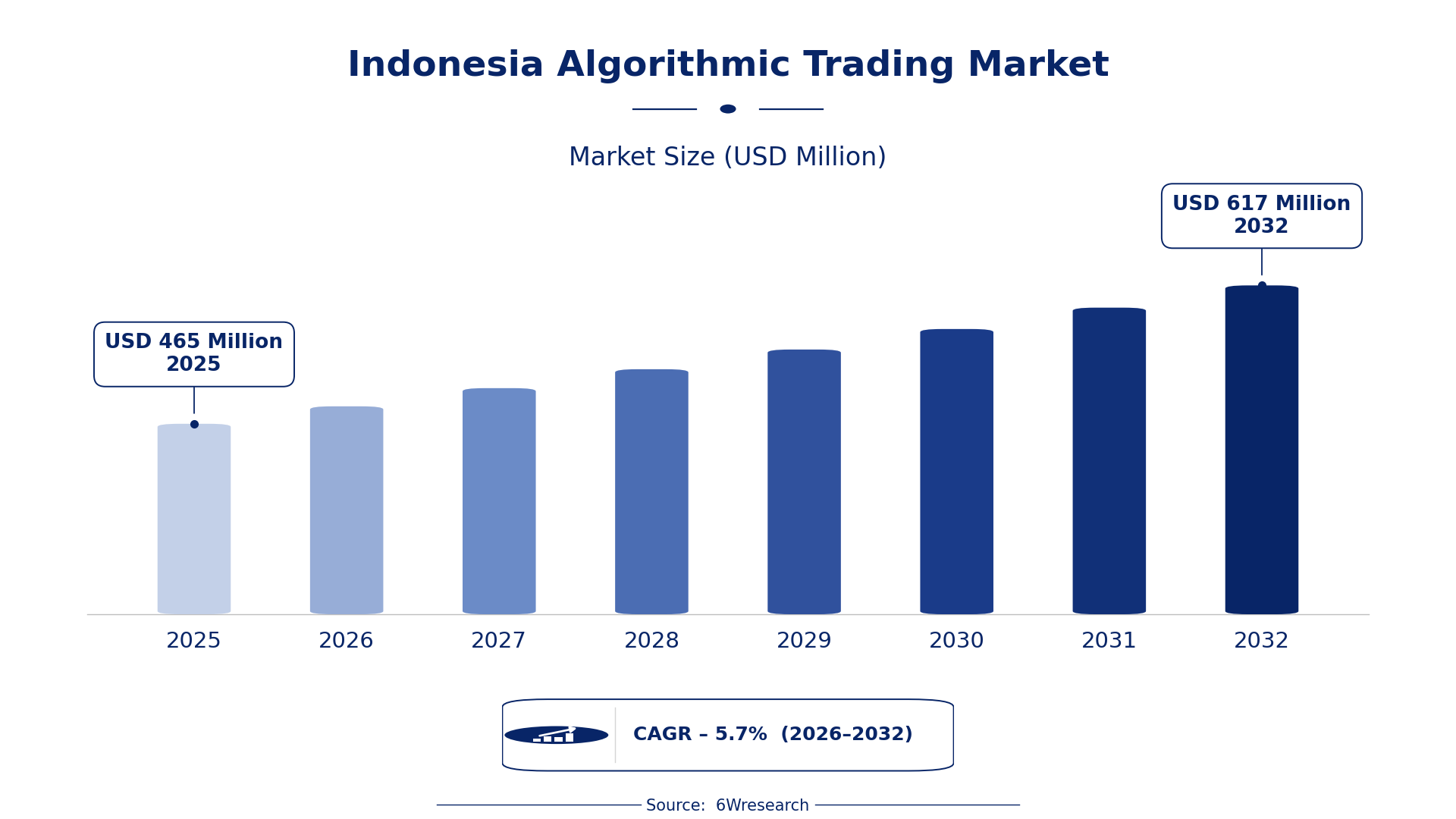
The Indonesia Algorithmic Trading Market was estimated at USD 465 Million in 2025 and is projected to reach USD 617 Million by 2032, growing at a CAGR of 5.7% from 2026 to 2032.
Indonesia Algorithmic Trading Market Synopsis
The rapid adoption of algorithmic trading strategies is the most powerful force driving the Indonesia Algorithmic Trading Market. Financial institutions are increasingly deploying these sophisticated techniques to enhance trading efficiency, minimize latency, and capitalize on market opportunities as they arise.
This surge in algorithmic trading aligns with broader advancements in financial technology, where automation and data analytics are reshaping traditional trading practices. The Indonesian market is witnessing a shift where traders are relying on algorithms to execute large volumes of trades seamlessly, creating a more dynamic trading environment.
Indonesia Algorithmic Trading Market Year-wise Growth Rate and Key Drivers
This graph illustrates the annual growth rates of the Indonesia Algorithmic Trading Market from 2021 to 2032, highlighting a steady upward trajectory and projected expansion over the forecast period.
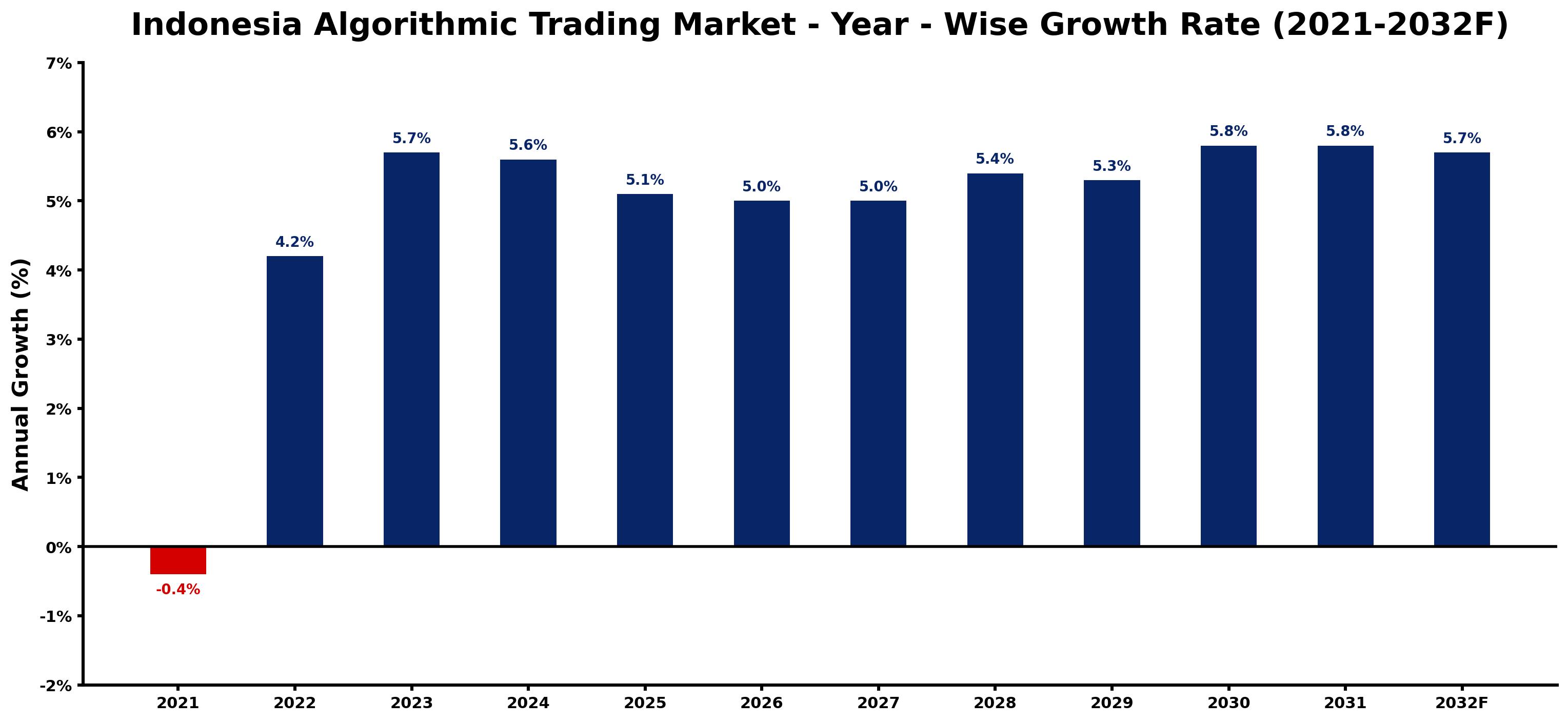
The table below presents the year‑wise growth rates along with the key drivers influencing the market
| Year | Growth Rate | Major Drivers |
| 2021 | -0.4% | Regulatory limitations from OJK on algorithmic strategies. |
| 2022 | 4.2% | Bank Indonesia's digital currency initiative boosts trading volume. |
| 2023 | 5.7% | Growing retail investor participation after regulatory simplifications. |
| 2024 | 5.6% | Increased investment in fintech startups enhances algorithmic tools. |
| 2025 | 5.1% | Surge in data analytics adoption among brokerage firms. |
| 2026 | 5.0% | New tax incentives for digital trading platforms boost engagement. |
| 2027 | 5.0% | Launched trading education programs increase algorithm proficiency. |
| 2028 | 5.4% | Major exchanges introduce more algorithmic trading products. |
| 2029 | 5.3% | Improved internet infrastructure supports high-frequency trading growth. |
| 2030 | 5.8% | Rising foreign investment diversifies algorithmic trading strategies. |
| 2031 | 5.8% | Increased regulation of traditional trading drives algorithm adoption. |
| 2032 | 5.7% | Innovative AI technologies enhance predictive trading models. |
Note: Market size estimations and growth projections presented in this report are based on 6Wresearch's proprietary forecasting methodology, utilizing the latest available industry data, government publications, and primary research inputs.
Indonesia Algorithmic Trading Market Key Takeaways
Below are some of the specific key takeaways from the market, including:
- The market is experiencing a strong upward trajectory, driven by technological advancements.
- Increased market volatility during the pandemic accelerated the adoption of algorithmic solutions.
- Financial institutions are prioritizing the integration of AI and machine learning into trading strategies.
- Regulatory frameworks are evolving to support the growth of algorithmic trading.
- Competition among investment firms is intensifying, with a focus on achieving optimal trade execution.
Evaluation of Restraints in Indonesia Algorithmic Trading Market
Despite the promising growth, the Indonesia Algorithmic Trading Market faces notable challenges. One major restraint is the integration of data across various trading platforms, which can be cumbersome and time-consuming. As firms look to consolidate their trading operations, achieving a standardized approach to data management becomes critical. Additionally, concerns around data privacy and ethical trading practices are increasingly coming into focus, requiring firms to tread carefully as they develop and deploy algorithmic solutions.
Indonesia Algorithmic Trading Market Trends
A few key trends are currently shaping the Indonesia Algorithmic Trading Market. Firstly, the incorporation of artificial intelligence and machine learning is enhancing predictive analytics capabilities, allowing traders to make informed decisions based on real-time data. Secondly, there is a marked increase in partnerships between fintech firms and traditional financial institutions, facilitating the development of innovative trading platforms. Lastly, the focus on regulatory compliance is prompting firms to invest in sophisticated risk management tools that integrate seamlessly with algorithmic trading systems.
Indonesia Algorithmic Trading Market Opportunities
The Indonesia Algorithmic Trading Market presents several avenues for growth and investment. Emerging market participants, particularly in sectors like commodities, are recognizing the value of algorithmic trading strategies. This opens doors for technology vendors to tailor solutions that meet the specific needs of these sectors. on top of that, as regulatory frameworks evolve, there will be opportunities to develop compliant trading solutions that cater to the unique challenges faced by Indonesian traders.
Government Initiatives in the Indonesia Algorithmic Trading Market
Government policy plays a crucial role in shaping the Indonesia Algorithmic Trading Market. As Indonesia seeks to enhance its financial sector's competitiveness, regulatory bodies are implementing measures to encourage technological adoption while ensuring market integrity. This proactive approach is essential for fostering investor confidence and supporting sustainable market growth.
- A national digital infrastructure upgrade programme was launched in late 2022 to enhance trading capabilities across various financial institutions.
- Currently, an initiative is underway to develop a regulatory framework aimed at enhancing the transparency of algorithmic trading practices.
- A planned public-private partnership expected to roll out by 2026 aims to provide training and resources for traders on algorithmic strategies.
- In 2023, a new regulatory guideline was introduced, mandating real-time reporting of algorithmic trades to improve market oversight.
- The government has initiated discussions on tax incentives for firms investing in advanced trading technologies, expected to be finalized by 2025.
Future Insights of the Indonesia Algorithmic Trading Market
Looking ahead to 2026-2032, the Indonesia Algorithmic Trading Market is set for substantial evolution. With increasing globalization, Indonesian traders will likely seek to integrate their operations with international markets. The push for greater technological sophistication will continue, with firms investing in more advanced algorithmic strategies to maintain a competitive edge. As regulatory environments become more accommodating, expect a surge in innovative trading solutions designed to meet the needs of a diverse range of investors.
Indonesia Algorithmic Trading Market Latest Developments
Recent activity in the Indonesia Algorithmic Trading Market has been characterized by an increased focus on technological advancements and strategic partnerships. Financial institutions are enhancing their algorithmic capabilities to keep pace with the rapid changes in market dynamics. This trend is not only reshaping trading practices but also fostering a collaborative environment among various stakeholders.
- A major technology vendor launched an upgraded algorithmic trading platform in early 2023, featuring enhanced analytics tools for traders.
- In Q2 2023, a leading investment firm began an initiative to integrate AI-driven algorithms into its trading operations, currently underway.
- A partnership between a fintech startup and a traditional brokerage firm was established in late 2023 to develop next-generation trading algorithms.
- An industry conference held in early 2024 focused on algorithmic trading innovations, attracting participation from major financial institutions and tech providers.
- A planned rollout of a new regulatory compliance software is expected to begin by mid-2024, aimed at assisting firms in adhering to evolving regulations.
Indonesia Algorithmic Trading Market - Key Attractiveness of the Report
- 10 Years of Market Numbers
- Historical Data Starting from 2022 to 2025
- Base Year: 2025
- Forecast Data until 2032
- Key Performance Indicators Impacting the Market
- Major Upcoming Developments and Projects
Key Highlights of the Report:
- Indonesia Algorithmic Trading Market Outlook
- Market Size of Indonesia Algorithmic Trading Market, 2025
- Forecast of Indonesia Algorithmic Trading Market, 2032
- Historical Data and Forecast of Indonesia Algorithmic Trading Revenues & Volume for the Period 2022-2032F
- Indonesia Algorithmic Trading Market Trend Evolution
- Indonesia Algorithmic Trading Market Drivers and Challenges
- Indonesia Algorithmic Trading Price Trends
- Indonesia Algorithmic Trading Porter's Five Forces
- Indonesia Algorithmic Trading Industry Life Cycle
- Historical Data and Forecast of Indonesia Algorithmic Trading Market Revenues & Volume By Trading Type for the Period 2022-2032F
- Historical Data and Forecast of Indonesia Algorithmic Trading Market Revenues & Volume By Foreign Exchange (FOREX) for the Period 2022-2032F
- Historical Data and Forecast of Indonesia Algorithmic Trading Market Revenues & Volume By Stock Markets for the Period 2022-2032F
- Historical Data and Forecast of Indonesia Algorithmic Trading Market Revenues & Volume By Exchange-Traded Fund (ETF) for the Period 2022-2032F
- Historical Data and Forecast of Indonesia Algorithmic Trading Market Revenues & Volume By Bonds for the Period 2022-2032F
- Historical Data and Forecast of Indonesia Algorithmic Trading Market Revenues & Volume By Cryptocurrencies for the Period 2022-2032F
- Historical Data and Forecast of Indonesia Algorithmic Trading Market Revenues & Volume By Others for the Period 2022-2032F
- Historical Data and Forecast of Indonesia Algorithmic Trading Market Revenues & Volume By Deployment Mode for the Period 2022-2032F
- Historical Data and Forecast of Indonesia Algorithmic Trading Market Revenues & Volume By Cloud for the Period 2022-2032F
- Historical Data and Forecast of Indonesia Algorithmic Trading Market Revenues & Volume By On-premises for the Period 2022-2032F
- Historical Data and Forecast of Indonesia Algorithmic Trading Market Revenues & Volume By Component for the Period 2022-2032F
- Historical Data and Forecast of Indonesia Algorithmic Trading Market Revenues & Volume By Solutions for the Period 2022-2032F
- Historical Data and Forecast of Indonesia Algorithmic Trading Market Revenues & Volume By Services for the Period 2022-2032F
- Historical Data and Forecast of Indonesia Algorithmic Trading Market Revenues & Volume By Enterprise Size for the Period 2022-2032F
- Historical Data and Forecast of Indonesia Algorithmic Trading Market Revenues & Volume By Small and Medium-sized Enterprises (SMEs) for the Period 2022-2032F
- Historical Data and Forecast of Indonesia Algorithmic Trading Market Revenues & Volume By Large Enterprises for the Period 2022-2032F
- Indonesia Algorithmic Trading Import Export Trade Statistics
- Market Opportunity Assessment By Trading Type
- Market Opportunity Assessment By Deployment Mode
- Market Opportunity Assessment By Component
- Market Opportunity Assessment By Enterprise Size
- Indonesia Algorithmic Trading Top Companies Market Share
- Indonesia Algorithmic Trading Competitive Benchmarking By Technical and Operational Parameters
- Indonesia Algorithmic Trading Company Profiles
- Indonesia Algorithmic Trading Key Strategic Recommendations






































