Indonesia Aluminum Based Strips Market Size, Share & Growth Rate
The Indonesia Aluminum Based Strips Market was estimated at USD 358 Million in 2025 and is projected to reach USD 478 Million by 2032, growing at a CAGR of 4.2% from 2026 to 2032. This growth trajectory is largely influenced by the robust demand in key sectors such as automotive and construction, where lightweight and corrosion-resistant materials are increasingly favored. Additionally, ongoing infrastructure development initiatives in Indonesia further enhance the prospects for aluminum-based strips, signaling a positive outlook for manufacturers and investors alike.
Indonesia Aluminum Based Strips Market Year-wise Growth Rate and Key Drivers
This graph highlights how the Indonesia Aluminum Based Strips Market has steadily grown over the years, supported by major growth factors.
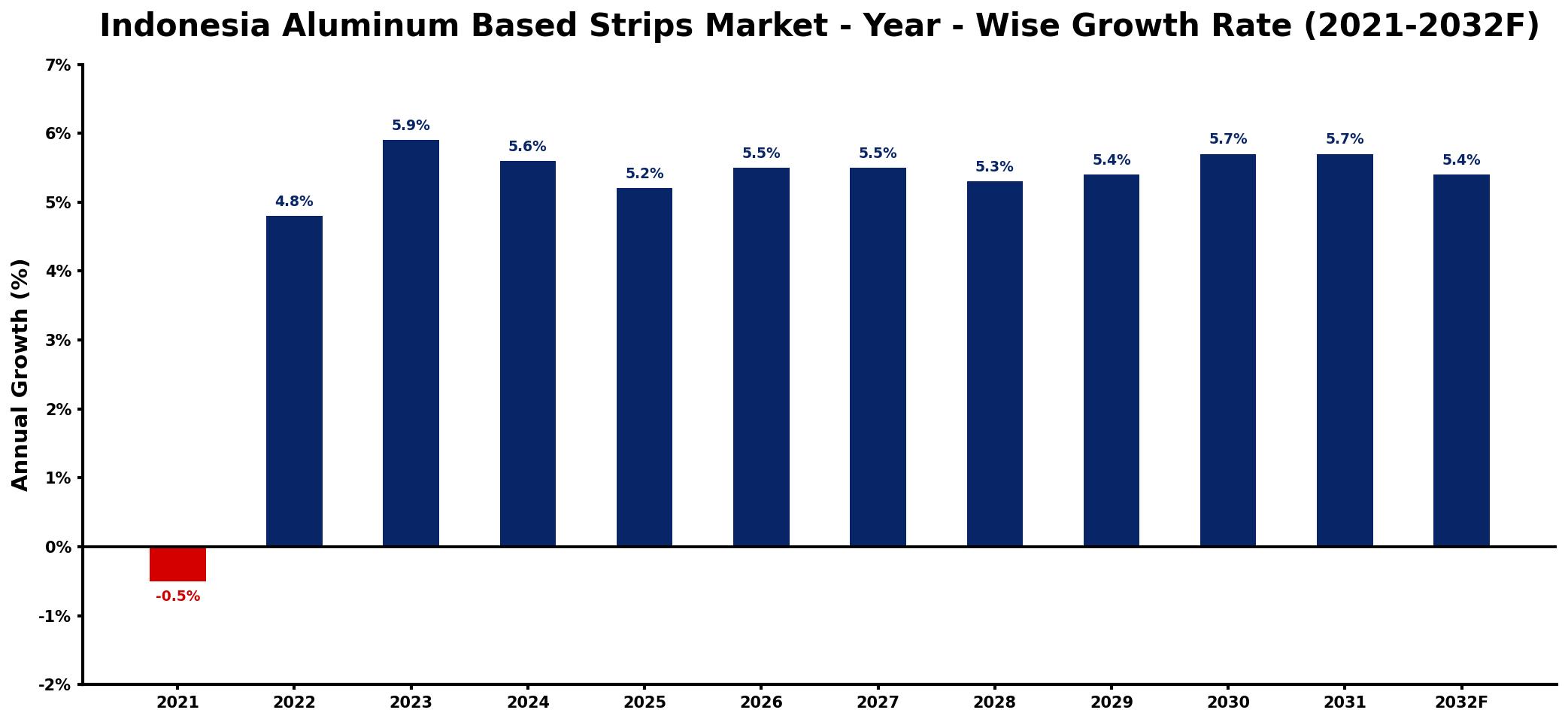
The table below presents the year‑wise growth rates along with the key drivers influencing the market
| Year | Growth Rate | Major Drivers |
| 2021 | -0.5% | decreased construction sector demand |
| 2022 | 4.8% | increased automotive industry investments |
| 2023 | 5.9% | growing renewable energy projects |
| 2024 | 5.6% | expansion in packaging applications |
| 2025 | 5.2% | rising infrastructure development initiatives |
| 2026 | 5.5% | increased demand from electronics |
| 2027 | 5.5% | growing construction material usage |
| 2028 | 5.3% | improved raw material availability |
| 2029 | 5.4% | rising demand for lightweight materials |
| 2030 | 5.7% | increased focus on sustainability practices |
| 2031 | 5.7% | growing exports to neighboring markets |
| 2032 | 5.4% | increased domestic production output |
Note: Market size estimations and growth projections presented in this report are based on 6Wresearch's proprietary forecasting methodology, utilizing the latest available industry data, government publications, and primary research inputs.
Indonesia Aluminum Based Strips Market Synopsis
The demand for aluminum-based strips in Indonesia is bolstered by their integral role in various applications, particularly in automotive components and building materials. As industries adapt to more sustainable practices, aluminums lightweight properties and recyclability make it an increasingly popular choice.
Furthermore, the market's resilience during the COVID-19 pandemic illustrates its adaptability, as production and supply chains gradually stabilize. Although challenges exist, the fundamental demand for aluminum strips across diverse sectors ensures a steady growth environment.
Indonesia Aluminum Based Strips Market Key Takeaways
- The Indonesia Aluminum Based Strips Market is projected to see significant growth, reflecting the countrys industrial advancements.
- Automotive, construction, and electrical industries are the primary drivers of demand for aluminum strips.
- Environmental considerations are pushing industries towards adopting aluminum due to its sustainability credentials.
- Potential raw material price fluctuations may challenge market stability but can be managed with strategic sourcing.
- Investment in local infrastructure is expected to propel future growth in the aluminum strips sector.
Evaluation of Restraints in Indonesia Aluminum Based Strips Market
Despite the market's overall growth potential, there are notable restraints affecting its trajectory. Fluctuations in raw material prices can lead to uncertainty for manufacturers, impacting profit margins and pricing strategies. Furthermore, intense competition from alternative materials, which may offer lower costs or different properties, poses a continuous challenge. These factors require stakeholders to stay agile and innovate to maintain a competitive edge in the market.
Indonesia Aluminum Based Strips Market Trends
Current trends in the Indonesia Aluminum Based Strips Market reveal a growing emphasis on sustainability, with industries increasingly prioritizing eco-friendly materials. Innovations in manufacturing processes also highlight advancements that enhance the quality and performance of aluminum strips. Additionally, the rise of automation in production lines indicates a shift towards efficiency and reduced labor costs, promising a more streamlined supply chain.
Indonesia Aluminum Based Strips Market Opportunities
Opportunities for growth in the Indonesia Aluminum Based Strips Market are ripe, particularly in sectors looking to modernize. As urbanization accelerates, the construction industry is poised to demand more aluminum products for residential and commercial projects. Furthermore, the automotive sector's transition towards electric vehicles presents an avenue for aluminum-based innovations that enhance performance while reducing vehicle weight.
Government Initiatives in the Indonesia Aluminum Based Strips Market
The Indonesian government has demonstrated a commitment to infrastructure development and energy efficiency, creating a favorable policy landscape for aluminum-based products. Initiatives aimed at promoting sustainable materials further enhance this environment, encouraging manufacturers to invest in research and development. Through various public spending programs, the government is also focused on enhancing local production capacities and reducing reliance on imports, bolstering the overall market.
Future Insights of the Indonesia Aluminum Based Strips Market
Looking ahead to 2026-2032, the Indonesia Aluminum Based Strips Market is expected to evolve significantly, driven by continued industrial growth and increased adoption of sustainable practices. Investments in technology and innovation will likely improve product quality and reduce costs. Additionally, as consumers and industries prioritize eco-friendly materials, aluminum's recyclability and lightweight properties will keep it at the forefront of material choices in various applications.
Indonesia Aluminum Based Strips Market Latest Developments (2025 - 2026)
Recent developments in the Indonesia Aluminum Based Strips Market indicate a shift towards more automated production facilities, enhancing efficiency and reducing production costs. Manufacturers are also focusing on expanding their product portfolios to meet the growing demand from the automotive and construction sectors. Innovations in alloy compositions are being explored to improve performance characteristics, aligning with the market's sustainability goals.
Indonesia Aluminum Based Strips Market - Key Attractiveness of the Report
- 10 Years of Market Numbers
- Historical Data Starting from 2022 to 2025
- Base Year: 2025
- Forecast Data until 2032
- Key Performance Indicators Impacting the Market
- Major Upcoming Developments and Projects
Key Highlights of the Report:
- Indonesia Aluminum Based Strips Market Outlook
- Market Size of Indonesia Aluminum Based Strips Market, 2025
- Forecast of Indonesia Aluminum Based Strips Market, 2032
- Historical Data and Forecast of Indonesia Aluminum Based Strips Revenues & Volume for the Period 2022-2032F
- Indonesia Aluminum Based Strips Market Trend Evolution
- Indonesia Aluminum Based Strips Market Drivers and Challenges
- Indonesia Aluminum Based Strips Price Trends
- Indonesia Aluminum Based Strips Porter's Five Forces
- Indonesia Aluminum Based Strips Industry Life Cycle
- Historical Data and Forecast of Indonesia Aluminum Based Strips Market Revenues & Volume By Product for the Period 2022-2032F
- Historical Data and Forecast of Indonesia Aluminum Based Strips Market Revenues & Volume By Width <6mm for the Period 2022-2032F
- Historical Data and Forecast of Indonesia Aluminum Based Strips Market Revenues & Volume By Width from 6 to 10mm for the Period 2022-2032F
- Historical Data and Forecast of Indonesia Aluminum Based Strips Market Revenues & Volume By Width >10mm for the Period 2022-2032F
- Historical Data and Forecast of Indonesia Aluminum Based Strips Market Revenues & Volume By Application for the Period 2022-2032F
- Historical Data and Forecast of Indonesia Aluminum Based Strips Market Revenues & Volume By Medical for the Period 2022-2032F
- Historical Data and Forecast of Indonesia Aluminum Based Strips Market Revenues & Volume By Automotive for the Period 2022-2032F
- Historical Data and Forecast of Indonesia Aluminum Based Strips Market Revenues & Volume By Electronics for the Period 2022-2032F
- Historical Data and Forecast of Indonesia Aluminum Based Strips Market Revenues & Volume By Others for the Period 2022-2032F
- Indonesia Aluminum Based Strips Import Export Trade Statistics
- Market Opportunity Assessment By Product
- Market Opportunity Assessment By Application
- Indonesia Aluminum Based Strips Top Companies Market Share
- Indonesia Aluminum Based Strips Competitive Benchmarking By Technical and Operational Parameters
- Indonesia Aluminum Based Strips Company Profiles
- Indonesia Aluminum Based Strips Key Strategic Recommendations






































