Indonesia Alunite Market Size, Share & Growth Rate
The Indonesia Alunite Market was estimated at USD 259 Million in 2025 and is projected to reach USD 341 Million by 2032, growing at a CAGR of 4.0% from 2026 to 2032. This upward trajectory can be attributed to the escalating demand for alunite as a critical raw material in various sectors such as ceramics, agriculture, and water treatment. Moreover, the growth is fueled by Indonesias expanding industrial base and a burgeoning agricultural sector that increasingly requires potassium-rich fertilizers.
Indonesia Alunite Market Year-wise Growth Rate and Key Drivers
This graph highlights how the Indonesia Alunite Market has steadily grown over the years, supported by major growth factors.
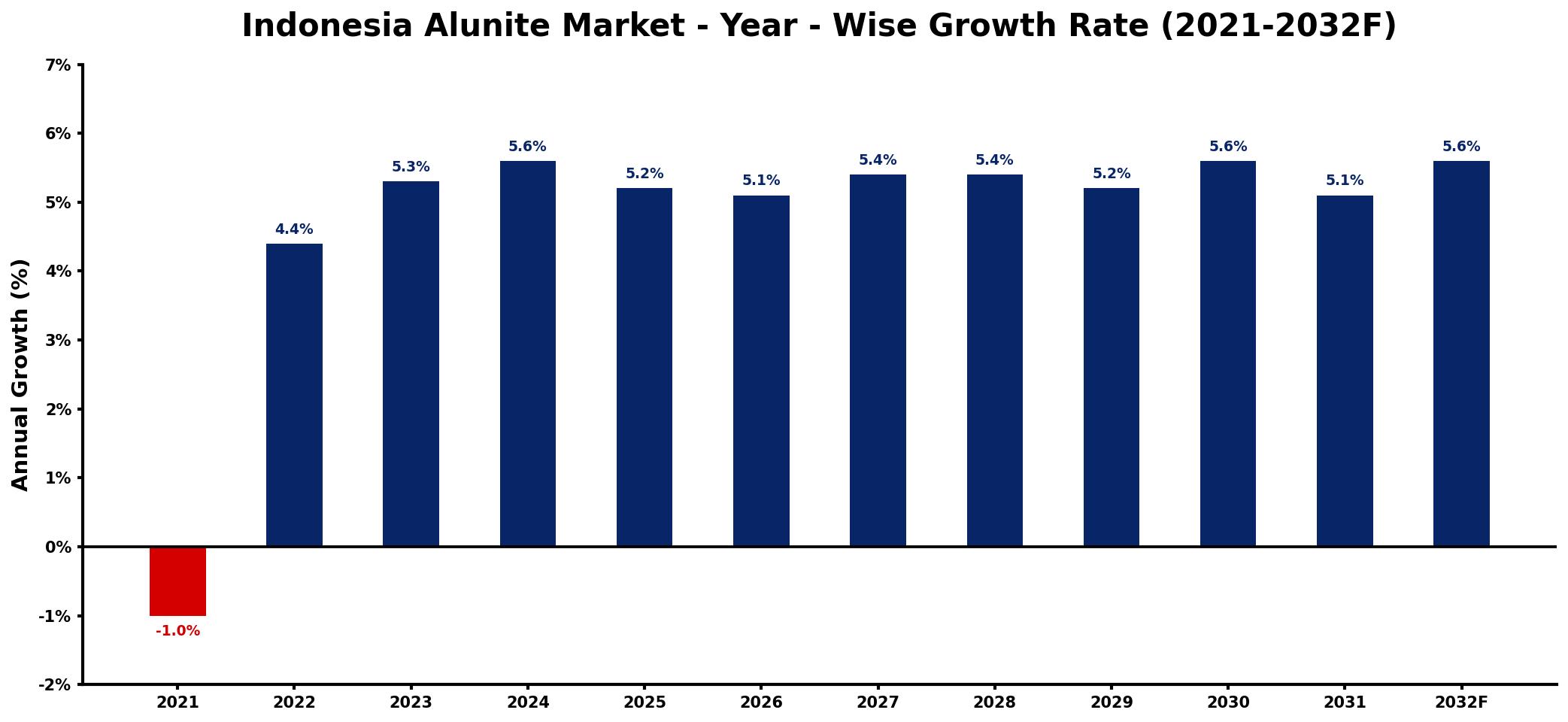
The table below presents the year‑wise growth rates along with the key drivers influencing the market
| Year | Growth Rate | Major Drivers |
| 2021 | -1.0% | decreased construction project investments |
| 2022 | 4.4% | growing demand for industrial minerals |
| 2023 | 5.3% | increased environmental regulations enforcement |
| 2024 | 5.6% | expansion of mining operations globally |
| 2025 | 5.2% | rising interest in sustainable materials |
| 2026 | 5.1% | growth in energy sector projects |
| 2027 | 5.4% | development of new extraction technologies |
| 2028 | 5.4% | increased investment in infrastructure projects |
| 2029 | 5.2% | higher demand from agricultural sector |
| 2030 | 5.6% | growing adoption of eco-friendly practices |
| 2031 | 5.1% | increased overall sector activity |
| 2032 | 5.6% | increased focus on mineral sourcing |
Note: Market size estimations and growth projections presented in this report are based on 6Wresearch's proprietary forecasting methodology, utilizing the latest available industry data, government publications, and primary research inputs.
Indonesia Alunite Market Synopsis
The Indonesian alunite market stands at a pivotal juncture, characterized by a surge in its application across multiple industries. Particularly, its role in alumina production and as an additive in cementation is gaining traction, reinforcing its market position.
Additionally, the mineral's utility in environmental applications, such as sewage treatment, highlights its versatility and importance in achieving sustainable industrial practices. The shift towards e-commerce platforms is also enhancing accessibility, catering to a wider audience in the post-pandemic landscape.
Indonesia Alunite Market Key Takeaways
- Increasing application scope in sectors like agriculture and construction is propelling market growth.
- Demand for potassium-rich fertilizers is a significant driver of alunite's market potential.
- The versatility of alunite in industrial processes continues to open new avenues for its utilization.
- Growing online distribution channels are making alunite more accessible to consumers.
- Indonesia's expanding industrial landscape presents a fertile ground for alunite market expansion.
Evaluation of Restraints in Indonesia Alunite Market
Despite the promising outlook, the Indonesian alunite market faces notable constraints. A lack of widespread awareness about its diverse applications hinders market penetration, as many potential users may default to more familiar alternatives. Additionally, competition from other raw materials may limit alunites adoption in certain applications. Efficient extraction and processing methods remain crucial to maximize profitability and market share, posing further challenges for stakeholders seeking to optimize their operations.
Indonesia Alunite Market Trends
A defining trend in the Indonesian alunite market is the heightened focus on sustainability. Industries are increasingly seeking raw materials that align with environmental goals, positioning alunite as a preferred choice due to its dual role in both industrial processes and environmental remediation. Furthermore, technological advancements in extraction and processing methods are expected to enhance efficiency and reduce costs, while the growing digital marketplace is making it easier for consumers and industries to source alunite.
Indonesia Alunite Market Opportunities
The future holds significant growth opportunities for the Indonesian alunite market. The agricultural sector's insatiable demand for potassium-rich fertilizers presents a prime avenue for expansion. Additionally, the rise of eco-friendly practices and the push towards using sustainable materials in construction and industry will likely boost alunites adoption. Strategic investments in research and development are also essential to unlock further applications, enhancing alunites value proposition across various industries.
Government Initiatives in the Indonesia Alunite Market
The Indonesian government is actively promoting initiatives aimed at enhancing the mining and utilization of local mineral resources, including alunite. Policies focusing on sustainable mining practices and increased investment in infrastructure are expected to support market growth. Furthermore, public spending directed at agricultural advancements will likely elevate the demand for potassium-rich fertilizers derived from alunite, reinforcing the minerals market position.
Future Insights of the Indonesia Alunite Market
Looking ahead to 2026-2032, the Indonesian alunite market is poised for steady growth, driven by expanding industrial applications and increasing demand in agriculture. Innovations in processing technologies may further enhance alunites appeal, while the continuous development of sustainable practices will create new opportunities. As awareness about alunites benefits spreads, we can anticipate a more prominent role for this mineral in Indonesias industrial landscape.
Indonesia Alunite Market Latest Developments (2025 - 2026)
Recent developments indicate a growing emphasis on the role of alunite in emerging environmental applications, particularly in water treatment processes. The trend towards digitalization is also becoming apparent, as companies increasingly leverage online platforms to reach broader markets. These shifts reflect a proactive industry response to changing consumer demands and global sustainability trends, fostering optimism for future market performance.
Indonesia Alunite Market - Key Attractiveness of the Report
- 10 Years of Market Numbers
- Historical Data Starting from 2022 to 2025
- Base Year: 2025
- Forecast Data until 2032
- Key Performance Indicators Impacting the Market
- Major Upcoming Developments and Projects
Key Highlights of the Report:
- Indonesia Alunite Market Outlook
- Market Size of Indonesia Alunite Market, 2025
- Forecast of Indonesia Alunite Market, 2032
- Historical Data and Forecast of Indonesia Alunite Revenues & Volume for the Period 2022-2032F
- Indonesia Alunite Market Trend Evolution
- Indonesia Alunite Market Drivers and Challenges
- Indonesia Alunite Price Trends
- Indonesia Alunite Porter's Five Forces
- Indonesia Alunite Industry Life Cycle
- Historical Data and Forecast of Indonesia Alunite Market Revenues & Volume By Product for the Period 2022-2032F
- Historical Data and Forecast of Indonesia Alunite Market Revenues & Volume By Natroalunite for the Period 2022-2032F
- Historical Data and Forecast of Indonesia Alunite Market Revenues & Volume By Potassium alunite for the Period 2022-2032F
- Historical Data and Forecast of Indonesia Alunite Market Revenues & Volume By End User for the Period 2022-2032F
- Historical Data and Forecast of Indonesia Alunite Market Revenues & Volume By Pharmaceuticals for the Period 2022-2032F
- Historical Data and Forecast of Indonesia Alunite Market Revenues & Volume By Cosmetics for the Period 2022-2032F
- Historical Data and Forecast of Indonesia Alunite Market Revenues & Volume By FMCG for the Period 2022-2032F
- Historical Data and Forecast of Indonesia Alunite Market Revenues & Volume By Others for the Period 2022-2032F
- Indonesia Alunite Import Export Trade Statistics
- Market Opportunity Assessment By Product
- Market Opportunity Assessment By End User
- Indonesia Alunite Top Companies Market Share
- Indonesia Alunite Competitive Benchmarking By Technical and Operational Parameters
- Indonesia Alunite Company Profiles
- Indonesia Alunite Key Strategic Recommendations






































