Indonesia Antiparasitics Drugs Market Size, Share & Growth Rate
The Indonesia Antiparasitics Drugs Market was estimated at USD 379 Million in 2025 and is projected to reach USD 501 Million by 2032, growing at a CAGR of 4.1% from 2026 to 2032. This growth trajectory is significantly influenced by the rising incidence of parasitic infections in the region, particularly zoonotic diseases such as malaria and leishmaniasis. Additionally, heightened awareness of preventive measures and the availability of effective treatment options are further fueling market expansion.
Indonesia Antiparasitics Drugs Market Year-wise Growth Rate and Key Drivers
This graph highlights how the Indonesia Antiparasitics Drugs Market has steadily grown over the years, supported by major growth factors.
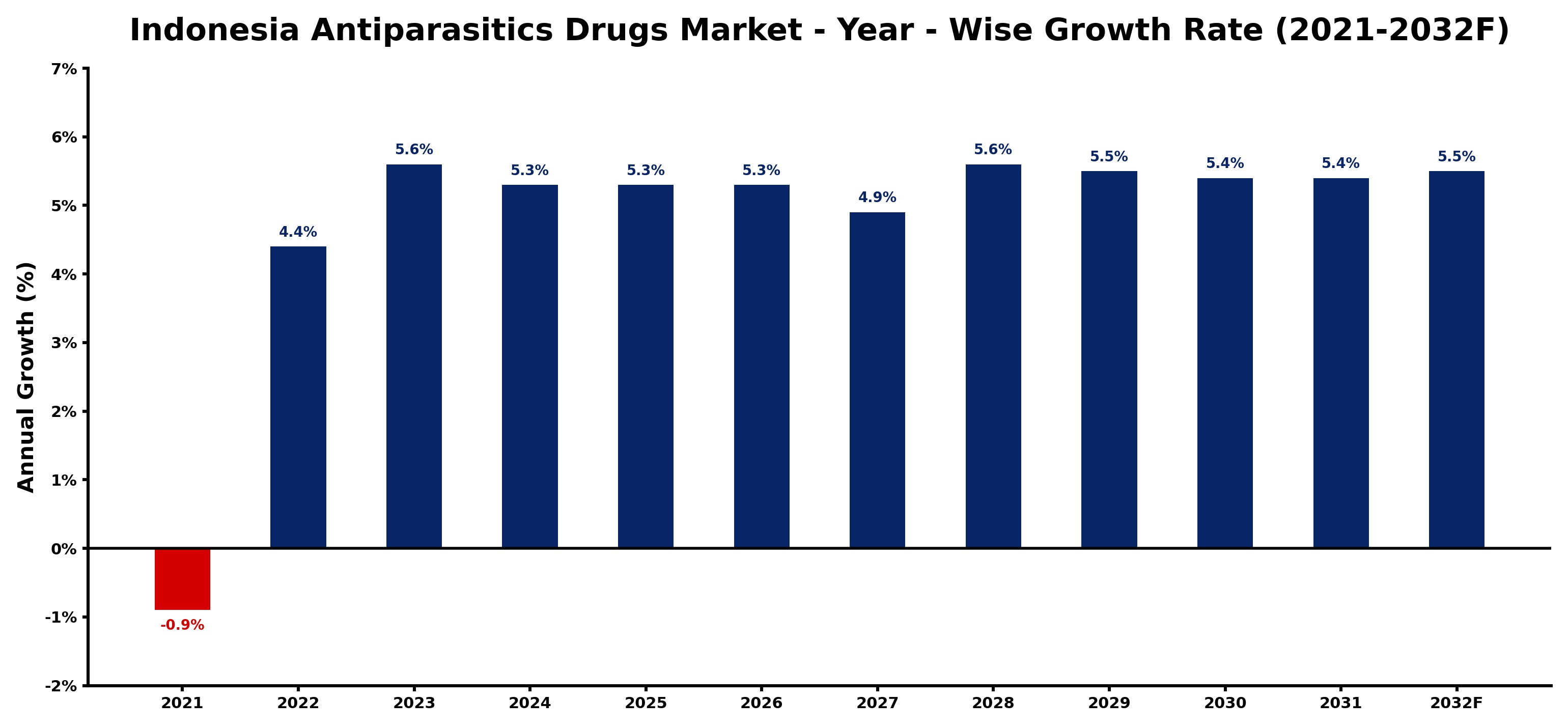
The table below presents the year‑wise growth rates along with the key drivers influencing the market
| Year | Growth Rate | Major Drivers |
| 2021 | -0.9% | Reduced domestic investments hampered antiparasitic production capacity expansion |
| 2022 | 4.4% | Accelerated local pharmaceutical production bolstered antiparasitic drug supply chains |
| 2023 | 5.6% | Domestic pharmaceutical manufacturers boost antiparasitic drug production capacity |
| 2024 | 5.3% | Pharmaceutical manufacturing upgrades boost antiparasitic drug production capacity |
| 2025 | 5.3% | OEM investments boosted capacity utilization in local antiparasitic production |
| 2026 | 5.3% | Domestic pharmaceutical production modernization enhances antiparasitic drug availability |
| 2027 | 4.9% | Digital health solutions boosted production efficiency in antiparasitic manufacturing |
| 2028 | 5.6% | Increased vehicle assembly demand boosted local API production capacity |
| 2029 | 5.5% | Manufacturing investments in local facilities boost antiparasitic drug production |
| 2030 | 5.4% | Regional pharmaceutical production ramp up drives antiparasitics demand recovery |
| 2031 | 5.4% | Pharmaceutical manufacturing capacity investments boosted antiparasitic drug output |
| 2032 | 5.5% | Modernized drug manufacturing facilities boost local antiparasitic production capacity |
Note - Market size estimations and growth projections presented in this report are based on 6Wresearch’s advanced forecasting approach, validated with industry datasets as of June 2026.
Indonesia Antiparasitics Drugs Market Synopsis
The Indonesian landscape for antiparasitics is evolving, marked by a surge in public health initiatives aimed at combating infectious diseases. Recent years have seen a concerted effort from both governmental and private sectors to bolster healthcare infrastructure, directly impacting the availability and accessibility of antiparasitic treatments.
The growing awareness of the health impacts associated with parasitic infections is prompting greater investment in research and development. This translates to a more dynamic marketplace, where innovative products and robust distribution channels are becoming pivotal in reaching underserved populations.
Indonesia Antiparasitics Drugs Market Key Takeaways
- The market is experiencing steady growth driven by increasing parasitic infections and improved healthcare awareness.
- Investment in healthcare infrastructure and R&D is leading to innovative treatment options and greater accessibility.
- Government initiatives are helping combat the burden of infectious diseases, particularly in rural areas.
- There is a marked shift towards the adoption of generic medicines, making treatments more affordable for consumers.
- The emergence of public-private partnerships is enhancing the distribution network for antiparasitic drugs.
Evaluation of Restraints in Indonesia Antiparasitics Drugs Market
Despite the positive growth outlook, the Indonesia Antiparasitics Drugs Market faces several constraints. Limited access to quality medications remains a significant challenge, particularly in remote areas where distribution can be erratic. Additionally, inadequate educational resources regarding proper drug usage can lead to improper treatment practices, resulting in a cycle of inefficiency in managing parasitic infections. Furthermore, the rising concern over antimicrobial resistance highlights the urgent need for new formulations and effective management strategies to combat evolving parasite strains.
Indonesia Antiparasitics Drugs Market Trends
Several key trends are shaping the landscape of the Indonesia Antiparasitics Drugs Market. The increase in zoonotic diseases, particularly malaria, is prompting a higher demand for effective treatment options. Concurrently, local pharmaceutical companies are innovating, reflecting a rising trend towards personalized medicine tailored for specific infections. Additionally, as the population becomes more health-conscious, there is a notable shift toward preventive healthcare measures, such as widespread vaccination programs and community health initiatives.
Indonesia Antiparasitics Drugs Market Opportunities
The opportunities within the Indonesia Antiparasitics Drugs Market are vast. The surge in healthcare spending opens doors for new entrants aiming to develop novel antiparasitic drugs. Additionally, the government's commitment to improving healthcare access creates an encouraging environment for investments in drug distribution and supply chain enhancement. The growing trend of telemedicine and digital health platforms also presents innovative channels to reach and educate patients, particularly in underserved regions.
Government Initiatives in the Indonesia Antiparasitics Drugs Market
The Indonesian government has been actively engaged in initiatives to strengthen public health concerning parasitic diseases. Increased funding for healthcare services has allowed for expanded vaccination programs and better access to essential medications. Public campaigns aimed at raising awareness about parasitic infections are also underway, promoting early diagnosis and treatment. By enhancing collaboration between public and private sectors, these initiatives aim to create a more resilient healthcare framework capable of addressing the challenges posed by infectious diseases.
Future Insights of the Indonesia Antiparasitics Drugs Market
Looking ahead to the period from 2026 to 2032, the Indonesia Antiparasitics Drugs Market is poised for considerable growth. The anticipated rise in healthcare expenditure combined with a focus on disease prevention will foster an environment conducive to innovation. With ongoing efforts to improve drug accessibility and enhance patient education, the market is expected to evolve significantly, driven by both domestic and international players seeking to address the pressing needs of the population.
Indonesia Antiparasitics Drugs Market Latest Developments (May 2025 - June 2026)
Recent developments in the Indonesia Antiparasitics Drugs Market highlight a growing trend towards collaboration between research institutions and pharmaceutical companies. Notably, increased investments in local manufacturing facilities are aimed at reducing reliance on imports while enhancing the supply chain efficiency. Additionally, health organizations are expanding their roles in public education campaigns, emphasizing the importance of parasite screening and treatment adherence, thereby catalyzing a cultural shift towards proactive health management.
Indonesia Antiparasitics Drugs Market - Key Attractiveness of the Report
- 10 Years of Market Numbers
- Historical Data Starting from 2022 to 2025
- Base Year: 2025
- Forecast Data until 2032
- Key Performance Indicators Impacting the Market
- Major Upcoming Developments and Projects
Key Highlights of the Report:
- Indonesia Antiparasitics Drugs Market Outlook
- Market Size of Indonesia Antiparasitics Drugs Market, 2025
- Forecast of Indonesia Antiparasitics Drugs Market, 2032
- Historical Data and Forecast of Indonesia Antiparasitics Drugs Revenues & Volume for the Period 2022-2032F
- Indonesia Antiparasitics Drugs Market Trend Evolution
- Indonesia Antiparasitics Drugs Market Drivers and Challenges
- Indonesia Antiparasitics Drugs Price Trends
- Indonesia Antiparasitics Drugs Porter's Five Forces
- Indonesia Antiparasitics Drugs Industry Life Cycle
- Historical Data and Forecast of Indonesia Antiparasitics Drugs Market Revenues & Volume By Route of Administration for the Period 2022-2032F
- Historical Data and Forecast of Indonesia Antiparasitics Drugs Market Revenues & Volume By Oral for the Period 2022-2032F
- Historical Data and Forecast of Indonesia Antiparasitics Drugs Market Revenues & Volume By Injectable for the Period 2022-2032F
- Historical Data and Forecast of Indonesia Antiparasitics Drugs Market Revenues & Volume By Topical for the Period 2022-2032F
- Historical Data and Forecast of Indonesia Antiparasitics Drugs Market Revenues & Volume By Drug class for the Period 2022-2032F
- Historical Data and Forecast of Indonesia Antiparasitics Drugs Market Revenues & Volume By Anthelmintics for the Period 2022-2032F
- Historical Data and Forecast of Indonesia Antiparasitics Drugs Market Revenues & Volume By Antiprotozoals for the Period 2022-2032F
- Historical Data and Forecast of Indonesia Antiparasitics Drugs Market Revenues & Volume By Others for the Period 2022-2032F
- Historical Data and Forecast of Indonesia Antiparasitics Drugs Market Revenues & Volume By Distribution Channel for the Period 2022-2032F
- Historical Data and Forecast of Indonesia Antiparasitics Drugs Market Revenues & Volume By Hospital Pharmacies for the Period 2022-2032F
- Historical Data and Forecast of Indonesia Antiparasitics Drugs Market Revenues & Volume By Retail Pharmacies for the Period 2022-2032F
- Historical Data and Forecast of Indonesia Antiparasitics Drugs Market Revenues & Volume By Online Pharmacies for the Period 2022-2032F
- Indonesia Antiparasitics Drugs Import Export Trade Statistics
- Market Opportunity Assessment By Route of Administration
- Market Opportunity Assessment By Drug class
- Market Opportunity Assessment By Distribution Channel
- Indonesia Antiparasitics Drugs Top Companies Market Share
- Indonesia Antiparasitics Drugs Competitive Benchmarking By Technical and Operational Parameters
- Indonesia Antiparasitics Drugs Company Profiles
- Indonesia Antiparasitics Drugs Key Strategic Recommendations






































