Indonesia Aquatic Herbicides Market: Import Trend Analysis
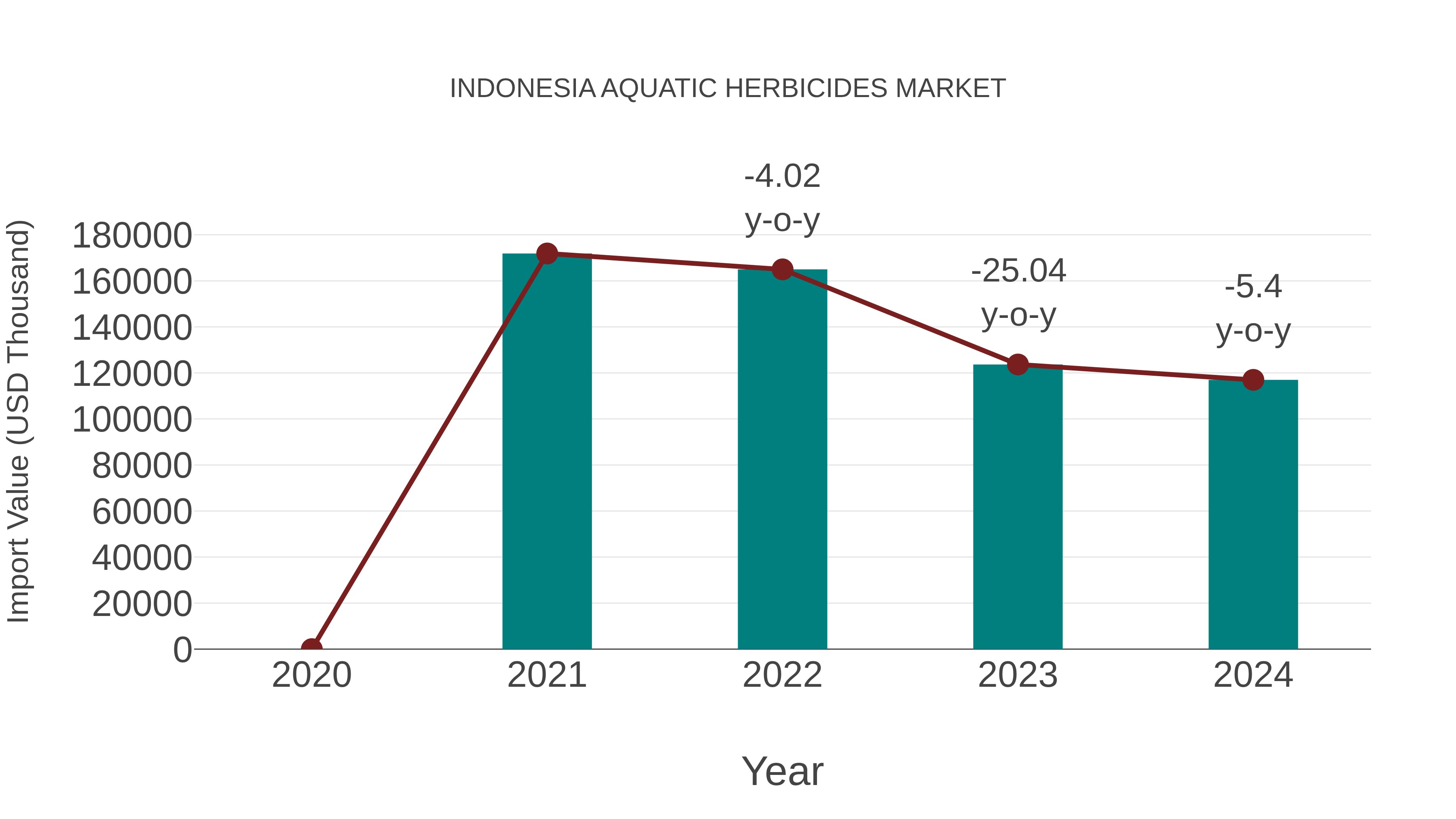
Indonesia`s import trend for aquatic herbicides in 2024 saw a decline, with a growth rate of -5.4% compared to the previous year. The compound annual growth rate (CAGR) for the period 2020-2024 stood at -12.04%. This negative import momentum could be attributed to a shift in demand dynamics or evolving trade policies impacting the market stability.
Indonesia Aquatic Herbicides Market Overview
In a country with abundant water bodies, the aquatic herbicides market in Indonesia addresses the need for effective control of aquatic weeds. These weeds can impede water flow, affect aquatic ecosystems, and hinder agricultural practices in areas with irrigation systems. The market offers a range of selective and non-selective herbicides tailored to different aquatic environments.
Drivers of the Market
The aquatic herbicides market in Indonesia is influenced by the need to control aquatic weeds and maintain water bodies for various purposes. These herbicides are essential for managing water resources, including agriculture, aquaculture, and recreational areas. Environmental regulations and the growing demand for clean and functional water bodies drive market growth.
Challenges of the Market
The aquatic herbicides market in Indonesia faces a significant challenge in minimizing off-target effects on aquatic ecosystems. Ensuring that herbicides effectively target unwanted aquatic plants without harming beneficial species or water quality is a complex task. Additionally, managing herbicide resistance in aquatic environments presents an ongoing challenge that necessitates research into alternative control methods.
COVID-19 Impacts on the Market
The Indonesia aquatic herbicides market faced challenges during the COVID-19 pandemic. Disruptions in supply chains and limited availability of labor affected the production and distribution of aquatic herbicides. This led to sporadic shortages and increased prices, impacting aquatic weed control efforts. As the situation improved and supply chains stabilized, the market began to recover.
Key Players of the Makret
In the aquatic herbicides market, PT BASF Indonesia is a leading provider of solutions to control and manage aquatic weeds, which are common in Indonesian rice fields and water bodies.
Key Highlights of the Report:
- Indonesia Aquatic Herbicides Market Outlook
- Market Size of Indonesia Aquatic Herbicides Market, 2025
- Forecast of Indonesia Aquatic Herbicides Market, 2032
- Historical Data and Forecast of Indonesia Aquatic Herbicides Revenues & Volume for the Period 2022-2032F
- Indonesia Aquatic Herbicides Market Trend Evolution
- Indonesia Aquatic Herbicides Market Drivers and Challenges
- Indonesia Aquatic Herbicides Price Trends
- Indonesia Aquatic Herbicides Porter's Five Forces
- Indonesia Aquatic Herbicides Industry Life Cycle
- Historical Data and Forecast of Indonesia Aquatic Herbicides Market Revenues & Volume By Type for the Period 2022-2032F
- Historical Data and Forecast of Indonesia Aquatic Herbicides Market Revenues & Volume By Glyphosate for the Period 2022-2032F
- Historical Data and Forecast of Indonesia Aquatic Herbicides Market Revenues & Volume By 2 for the Period 2022-2032F
- Historical Data and Forecast of Indonesia Aquatic Herbicides Market Revenues & Volume By 4-D for the Period 2022-2032F
- Historical Data and Forecast of Indonesia Aquatic Herbicides Market Revenues & Volume By Imazapyr for the Period 2022-2032F
- Historical Data and Forecast of Indonesia Aquatic Herbicides Market Revenues & Volume By Diquat for the Period 2022-2032F
- Historical Data and Forecast of Indonesia Aquatic Herbicides Market Revenues & Volume By Triclopyr for the Period 2022-2032F
- Historical Data and Forecast of Indonesia Aquatic Herbicides Market Revenues & Volume By Application Method for the Period 2022-2032F
- Historical Data and Forecast of Indonesia Aquatic Herbicides Market Revenues & Volume By Foliar for the Period 2022-2032F
- Historical Data and Forecast of Indonesia Aquatic Herbicides Market Revenues & Volume By Submerged for the Period 2022-2032F
- Historical Data and Forecast of Indonesia Aquatic Herbicides Market Revenues & Volume By Application for the Period 2022-2032F
- Historical Data and Forecast of Indonesia Aquatic Herbicides Market Revenues & Volume By Agricultural Waters for the Period 2022-2032F
- Historical Data and Forecast of Indonesia Aquatic Herbicides Market Revenues & Volume By Fisheries for the Period 2022-2032F
- Historical Data and Forecast of Indonesia Aquatic Herbicides Market Revenues & Volume By Recreational Waters for the Period 2022-2032F
- Indonesia Aquatic Herbicides Import Export Trade Statistics
- Market Opportunity Assessment By Type
- Market Opportunity Assessment By Application Method
- Market Opportunity Assessment By Application
- Indonesia Aquatic Herbicides Top Companies Market Share
- Indonesia Aquatic Herbicides Competitive Benchmarking By Technical and Operational Parameters
- Indonesia Aquatic Herbicides Company Profiles
- Indonesia Aquatic Herbicides Key Strategic Recommendations






































