Indonesia Artificial Intelligence in Retail Market Size & Growth Rate (2026-2032)
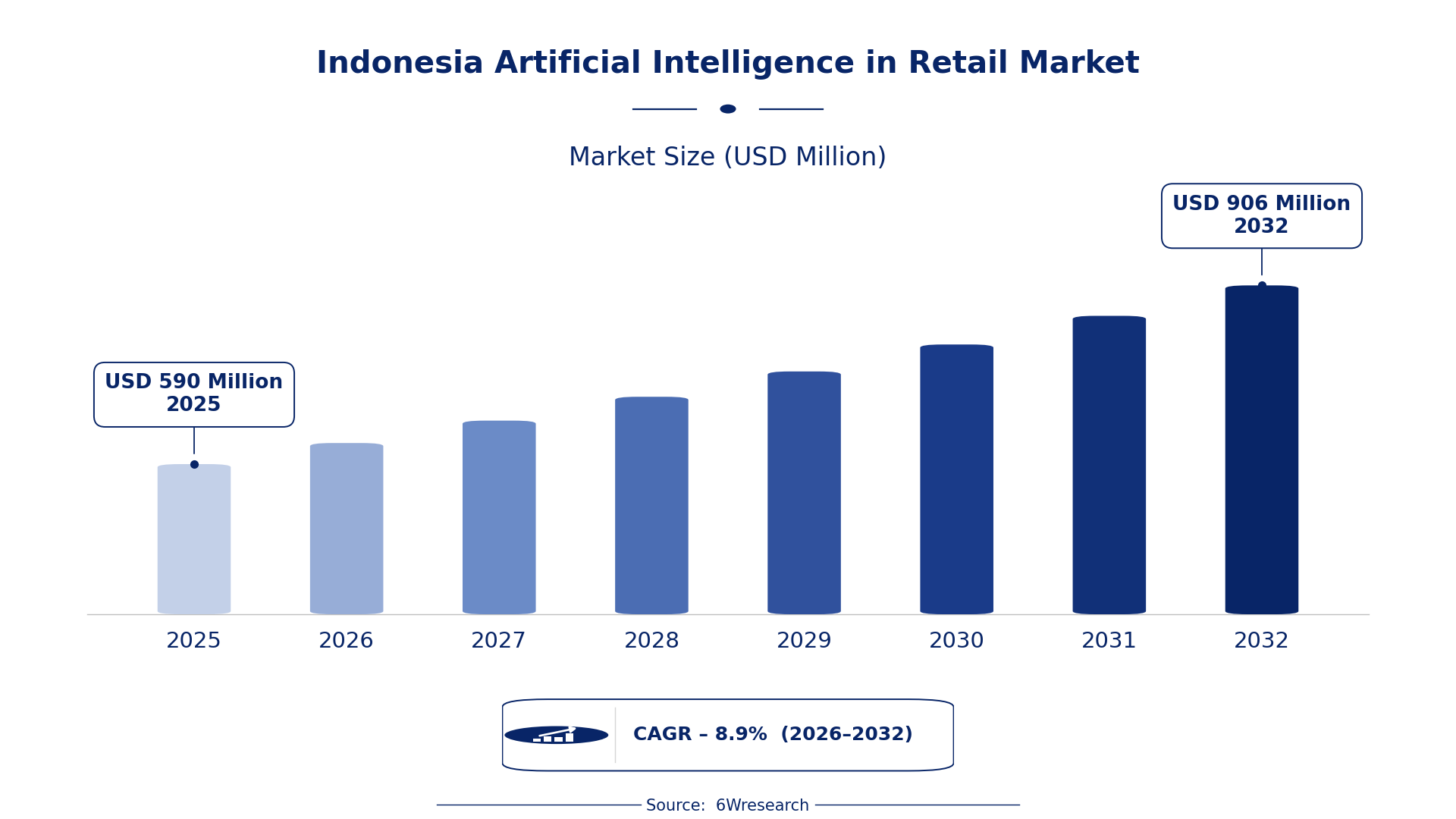
The Indonesia Artificial Intelligence in Retail Market was estimated at USD 590 Million in 2025 and is projected to reach USD 906 Million by 2032, growing at a CAGR of 8.9% from 2026 to 2032.
Indonesia Artificial Intelligence in Retail Market Synopsis
The drive for enhanced customer engagement is currently the most powerful force shaping the Indonesia Artificial Intelligence in Retail Market. Retailers are increasingly adopting AI technologies to create personalized shopping experiences and streamline their operations, fundamentally altering how consumers interact with brands.
As businesses adapt to a more digital-centric retail environment, the demand for AI solutions has surged. Retailers are leveraging AI for various applications, including customer sentiment analysis, automated inventory management, and demand forecasting, all of which contribute to more efficient operations and improved customer satisfaction.
Indonesia Artificial Intelligence in Retail Market Year-wise Growth Rate and Key Drivers
This graph illustrates the annual growth rates of the Indonesia Artificial Intelligence in Retail Market from 2021 to 2032, highlighting a steady upward trajectory and projected expansion over the forecast period.
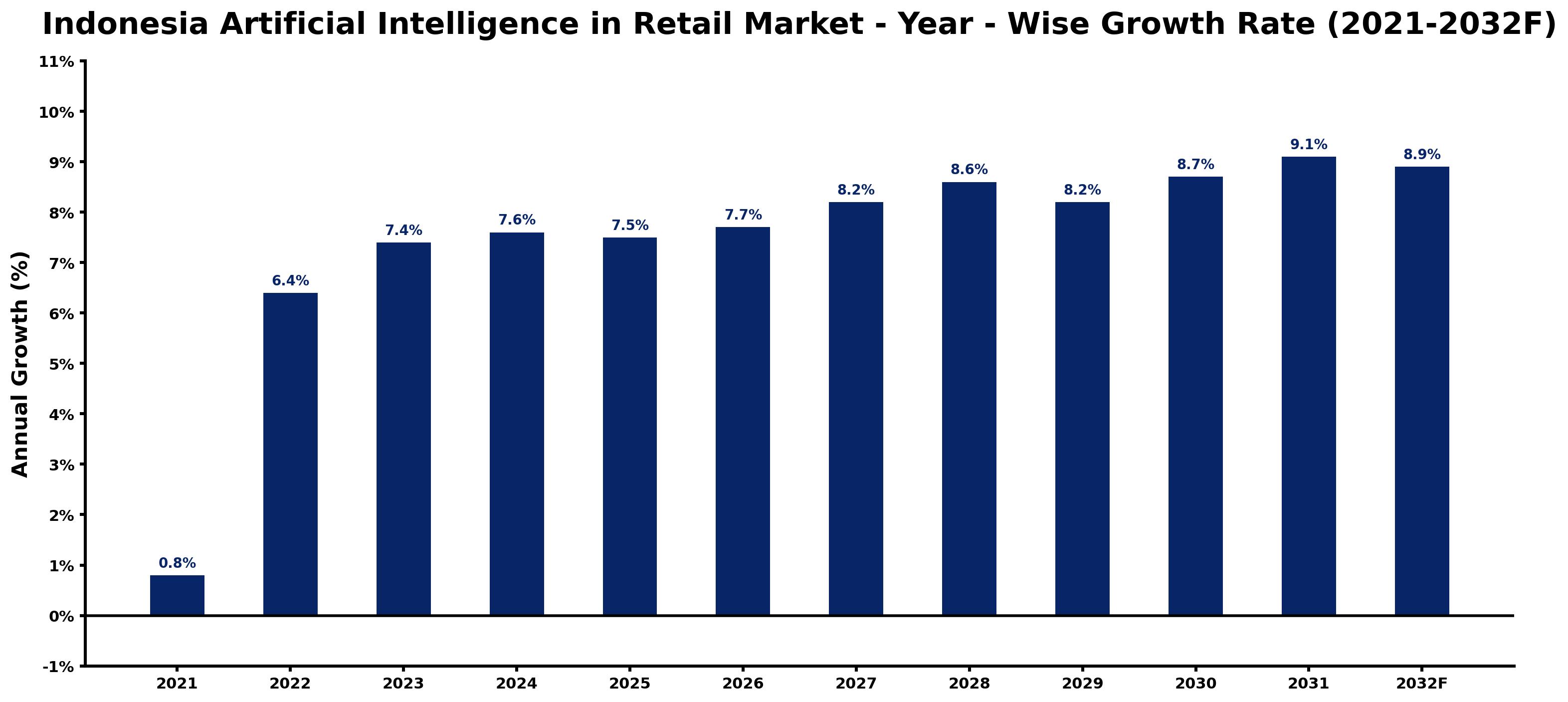
The table below presents the year‑wise growth rates along with the key drivers influencing the market
| Year | Growth Rate | Major Drivers |
| 2021 | 0.8% | E-commerce growth spurred by pandemic shopping habits. |
| 2022 | 6.4% | Rise in mobile payment systems boosting retail AI adoption. |
| 2023 | 7.4% | Investment in AI analytics by leading Indonesian retailers. |
| 2024 | 7.6% | Youth demographic driving demand for personalized shopping experiences. |
| 2025 | 7.5% | B2C platforms adopting AI for customer engagement strategies. |
| 2026 | 7.7% | Government support for AI startups in retail sector. |
| 2027 | 8.2% | Integration of AI chatbot technology in customer service. |
| 2028 | 8.6% | Local partnerships enhancing AI-driven inventory management solutions. |
| 2029 | 8.2% | Increasing online sales channels demanding robust AI analytics. |
| 2030 | 8.7% | Shift towards sustainable retail practices fueled by AI insights. |
| 2031 | 9.1% | Emergence of AI-based loyalty programs among retailers. |
| 2032 | 8.9% | Growing consumer trust in AI-driven product recommendations. |
Note: Market size estimations and growth projections presented in this report are based on 6Wresearch's proprietary forecasting methodology, utilizing the latest available industry data, government publications, and primary research inputs.
Indonesia Artificial Intelligence in Retail Market Key Takeaways
Below are some of the specific key takeaways from the market, including:
- The retail sector's rapid digital transformation is catalyzing AI adoption across Indonesia.
- AI-driven personalization is becoming critical for retailers to maintain customer loyalty.
- Data quality and integration challenges pose significant hurdles for AI implementation.
- COVID-19 has accelerated the shift to e-commerce, increasing demand for AI solutions.
- A vibrant ecosystem of AI solution providers is emerging to serve the specific needs of retailers.
Evaluation of Restraints in Indonesia Artificial Intelligence in Retail Market
The primary restraints affecting the Indonesia Artificial Intelligence in Retail Market stem from data quality issues and integration complexities. Many retailers struggle to gather clean, structured data, which is essential for effective AI system implementation. The transition to AI-based operations can also face resistance from traditional retail practices, making the integration process challenging. These factors can delay or even derail projects aimed at incorporating AI technologies into retail operations.
Indonesia Artificial Intelligence in Retail Market Trends
Noteworthy trends are emerging within the Indonesia Artificial Intelligence in Retail Market. Retailers are increasingly focusing on AI for inventory optimization, allowing them to respond more effectively to consumer demand. Enhanced customer insights derived from AI analytics are also driving marketing strategies. The rise of omnichannel retailing is pushing companies to adopt AI solutions that provide a unified customer experience across platforms, from physical stores to online shopping.
Indonesia Artificial Intelligence in Retail Market Opportunities
The opportunities for growth in this market are substantial. Retailers can capitalize on AI technologies to enhance operational efficiency, leading to cost savings and improved profit margins. Investments in AI for predictive analytics can also help retailers forecast trends and adjust inventory accordingly, minimizing waste. on top of that, the ongoing digitalization of retail opens doors for collaborations with tech companies specializing in AI, creating innovative solutions tailored to consumer needs.
Government Initiatives in the Indonesia Artificial Intelligence in Retail Market
Government policy is playing a crucial role in shaping the Indonesia Artificial Intelligence in Retail Market. With a focus on digital transformation, the government is implementing various initiatives that aim to support the integration of AI in retail. These policies are designed to enhance the regulatory environment and promote the development of AI technologies within the sector.
- A national digital infrastructure upgrade programme launched in 2023 aims to improve connectivity and data accessibility for retailers.
- A regulatory framework introduced in 2024 mandates transparency in AI data usage, fostering trust between consumers and retailers.
- Current initiatives are underway to provide training and resources for retailers looking to adopt AI technologies effectively.
- A planned public-private initiative expected to launch in 2025 aims to develop AI applications specifically for small and medium-sized enterprises in retail.
Future Insights of the Indonesia Artificial Intelligence in Retail Market
Looking ahead to 2026-2032, the Indonesia Artificial Intelligence in Retail Market is set for significant expansion. As retailers increasingly prioritize customer-centric strategies, the demand for AI solutions that enhance personalization and operational efficiency will grow. The integration of advanced technologies, such as machine learning and natural language processing, will redefine the shopping experience, creating opportunities for retailers to innovate continually and stay ahead of the competition.
Indonesia Artificial Intelligence in Retail Market Latest Developments
Recent activity in the Indonesia Artificial Intelligence in Retail Market has been characterized by a surge in technological advancements and strategic partnerships. Retailers are focusing on incorporating AI to streamline processes and enhance customer engagement.
- A major technology vendor launched an AI-driven customer engagement platform in Q1 2023, designed to improve personalized marketing efforts.
- An initiative to integrate AI into supply chain management began in mid-2023 and is currently underway, aimed at optimizing logistics and inventory management.
- In early 2024, a collaboration between leading retail chains and AI solution providers was announced, focusing on developing tailored AI applications.
- Upcoming in 2025 is a rollout of a nationwide training program for retail employees to better understand AI tools and their applications in the sector.
Indonesia Artificial Intelligence in Retail Market - Key Attractiveness of the Report
- 10 Years of Market Numbers
- Historical Data Starting from 2022 to 2025
- Base Year: 2025
- Forecast Data until 2032
- Key Performance Indicators Impacting the Market
- Major Upcoming Developments and Projects
Key Highlights of the Report:
- Indonesia Artificial Intelligence in Retail Market Outlook
- Market Size of Indonesia Artificial Intelligence in Retail Market, 2025
- Forecast of Indonesia Artificial Intelligence in Retail Market, 2032
- Historical Data and Forecast of Indonesia Artificial Intelligence in Retail Revenues & Volume for the Period 2022-2032F
- Indonesia Artificial Intelligence in Retail Market Trend Evolution
- Indonesia Artificial Intelligence in Retail Market Drivers and Challenges
- Indonesia Artificial Intelligence in Retail Price Trends
- Indonesia Artificial Intelligence in Retail Porter's Five Forces
- Indonesia Artificial Intelligence in Retail Industry Life Cycle
- Historical Data and Forecast of Indonesia Artificial Intelligence in Retail Market Revenues & Volume By Type for the Period 2022-2032F
- Historical Data and Forecast of Indonesia Artificial Intelligence in Retail Market Revenues & Volume By Online for the Period 2022-2032F
- Historical Data and Forecast of Indonesia Artificial Intelligence in Retail Market Revenues & Volume By Offline for the Period 2022-2032F
- Historical Data and Forecast of Indonesia Artificial Intelligence in Retail Market Revenues & Volume By Service for the Period 2022-2032F
- Historical Data and Forecast of Indonesia Artificial Intelligence in Retail Market Revenues & Volume By Professional for the Period 2022-2032F
- Historical Data and Forecast of Indonesia Artificial Intelligence in Retail Market Revenues & Volume By Managed for the Period 2022-2032F
- Historical Data and Forecast of Indonesia Artificial Intelligence in Retail Market Revenues & Volume By Technology for the Period 2022-2032F
- Historical Data and Forecast of Indonesia Artificial Intelligence in Retail Market Revenues & Volume By Machine Learning for the Period 2022-2032F
- Historical Data and Forecast of Indonesia Artificial Intelligence in Retail Market Revenues & Volume By Deep Learning for the Period 2022-2032F
- Historical Data and Forecast of Indonesia Artificial Intelligence in Retail Market Revenues & Volume By NLP for the Period 2022-2032F
- Indonesia Artificial Intelligence in Retail Import Export Trade Statistics
- Market Opportunity Assessment By Type
- Market Opportunity Assessment By Service
- Market Opportunity Assessment By Technology
- Indonesia Artificial Intelligence in Retail Top Companies Market Share
- Indonesia Artificial Intelligence in Retail Competitive Benchmarking By Technical and Operational Parameters
- Indonesia Artificial Intelligence in Retail Company Profiles
- Indonesia Artificial Intelligence in Retail Key Strategic Recommendations






































