Indonesia Artificial Wood Beams Market Size, Share & Growth Rate
The Indonesia Artificial Wood Beams Market was estimated at USD 477 Million in 2025 and is projected to reach USD 635 Million by 2032, growing at a CAGR of 4.2% from 2026 to 2032. This promising growth trajectory is driven primarily by the ongoing urbanization and infrastructure development across the archipelago. Furthermore, the increasing preference for sustainable building materials aligns with the demands of modern construction and design, significantly boosting the market's potential.
Indonesia Artificial Wood Beams Market Year-wise Growth Rate and Key Drivers
This graph highlights how the Indonesia Artificial Wood Beams Market has steadily grown over the years, supported by major growth factors.
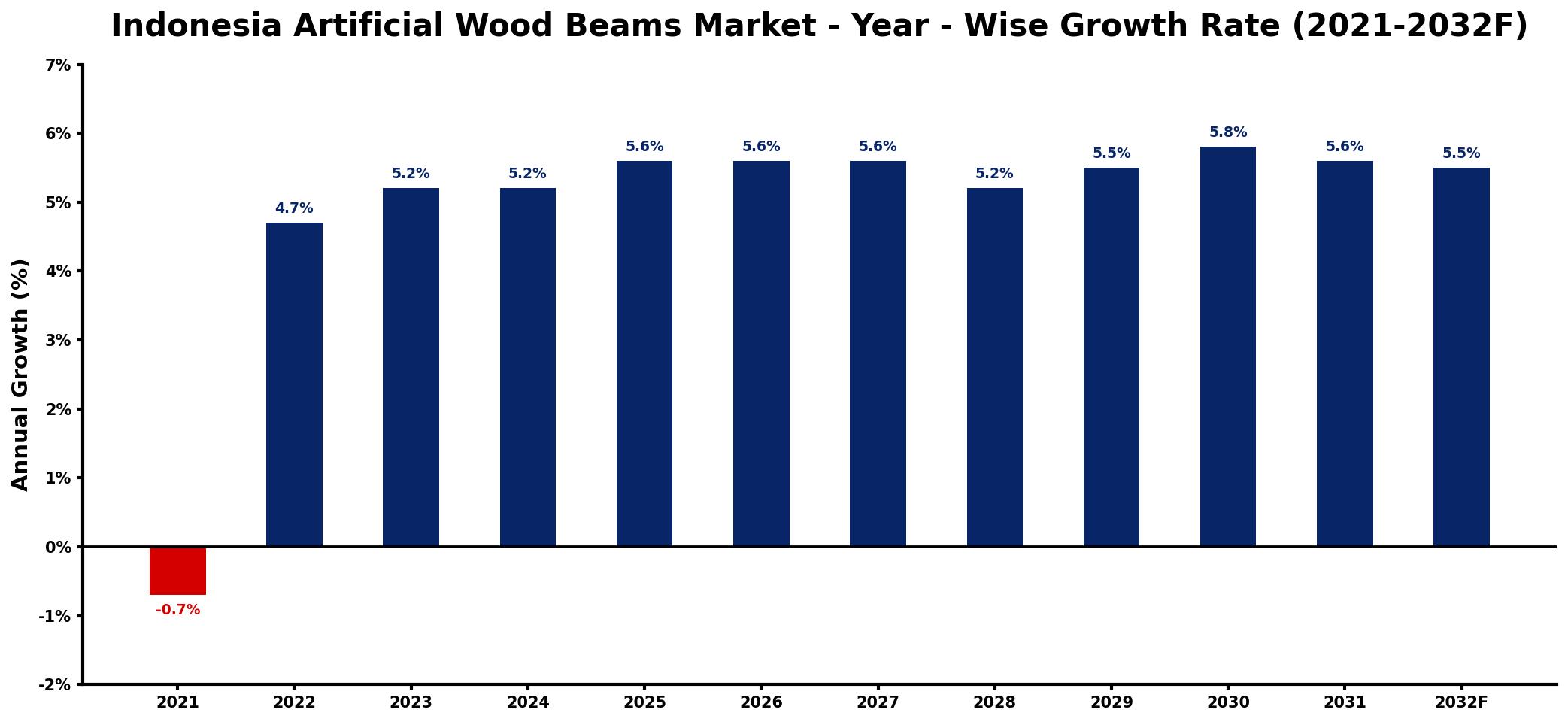
The table below presents the year‑wise growth rates along with the key drivers influencing the market
| Year | Growth Rate | Major Drivers |
| 2021 | -0.7% | Construction projects faced delays |
| 2022 | 4.7% | Rising construction demand increases investments |
| 2023 | 5.2% | Sustainable materials gaining popularity |
| 2024 | 5.2% | Technological advancements enhance production |
| 2025 | 5.6% | Urbanization drives new infrastructure projects |
| 2026 | 5.6% | Increased focus on renewable resources |
| 2027 | 5.6% | Growing DIY home improvement trends |
| 2028 | 5.2% | Expansion of green building initiatives |
| 2029 | 5.5% | Rising disposable income boosts spending |
| 2030 | 5.8% | Government incentives for sustainable construction |
| 2031 | 5.6% | Emerging markets increase construction activities |
| 2032 | 5.5% | Collaborative partnerships strengthen supply chains |
Note: Market size estimations and growth projections presented in this report are based on 6Wresearch's proprietary forecasting methodology, utilizing the latest available industry data, government publications, and primary research inputs.
Indonesia Artificial Wood Beams Market Synopsis
The current landscape of the Indonesia artificial wood beams market reflects a critical pivot towards environmentally sustainable construction materials. As urban development initiatives gain momentum, artificial wood beams are increasingly being recognized for their blend of aesthetic appeal and structural utility. This shift is particularly pertinent in urban centers where space and sustainability are paramount.
Consumer awareness around eco-friendly practices continues to rise, prompting architects and builders to opt for materials that not only enhance design but also adhere to environmental standards. The growth of this market is further bolstered by technological advancements in production, which enhance the durability and functionality of artificial wood beams.
Indonesia Artificial Wood Beams Market Key Takeaways
- The market is driven by urbanization, particularly in major cities.
- Sustainable and eco-friendly building practices are becoming standard in construction.
- Technological innovations are improving the quality and application versatility of artificial wood beams.
- Demand for aesthetically pleasing architectural elements is increasing among homeowners and builders.
- Investment in infrastructure projects is expected to boost market growth significantly.
Evaluation of Restraints in Indonesia Artificial Wood Beams Market
Despite the optimistic outlook for the Indonesia artificial wood beams market, several constraints hinder its full potential. One primary limitation is the challenge of ensuring durability while maintaining environmental compliance. Companies are pressed to innovate materials that do not compromise structural integrity or longevity, which can be a complex balancing act. Additionally, fluctuations in raw material costs may lead to unpredictable pricing, making it difficult for manufacturers to maintain competitive pricing structures. Regulatory hurdles can also impede market entry for new players seeking to offer innovative solutions.
Indonesia Artificial Wood Beams Market Trends
Emerging trends in the Indonesia artificial wood beams market are reflective of broader shifts in construction practices. There is a growing demand for customized solutions that cater to specific architectural designs, often integrating advanced technology such as prefabrication techniques. Alongside this, the use of recyclable materials in the production process is gaining traction, driven by both consumer demand and regulatory pressures. Furthermore, the rise of smart home technology is leading to innovations in building materials that are not only functional but also integrate seamlessly with modern living spaces.
Indonesia Artificial Wood Beams Market Opportunities
Opportunities within the Indonesia artificial wood beams market are abundant as the construction sector continues to expand. A notable area for growth lies in residential construction, where demand for modern, sustainable housing is on the rise. Furthermore, the increasing push for green building certifications presents an avenue for companies to innovate and differentiate themselves in the marketplace. Collaborations with government initiatives aimed at sustainable urban development could also provide significant leverage in capturing market share.
Government Initiatives in the Indonesia Artificial Wood Beams Market
The Indonesian government has implemented several initiatives aimed at promoting sustainable construction practices, which include incentives for using eco-friendly materials in construction projects. Programs designed to improve urban infrastructure and enhance building standards are in place, encouraging compliance with environmental regulations. These initiatives serve not only to bolster the construction industry but also to position Indonesia as a leader in sustainable development, thereby indirectly supporting the artificial wood beams market.
Future Insights of the Indonesia Artificial Wood Beams Market
Looking ahead to the period from 2026 to 2032, the Indonesia artificial wood beams market is poised for steady growth propelled by ongoing urbanization and infrastructural investments. The increasing consumer demand for sustainable materials is expected to foster innovation in product development, encouraging manufacturers to explore alternative materials and production methods. Furthermore, as the construction industry adapts to the challenges posed by climate change, artificial wood beams are likely to gain further traction as a favored building material due to their eco-friendly characteristics.
Indonesia Artificial Wood Beams Market Latest Developments (2025 - 2026)
Recent developments in the Indonesia artificial wood beams market have highlighted a shift towards innovative manufacturing processes. Companies are investing in research and development to create more durable and environmentally responsible products. Additionally, collaborations between private enterprises and government agencies have been initiated to advance sustainable building practices. These directions are not only set to elevate market standards but also to align with global sustainability trends.
Indonesia Artificial Wood Beams Market - Key Attractiveness of the Report
- 10 Years of Market Numbers
- Historical Data Starting from 2022 to 2025
- Base Year: 2025
- Forecast Data until 2032
- Key Performance Indicators Impacting the Market
- Major Upcoming Developments and Projects
Key Highlights of the Report:
- Indonesia Artificial Wood Beams Market Outlook
- Market Size of Indonesia Artificial Wood Beams Market, 2025
- Forecast of Indonesia Artificial Wood Beams Market, 2032
- Historical Data and Forecast of Indonesia Artificial Wood Beams Revenues & Volume for the Period 2022-2032F
- Indonesia Artificial Wood Beams Market Trend Evolution
- Indonesia Artificial Wood Beams Market Drivers and Challenges
- Indonesia Artificial Wood Beams Price Trends
- Indonesia Artificial Wood Beams Porter's Five Forces
- Indonesia Artificial Wood Beams Industry Life Cycle
- Historical Data and Forecast of Indonesia Artificial Wood Beams Market Revenues & Volume By Product Type for the Period 2022-2032F
- Historical Data and Forecast of Indonesia Artificial Wood Beams Market Revenues & Volume By U-shaped Beams for the Period 2022-2032F
- Historical Data and Forecast of Indonesia Artificial Wood Beams Market Revenues & Volume By Box Beams for the Period 2022-2032F
- Historical Data and Forecast of Indonesia Artificial Wood Beams Market Revenues & Volume By Arched Beams for the Period 2022-2032F
- Historical Data and Forecast of Indonesia Artificial Wood Beams Market Revenues & Volume By Decorative Beams for the Period 2022-2032F
- Historical Data and Forecast of Indonesia Artificial Wood Beams Market Revenues & Volume By Others for the Period 2022-2032F
- Historical Data and Forecast of Indonesia Artificial Wood Beams Market Revenues & Volume By Material Type for the Period 2022-2032F
- Historical Data and Forecast of Indonesia Artificial Wood Beams Market Revenues & Volume By Thermoplastic for the Period 2022-2032F
- Historical Data and Forecast of Indonesia Artificial Wood Beams Market Revenues & Volume By Thermosetting for the Period 2022-2032F
- Historical Data and Forecast of Indonesia Artificial Wood Beams Market Revenues & Volume By Others for the Period 2022-2032F
- Historical Data and Forecast of Indonesia Artificial Wood Beams Market Revenues & Volume By End Users for the Period 2022-2032F
- Historical Data and Forecast of Indonesia Artificial Wood Beams Market Revenues & Volume By Residential for the Period 2022-2032F
- Historical Data and Forecast of Indonesia Artificial Wood Beams Market Revenues & Volume By Commercial for the Period 2022-2032F
- Indonesia Artificial Wood Beams Import Export Trade Statistics
- Market Opportunity Assessment By Product Type
- Market Opportunity Assessment By Material Type
- Market Opportunity Assessment By End Users
- Indonesia Artificial Wood Beams Top Companies Market Share
- Indonesia Artificial Wood Beams Competitive Benchmarking By Technical and Operational Parameters
- Indonesia Artificial Wood Beams Company Profiles
- Indonesia Artificial Wood Beams Key Strategic Recommendations






































