Indonesia Auto Parts And Accessories Market Size, Share & Growth Rate
The Indonesia Auto Parts And Accessories Market was estimated at USD 439 Million in 2025 and is projected to reach USD 580 Million by 2032, growing at a CAGR of 4.1% from 2026 to 2032. This growth trajectory is fueled by increasing vehicle ownership driven by the expanding middle class and rising disposable incomes. Moreover, the aging vehicle fleet necessitates an ongoing demand for replacement parts and aftermarket accessories, ensuring a robust market environment.
Indonesia Auto Parts And Accessories Market Year-wise Growth Rate and Key Drivers
This graph highlights how the Indonesia Auto Parts And Accessories Market has steadily grown over the years, supported by major growth factors.
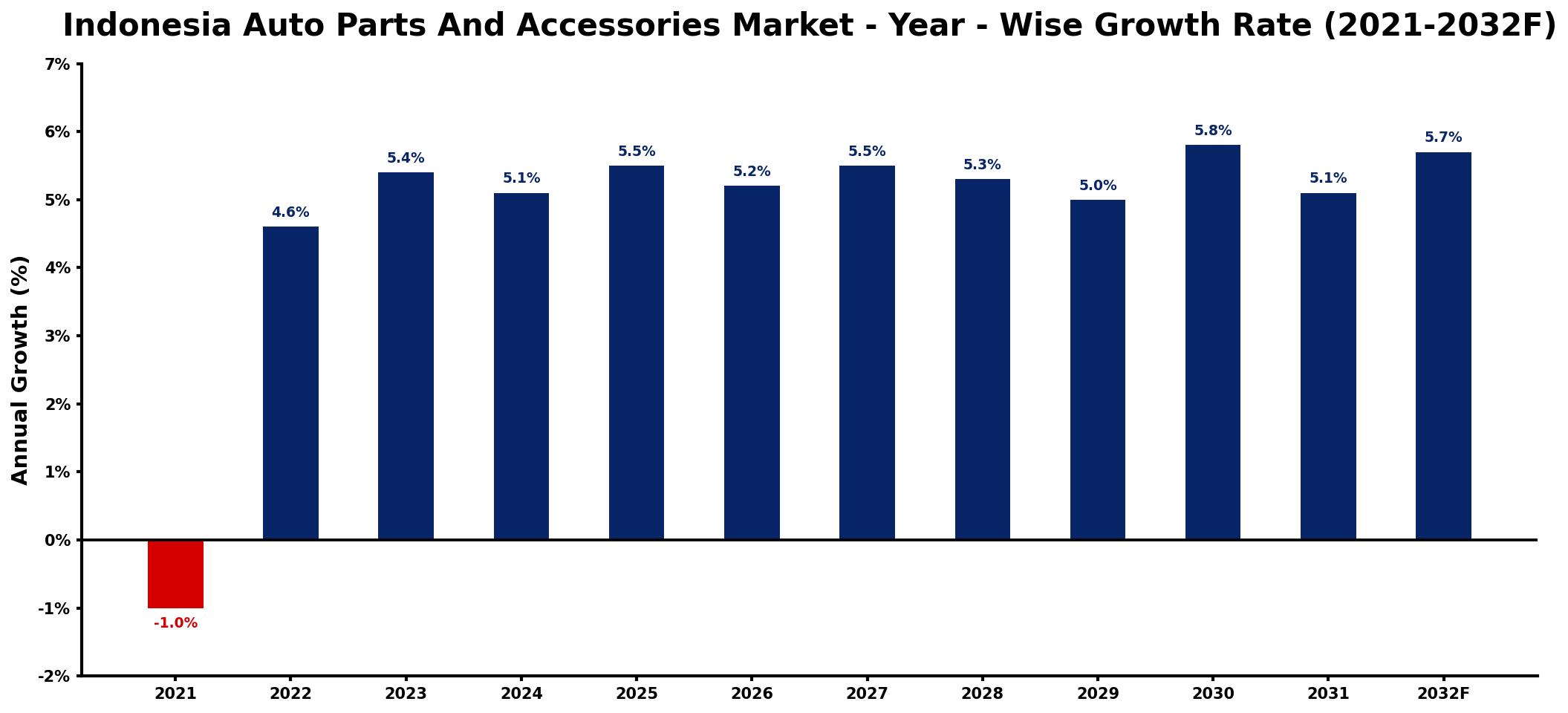
The table below presents the year‑wise growth rates along with the key drivers influencing the market
| Year | Growth Rate | Major Drivers |
| 2021 | -1.0% | Decreased vehicle production rates |
| 2022 | 4.6% | Rising consumer vehicle purchases |
| 2023 | 5.4% | Growth in e-commerce platforms |
| 2024 | 5.1% | Increased investments in logistics |
| 2025 | 5.5% | Expansion of repair service networks |
| 2026 | 5.2% | Surge in electric vehicle sales |
| 2027 | 5.5% | Growing demand for sustainability |
| 2028 | 5.3% | Technological advancements in manufacturing |
| 2029 | 5.0% | Rising average vehicle age |
| 2030 | 5.8% | Increase in urban mobility solutions |
| 2031 | 5.1% | enhanced product quality standards |
| 2032 | 5.7% | stronger distribution network expansion |
Note: Market size estimations and growth projections presented in this report are based on 6Wresearch's proprietary forecasting methodology, utilizing the latest available industry data, government publications, and primary research inputs.
Indonesia Auto Parts And Accessories Market Synopsis
In Indonesia, the auto parts and accessories market is increasingly characterized by a diverse offering of products, ranging from essential components like brakes and engine parts to customized accessories that cater to consumer preferences. The rise of e-commerce platforms has revolutionized how consumers shop for automotive products, providing access to a wider array of choices and facilitating convenient purchasing.
The trend towards vehicle personalization has gained significant traction, with many Indonesian consumers opting to enhance their vehicles with custom audio systems, interior upgrades, and specialized lighting. This growing inclination towards individual expression through automotive modifications is further stimulating demand within the accessories segment of the market.
Indonesia Auto Parts And Accessories Market Key Takeaways
- The market is driven by rising disposable incomes and increasing vehicle ownership among the expanding middle class.
- Demand for aftermarket auto parts is fueled by an aging vehicle fleet that requires consistent maintenance.
- E-commerce platforms have transformed consumer access to a broad range of auto parts and accessories.
- Vehicle customization trends are significantly boosting the accessories segment.
- Regulatory challenges exist due to the prevalence of counterfeit products, impacting consumer safety.
Evaluation of Restraints in Indonesia Auto Parts And Accessories Market
The Indonesia Auto Parts and Accessories Market faces significant challenges that hinder its potential growth. A primary concern is the widespread availability of counterfeit and substandard parts, which not only compromise consumer safety but also undermine the reputation of legitimate suppliers. The absence of standardized regulations further complicates matters, making it difficult for consumers to identify authentic products. Additionally, fluctuations in the economy can lead to reduced consumer spending on non-essential automotive accessories, which may dampen market enthusiasm during economic downturns.
Indonesia Auto Parts And Accessories Market Trends
Several notable trends are shaping the Indonesia Auto Parts and Accessories Market. Firstly, the growth of electric and hybrid vehicles is prompting the development of specialized parts and accessories tailored to these technologies. Furthermore, advances in e-commerce have led to increased consumer awareness and education, allowing buyers to make more informed decisions. Social media platforms also play a significant role in influencing automotive trends and consumer preferences, particularly in customization and accessory selection.
Indonesia Auto Parts And Accessories Market Opportunities
As the Indonesian automotive sector continues to evolve, several growth opportunities are emerging within the auto parts and accessories market. Investments in sustainable and eco-friendly automotive products are gaining traction, aligning with global shifts towards greener technologies. Furthermore, enhancing partnerships with e-commerce platforms could facilitate market penetration and accessibility. Local manufacturers have the chance to innovate by developing high-quality, competitively priced products that cater to the needs of discerning consumers who prioritize reliability and authenticity.
Government Initiatives in the Indonesia Auto Parts And Accessories Market
The Indonesian government has initiated several policies aimed at supporting the automotive industry, which subsequently benefits the auto parts and accessories sector. These include incentives for domestic manufacturing and investments in infrastructure to improve logistics and distribution channels. Regulatory frameworks are also being considered to address the prevalence of counterfeit products, thereby promoting safer and higher-quality components in the market.
Future Insights of the Indonesia Auto Parts And Accessories Market
Looking ahead to 2026-2032, the Indonesia Auto Parts and Accessories Market is positioned for significant growth as the automotive industry recovers and expands. The ongoing rise in vehicle ownership, coupled with a keen interest in vehicle personalization, is expected to drive demand for both essential components and aftermarket accessories. Technological advancements in vehicle design and materials, along with an increasing focus on sustainability, will further shape the market landscape and create opportunities for innovative manufacturers.
Indonesia Auto Parts And Accessories Market Latest Developments (2025 - 2026)
In recent months, the industry has seen a shift towards greater digital integration, with companies enhancing their online platforms to streamline the purchasing process for consumers. Additionally, there has been a growing emphasis on establishing quality assurance processes to combat counterfeit goods. This focus not only aims to enhance consumer trust but also to elevate the standards within the industry as a whole.
Indonesia Auto Parts And Accessories Market - Key Attractiveness of the Report
- 10 Years of Market Numbers
- Historical Data Starting from 2022 to 2025
- Base Year: 2025
- Forecast Data until 2032
- Key Performance Indicators Impacting the Market
- Major Upcoming Developments and Projects
Key Highlights of the Report:
- Indonesia Auto Parts And Accessories Market Outlook
- Market Size of Indonesia Auto Parts And Accessories Market, 2025
- Forecast of Indonesia Auto Parts And Accessories Market, 2032
- Historical Data and Forecast of Indonesia Auto Parts And Accessories Revenues & Volume for the Period 2022-2032F
- Indonesia Auto Parts And Accessories Market Trend Evolution
- Indonesia Auto Parts And Accessories Market Drivers and Challenges
- Indonesia Auto Parts And Accessories Price Trends
- Indonesia Auto Parts And Accessories Porter's Five Forces
- Indonesia Auto Parts And Accessories Industry Life Cycle
- Historical Data and Forecast of Indonesia Auto Parts And Accessories Market Revenues & Volume By Product for the Period 2022-2032F
- Historical Data and Forecast of Indonesia Auto Parts And Accessories Market Revenues & Volume By Driveline & Powertrain for the Period 2022-2032F
- Historical Data and Forecast of Indonesia Auto Parts And Accessories Market Revenues & Volume By Interiors & Exteriors for the Period 2022-2032F
- Historical Data and Forecast of Indonesia Auto Parts And Accessories Market Revenues & Volume By Electronics for the Period 2022-2032F
- Historical Data and Forecast of Indonesia Auto Parts And Accessories Market Revenues & Volume By Bodies & Chassis for the Period 2022-2032F
- Historical Data and Forecast of Indonesia Auto Parts And Accessories Market Revenues & Volume By Wheel & Tires for the Period 2022-2032F
- Historical Data and Forecast of Indonesia Auto Parts And Accessories Market Revenues & Volume By Others for the Period 2022-2032F
- Historical Data and Forecast of Indonesia Auto Parts And Accessories Market Revenues & Volume By Application for the Period 2022-2032F
- Historical Data and Forecast of Indonesia Auto Parts And Accessories Market Revenues & Volume By OEMs for the Period 2022-2032F
- Historical Data and Forecast of Indonesia Auto Parts And Accessories Market Revenues & Volume By Aftermarket for the Period 2022-2032F
- Indonesia Auto Parts And Accessories Import Export Trade Statistics
- Market Opportunity Assessment By Product
- Market Opportunity Assessment By Application
- Indonesia Auto Parts And Accessories Top Companies Market Share
- Indonesia Auto Parts And Accessories Competitive Benchmarking By Technical and Operational Parameters
- Indonesia Auto Parts And Accessories Company Profiles
- Indonesia Auto Parts And Accessories Key Strategic Recommendations






































