Indonesia Aviation Test Equipment Market Size, Share & Growth Rate
The Indonesia Aviation Test Equipment Market was estimated at USD 305 Million in 2025 and is projected to reach USD 406 Million by 2032, growing at a CAGR of 4.2% from 2026 to 2032. This growth trajectory is primarily driven by the burgeoning aviation sector within Indonesia, which emphasizes strict maintenance protocols and adherence to international safety standards. As the number of operational aircraft rises, the demand for innovative test equipment that meets these requirements intensifies, positioning the market for sustained expansion.
Indonesia Aviation Test Equipment Market Year-wise Growth Rate and Key Drivers
This graph highlights how the Indonesia Aviation Test Equipment Market has steadily grown over the years, supported by major growth factors.
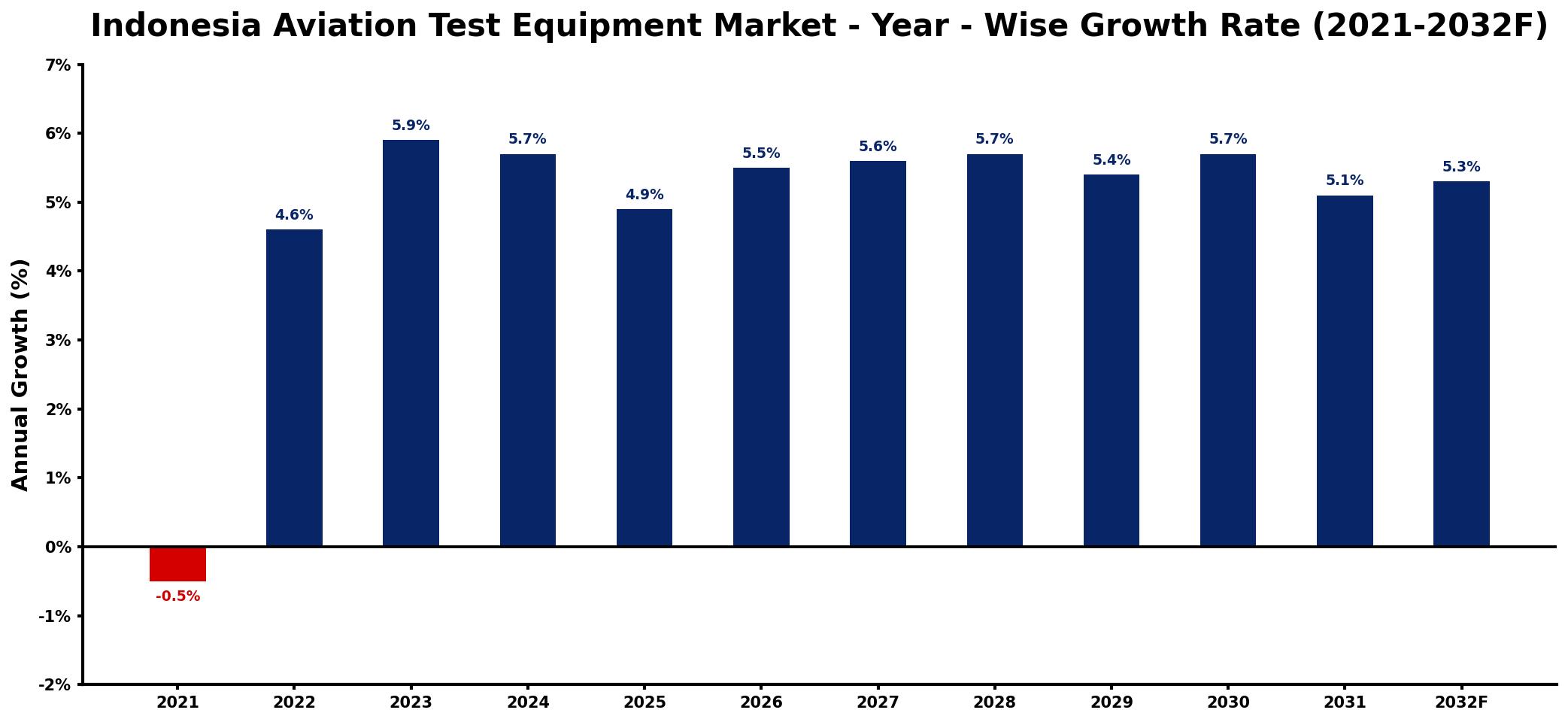
The table below presents the year‑wise growth rates along with the key drivers influencing the market
| Year | Growth Rate | Major Drivers |
| 2021 | -0.5% | decrease in defense spending priorities |
| 2022 | 4.6% | rise in commercial flight demand |
| 2023 | 5.9% | increased government infrastructure investments |
| 2024 | 5.7% | expansion of regional airline networks |
| 2025 | 4.9% | growth in pilot training programs |
| 2026 | 5.5% | advancements in simulation technologies |
| 2027 | 5.6% | boost in international travel recovery |
| 2028 | 5.7% | increased focus on safety regulations |
| 2029 | 5.4% | development of new training facilities |
| 2030 | 5.7% | enhanced partnerships with aerospace firms |
| 2031 | 5.1% | uptick in R&D funding allocations |
| 2032 | 5.3% | growing reliance on digital solutions |
Note: Market size estimations and growth projections presented in this report are based on 6Wresearch's proprietary forecasting methodology, utilizing the latest available industry data, government publications, and primary research inputs.
Indonesia Aviation Test Equipment Market Synopsis
A pivotal force shaping the Indonesia Aviation Test Equipment Market is the industry's unwavering commitment to safety and compliance. As airlines and maintenance organizations prioritize airworthiness, advanced testing equipment becomes essential for meeting regulatory mandates and ensuring the integrity of aircraft operations.
Moreover, the increasing investment in infrastructure and the rising number of aviation players in Indonesia catalyze the need for sophisticated testing technologies. Stakeholders are actively seeking equipment that not only adheres to international benchmarks but also enhances operational efficiency in maintenance practices.
Indonesia Aviation Test Equipment Market Key Takeaways
- Significant projected market growth driven by increasing aircraft operations and maintenance needs.
- Emphasis on safety standards propelling demand for advanced test equipment solutions.
- Regulatory compliance remains a critical driver of market dynamics.
- Counterfeit parts and regulatory gaps are key challenges impacting equipment safety.
- Investment opportunities exist in innovative technologies that enhance testing efficiency.
Evaluation of Restraints in Indonesia Aviation Test Equipment Market
The aviation test equipment market in Indonesia faces notable challenges stemming from counterfeit aftermarket parts and a relatively weak regulatory framework. The proliferation of substandard components poses safety risks that can undermine public confidence and operational integrity. Additionally, the absence of stringent regulations hampers manufacturers' and suppliers' ability to enforce quality controls, thus complicating the landscape for genuine equipment providers. Addressing these issues through robust policy frameworks is essential for safeguarding the market's future.
Indonesia Aviation Test Equipment Market Trends
Key trends shaping the Indonesia Aviation Test Equipment Market include the integration of digital technologies such as IoT and AI in testing processes. These advancements enhance the precision of diagnostics and predictive maintenance, driving operational efficiencies. Additionally, an increasing focus on sustainability is pushing manufacturers to innovate eco-friendly testing solutions, aligning with global aviation trends towards reduced environmental impact.
Indonesia Aviation Test Equipment Market Opportunities
Opportunities for growth and investment in the Indonesia Aviation Test Equipment Market are abundant, particularly in the realm of modernizing existing infrastructure. Upgrading testing equipment to incorporate state-of-the-art technology presents avenues for improved operational effectiveness. Furthermore, training programs aimed at enhancing the skills of technicians in using advanced equipment could bolster market demand, fostering a culture of safety and reliability within the aviation sector.
Government Initiatives in the Indonesia Aviation Test Equipment Market
The Indonesian government is actively pursuing policies that aim to boost the aviation sector, which indirectly supports the aviation test equipment market. Public spending on infrastructure improvements, combined with initiatives to enhance safety regulations, plays a vital role in creating a more robust market environment. Furthermore, collaborative programs between government and industry stakeholders are aimed at elevating compliance standards and promoting technological advancement within the sector.
Future Insights of the Indonesia Aviation Test Equipment Market
Looking ahead to 2026-2032, the Indonesia Aviation Test Equipment Market is poised for significant transformation. As the aviation industry rebounds from pandemic-related disruptions, there will be a renewed focus on maintenance excellence and safety compliance. The accelerating demand for innovative and reliable testing solutions will necessitate ongoing investments in advanced technologies. This period is likely to witness the emergence of new players and collaborations, further invigorating the market landscape.
Indonesia Aviation Test Equipment Market Latest Developments (2025 - 2026)
Recent industry developments indicate a marked shift towards digitalization within the aviation test equipment sector. Emerging technologies are being implemented to enhance testing accuracy and efficiency. Additionally, there is a growing trend of partnerships between equipment manufacturers and airlines, aimed at streamlining maintenance processes and improving equipment reliability. These dynamics suggest a proactive response to the evolving demands of the aviation market.
Indonesia Aviation Test Equipment Market - Key Attractiveness of the Report
- 10 Years of Market Numbers
- Historical Data Starting from 2022 to 2025
- Base Year: 2025
- Forecast Data until 2032
- Key Performance Indicators Impacting the Market
- Major Upcoming Developments and Projects
Key Highlights of the Report:
- Indonesia Aviation Test Equipment Market Outlook
- Market Size of Indonesia Aviation Test Equipment Market, 2025
- Forecast of Indonesia Aviation Test Equipment Market, 2032
- Historical Data and Forecast of Indonesia Aviation Test Equipment Revenues & Volume for the Period 2022-2032FF
- Indonesia Aviation Test Equipment Market Trend Evolution
- Indonesia Aviation Test Equipment Market Drivers and Challenges
- Indonesia Aviation Test Equipment Price Trends
- Indonesia Aviation Test Equipment Porter's Five Forces
- Indonesia Aviation Test Equipment Industry Life Cycle
- Historical Data and Forecast of Indonesia Aviation Test Equipment Market Revenues & Volume By Product for the Period 2022-2032FF
- Historical Data and Forecast of Indonesia Aviation Test Equipment Market Revenues & Volume By Electrical Aviation Test Equipment for the Period 2022-2032FF
- Historical Data and Forecast of Indonesia Aviation Test Equipment Market Revenues & Volume By Hydraulic Aviation Test Equipment for the Period 2022-2032FF
- Historical Data and Forecast of Indonesia Aviation Test Equipment Market Revenues & Volume By Power Aviation Test Equipment for the Period 2022-2032FF
- Historical Data and Forecast of Indonesia Aviation Test Equipment Market Revenues & Volume By Pneumatic Aviation Test Equipment for the Period 2022-2032FF
- Historical Data and Forecast of Indonesia Aviation Test Equipment Market Revenues & Volume By End User for the Period 2022-2032FF
- Historical Data and Forecast of Indonesia Aviation Test Equipment Market Revenues & Volume By Commercial for the Period 2022-2032FF
- Historical Data and Forecast of Indonesia Aviation Test Equipment Market Revenues & Volume By Defense/Military Sector for the Period 2022-2032FF
- Indonesia Aviation Test Equipment Import Export Trade Statistics
- Market Opportunity Assessment By Product
- Market Opportunity Assessment By End User
- Indonesia Aviation Test Equipment Top Companies Market Share
- Indonesia Aviation Test Equipment Competitive Benchmarking By Technical and Operational Parameters
- Indonesia Aviation Test Equipment Company Profiles
- Indonesia Aviation Test Equipment Key Strategic Recommendations






































