Indonesia Big Data Market Size & Growth Rate (2026-2032)
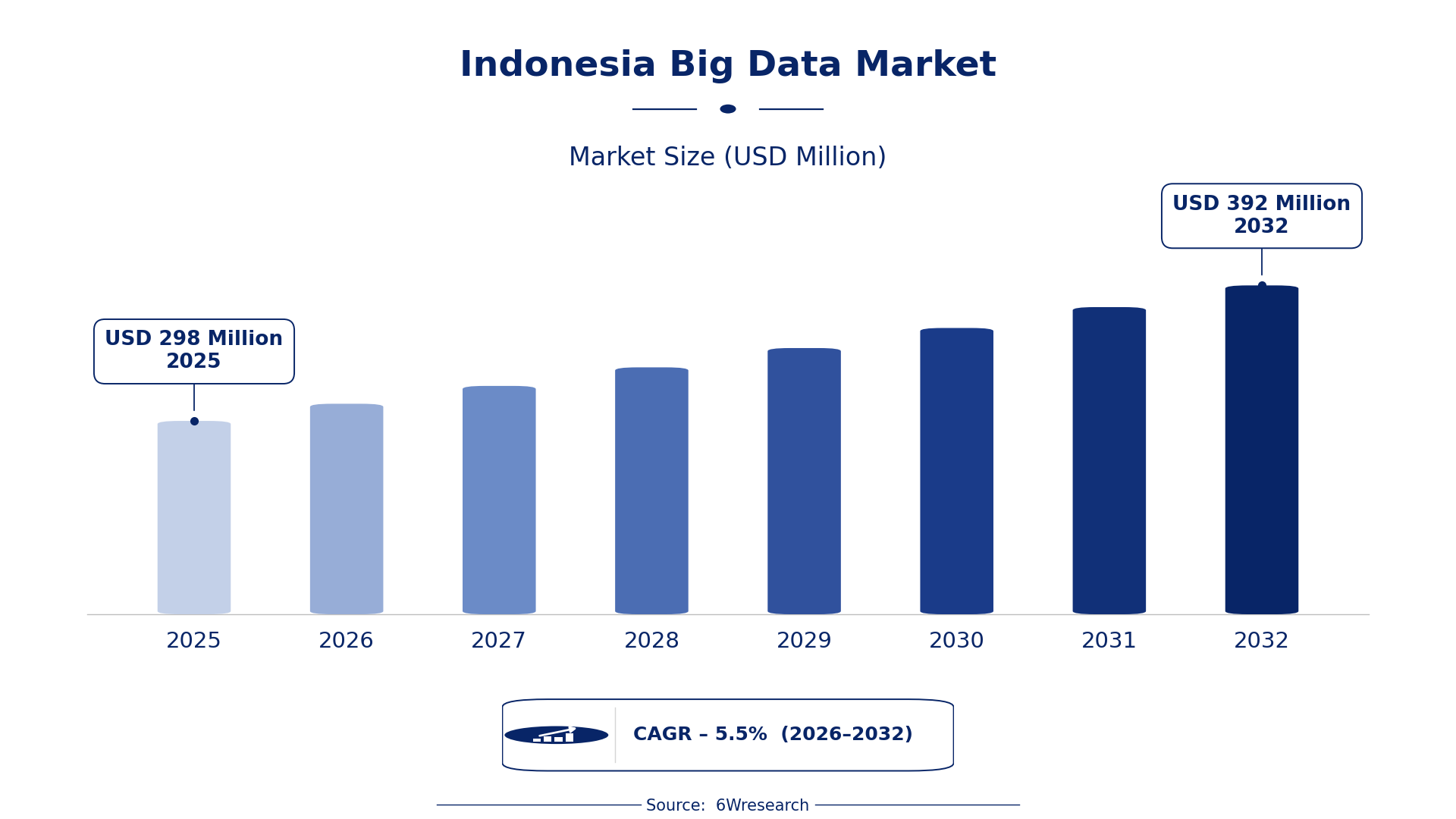
The Indonesia Big Data Market was estimated at USD 298 Million in 2025 and is projected to reach USD 392 Million by 2032, growing at a CAGR of 5.5% from 2026 to 2032.
Indonesia Big Data Market Synopsis
The most compelling force shaping the Indonesia Big Data Market is the surge in data generation across various sectors, driven by widespread digital transformation. The increasing reliance on data analytics is compelling organizations to adopt advanced big data solutions, particularly in e-commerce, telecommunications, and finance.
As businesses strive to understand customer behaviors and optimize operations, investments in big data infrastructure are accelerating. The sector is witnessing a concerted effort to enhance data analytics capabilities, which is pivotal for remaining competitive in today’s data-centric economy.
Indonesia Big Data Market Year-wise Growth Rate and Key Drivers
This graph illustrates the annual growth rates of the Indonesia Big Data Market from 2021 to 2032, highlighting a steady upward trajectory and projected expansion over the forecast period.
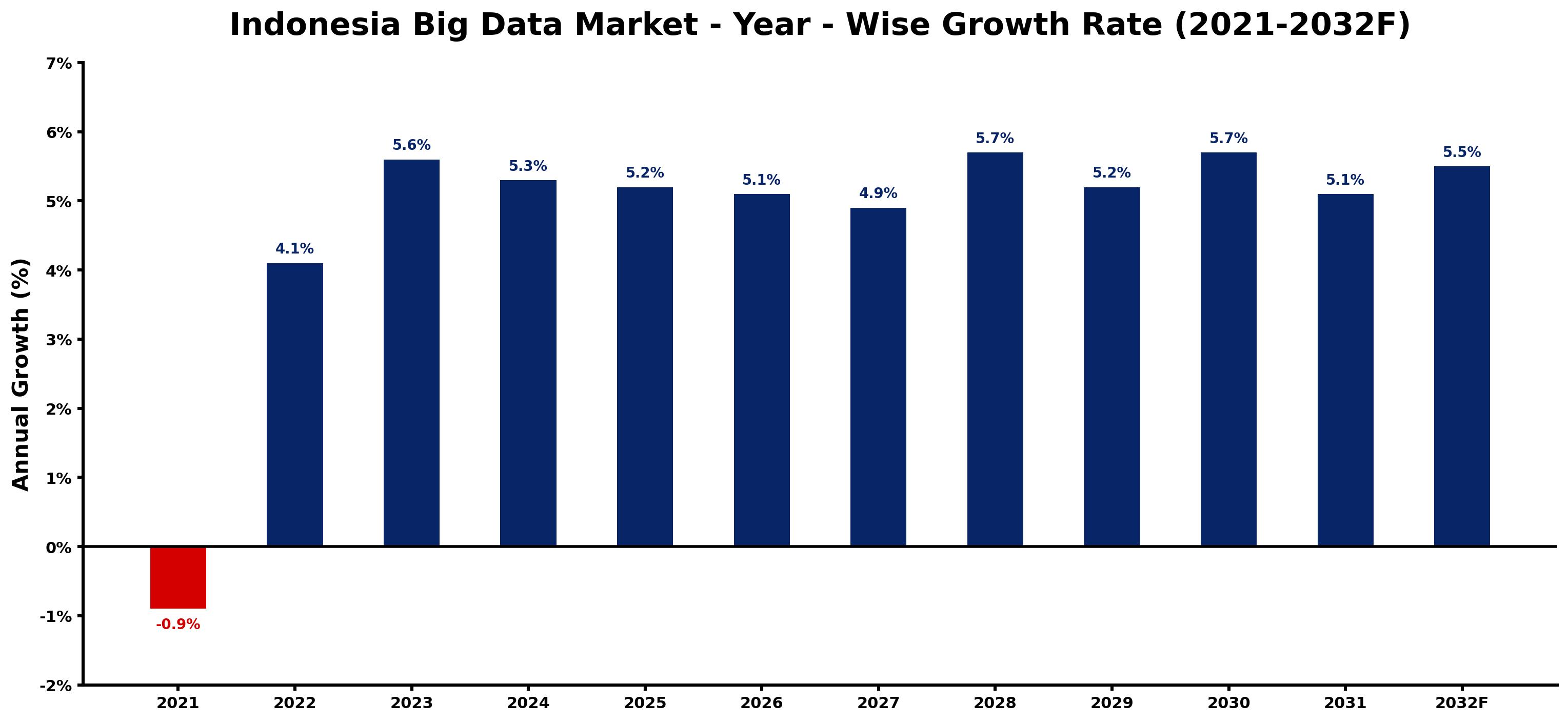
The table below presents the year‑wise growth rates along with the key drivers influencing the market
| Year | Growth Rate | Major Drivers |
| 2021 | -0.9% | Data localization laws hindered foreign investment in big data. |
| 2022 | 4.1% | Government's 2021 Digital Economy Roadmap implementation boosts data usage. |
| 2023 | 5.6% | Increased investment in AI drives big data analytics growth. |
| 2024 | 5.3% | E-commerce expansion necessitates enhanced data management strategies. |
| 2025 | 5.2% | Rising consumer mobile internet access amplifies data generation. |
| 2026 | 5.1% | Emerging fintech companies require advanced data analytics solutions. |
| 2027 | 4.9% | Government regulation on data privacy strengthens big data demand. |
| 2028 | 5.7% | Smart city initiatives increase urban data collection and analysis. |
| 2029 | 5.2% | Digital transformation in healthcare accelerates data-driven decision making. |
| 2030 | 5.7% | Telecommunications upgrades promote higher volume of data traffic. |
| 2031 | 5.1% | Local startups leverage big data for competitive advantage. |
| 2032 | 5.5% | Increased public awareness of data-driven insights fosters market growth. |
Note: Market size estimations and growth projections presented in this report are based on 6Wresearch's proprietary forecasting methodology, utilizing the latest available industry data, government publications, and primary research inputs.
Indonesia Big Data Market Key Takeaways
Below are some of the specific key takeaways from the market, including:
- The market is characterized by rapid growth due to the explosion of data from IoT devices and online transactions.
- Enterprises are increasingly adopting big data analytics to make data-driven decisions.
- Data privacy and governance remain critical challenges that need to be addressed.
- The COVID-19 pandemic highlighted the importance of big data in crisis management and operational efficiency.
- Investment in big data technologies is seen as essential for long-term business sustainability.
Evaluation of Restraints in Indonesia Big Data Market
While the market is growing, several restraints hinder its full potential. The challenges of data storage and management loom large, particularly as businesses seek cost-effective solutions. Organizations are also grappling with the complexities of data governance, which poses risks to compliance and operational integrity. on top of that, ensuring data privacy in line with regulatory standards remains a significant concern, complicating the landscape for businesses aiming to harness big data effectively.
Indonesia Big Data Market Trends
The current trends in the Indonesia Big Data Market are shifting towards greater integration of artificial intelligence and machine learning into analytics processes. Companies are increasingly utilizing these technologies to derive insights from massive datasets, enhancing predictive analytics capabilities. on top of that, cloud-based solutions are gaining traction, allowing businesses to scale their data operations efficiently. The demand for real-time analytics is also on the rise, driven by the need for agile decision-making in competitive markets.
Indonesia Big Data Market Opportunities
Significant growth opportunities exist for businesses that can capitalize on emerging technologies and innovative data solutions. The expansion of e-commerce presents a unique chance for organizations to leverage big data for customer insights and operational efficiency. Additionally, sectors like healthcare and logistics are ripe for investment, as they require sophisticated analytics to streamline processes and improve service delivery. The increasing adoption of smart city initiatives also opens new avenues for big data applications in urban planning and management.
Government Initiatives in the Indonesia Big Data Market
The Indonesian government is actively shaping the Big Data Market through various initiatives aimed at fostering a conducive environment for data-driven innovation. With a focus on enhancing digital infrastructure and promoting data privacy, these initiatives are crucial for attracting investment and supporting local enterprises in their big data journeys.
- A national digital infrastructure upgrade programme launched in early 2023, aimed at improving connectivity across urban and rural areas.
- Current efforts include a regulatory framework introduced in 2024 mandating data governance standards to protect consumer privacy.
- Upcoming initiatives involve a planned public-private partnership expected to enhance analytics capabilities in the healthcare sector by 2026.
- The government is also promoting training programs for data professionals to build local expertise in big data analytics.
- Recently completed initiatives include a nationwide campaign to improve data literacy among businesses and consumers alike.
Future Insights of the Indonesia Big Data Market
Looking ahead to 2026-2032, the Indonesia Big Data Market is set for transformative growth. As organizations increasingly recognize the value of data in driving strategic initiatives, investment in advanced analytics and data management solutions will be critical. The focus on privacy and compliance will shape technology adoption, while sectors like finance and healthcare will lead the charge in leveraging big data for improved outcomes. Continued government support and the rise of digital services will further accelerate this momentum.
Indonesia Big Data Market Latest Developments
In the last 12-14 months, the Indonesia Big Data Market has seen a surge in activity as businesses ramp up their data capabilities. The urgency to adapt to changing consumer behaviors and market dynamics has led to numerous advancements in big data technologies and applications.
- A leading regional operator launched a new analytics platform in Q1 2025 aimed at enhancing real-time data processing capabilities for enterprises.
- An initiative that began in mid-2025 and remains underway focuses on integrating big data solutions within the logistics sector to optimize supply chains.
- By late 2025, a major technology vendor plans to introduce a cloud-based big data service tailored for SMEs, enabling wider access to analytics tools.
- A pilot project initiated in early 2025 seeks to utilize big data analytics for urban planning in several major cities.
- In Q3 2025, a collaborative program between tech firms and universities is set to launch, aiming to foster innovation in big data applications.
Indonesia Big Data Market - Key Attractiveness of the Report
- 10 Years of Market Numbers
- Historical Data Starting from 2022 to 2025
- Base Year: 2025
- Forecast Data until 2032
- Key Performance Indicators Impacting the Market
- Major Upcoming Developments and Projects
Key Highlights of the Report:
- Indonesia Big Data Market Outlook
- Market Size of Indonesia Big Data Market, 2025
- Forecast of Indonesia Big Data Market, 2032
- Historical Data and Forecast of Indonesia Big Data Revenues & Volume for the Period 2022-2032F
- Indonesia Big Data Market Trend Evolution
- Indonesia Big Data Market Drivers and Challenges
- Indonesia Big Data Price Trends
- Indonesia Big Data Porter's Five Forces
- Indonesia Big Data Industry Life Cycle
- Historical Data and Forecast of Indonesia Big Data Market Revenues & Volume By Business Function for the Period 2022-2032F
- Historical Data and Forecast of Indonesia Big Data Market Revenues & Volume By Finance for the Period 2022-2032F
- Historical Data and Forecast of Indonesia Big Data Market Revenues & Volume By Marketing and Sales for the Period 2022-2032F
- Historical Data and Forecast of Indonesia Big Data Market Revenues & Volume By Human Resources for the Period 2022-2032F
- Historical Data and Forecast of Indonesia Big Data Market Revenues & Volume By Operations for the Period 2022-2032F
- Historical Data and Forecast of Indonesia Big Data Market Revenues & Volume By Industry Vertical for the Period 2022-2032F
- Historical Data and Forecast of Indonesia Big Data Market Revenues & Volume By BFSI for the Period 2022-2032F
- Historical Data and Forecast of Indonesia Big Data Market Revenues & Volume By Government and Defense for the Period 2022-2032F
- Historical Data and Forecast of Indonesia Big Data Market Revenues & Volume By Healthcare and Life Sciences for the Period 2022-2032F
- Historical Data and Forecast of Indonesia Big Data Market Revenues & Volume By Manufacturing for the Period 2022-2032F
- Historical Data and Forecast of Indonesia Big Data Market Revenues & Volume By Retail and Consumer Goods for the Period 2022-2032F
- Historical Data and Forecast of Indonesia Big Data Market Revenues & Volume By Media and Entertainment for the Period 2022-2032F
- Historical Data and Forecast of Indonesia Big Data Market Revenues & Volume By Telecommunications and IT for the Period 2022-2032F
- Historical Data and Forecast of Indonesia Big Data Market Revenues & Volume By Transportation and Logistics for the Period 2022-2032F
- Historical Data and Forecast of Indonesia Big Data Market Revenues & Volume By Component for the Period 2022-2032F
- Historical Data and Forecast of Indonesia Big Data Market Revenues & Volume By Solutions for the Period 2022-2032F
- Historical Data and Forecast of Indonesia Big Data Market Revenues & Volume By Big Data Analytics for the Period 2022-2032F
- Historical Data and Forecast of Indonesia Big Data Market Revenues & Volume By Data Discovery for the Period 2022-2032F
- Historical Data and Forecast of Indonesia Big Data Market Revenues & Volume By Data Visualization for the Period 2022-2032F
- Historical Data and Forecast of Indonesia Big Data Market Revenues & Volume By Data Management for the Period 2022-2032F
- Historical Data and Forecast of Indonesia Big Data Market Revenues & Volume By Services for the Period 2022-2032F
- Historical Data and Forecast of Indonesia Big Data Market Revenues & Volume By Deployment Mode for the Period 2022-2032F
- Historical Data and Forecast of Indonesia Big Data Market Revenues & Volume By Cloud for the Period 2022-2032F
- Historical Data and Forecast of Indonesia Big Data Market Revenues & Volume By Public Cloud for the Period 2022-2032F
- Historical Data and Forecast of Indonesia Big Data Market Revenues & Volume By Private Cloud for the Period 2022-2032F
- Historical Data and Forecast of Indonesia Big Data Market Revenues & Volume By Hybrid Cloud for the Period 2022-2032F
- Historical Data and Forecast of Indonesia Big Data Market Revenues & Volume By On-premises for the Period 2022-2032F
- Historical Data and Forecast of Indonesia Big Data Market Revenues & Volume By Organization Size for the Period 2022-2032F
- Historical Data and Forecast of Indonesia Big Data Market Revenues & Volume By Small and Medium-Sized Enterprises for the Period 2022-2032F
- Historical Data and Forecast of Indonesia Big Data Market Revenues & Volume By Large Enterprises for the Period 2022-2032F
- Indonesia Big Data Import Export Trade Statistics
- Market Opportunity Assessment By Business Function
- Market Opportunity Assessment By Industry Vertical
- Market Opportunity Assessment By Component
- Market Opportunity Assessment By Deployment Mode
- Market Opportunity Assessment By Organization Size
- Indonesia Big Data Top Companies Market Share
- Indonesia Big Data Competitive Benchmarking By Technical and Operational Parameters
- Indonesia Big Data Company Profiles
- Indonesia Big Data Key Strategic Recommendations






































