Indonesia Borosilicate Glass Market Size, Share & Growth Rate
The Indonesia Borosilicate Glass Market was estimated at USD 307 Million in 2025 and is projected to reach USD 407 Million by 2032, growing at a CAGR of 4.1% from 2026 to 2032. This growth trajectory is primarily driven by the expanding pharmaceutical, chemicals, and electronics industries in the region, all of which demand high-quality borosilicate glass for their production processes. Additionally, the rising popularity of borosilicate glass in the food and beverage sector, owing to its safety and inert characteristics, further enhances market potential.
Indonesia Borosilicate Glass Market Year-wise Growth Rate and Key Drivers
This graph highlights how the Indonesia Borosilicate Glass Market has steadily grown over the years, supported by major growth factors.
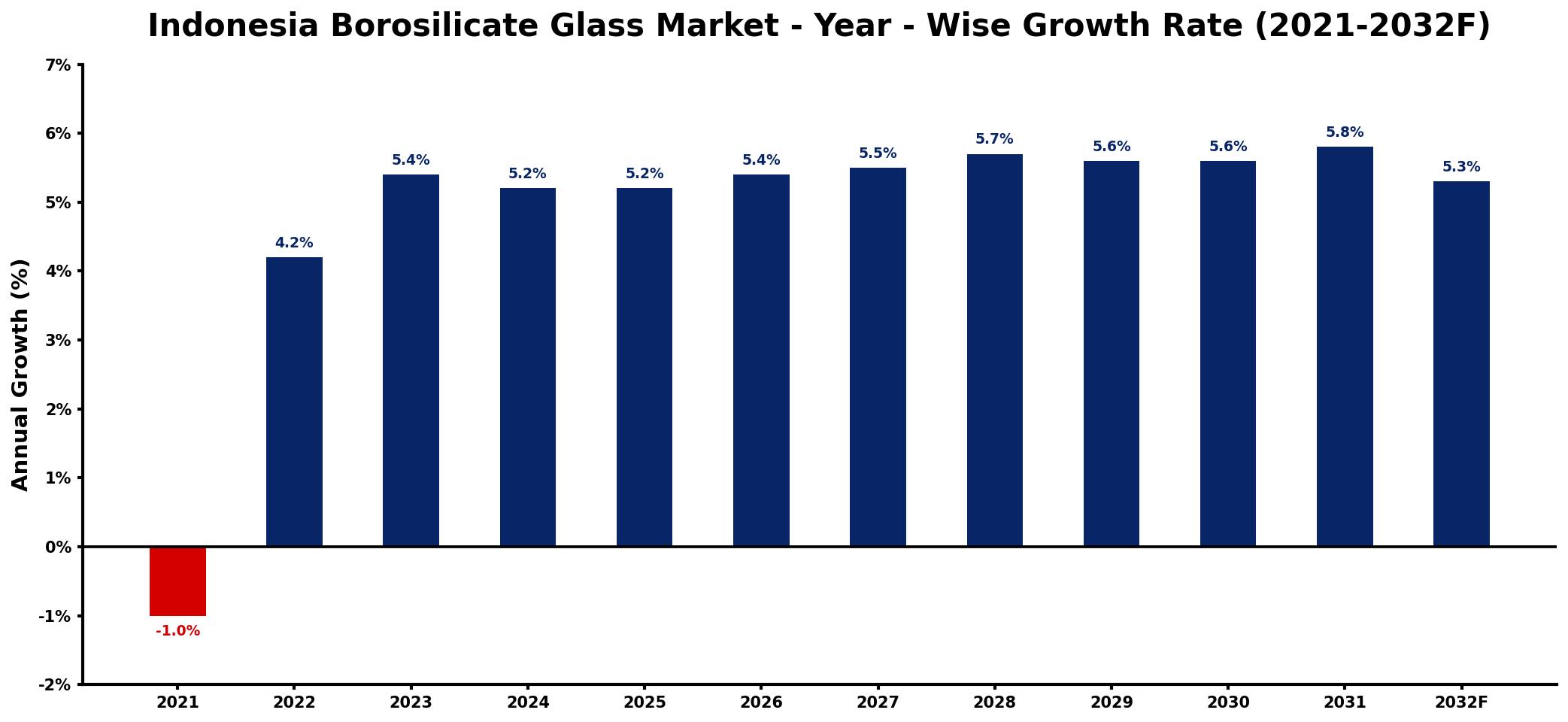
The table below presents the year‑wise growth rates along with the key drivers influencing the market
| Year | Growth Rate | Major Drivers |
| 2021 | -1.0% | decreased consumer spending on imports |
| 2022 | 4.2% | increased demand from food industry |
| 2023 | 5.4% | expansion of home brewing market |
| 2024 | 5.2% | growing interest in eco-friendly packaging |
| 2025 | 5.2% | rising popularity of laboratory equipment |
| 2026 | 5.4% | increased investments in research facilities |
| 2027 | 5.5% | growth of e-commerce distribution channels |
| 2028 | 5.7% | increased use in pharmaceutical sector |
| 2029 | 5.6% | rising end-use demand growth |
| 2030 | 5.6% | growing trend of sustainable products |
| 2031 | 5.8% | increased capital investment inflows |
| 2032 | 5.3% | growing emerging market penetration |
Note: Market size estimations and growth projections presented in this report are based on 6Wresearch's proprietary forecasting methodology, utilizing the latest available industry data, government publications, and primary research inputs.
Indonesia Borosilicate Glass Market Synopsis
The Indonesia Borosilicate Glass Market is experiencing a robust upswing as industries recognize the unique benefits of this specialized glass. Its exceptional thermal resistance and chemical stability make it a critical material in laboratory settings and various manufacturing processes.
Recent developments in the food and beverage sector further highlight the growing adoption of borosilicate glass, especially in kitchenware and tableware applications. With a focus on product safety and quality, industries are turning to this durable glass to meet consumer demands and regulatory standards.
Indonesia Borosilicate Glass Market Key Takeaways
- The market is anticipated to grow significantly due to increasing industrial applications, especially in pharmaceuticals and electronics.
- Borosilicate glass's unique properties, such as thermal shock resistance, are making it a preferred choice in laboratory equipment.
- Environmental sustainability remains a key concern, prompting the industry to seek eco-friendly production methods.
- Growth in the food and beverage sector is enhancing market dynamics, driven by demands for safety and quality.
- Recovery from the COVID-19 pandemic has revitalized supply chains, supporting a resurgence in borosilicate glass demand.
Evaluation of Restraints in Indonesia Borosilicate Glass Market
Despite its advantages, the Indonesia Borosilicate Glass Market grapples with challenges related to environmental sustainability. The production of borosilicate glass is known to be energy-intensive, raising concerns over carbon footprints and environmental impact. To address these issues, manufacturers are under pressure to adopt greener practices, including efficient resource usage and better waste management strategies. Balancing operational efficiency with sustainability will be a critical area for development as the market evolves.
Indonesia Borosilicate Glass Market Trends
Several trends are currently shaping the Indonesia Borosilicate Glass Market. One notable trend is the increasing integration of technology in manufacturing processes, allowing for enhanced quality control and innovation in product development. Furthermore, sustainability initiatives are prompting companies to explore alternative production methods that reduce environmental impact. Additionally, as consumers become more environmentally conscious, there's a growing demand for borosilicate glass products that align with eco-friendly practices.
Indonesia Borosilicate Glass Market Opportunities
The future of the Indonesia Borosilicate Glass Market holds promising growth opportunities, particularly in the expansion of the pharmaceutical and electronics sectors. These industries are poised for significant development as Indonesia continues to enhance its manufacturing capabilities. Moreover, the trend towards home cooking and food safety is encouraging investments in kitchenware made from borosilicate glass. Exploring niche markets such as customizable glass products could further unlock potential for manufacturers looking to differentiate themselves in a competitive landscape.
Government Initiatives in the Indonesia Borosilicate Glass Market
The Indonesian government is actively promoting industrial growth through various initiatives aimed at strengthening the manufacturing sector. Policies encouraging foreign investment and technological advancement are expected to benefit the borosilicate glass market. Additionally, sustainability programs aimed at reducing environmental impacts are fostering an environment where eco-friendly production practices can thrive, paving the way for a more sustainable industry in the coming years.
Future Insights of the Indonesia Borosilicate Glass Market
Looking ahead to 2026-2032, the Indonesia Borosilicate Glass Market is on a clear path of expansion, propelled by the ongoing evolution of key industries. The combination of increased investments in research and development and the rise of automation technologies is expected to enhance manufacturing efficiency and product quality. As consumer preferences shift towards sustainable and high-quality materials, borosilicate glass is well-positioned to meet these demands, reinforcing its role across diverse applications and cementing its growth in the Indonesian market.
Indonesia Borosilicate Glass Market Latest Developments (2025 - 2026)
Recent months have seen a flurry of activity within the Indonesia Borosilicate Glass Market, with manufacturers exploring innovative ways to enhance product offerings. Key players are focusing on improving the sustainability of their production processes, integrating advanced technologies to optimize efficiency. Furthermore, collaborations between industry stakeholders are becoming increasingly common as businesses seek to share knowledge and resources to capitalize on emerging market trends.
Indonesia Borosilicate Glass Market - Key Attractiveness of the Report
- 10 Years of Market Numbers
- Historical Data Starting from 2022 to 2025
- Base Year: 2025
- Forecast Data until 2032
- Key Performance Indicators Impacting the Market
- Major Upcoming Developments and Projects
Key Highlights of the Report:
- Indonesia Borosilicate Glass Market Outlook
- Market Size of Indonesia Borosilicate Glass Market, 2025
- Forecast of Indonesia Borosilicate Glass Market, 2032
- Historical Data and Forecast of Indonesia Borosilicate Glass Revenues & Volume for the Period 2022-2032F
- Indonesia Borosilicate Glass Market Trend Evolution
- Indonesia Borosilicate Glass Market Drivers and Challenges
- Indonesia Borosilicate Glass Price Trends
- Indonesia Borosilicate Glass Porter's Five Forces
- Indonesia Borosilicate Glass Industry Life Cycle
- Historical Data and Forecast of Indonesia Borosilicate Glass Market Revenues & Volume By Type for the Period 2022-2032F
- Historical Data and Forecast of Indonesia Borosilicate Glass Market Revenues & Volume By High Borosilicate Glass for the Period 2022-2032F
- Historical Data and Forecast of Indonesia Borosilicate Glass Market Revenues & Volume By Medium Borosilicate Glass for the Period 2022-2032F
- Historical Data and Forecast of Indonesia Borosilicate Glass Market Revenues & Volume By Application for the Period 2022-2032F
- Historical Data and Forecast of Indonesia Borosilicate Glass Market Revenues & Volume By Solar Energy Tubes for the Period 2022-2032F
- Historical Data and Forecast of Indonesia Borosilicate Glass Market Revenues & Volume By Heat Glassware for the Period 2022-2032F
- Historical Data and Forecast of Indonesia Borosilicate Glass Market Revenues & Volume By Laboratory Glassware for the Period 2022-2032F
- Historical Data and Forecast of Indonesia Borosilicate Glass Market Revenues & Volume By Pharmaceutical Packaging for the Period 2022-2032F
- Historical Data and Forecast of Indonesia Borosilicate Glass Market Revenues & Volume By Chemical Tubes for the Period 2022-2032F
- Historical Data and Forecast of Indonesia Borosilicate Glass Market Revenues & Volume By Others for the Period 2022-2032F
- Indonesia Borosilicate Glass Import Export Trade Statistics
- Market Opportunity Assessment By Type
- Market Opportunity Assessment By Application
- Indonesia Borosilicate Glass Top Companies Market Share
- Indonesia Borosilicate Glass Competitive Benchmarking By Technical and Operational Parameters
- Indonesia Borosilicate Glass Company Profiles
- Indonesia Borosilicate Glass Key Strategic Recommendations






































