Indonesia Business Intelligence Market Size & Growth Rate (2026-2032)
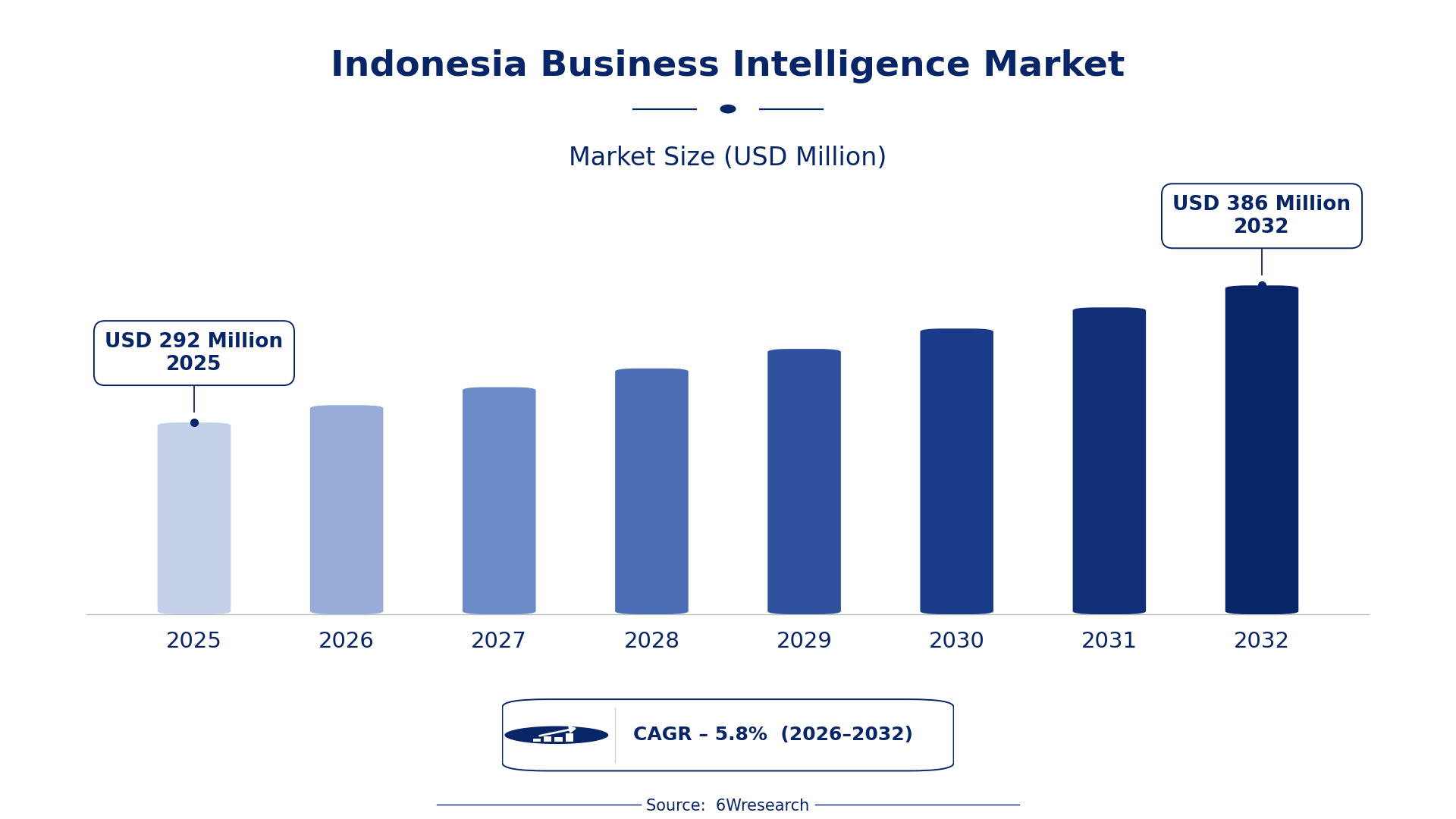
The Indonesia Business Intelligence Market was estimated at USD 292 Million in 2025 and is projected to reach USD 386 Million by 2032, growing at a CAGR of 5.8% from 2026 to 2032.
Indonesia Business Intelligence Market Synopsis
As businesses in Indonesia increasingly acknowledge the importance of data for strategic decisions, the demand for business intelligence solutions is on the rise. Organizations are harnessing these tools to collect and analyze vast amounts of data, enabling them to stay competitive in a fast-paced market environment.
This market is witnessing growth driven by the surge in data generation and the pressing need for actionable insights. The advent of cloud computing and IoT technologies further enhances this trend, presenting businesses with new opportunities to optimize operations and improve decision-making.
Indonesia Business Intelligence Market Year-wise Growth Rate and Key Drivers
This graph illustrates the annual growth rates of the Indonesia Business Intelligence Market from 2021 to 2032, highlighting a steady upward trajectory and projected expansion over the forecast period.
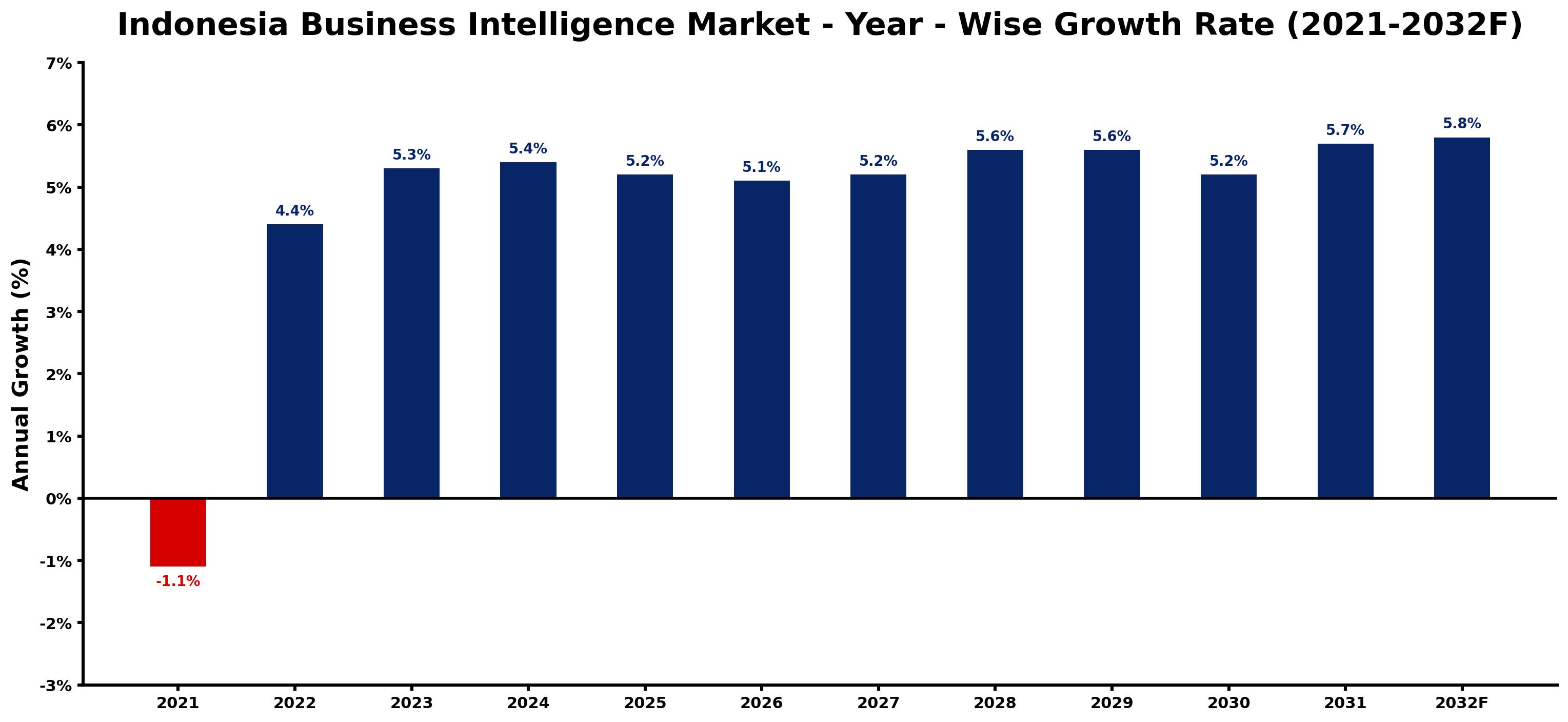
The table below presents the year‑wise growth rates along with the key drivers influencing the market
| Year | Growth Rate | Major Drivers |
| 2021 | -1.1% | Limited cloud infrastructure investment stifles analytics adoption. |
| 2022 | 4.4% | Adoption of data analytics by SMEs in Indonesia. |
| 2023 | 5.3% | Increased investment in AI for local business sectors. |
| 2024 | 5.4% | Growth of e-commerce boosting analytics needs. |
| 2025 | 5.2% | Tax incentives for technology investments in Jakarta. |
| 2026 | 5.1% | BPS support for big data initiatives nationwide. |
| 2027 | 5.2% | Digital literacy programs enhancing BI tool usage. |
| 2028 | 5.6% | Rise of fintech requiring advanced analytical solutions. |
| 2029 | 5.6% | Government regulations favoring data transparency and access. |
| 2030 | 5.2% | Emergence of startup ecosystem driving BI demand. |
| 2031 | 5.7% | Regulatory push for performance metrics in industries. |
| 2032 | 5.8% | Collaboration with local universities for data science education. |
Note: Market size estimations and growth projections presented in this report are based on 6Wresearch's proprietary forecasting methodology, utilizing the latest available industry data, government publications, and primary research inputs.
Indonesia Business Intelligence Market Key Takeaways
Below are some of the specific key takeaways from the market, including:
- Increasing adoption of data-driven strategies among Indonesian companies to boost competitiveness.
- Growing demand for cloud-based business intelligence solutions as organizations shift to digital platforms.
- Rising regulatory compliance requirements influencing investment in business intelligence tools.
- Challenges in data integration and interoperability persist, impacting market efficiency.
- The COVID-19 pandemic accelerated the focus on real-time data for agile decision-making.
Evaluation of Restraints in Indonesia Business Intelligence Market
Several factors currently restrain the growth of the Indonesia Business Intelligence Market. A primary concern is the integration of disparate data systems within organizations. Many companies operate with legacy systems that do not communicate effectively with modern business intelligence tools. This fragmented data landscape complicates the extraction of meaningful insights, hindering the overall effectiveness of business intelligence initiatives. on top of that, a shortage of skilled personnel capable of leveraging these advanced tools creates a significant bottleneck in market progress.
Indonesia Business Intelligence Market Trends
Several trends are shaping the Indonesia Business Intelligence Market. Firstly, there is a marked shift towards cloud-based solutions, as companies seek flexibility and scalability in their data management. Secondly, the integration of AI and machine learning technologies within business intelligence tools is gaining traction, enabling more sophisticated data analysis and predictive capabilities. Finally, increasing awareness of data privacy and security is driving businesses to adopt more robust compliance measures in their data handling practices.
Indonesia Business Intelligence Market Opportunities
The Indonesia Business Intelligence Market presents various growth opportunities for stakeholders. The increasing volume of data generated across sectors creates a pressing need for effective data management solutions. Organizations can capitalize on this by developing innovative business intelligence tools that cater to specific industry requirements. Additionally, the ongoing digital transformation across sectors provides a fertile ground for investments in business intelligence capabilities, particularly in sectors like retail, healthcare, and finance.
Government Initiatives in the Indonesia Business Intelligence Market
Government policies are pivotal in shaping the trajectory of the Indonesia Business Intelligence Market. The regulatory environment is increasingly supportive of digital initiatives, with an emphasis on enhancing data-driven decision-making capabilities across both public and private sectors. This focus on digital transformation aligns with national priorities to foster economic growth and innovation.
- A national digital infrastructure upgrade program recently launched to improve data accessibility and analytics capabilities across various sectors.
- Ongoing initiatives aimed at enhancing public sector data transparency and accountability, fostering better governance through data utilization.
- Planned public-private partnerships expected to drive investments in business intelligence technologies by 2027, targeting key sectors like healthcare and finance.
- A regulatory framework introduced in 2025 mandating data security measures for companies to enhance consumer trust and compliance.
Future Insights of the Indonesia Business Intelligence Market
Looking ahead to 2026-2032, the Indonesia Business Intelligence Market is set to experience notable advancements. With the continuous growth in data volume and complexity, businesses will increasingly rely on sophisticated tools for data analysis. The integration of artificial intelligence and machine learning will not only enhance analytical capabilities but also drive automation in decision-making processes. As companies adopt more data-centric strategies, the demand for innovative business intelligence solutions will undoubtedly expand, creating a dynamic and competitive market environment.
Indonesia Business Intelligence Market Latest Developments
Recent activity in the Indonesia Business Intelligence Market has highlighted a shift toward greater technological integration. Organizations are eager to adopt tools that can effectively analyze and visualize data, driving demand for business intelligence solutions. As companies recognize the value of real-time insights, investments in this area are accelerating.
- A leading technology vendor launched a new business intelligence platform in early 2025, aimed at enhancing data visualization capabilities for SMEs.
- An ongoing initiative that began in late 2025 is focused on developing AI-powered analytics tools tailored for the financial sector.
- A strategic partnership between a major software company and Indonesian universities is currently underway, aimed at fostering talent development in data analytics.
- A rollout of a government-backed data literacy program is expected to commence in mid-2026, targeting both public and private sectors to improve data competencies.
Indonesia Business Intelligence Market - Key Attractiveness of the Report
- 10 Years of Market Numbers
- Historical Data Starting from 2022 to 2025
- Base Year: 2025
- Forecast Data until 2032
- Key Performance Indicators Impacting the Market
- Major Upcoming Developments and Projects
Key Highlights of the Report:
- Indonesia Business Intelligence Market Outlook
- Market Size of Indonesia Business Intelligence Market, 2025
- Forecast of Indonesia Business Intelligence Market, 2032
- Historical Data and Forecast of Indonesia Business Intelligence Revenues & Volume for the Period 2022-2032F
- Indonesia Business Intelligence Market Trend Evolution
- Indonesia Business Intelligence Market Drivers and Challenges
- Indonesia Business Intelligence Price Trends
- Indonesia Business Intelligence Porter's Five Forces
- Indonesia Business Intelligence Industry Life Cycle
- Historical Data and Forecast of Indonesia Business Intelligence Market Revenues & Volume By Component for the Period 2022-2032F
- Historical Data and Forecast of Indonesia Business Intelligence Market Revenues & Volume By Solutions for the Period 2022-2032F
- Historical Data and Forecast of Indonesia Business Intelligence Market Revenues & Volume By Services for the Period 2022-2032F
- Historical Data and Forecast of Indonesia Business Intelligence Market Revenues & Volume By Business Function for the Period 2022-2032F
- Historical Data and Forecast of Indonesia Business Intelligence Market Revenues & Volume By Human Resource for the Period 2022-2032F
- Historical Data and Forecast of Indonesia Business Intelligence Market Revenues & Volume By Finance for the Period 2022-2032F
- Historical Data and Forecast of Indonesia Business Intelligence Market Revenues & Volume By Operations for the Period 2022-2032F
- Historical Data and Forecast of Indonesia Business Intelligence Market Revenues & Volume By Sales and Marketing for the Period 2022-2032F
- Historical Data and Forecast of Indonesia Business Intelligence Market Revenues & Volume By Deployment Mode for the Period 2022-2032F
- Historical Data and Forecast of Indonesia Business Intelligence Market Revenues & Volume By On-premises for the Period 2022-2032F
- Historical Data and Forecast of Indonesia Business Intelligence Market Revenues & Volume By Cloud for the Period 2022-2032F
- Historical Data and Forecast of Indonesia Business Intelligence Market Revenues & Volume By Organization Size for the Period 2022-2032F
- Historical Data and Forecast of Indonesia Business Intelligence Market Revenues & Volume By SMEs for the Period 2022-2032F
- Historical Data and Forecast of Indonesia Business Intelligence Market Revenues & Volume By Large Enterprises for the Period 2022-2032F
- Historical Data and Forecast of Indonesia Business Intelligence Market Revenues & Volume By Vertical for the Period 2022-2032F
- Historical Data and Forecast of Indonesia Business Intelligence Market Revenues & Volume By Retail for the Period 2022-2032F
- Historical Data and Forecast of Indonesia Business Intelligence Market Revenues & Volume By Manufacturing for the Period 2022-2032F
- Historical Data and Forecast of Indonesia Business Intelligence Market Revenues & Volume By Government and Public Services for the Period 2022-2032F
- Historical Data and Forecast of Indonesia Business Intelligence Market Revenues & Volume By Media and Entertainment for the Period 2022-2032F
- Historical Data and Forecast of Indonesia Business Intelligence Market Revenues & Volume By Transportation and Logistics for the Period 2022-2032F
- Historical Data and Forecast of Indonesia Business Intelligence Market Revenues & Volume By BFSI for the Period 2022-2032F
- Historical Data and Forecast of Indonesia Business Intelligence Market Revenues & Volume By Telecom and IT for the Period 2022-2032F
- Historical Data and Forecast of Indonesia Business Intelligence Market Revenues & Volume By Healthcare and Life Sciences for the Period 2022-2032F
- Indonesia Business Intelligence Import Export Trade Statistics
- Market Opportunity Assessment By Component
- Market Opportunity Assessment By Business Function
- Market Opportunity Assessment By Deployment Mode
- Market Opportunity Assessment By Organization Size
- Market Opportunity Assessment By Vertical
- Indonesia Business Intelligence Top Companies Market Share
- Indonesia Business Intelligence Competitive Benchmarking By Technical and Operational Parameters
- Indonesia Business Intelligence Company Profiles
- Indonesia Business Intelligence Key Strategic Recommendations






































