Indonesia Camera Lens Market: Import Trend Analysis
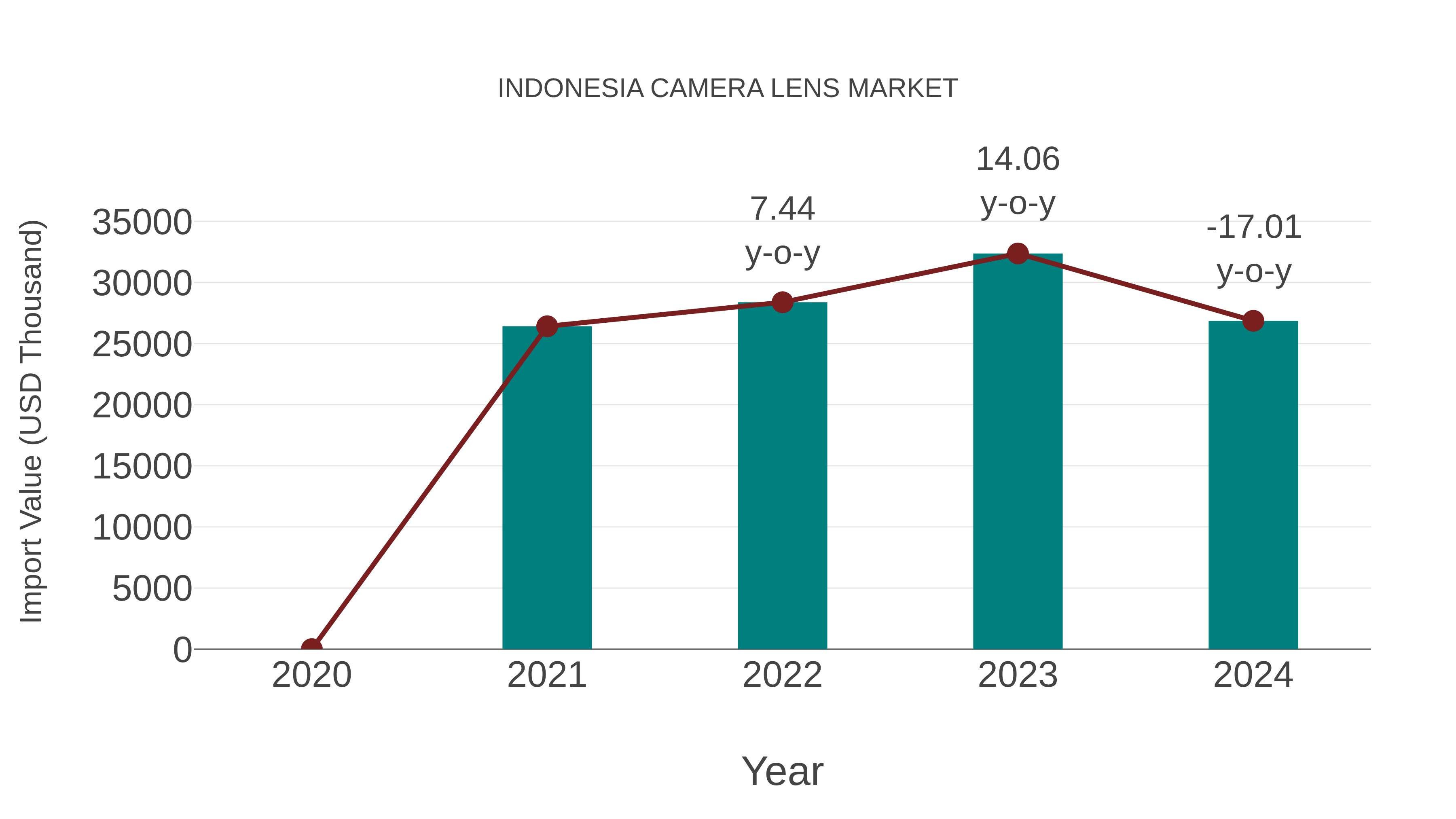
In the Indonesia camera lens market, the import trend experienced a decline from 2023 to 2024, with a growth rate of -17.01%. The compound annual growth rate (CAGR) for imports between 2020 and 2024 stood at 0.56%. This negative import momentum in 2024 could be attributed to shifting demand patterns or potential changes in trade policies impacting the market`s stability.
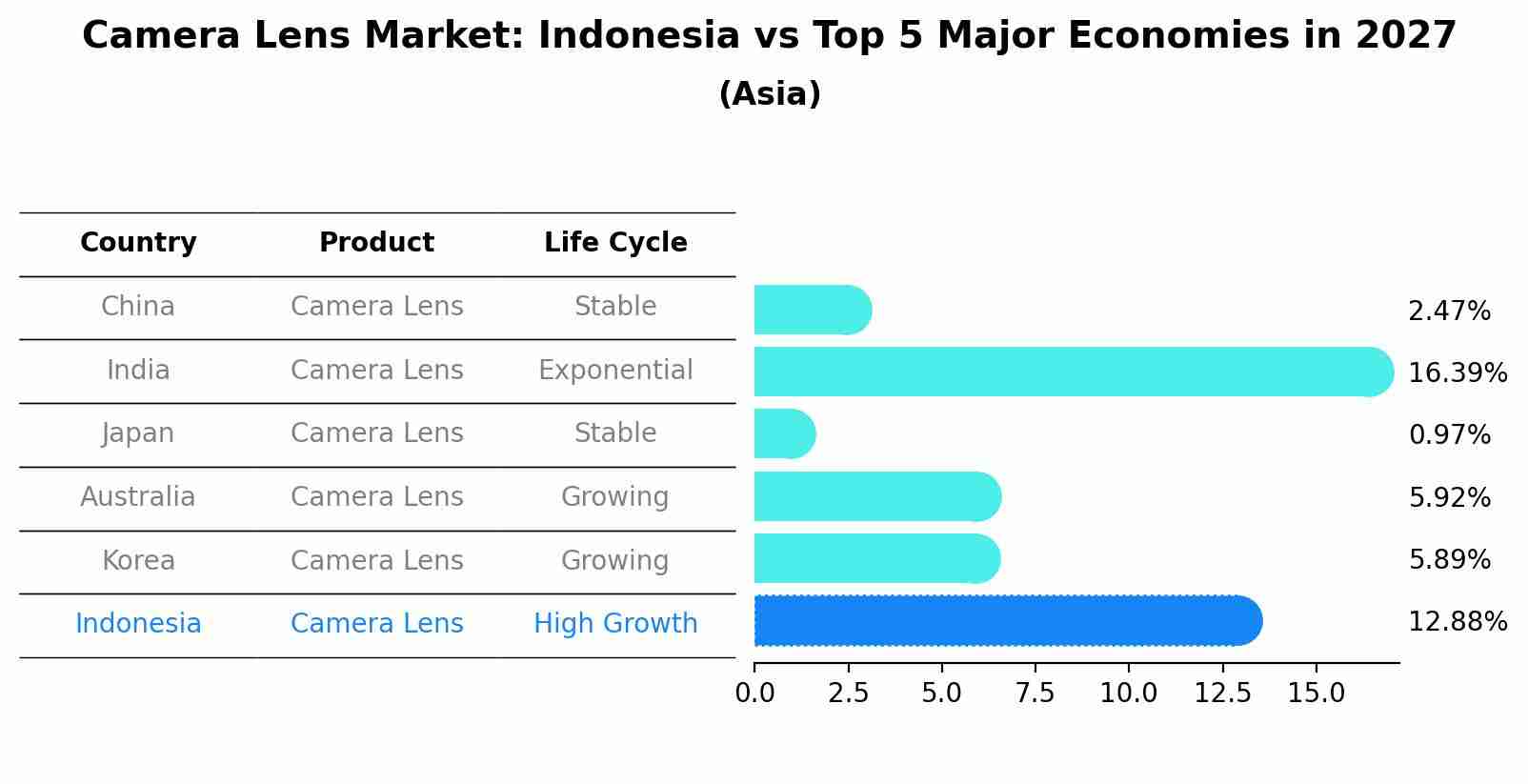
Camera Lens Market: Indonesia vs Top 5 Major Economies in 2027 (Asia)
By 2027, the Camera Lens market in Indonesia is anticipated to reach a growth rate of 12.88%, as part of an increasingly competitive Asia region, where China remains at the forefront, supported by India, Japan, Australia and South Korea, driving innovations and market adoption across sectors.
Indonesia Camera Lens Market Synopsis
The Indonesia Camera Lens market is evolving in response to the growing interest in photography and videography, driven by social media and content creation trends. The market encompasses a wide range of lenses, including prime, zoom, wide-angle, and macro lenses, catering to diverse photography needs. Smartphone photography is also contributing to market growth, with many consumers seeking high-quality camera lenses as accessories for their mobile devices. Furthermore, professional photographers and filmmakers demand advanced camera lenses for their work. The market is characterized by intense competition among major players, leading to continuous innovation and the introduction of cutting-edge lens technologies.
Drivers of the Market
The Indonesia Camera Lens market is on an upward trajectory due to several driving factors. Firstly, the growing popularity of photography as a hobby and profession is fueling demand for high-quality camera lenses. As consumers upgrade their camera equipment, there is a corresponding increase in demand for advanced lenses to enhance photographic capabilities. Additionally, the rise of social media and content creation has led to a surge in demand for better camera equipment, including lenses. Furthermore, the tourism industry`s expansion and the need for professional photography services have contributed to the market`s growth.
Challenges of the Market
The Indonesia Camera Lens market is confronted with several challenges. One of the primary challenges is the increasing competition from smartphone cameras, which are becoming more advanced and capable of replacing traditional cameras for many consumers. Additionally, the market faces pressure from counterfeit and low-quality camera lenses, which can harm the reputation of reputable brands. Furthermore, the economic instability in Indonesia can affect consumers` purchasing power, making it challenging for them to invest in high-end camera lenses. Lastly, the industry must keep up with rapidly advancing technology and changing consumer preferences to remain relevant in a dynamic market.
COVID-19 Impact on the Market
The camera lens market in Indonesia experienced a slowdown during the pandemic due to reduced consumer spending and travel restrictions. Professional photographers and enthusiasts delayed upgrading their equipment, leading to decreased demand. However, with the gradual easing of restrictions, the market has shown signs of recovery as people reengage in photography and videography.
Key Players in the Market
The Indonesia camera lens market is experiencing growth with the rising popularity of photography and videography. Key players in this market include Canon Inc., Nikon Corporation, and Sony Corporation. These companies offer a wide range of camera lenses, catering to amateur photographers and professionals alike. With the increasing use of cameras for various purposes, including social media content creation, the camera lens market is poised for continuous expansion.
Key Highlights of the Report:
- Indonesia Camera Lens Market Outlook
- Market Size of Indonesia Camera Lens Market, 2025
- Forecast of Indonesia Camera Lens Market, 2032
- Historical Data and Forecast of Indonesia Camera Lens Revenues & Volume for the Period 2022-2032F
- Indonesia Camera Lens Market Trend Evolution
- Indonesia Camera Lens Market Drivers and Challenges
- Indonesia Camera Lens Price Trends
- Indonesia Camera Lens Porter's Five Forces
- Indonesia Camera Lens Industry Life Cycle
- Historical Data and Forecast of Indonesia Camera Lens Market Revenues & Volume By Application for the Period 2022-2032F
- Historical Data and Forecast of Indonesia Camera Lens Market Revenues & Volume By Consumer Electronics for the Period 2022-2032F
- Historical Data and Forecast of Indonesia Camera Lens Market Revenues & Volume By Automotive for the Period 2022-2032F
- Historical Data and Forecast of Indonesia Camera Lens Market Revenues & Volume By Medical for the Period 2022-2032F
- Historical Data and Forecast of Indonesia Camera Lens Market Revenues & Volume By Other Applications for the Period 2022-2032F
- Historical Data and Forecast of Indonesia Camera Lens Market Revenues & Volume By Distribution Channel for the Period 2022-2032F
- Historical Data and Forecast of Indonesia Camera Lens Market Revenues & Volume By Online for the Period 2022-2032F
- Historical Data and Forecast of Indonesia Camera Lens Market Revenues & Volume By Offline for the Period 2022-2032F
- Indonesia Camera Lens Import Export Trade Statistics
- Market Opportunity Assessment By Application
- Market Opportunity Assessment By Distribution Channel
- Indonesia Camera Lens Top Companies Market Share
- Indonesia Camera Lens Competitive Benchmarking By Technical and Operational Parameters
- Indonesia Camera Lens Company Profiles
- Indonesia Camera Lens Key Strategic Recommendations






































