Indonesia Cameras Market Summary
The indonesia cameras market was estimated at USD 378 Million in 2025 and is projected to reach USD 501 Million by 2032, growing at a CAGR of 5.6% from 2026 to 2032.
Indonesia Cameras Market Year-wise Growth Rate and Key Drivers
This graph highlights how the Indonesia Cameras Market has steadily grown over the years, supported by major growth factors.
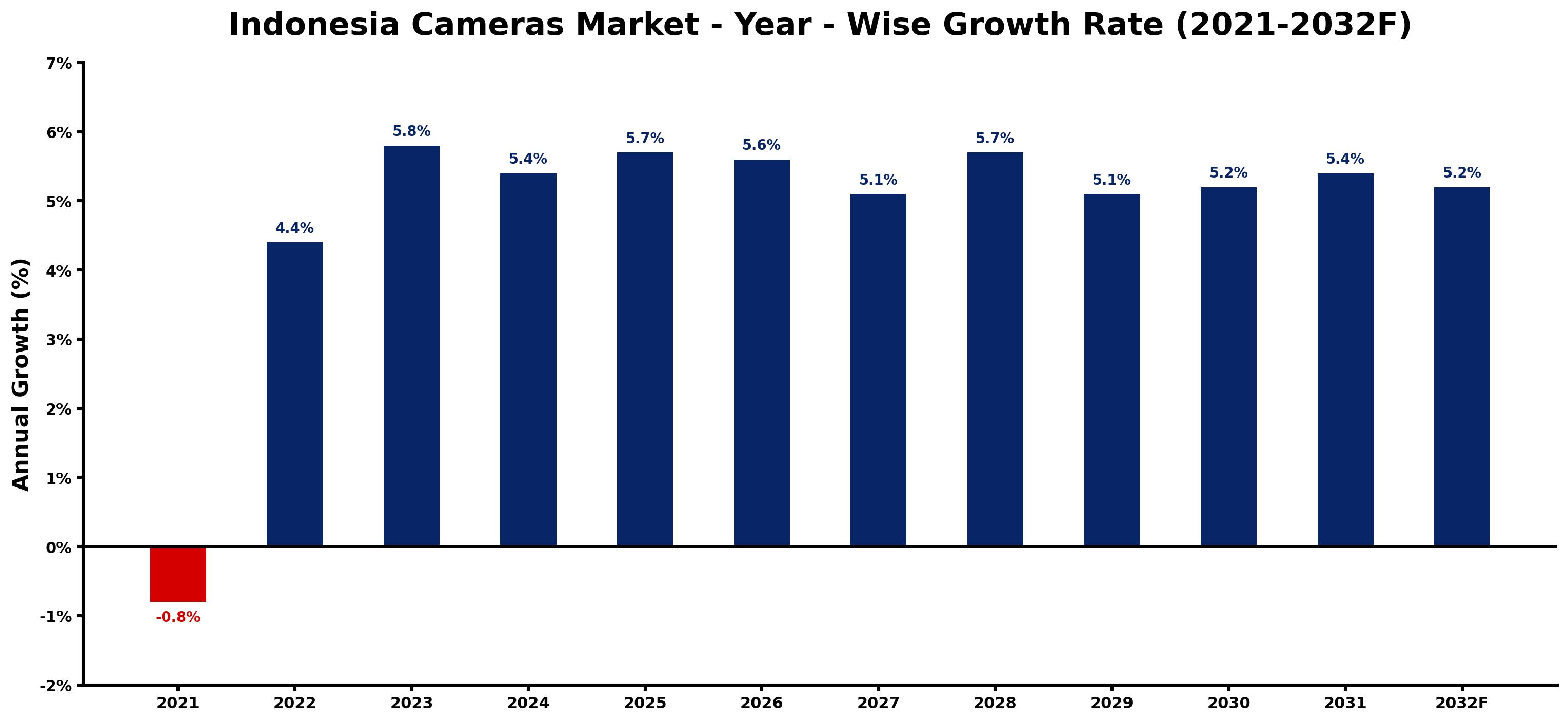
The table below presents the year wise growth rates along with the key drivers influencing the market
| Year | Growth Rate | Major Drivers |
| 2021 | -0.8% | Supply chain disruptions caused by the pandemic severely limited camera availability and reduced consumer purchases. |
| 2022 | 4.4% | Social media influencers showcased higher quality visuals, increasing demand for advanced cameras. |
| 2023 | 5.8% | Technological enhancements in mirrorless systems attracted amateur photographers and professionals alike. |
| 2024 | 5.4% | Urbanization trends led to more tourism, elevating the need for portable, high-quality cameras. |
| 2025 | 5.7% | Local manufacturers introduced affordable models, capturing youth interest in photography. |
| 2026 | 5.6% | Photography workshops and courses became popular, generating a community around camera use. |
| 2027 | 5.1% | E-commerce platforms expanded, simplifying camera access across remote Indonesian regions. |
| 2028 | 5.7% | High-profile events and sports boosted demand for professional-grade equipment in urban centers. |
| 2029 | 5.1% | Collaborations between brands and local artists flourished, enhancing brand visibility and appeal. |
| 2030 | 5.2% | Sustainable practices gained traction, with eco-friendly cameras entering the Indonesian market. |
| 2031 | 5.4% | Virtual reality experiences surged, necessitating innovative camera solutions for immersive content. |
| 2032 | 5.2% | Smartphone camera upgrades prompted consumers to explore complementary professional gear options. |
Note - Market size estimations and growth projections presented in this report are based on 6Wresearch's advanced forecasting approach, validated with industry datasets as of June 2026.
Indonesia Cameras Market Synopsis
The Indonesia Cameras Market is projected to reach 5.6% and witness significant growth during the forecast period (2026-2032). This growth trajectory is anticipated at a compound annual growth rate (CAGR) of 8.33%, driven by several pivotal factors. Rising disposable incomes, increasing smartphone penetration, and a growing demand for digital cameras from businesses and educational institutions are fundamental in propelling this market forward. Additionally, the trend of social media consumption has catalyzed a shift towards high-quality imaging solutions, prompting manufacturers to innovate continuously in product design and technological specifications.
Indonesia Cameras Market Growth Drivers
The expansion of the Indonesia cameras market is influenced by multiple drivers:
- The surge in disposable incomes among Indonesian consumers enables them to invest in high-quality cameras equipped with advanced features. This shift signals a departure from basic photography needs towards more sophisticated imaging solutions.
- Smartphone penetration continues to rise, providing users with convenient alternatives for photography. However, this has also stimulated competition, prompting traditional camera manufacturers to enhance their offerings to maintain market share.
- The increasing demand for digital cameras from educational institutions enhances market prospects as these entities seek quality imaging tools for various purposes, including documentation and content creation.
- Social media's popularity drives consumers to prioritize cameras that can deliver superior photo and video quality, further increasing demand for advanced imaging devices in both consumer and professional markets.
- Innovation remains crucial, as companies strive to differentiate their products through improved designs and technical specifications, ensuring they remain competitive in a fast-evolving marketplace.
Indonesia Cameras Market Challenges and Restraints
Despite its promising prospects, the Indonesia cameras market faces several challenges:
- The high prices associated with advanced digital cameras can deter potential buyers, especially in a market where price sensitivity is prevalent. Sophisticated lenses and features significantly inflate costs, posing a barrier to entry for many consumers.
- Competition from smartphones, which often provide adequate photography capabilities at a lower price point, can impact sales of dedicated cameras. This results in a market where manufacturers must balance quality and affordability.
- The necessity for technological upgrades places additional pressure on manufacturers, who must continuously invest in research and development to keep pace with consumer expectations and competitive pressures.
- Economic fluctuations can also affect consumer spending patterns, leading to uncertain demand levels for camera products, especially in a developing market like Indonesia.
- Regulatory challenges and trade policies may impose restrictions or tariffs on camera imports, potentially influencing market pricing and availability.
Indonesia Cameras Market Government Investment and Initiatives
The Indonesian government has implemented several initiatives aimed at bolstering the domestic cameras market. Financial incentives for local manufacturing have been introduced to encourage production within the country, reducing reliance on imports and fostering local innovation. Additionally, educational programs focused on photography and videography are being promoted to cultivate a new generation of professionals skilled in utilizing advanced imaging technologies. Government spending on infrastructure, such as improving internet access and digital literacy programs, also contributes positively to the Indonesia cameras market by facilitating the growth of digital content creation and consumption.
Indonesia Cameras Market Latest Developments (May 2025 - June 2026)
In the period from May 2025 to June 2026, the Indonesia cameras market has experienced notable directional shifts. The emergence of new technological advancements, particularly in mirrorless camera systems, has started to attract attention from both amateur and professional photographers. Increased collaborations between technology firms and educational institutions have been observed, aiming to ensure students are equipped with the latest skills and knowledge in digital imaging. Furthermore, market players are increasingly focusing on sustainability practices in manufacturing processes, responding to consumer demand for environmentally friendly products. Enhanced after-sales service and warranty programs are also being introduced to improve consumer confidence in purchasing high-value items such as digital cameras.
Indonesia Cameras Market - Key Attractiveness of the Report
- 10 Years of Market Numbers
- Historical Data Starting from 2022 to 2025
- Base Year: 2025
- Forecast Data until 2032
- Key Performance Indicators Impacting the Market
- Major Upcoming Developments and Projects
Key Highlights of the Report:
- Indonesia Cameras Market Outlook
- Market Size of Indonesia Cameras Market, 2025
- Forecast of Indonesia Cameras Market, 2032F
- Historical Data and Forecast of Indonesia Cameras Revenues & Volume for the Period 2022-2032F
- Indonesia Cameras Market Trend Evolution
- Indonesia Cameras Market Drivers and Challenges
- Indonesia Cameras Price Trends
- Indonesia Cameras Porter's Five Forces
- Indonesia Cameras Industry Life Cycle
- Historical Data and Forecast of Indonesia Cameras Market Revenues & Volume By Product Type for the Period 2022-2032F
- Historical Data and Forecast of Indonesia Cameras Market Revenues & Volume By Built-in Lens Camera for the Period 2022-2032F
- Historical Data and Forecast of Indonesia Cameras Market Revenues & Volume By Interchangeable Lens Camera for the Period 2022-2032F
- Historical Data and Forecast of Indonesia Cameras Market Revenues & Volume By DSLR for the Period 2022-2032F
- Historical Data and Forecast of Indonesia Cameras Market Revenues & Volume By Non-reflex for the Period 2022-2032F
- Historical Data and Forecast of Indonesia Cameras Market Revenues & Volume By Application for the Period 2022-2032F
- Historical Data and Forecast of Indonesia Cameras Market Revenues & Volume By Commercial for the Period 2022-2032F
- Historical Data and Forecast of Indonesia Cameras Market Revenues & Volume By Residential for the Period 2022-2032F
- Historical Data and Forecast of Indonesia Cameras Market Revenues & Volume By Distribution Channel for the Period 2022-2032F
- Historical Data and Forecast of Indonesia Cameras Market Revenues & Volume By Online for the Period 2022-2032F
- Historical Data and Forecast of Indonesia Cameras Market Revenues & Volume By Offline for the Period 2022-2032F
- Indonesia Cameras Import Export Trade Statistics
- Market Opportunity Assessment By Product Type
- Market Opportunity Assessment By Application
- Market Opportunity Assessment By Distribution Channel
- Indonesia Cameras Top Companies Market Share
- Indonesia Cameras Competitive Benchmarking By Technical and Operational Parameters
- Indonesia Cameras Company Profiles
- Indonesia Cameras Key Strategic Recommendations






































