Indonesia Car Vacuum Cleaner Market Size, Share & Growth Rate
The Indonesia Car Vacuum Cleaner Market was estimated at USD 248 Million in 2025 and is projected to reach USD 327 Million by 2032, growing at a CAGR of 4.0% from 2026 to 2032. This growth is primarily fueled by rising disposable incomes among consumers, fostering an increasing preference for vehicle maintenance and cleanliness. Moreover, the ongoing trend of urbanization and a growing number of vehicle owners have significantly contributed to the demand for efficient and user-friendly car cleaning solutions.
Indonesia Car Vacuum Cleaner Market Year-wise Growth Rate and Key Drivers
This graph highlights how the Indonesia Car Vacuum Cleaner Market has steadily grown over the years, supported by major growth factors.
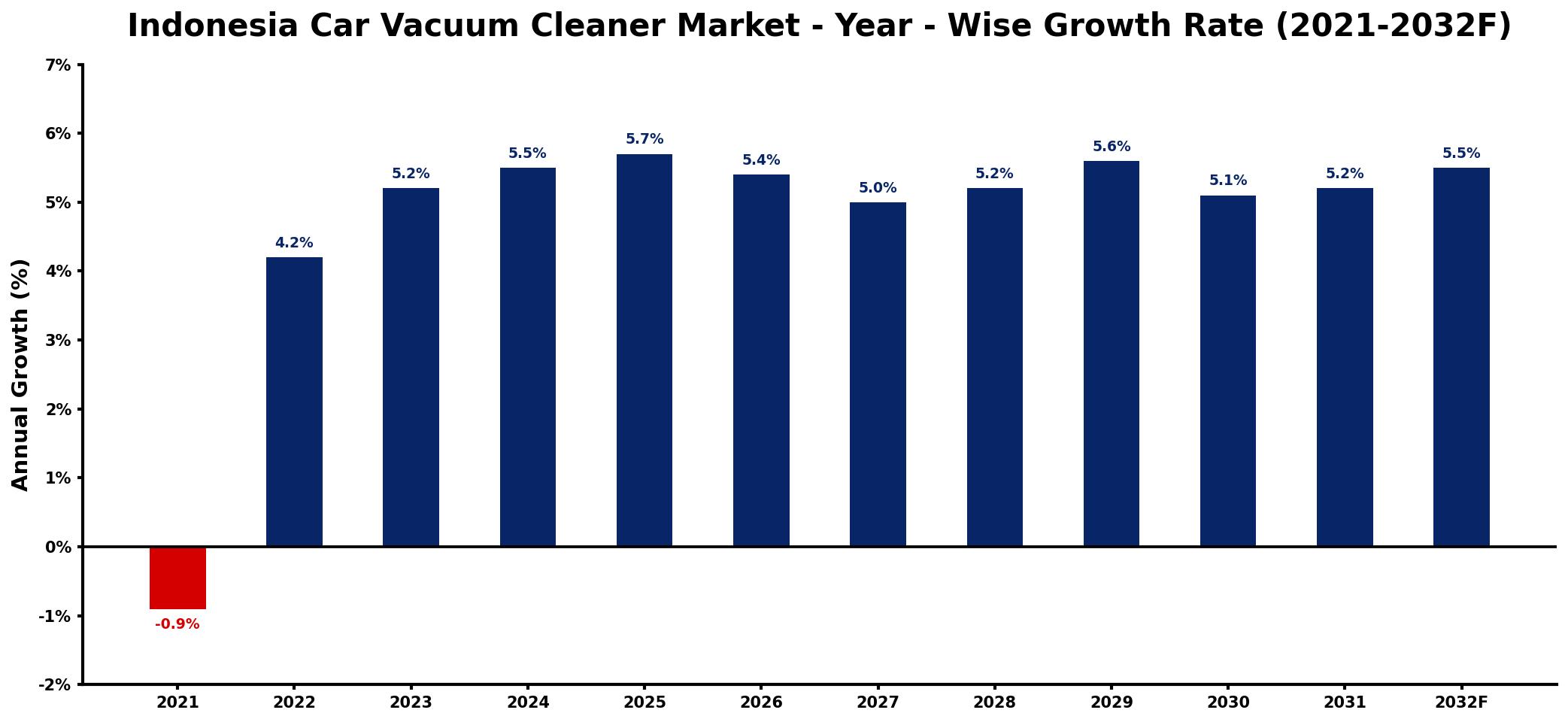
The table below presents the year‑wise growth rates along with the key drivers influencing the market
| Year | Growth Rate | Major Drivers |
| 2021 | -0.9% | Decreased consumer spending on accessories |
| 2022 | 4.2% | Rising disposable income among consumers |
| 2023 | 5.2% | Increased awareness of cleanliness benefits |
| 2024 | 5.5% | Expansion of online retail channels |
| 2025 | 5.7% | Growth in automotive industry services |
| 2026 | 5.4% | Emergence of eco-friendly technology |
| 2027 | 5.0% | Surge in home convenience products |
| 2028 | 5.2% | Increase in urban population density |
| 2029 | 5.6% | Adoption of smart home devices |
| 2030 | 5.1% | Focus on sustainability in products |
| 2031 | 5.2% | rising procurement volume requirements |
| 2032 | 5.5% | Enhanced marketing and promotional strategies |
Note: Market size estimations and growth projections presented in this report are based on 6Wresearch's proprietary forecasting methodology, utilizing the latest available industry data, government publications, and primary research inputs.
Indonesia Car Vacuum Cleaner Market Synopsis
The most compelling force shaping the Indonesia Car Vacuum Cleaner Market today is the evolving consumer preference for high-quality, innovative cleaning products. As more Indonesian households invest in their vehicles, the necessity for effective cleaning equipment is becoming ever more apparent.
Additionally, increased awareness of the importance of vehicle hygiene, particularly in the aftermath of the COVID-19 pandemic, has led to a shift in consumer behavior towards more regular cleaning routines. This trend is further supported by advancements in technology that enhance the efficiency and effectiveness of car vacuum cleaners.
Indonesia Car Vacuum Cleaner Market Key Takeaways
- The market is experiencing consistent growth, reflecting changes in consumer behavior and preferences.
- Technological advancements are driving product innovations and expanding customer choices.
- Urbanization and increased vehicle ownership are key factors behind the demand surge.
- The importance of vehicle hygiene has gained heightened awareness post-pandemic.
- Research and development investments are crucial for maintaining competitive advantages in the market.
Evaluation of Restraints in Indonesia Car Vacuum Cleaner Market
Despite the positive outlook, the Indonesia Car Vacuum Cleaner Market faces several restraints that could hinder its growth. One significant constraint is the availability of high-quality components needed for vacuum cleaner manufacturing. Issues related to quality control can impact product reliability, leading to consumer dissatisfaction. Additionally, counterfeit products pose a risk, as they not only compromise safety but also undermine the reputation of legitimate manufacturers in a market that is becoming increasingly competitive.
Indonesia Car Vacuum Cleaner Market Trends
Current trends indicate a marked shift towards more compact and portable car vacuum cleaners, catering to urban consumers who favor convenience and efficiency. Furthermore, an increasing emphasis on environmentally friendly products is encouraging manufacturers to explore sustainable materials and energy-efficient designs. The integration of smart technology into car vacuum cleaners, allowing for improved functionality and usability, is also emerging as a notable trend.
Indonesia Car Vacuum Cleaner Market Opportunities
Significant opportunities exist within the Indonesia Car Vacuum Cleaner Market, particularly in targeting untapped consumer segments. As e-commerce continues to expand, online platforms present a promising avenue for reaching a broader audience. Furthermore, partnerships with automotive service providers can enhance distribution channels, allowing for improved accessibility of high-quality car vacuum cleaners. Investment in innovative designs and features can further create differentiated products that appeal to discerning consumers.
Government Initiatives in the Indonesia Car Vacuum Cleaner Market
The Indonesian government has been focusing on enhancing the automotive and consumer goods sectors through various initiatives aimed at promoting sustainable practices and fostering local manufacturing. Incentives for energy-efficient products and support for research in clean technology can also indirectly benefit the car vacuum cleaner market, encouraging manufacturers to innovate while aligning with governmental sustainability goals.
Future Insights of the Indonesia Car Vacuum Cleaner Market
Looking forward to 2026-2032, the Indonesia Car Vacuum Cleaner Market is poised for further growth, driven by technological advancements and evolving consumer preferences. The increasing integration of smart technologies will likely redefine user experience, while a heightened emphasis on product sustainability could attract environmentally conscious consumers. As urbanization continues and vehicle ownership rises, the market is expected to adapt, with manufacturers focusing on innovation and product differentiation to capture emerging opportunities.
Indonesia Car Vacuum Cleaner Market Latest Developments (2025 - 2026)
Recent developments in the Indonesia Car Vacuum Cleaner Market have highlighted a shift towards online sales channels, with many manufacturers enhancing their digital presence to cater to a growing base of online shoppers. Additionally, there has been a notable increase in collaborations between vacuum cleaner brands and automotive service platforms, promoting bundled services that offer added value to consumers. The introduction of advanced filtration systems and ergonomic designs has also been on the rise, reflecting a commitment to innovation and quality.
Indonesia Car Vacuum Cleaner Market - Key Attractiveness of the Report
- 10 Years of Market Numbers
- Historical Data Starting from 2022 to 2025
- Base Year: 2025
- Forecast Data until 2032
- Key Performance Indicators Impacting the Market
- Major Upcoming Developments and Projects
Key Highlights of the Report:
- Indonesia Car Vacuum Cleaner Market Outlook
- Market Size of Indonesia Car Vacuum Cleaner Market, 2025
- Forecast of Indonesia Car Vacuum Cleaner Market, 2032
- Historical Data and Forecast of Indonesia Car Vacuum Cleaner Revenues & Volume for the Period 2022-2032F
- Indonesia Car Vacuum Cleaner Market Trend Evolution
- Indonesia Car Vacuum Cleaner Market Drivers and Challenges
- Indonesia Car Vacuum Cleaner Price Trends
- Indonesia Car Vacuum Cleaner Porter's Five Forces
- Indonesia Car Vacuum Cleaner Industry Life Cycle
- Historical Data and Forecast of Indonesia Car Vacuum Cleaner Market Revenues & Volume By Type for the Period 2022-2032F
- Historical Data and Forecast of Indonesia Car Vacuum Cleaner Market Revenues & Volume By Below 100 Watts for the Period 2022-2032F
- Historical Data and Forecast of Indonesia Car Vacuum Cleaner Market Revenues & Volume By 100 - 300 Watts for the Period 2022-2032F
- Historical Data and Forecast of Indonesia Car Vacuum Cleaner Market Revenues & Volume By Above 300 Watts for the Period 2022-2032F
- Historical Data and Forecast of Indonesia Car Vacuum Cleaner Market Revenues & Volume By Vacuum Bag Type for the Period 2022-2032F
- Historical Data and Forecast of Indonesia Car Vacuum Cleaner Market Revenues & Volume By Bagged for the Period 2022-2032F
- Historical Data and Forecast of Indonesia Car Vacuum Cleaner Market Revenues & Volume By Bagless for the Period 2022-2032F
- Historical Data and Forecast of Indonesia Car Vacuum Cleaner Market Revenues & Volume By Cord Type for the Period 2022-2032F
- Historical Data and Forecast of Indonesia Car Vacuum Cleaner Market Revenues & Volume By Corded for the Period 2022-2032F
- Historical Data and Forecast of Indonesia Car Vacuum Cleaner Market Revenues & Volume By Cordless for the Period 2022-2032F
- Historical Data and Forecast of Indonesia Car Vacuum Cleaner Market Revenues & Volume By Distribution Channel for the Period 2022-2032F
- Historical Data and Forecast of Indonesia Car Vacuum Cleaner Market Revenues & Volume By Offline for the Period 2022-2032F
- Historical Data and Forecast of Indonesia Car Vacuum Cleaner Market Revenues & Volume By Online for the Period 2022-2032F
- Indonesia Car Vacuum Cleaner Import Export Trade Statistics
- Market Opportunity Assessment By Type
- Market Opportunity Assessment By Vacuum Bag Type
- Market Opportunity Assessment By Cord Type
- Market Opportunity Assessment By Distribution Channel
- Indonesia Car Vacuum Cleaner Top Companies Market Share
- Indonesia Car Vacuum Cleaner Competitive Benchmarking By Technical and Operational Parameters
- Indonesia Car Vacuum Cleaner Company Profiles
- Indonesia Car Vacuum Cleaner Key Strategic Recommendations






































