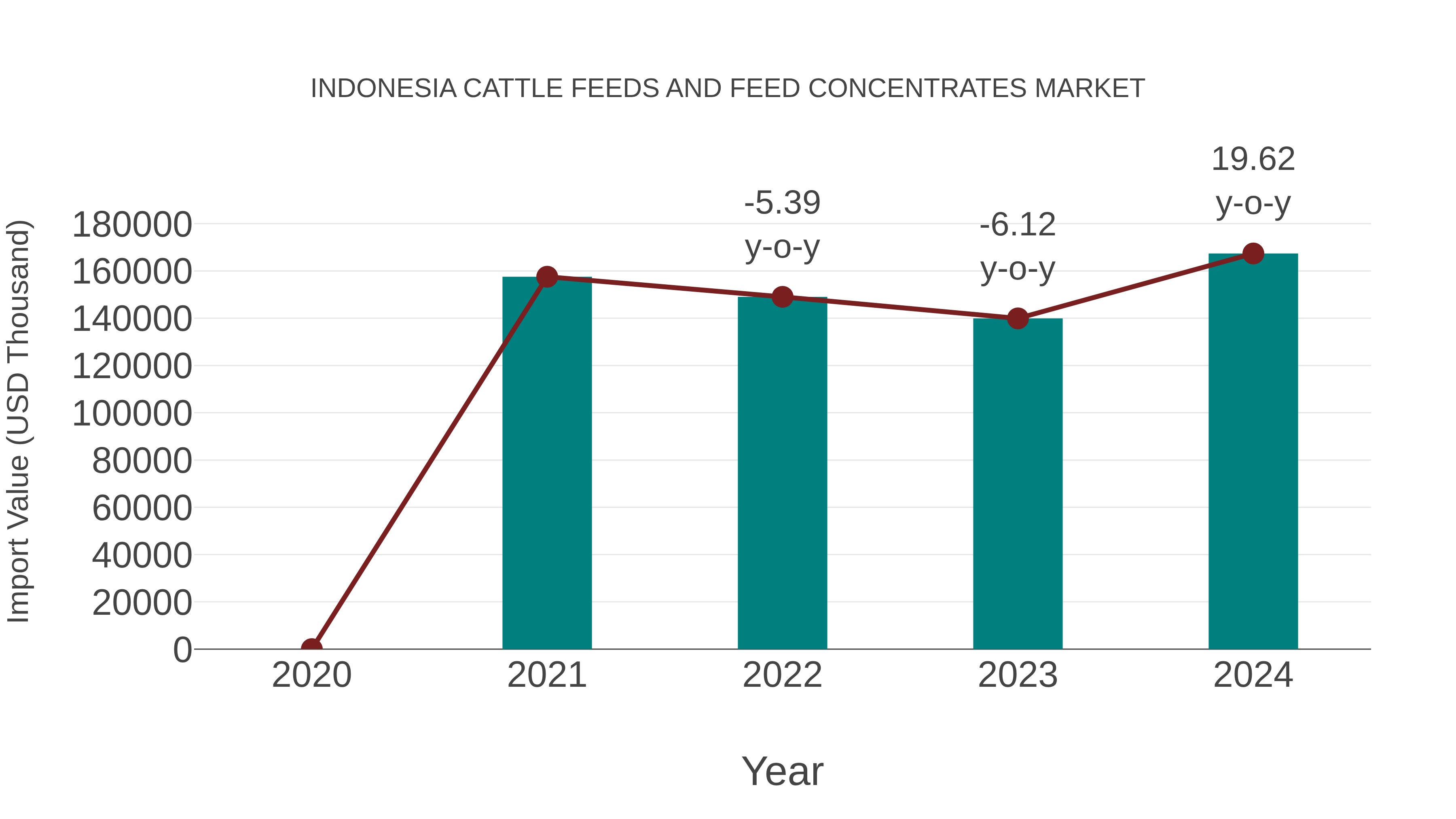
Indonesia Cattle Feeds and Feed Concentrates Market: Import Trend Analysis
Indonesia`s import trend for cattle feeds and feed concentrates witnessed a notable growth rate of 19.62% from 2023 to 2024, with a compound annual growth rate (CAGR) of 2.04% from 2020 to 2024. This upward import momentum can be attributed to shifting demand patterns in the livestock industry, indicating a potential market stability in the sector.
Indonesia Cattle feeds and Feed Concentrates Market Synopsis
The Indonesia cattle feeds and feed concentrates market is expected to witness a CAGR of 3.5% during theperiod (2020-2026). Thein the Indonesia cattle feedcan be attributed to increasing demand for livestock production and rising exports from major global suppliers such as Brazil and Australia. Moreover government initiatives aimed at promoting animal welfare are also driving market .
Key Factors Driving the Market
The demand for meat products has been growing rapidly due to the increased purchasing power of people in Indonesia. This has led to an increase in both domestic production and imports of beef poultry pork seafood eggs dairy products etc. resulting in higher consumption of animal feed materials like corn and other grains used as ingredients for these products. Due to high quality standards that meet international requirements coupled with competitive pricing policies offered by some exporters such as Brazil and Australia; there has been a rise in exports from these countries into Indonesia which have stimulated marketfurther through availability of better priced raw material inputs needed by local manufacturers.
Challenges Facing the Market
One challenge faced by theis unavailability or scarcity of local raw materials used for making cattle feeds such as maize grain (corn) which results into higher import costs thus affecting profitability margins negatively; this is mainly because most farmers prefer producing rice rather than maize due its higher salecompared against maize grain?s price per tonne produced locally within country borders.
Key Market Player
Some key players operating within Indonesia cattle feeds feed concentrate markets include PT Charoen Pokphand Group Tbk. PT Wirakarya Sakti Agroindustri JSC (WSA) Nutrifood Nutrition Technology Industries Tbk. Inti Indoraya Abadi Perdana Co Ltd. PT Yup Hup Seng Trading Co Ltd. CV AGROFEEDINDO NUSANTARA among others.
Key Highlights of the Report:
- Indonesia Cattle feeds and Feed Concentrates Market Outlook
- Market Size of Indonesia Cattle feeds and Feed Concentrates Market, 2023
- Forecast of Indonesia Cattle feeds and Feed Concentrates Market, 2030
- Historical Data and Forecast of Indonesia Cattle feeds and Feed Concentrates Revenues & Volume for the Period 2020-2030
- Indonesia Cattle feeds and Feed Concentrates Market Trend Evolution
- Indonesia Cattle feeds and Feed Concentrates Market Drivers and Challenges
- Indonesia Cattle feeds and Feed Concentrates Price Trends
- Indonesia Cattle feeds and Feed Concentrates Porter's Five Forces
- Indonesia Cattle feeds and Feed Concentrates Industry Life Cycle
- Historical Data and Forecast of Indonesia Cattle feeds and Feed Concentrates Market Revenues & Volume By Product Type for the Period 2020-2030
- Historical Data and Forecast of Indonesia Cattle feeds and Feed Concentrates Market Revenues & Volume By Straights for the Period 2020-2030
- Historical Data and Forecast of Indonesia Cattle feeds and Feed Concentrates Market Revenues & Volume By Blends for the Period 2020-2030
- Historical Data and Forecast of Indonesia Cattle feeds and Feed Concentrates Market Revenues & Volume By Compounds for the Period 2020-2030
- Historical Data and Forecast of Indonesia Cattle feeds and Feed Concentrates Market Revenues & Volume By Distribution Channel for the Period 2020-2030
- Historical Data and Forecast of Indonesia Cattle feeds and Feed Concentrates Market Revenues & Volume By Hypermarkets/Supermarkets for the Period 2020-2030
- Historical Data and Forecast of Indonesia Cattle feeds and Feed Concentrates Market Revenues & Volume By Specialty Stores for the Period 2020-2030
- Historical Data and Forecast of Indonesia Cattle feeds and Feed Concentrates Market Revenues & Volume By Retail Stores for the Period 2020-2030
- Historical Data and Forecast of Indonesia Cattle feeds and Feed Concentrates Market Revenues & Volume By Online Stores for the Period 2020-2030
- Historical Data and Forecast of Indonesia Cattle feeds and Feed Concentrates Market Revenues & Volume By End-Use for the Period 2020-2030
- Historical Data and Forecast of Indonesia Cattle feeds and Feed Concentrates Market Revenues & Volume By Household (Retail) for the Period 2020-2030
- Historical Data and Forecast of Indonesia Cattle feeds and Feed Concentrates Market Revenues & Volume By Commercial for the Period 2020-2030
- Indonesia Cattle feeds and Feed Concentrates Import Export Trade Statistics
- Market Opportunity Assessment By Product Type
- Market Opportunity Assessment By Distribution Channel
- Market Opportunity Assessment By End-Use
- Indonesia Cattle feeds and Feed Concentrates Top Companies Market Share
- Indonesia Cattle feeds and Feed Concentrates Competitive Benchmarking By Technical and Operational Parameters
- Indonesia Cattle feeds and Feed Concentrates Company Profiles
- Indonesia Cattle feeds and Feed Concentrates Key Strategic Recommendations






































