Indonesia Chandeliers & Pendant Lights Market Summary
The indonesia chandeliers & pendant lights market was estimated at USD 202 Million in 2025 and is projected to reach USD 268 Million by 2032, growing at a CAGR of 5.5% from 2026 to 2032.
Indonesia Chandeliers & Pendant Lights Market Year-wise Growth Rate and Key Drivers
This graph highlights how the Indonesia Chandeliers & Pendant Lights Market has steadily grown over the past five years, supported by major growth factors.
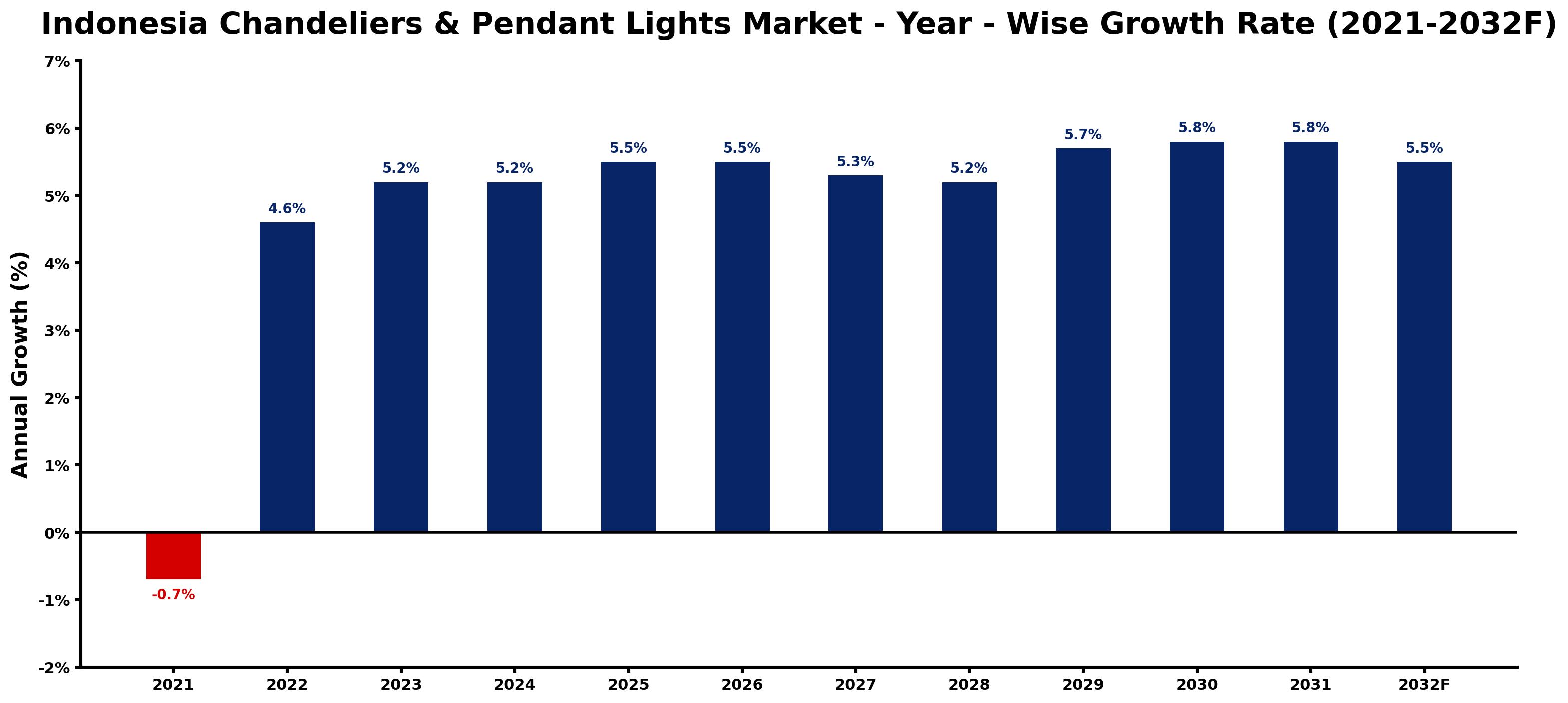
The table below presents the year wise growth rates along with the key drivers influencing the market
| Year | Growth Rate | Major Drivers |
| 2021 | -0.7% | Heightened economic uncertainty led to decreased discretionary spending on home decor and lighting fixtures. |
| 2022 | 4.6% | Local artisans began producing unique chandelier designs, appealing to niche markets. |
| 2023 | 5.2% | Emerging middle class increased spending on home improvements and stylish lighting options. |
| 2024 | 5.2% | E-commerce platforms expanded, facilitating easier access to diverse lighting products. |
| 2025 | 5.5% | Sustainability trends led to a demand for eco-friendly chandelier materials and designs. |
| 2026 | 5.5% | Expanding urban areas saw new residential developments requiring modern lighting solutions. |
| 2027 | 5.3% | Cultural festivals emphasized decorative lighting, elevating market visibility and engagement. |
| 2028 | 5.2% | Technological innovations introduced smart lighting solutions, enhancing consumer interest significantly. |
| 2029 | 5.7% | Increased tourism spurred luxury hotel developments, boosting demand for elegant pendant lights. |
| 2030 | 5.8% | Interior design trends shifted towards personalized spaces, driving custom chandelier demand. |
| 2031 | 5.8% | Collaboration with local designers fostered unique collections, enriching the overall market diversity. |
| 2032 | 5.5% | Investment in infrastructure and urban planning created opportunities for large-scale lighting projects. |
Note - Market size estimations and growth projections presented in this report are based on 6Wresearch's advanced forecasting approach, validated with industry datasets as of June 2026.
Indonesia Chandeliers & Pendant Lights Market Synopsis
The Indonesia Chandeliers Pendant Lights Market is projected to reach 5.5% and witness significant growth during the forecast period (2026-2032). The market is expected to expand at a compound annual growth rate (CAGR) of 8.4%, driven by a variety of factors. Key influences include a growing demand for luxury lighting products, the rise of decorative lighting solutions, and a shift towards modern designs among consumers. Additionally, technological advancements in chandelier and pendant light designs are providing new opportunities for market expansion. The rapid growth in the real estate sector further supports the increasing consumption of these lighting fixtures. E-commerce's emergence has transformed the retail landscape, making it simpler for customers to shop for chandeliers and pendant lights online, which is expected to enhance market accessibility.
Indonesia Chandeliers & Pendant Lights Market Growth Drivers
A variety of growth drivers are propelling the Indonesia Chandeliers & Pendant Lights Market forward. The influence of luxury products on consumer preferences is prominent, as homeowners increasingly seek high-end lighting solutions to elevate their interiors. The decorative lighting trend has captured consumer attention, leading to a surge in stylish lighting options that complement modern architectural designs. Technological advancements play a critical role, with energy-efficient lighting solutions gaining traction among environmentally conscious consumers. Furthermore, the expansion of the real estate market creates a demand for aesthetically pleasing lighting fixtures in new residential and commercial spaces.
Indonesia Chandeliers & Pendant Lights Market Trends and Opportunities
In the current landscape, several trends and opportunities are shaping the Indonesia Chandeliers & Pendant Lights Market. A notable trend is the increasing interest in smart lighting solutions that allow users to control brightness and color through mobile applications. This resonates with the growing consumer base seeking convenience and modern technology integration. Additionally, the trend towards customization presents opportunities for manufacturers to create bespoke lighting fixtures tailored to individual preferences. The rise in online shopping further opens avenues for market participants to reach broader audiences, facilitating growth in e-commerce-driven sales.
Indonesia Chandeliers & Pendant Lights Market Challenges and Restraints
Despite the promising growth trajectory, the Indonesia Chandeliers & Pendant Lights Market faces several challenges. High installation costs present a significant barrier for potential buyers, potentially limiting consumer uptake of these premium products. Furthermore, the availability of counterfeit lighting products poses a major threat to genuine manufacturers, as consumers may opt for lower-cost alternatives. This compromises both market integrity and profit margins. Additionally, fluctuations in raw material prices can impact production costs, leading to pricing challenges in the competitive lighting market.
Indonesia Chandeliers & Pendant Lights Market Government Investment and Initiatives
The Indonesian government plays a crucial role in fostering the growth of the Chandeliers & Pendant Lights Market through various investment initiatives and policy frameworks. Efforts to stimulate the real estate sector include incentives for property development and infrastructure improvements, thereby enhancing market demand for lighting solutions. Government programs aimed at promoting energy-efficient technologies also encourage the adoption of advanced lighting fixtures, aligning with environmental sustainability goals. Furthermore, the commitment to improving urban environments encourages innovative lighting designs that contribute aesthetically to public spaces.
Indonesia Chandeliers & Pendant Lights Market Latest Developments (May 2025 - June 2026)
In the period from May 2025 to June 2026, the Indonesia Chandeliers & Pendant Lights Market has experienced several key developments indicative of evolving industry trends. There has been an increase in collaborations between technology firms and lighting manufacturers to integrate smart technology into existing product lines. Additionally, consumer interest in sustainable and energy-efficient lighting options has prompted several manufacturers to innovate their designs and production processes. The competitive landscape has seen heightened activity as companies focus on enhancing their online presence and marketing strategies, responding to the growing trend of online consumer behavior. Furthermore, trade shows and exhibitions focused on lighting solutions have gained popularity, showcasing new products and design trends.
Indonesia Chandeliers & Pendant Lights Market - Key Attractiveness of the Report
- 10 Years of Market Numbers
- Historical Data Starting from 2022 to 2025
- Base Year: 2025
- Forecast Data until 2032
- Key Performance Indicators Impacting the Market
- Major Upcoming Developments and Projects
Key Highlights of the Report:
- Indonesia Chandeliers & Pendant Lights Market Outlook
- Market Size of Indonesia Chandeliers & Pendant Lights Market, 2025
- Forecast of Indonesia Chandeliers & Pendant Lights Market, 2032
- Historical Data and Forecast of Indonesia Chandeliers & Pendant Lights Revenues & Volume for the Period 2022-2032
- Indonesia Chandeliers & Pendant Lights Market Trend Evolution
- Indonesia Chandeliers & Pendant Lights Market Drivers and Challenges
- Indonesia Chandeliers & Pendant Lights Price Trends
- Indonesia Chandeliers & Pendant Lights Porter's Five Forces
- Indonesia Chandeliers & Pendant Lights Industry Life Cycle
- Historical Data and Forecast of Indonesia Chandeliers & Pendant Lights Market Revenues & Volume By Product Type for the Period 2022-2032
- Historical Data and Forecast of Indonesia Chandeliers & Pendant Lights Market Revenues & Volume By Traditional for the Period 2022-2032
- Historical Data and Forecast of Indonesia Chandeliers & Pendant Lights Market Revenues & Volume By Transitional for the Period 2022-2032
- Historical Data and Forecast of Indonesia Chandeliers & Pendant Lights Market Revenues & Volume By Modern for the Period 2022-2032
- Historical Data and Forecast of Indonesia Chandeliers & Pendant Lights Market Revenues & Volume By Applications for the Period 2022-2032
- Historical Data and Forecast of Indonesia Chandeliers & Pendant Lights Market Revenues & Volume By Commercial for the Period 2022-2032
- Historical Data and Forecast of Indonesia Chandeliers & Pendant Lights Market Revenues & Volume By Residential for the Period 2022-2032
- Historical Data and Forecast of Indonesia Chandeliers & Pendant Lights Market Revenues & Volume By Distribution Channel for the Period 2022-2032
- Historical Data and Forecast of Indonesia Chandeliers & Pendant Lights Market Revenues & Volume By Online for the Period 2022-2032
- Historical Data and Forecast of Indonesia Chandeliers & Pendant Lights Market Revenues & Volume By Offline for the Period 2022-2032
- Indonesia Chandeliers & Pendant Lights Import Export Trade Statistics
- Market Opportunity Assessment By Product Type
- Market Opportunity Assessment By Applications
- Market Opportunity Assessment By Distribution Channel
- Indonesia Chandeliers & Pendant Lights Top Companies Market Share
- Indonesia Chandeliers & Pendant Lights Competitive Benchmarking By Technical and Operational Parameters
- Indonesia Chandeliers & Pendant Lights Company Profiles
- Indonesia Chandeliers & Pendant Lights Key Strategic Recommendations






































