Indonesia Chromium Sulphate Market Size, Share & Growth Rate
The Indonesia Chromium Sulphate Market was estimated at USD 489 Million in 2025 and is projected to reach USD 649 Million by 2032, growing at a CAGR of 4.1% from 2026 to 2032. This significant growth is primarily driven by the robust demand from the leather and automotive sectors, as well as increasing construction activities across the nation. Additionally, the market is likely to benefit from the government's initiatives to promote exports, further enhancing the market's overall dynamics.
Indonesia Chromium Sulphate Market Year-wise Growth Rate and Key Drivers
This graph highlights how the Indonesia Chromium Sulphate Market has steadily grown over the years, supported by major growth factors.
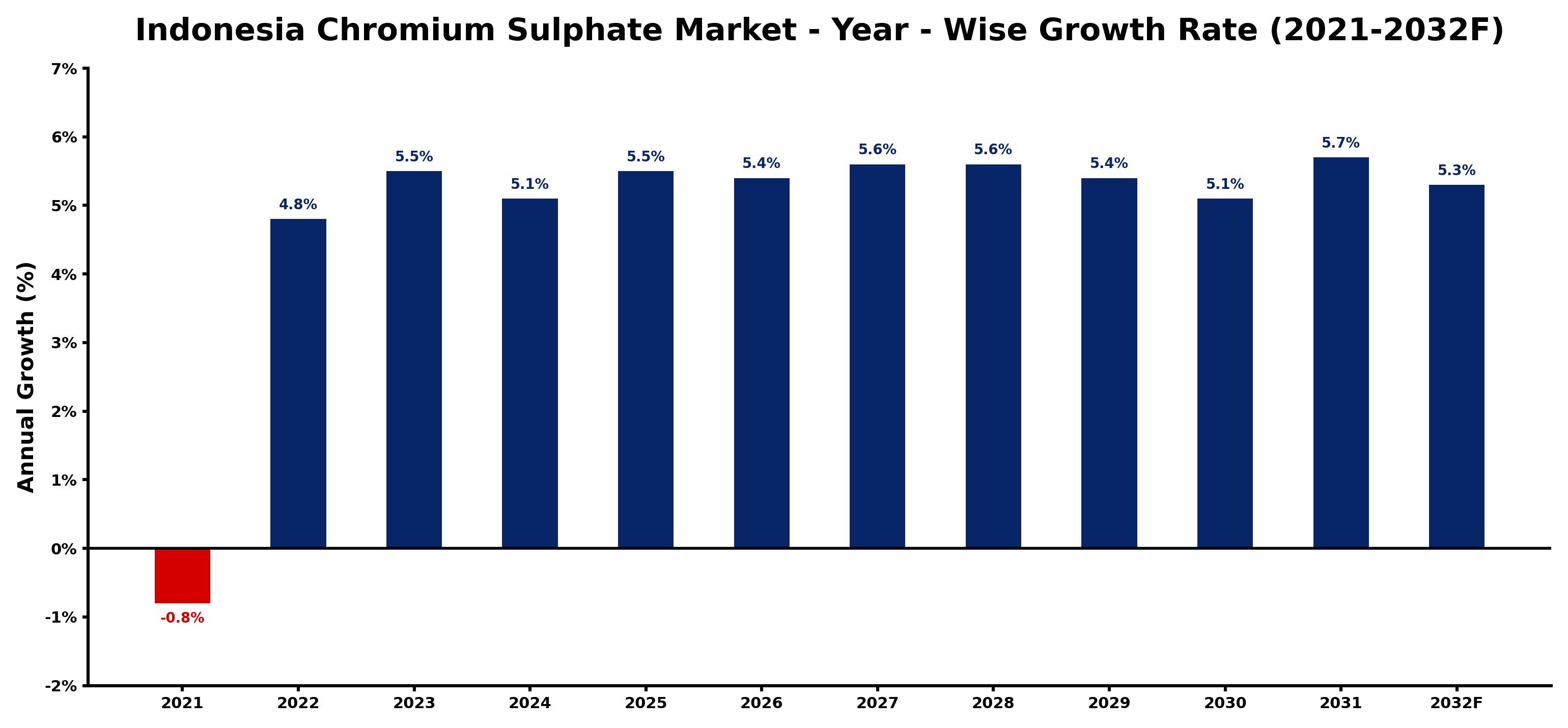
The table below presents the year‑wise growth rates along with the key drivers influencing the market
| Year | Growth Rate | Major Drivers |
| 2021 | -0.8% | Supply chain disruptions limited availability |
| 2022 | 4.8% | Manufacturing capacity expansion initiated |
| 2023 | 5.5% | Increased demand from leather industry |
| 2024 | 5.1% | Technological advancements improved production |
| 2025 | 5.5% | Rising exports to Asian markets |
| 2026 | 5.4% | Sustainability initiatives enhanced reputation |
| 2027 | 5.6% | Growing automotive sector boosted usage |
| 2028 | 5.6% | Investment in infrastructure accelerated growth |
| 2029 | 5.4% | Emerging markets increased consumption rates |
| 2030 | 5.1% | Regulatory support fostered industry stability |
| 2031 | 5.7% | Collaborations with international firms expanded |
| 2032 | 5.3% | Innovative applications drove market interest |
Note - Market size estimations and growth projections presented in this report are based on 6Wresearch's advanced forecasting approach, validated with industry datasets as of June 2026.
Indonesia Chromium Sulphate Market Synopsis
In Indonesia, the demand for chromium sulphate is primarily fueled by the thriving leather industry, which relies on this compound for effective tanning processes, ensuring durability and quality. With the country's rich natural resources and an expanding manufacturing base, chromium sulphate has become indispensable in various applications, from automotive components to metal treatments.
The market has seen a steady influx of foreign investments, driven by the competitive labor costs and favorable production conditions. Moreover, the increasing adoption of chromium sulphate in several industrial sectors, such as ceramics and electronics, illustrates its growing importance within Indonesia's economic landscape.
Indonesia Chromium Sulphate Market Key Takeaways
- The market is significantly driven by the expanding leather and automotive industries, highlighting the compound's critical role in production processes.
- Government support and export promotion policies are expected to facilitate further growth in the chromium sulphate sector.
- Investments in capacity expansion by various companies present promising opportunities for suppliers and stakeholders.
- Environmental regulations are prompting a shift towards sustainable practices within the chromium sulphate industry, opening avenues for innovation.
- The competitive landscape remains challenging due to the availability of cheaper substitute materials, necessitating strategic adjustments from manufacturers.
Evaluation of Restraints in Indonesia Chromium Sulphate Market
Despite its growth potential, the Indonesia chromium sulphate market faces several restraints that may hinder its progress. High production costs stemming from expensive raw materials create pressure on manufacturers to maintain profitability. Furthermore, the underdeveloped distribution network can lead to inefficiencies in supply chain management, complicating access to end-users. Coupled with limited technological advancements, these factors may restrict the market's capacity to optimize production efficiency and meet rising demand effectively.
Indonesia Chromium Sulphate Market Trends
A notable trend in the Indonesia chromium sulphate market is the increasing focus on sustainable practices, driven by stringent environmental regulations. Companies are actively adopting greener technologies to mitigate environmental impacts, thus creating new avenues for innovation and growth. Additionally, the rise of e-commerce in various industrial sectors is reshaping distribution channels, offering manufacturers a chance to expand their reach and improve market penetration.
Indonesia Chromium Sulphate Market Opportunities
The potential for growth in the Indonesia chromium sulphate market is substantial, particularly in light of the country's expanding automotive and construction sectors. Opportunities lie in increasing investments in research and development to enhance product applications and processing techniques. Furthermore, as demand for high-quality leather products continues to rise globally, Indonesian producers stand to benefit from leveraging local advantages in production capacity and expertise.
Government Initiatives in the Indonesia Chromium Sulphate Market
The Indonesian government has been actively involved in promoting the chemicals industry, including chromium sulphate, through various initiatives aimed at boosting exports and attracting foreign investments. Policies designed to enhance local manufacturing capabilities, coupled with incentives for sustainable practices, are expected to create a conducive environment for the growth of this sector. Public spending on infrastructure improvements will further facilitate better access to markets and supply chains.
Future Insights of the Indonesia Chromium Sulphate Market
Looking ahead to 2026-2032, the Indonesia chromium sulphate market is poised for continued expansion, driven by escalating demand from key sectors. The increasing emphasis on sustainability and eco-friendly practices is likely to reshape the competitive landscape, fostering innovation. As domestic manufacturers adapt to emerging trends and continue to enhance operational efficiencies, the market is anticipated to exhibit robust growth, benefiting from both local and international opportunities.
Indonesia Chromium Sulphate Market Latest Developments (May 2025 - June 2026)
Recent industry developments indicate a strategic shift towards increased capacity and technological investments within the Indonesia chromium sulphate market. Companies are focusing on expanding their product offerings to meet the diverse needs of end-users while adhering to stringent environmental standards. Collaborative efforts between domestic manufacturers and international players are also emerging, aimed at enhancing technological know-how and market reach.
Indonesia Chromium Sulphate Market - Key Attractiveness of the Report
- 10 Years of Market Numbers
- Historical Data Starting from 2022 to 2025
- Base Year: 2025
- Forecast Data until 2032
- Key Performance Indicators Impacting the Market
- Major Upcoming Developments and Projects
Key Highlights of the Report:
- Indonesia Chromium Sulphate Market Outlook
- Market Size of Indonesia Chromium Sulphate Market, 2025
- Forecast of Indonesia Chromium Sulphate Market, 2032
- Historical Data and Forecast of Indonesia Chromium Sulphate Revenues & Volume for the Period 2022-2032F
- Indonesia Chromium Sulphate Market Trend Evolution
- Indonesia Chromium Sulphate Market Drivers and Challenges
- Indonesia Chromium Sulphate Price Trends
- Indonesia Chromium Sulphate Porter's Five Forces
- Indonesia Chromium Sulphate Industry Life Cycle
- Historical Data and Forecast of Indonesia Chromium Sulphate Market Revenues & Volume By Products for the Period 2022-2032F
- Historical Data and Forecast of Indonesia Chromium Sulphate Market Revenues & Volume By Basic Chromium Sulphate 21%-23% for the Period 2022-2032F
- Historical Data and Forecast of Indonesia Chromium Sulphate Market Revenues & Volume By Basic Chromium Sulphate 24%-26% for the Period 2022-2032F
- Historical Data and Forecast of Indonesia Chromium Sulphate Market Revenues & Volume By Applications for the Period 2022-2032F
- Historical Data and Forecast of Indonesia Chromium Sulphate Market Revenues & Volume By Tanning Agent for the Period 2022-2032F
- Historical Data and Forecast of Indonesia Chromium Sulphate Market Revenues & Volume By Dyeing for the Period 2022-2032F
- Historical Data and Forecast of Indonesia Chromium Sulphate Market Revenues & Volume By Painting & Coating for the Period 2022-2032F
- Indonesia Chromium Sulphate Import Export Trade Statistics
- Market Opportunity Assessment By Products
- Market Opportunity Assessment By Applications
- Indonesia Chromium Sulphate Top Companies Market Share
- Indonesia Chromium Sulphate Competitive Benchmarking By Technical and Operational Parameters
- Indonesia Chromium Sulphate Company Profiles
- Indonesia Chromium Sulphate Key Strategic Recommendations






































