Indonesia Coaxial Cables Market Summary
The indonesia coaxial cables market was estimated at USD 228 Million in 2025 and is projected to reach USD 302 Million by 2032, growing at a CAGR of 5.5% from 2026 to 2032.
Indonesia Coaxial Cables Market Year-wise Growth Rate and Key Drivers
This graph highlights how the Indonesia Coaxial Cables Market has steadily grown over the past five years, supported by major growth factors.
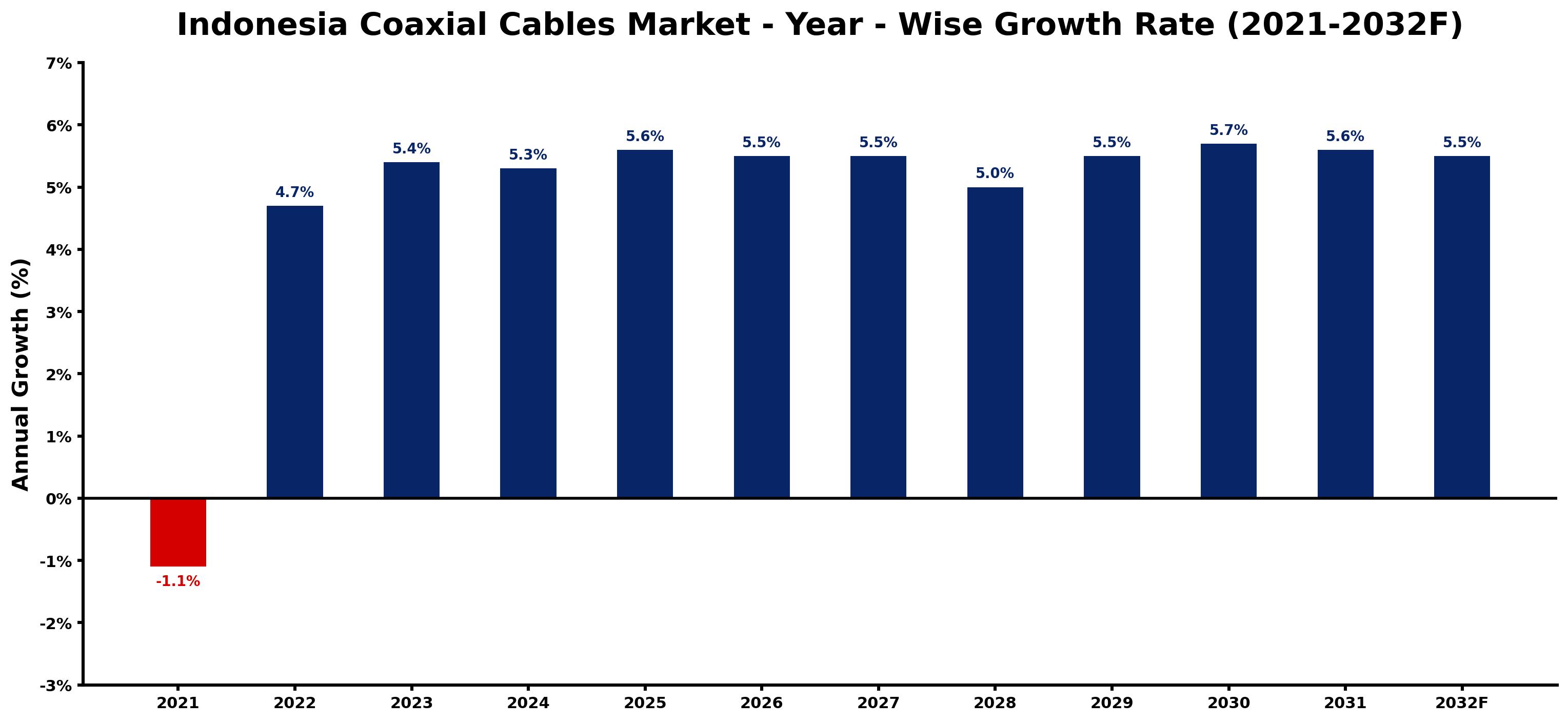
The table below presents the year wise growth rates along with the key drivers influencing the market
| Year | Growth Rate | Major Drivers |
| 2021 | -1.1% | Decreased infrastructure investment curtailed demand for coaxial solutions in telecommunications and broadcasting sectors. |
| 2022 | 4.7% | Legacy copper grid failures prompted a transition to more reliable coaxial solutions. |
| 2023 | 5.4% | Enterprise budgets prioritizing smart technology integration boosted coaxial cable installations. |
| 2024 | 5.3% | The expanded telecommunications infrastructure connected remote areas to urban networks efficiently. |
| 2025 | 5.6% | Rapid urbanization led to increased demand for high-capacity coaxial cable installations. |
| 2026 | 5.5% | Investments in entertainment sectors created a surge in coaxial cable requirements. |
| 2027 | 5.5% | Competitive pricing among manufacturers encouraged broader market penetration for coaxial products. |
| 2028 | 5.0% | Emerging Internet of Things applications required enhanced coaxial cable performance and reliability. |
| 2029 | 5.5% | Sustainable building practices integrated coaxial cables for improved energy efficiency and longevity. |
| 2030 | 5.7% | Technological collaborations between companies introduced innovative coaxial cable designs and materials. |
| 2031 | 5.6% | Rising consumer electronics demand directly influenced the coaxial cable market expansion. |
| 2032 | 5.5% | Increased focus on renewable energy projects necessitated robust coaxial connections for infrastructure. |
Note - Market size estimations and growth projections presented in this report are based on 6Wresearch's advanced forecasting approach, validated with industry datasets as of June 2026.
Indonesia Coaxial Cables Market Synopsis
The Indonesia Coaxial Cables Market is projected to reach 5.5% and witness significant growth during the forecast period (2026-2032). This expected growth can be largely attributed to the increasing adoption of coaxial cables across various applications, including computer networks, television transmission systems, and other sectors throughout the country. As high-speed data transfer becomes crucial in various industries, the demand for coaxial cables continues to rise. Further fueling this market is the escalating investment by the Indonesian government in infrastructure development and telecommunications, which contributes to the heightened demand for coaxial cable products. Additionally, technological advancements, particularly the introduction of 4K Ultra HD technology, are stimulating increased usage of coaxial cables, further driving sales over time. Government initiatives aimed at enhancing digitization are also making coaxial cable installations more prevalent across different sectors, underscoring the evolving nature of this market.
Indonesia Coaxial Cables Market Growth Drivers
The growth of the Indonesia Coaxial Cables Market is fueled by several key factors:
- The increasing adoption of coaxial cables across diverse application areas such as computer networking and television transmission systems is a primary driver.
- Rising demand for high-speed data transfer within various industries promotes the necessity for advanced coaxial cable solutions.
- Government investments in digital infrastructure, communications, and overall technological advancement boost the market for coaxial cables.
- Emerging technologies, particularly in video broadcasting like 4K Ultra HD, are creating new avenues for coaxial cable installation and use.
- The focus on improving data security and reliable transmissions in line with government digitization initiatives further enhances the need for coaxial cable products across multiple sectors.
Indonesia Coaxial Cables Market Challenges and Restraints
Despite the promising growth, the Indonesia Coaxial Cables Market faces several challenges:
- Market competition is intensifying as new players enter, which may put pressure on pricing and profit margins.
- The rapid pace of technological evolution requires continuous innovation and investment, which can strain resources for industry players.
- Supply chain disruptions and fluctuations in raw material prices can adversely impact cable manufacturing costs and operations.
- Regulatory and compliance issues surrounding telecommunications infrastructure can pose challenges to market entrants and expansions.
- Potential shifts towards alternative technologies, such as fiber optics, might threaten the traditional coaxial cable market unless it adapts accordingly.
Indonesia Coaxial Cables Market Government Investment and Initiatives
The Indonesian government is playing a crucial role in promoting the growth of the coaxial cables market through various investments and initiatives:
- Significant funding is being allocated for telecommunications infrastructure improvements, enhancing connectivity and access across urban and rural areas.
- Public spending on digital transformation projects aims to bolster national internet penetration rates, directly impacting the demand for coaxial cables.
- Partnerships between the government and private sectors are fostering innovation in communication technologies, thereby increasing the need for reliable coaxial cable solutions.
- Incentives and subsidies for infrastructure development projects encourage the adoption of updated telecommunications technologies, including coaxial cables.
- Government-led initiatives focused on enhancing data security and establishing safe transmission channels drive higher demand for coaxial cables in various sectors.
Indonesia Coaxial Cables Market Latest Developments (May 2025 - June 2026)
Recent developments in the Indonesia Coaxial Cables Market between May 2025 and June 2026 highlight a continued trend toward growth and adaptation:
- Several telecommunications companies have announced substantial investments in upgrading their existing cable infrastructures to accommodate higher data transfer rates.
- Emerging consumer demand for high-definition broadcast content has led to an increase in coaxial cable installation in both residential and commercial sectors.
- Technological advancements in coaxial cable manufacturing processes are being pursued to enhance performance and reduce production costs.
- New regulations promoting digital infrastructure improvements have resulted in heightened government support for projects utilizing coaxial cables.
- Increased collaboration between industry stakeholders aims to address supply chain challenges, ensuring stability in cable availability and pricing.
Indonesia Coaxial Cables Market - Key Attractiveness of the Report
- 10 Years of Market Numbers
- Historical Data Starting from 2022 to 2025
- Base Year: 2025
- Forecast Data until 2032
- Key Performance Indicators Impacting the Market
- Major Upcoming Developments and Projects
Key Highlights of the Report:
- Indonesia Coaxial Cables Market Outlook
- Market Size of Indonesia Coaxial Cables Market, 2025
- Forecast of Indonesia Coaxial Cables Market, 2032F
- Historical Data and Forecast of Indonesia Coaxial Cables Revenues & Volume for the Period 2022-2032F
- Indonesia Coaxial Cables Market Trend Evolution
- Indonesia Coaxial Cables Market Drivers and Challenges
- Indonesia Coaxial Cables Price Trends
- Indonesia Coaxial Cables Porter's Five Forces
- Indonesia Coaxial Cables Industry Life Cycle
- Historical Data and Forecast of Indonesia Coaxial Cables Market Revenues & Volume By Types for the Period 2022-2032F
- Historical Data and Forecast of Indonesia Coaxial Cables Market Revenues & Volume By Hard-line Cable for the Period 2022-2032F
- Historical Data and Forecast of Indonesia Coaxial Cables Market Revenues & Volume By Triaxial Cable for the Period 2022-2032F
- Historical Data and Forecast of Indonesia Coaxial Cables Market Revenues & Volume By Twin Axial Cable for the Period 2022-2032F
- Historical Data and Forecast of Indonesia Coaxial Cables Market Revenues & Volume By Applications for the Period 2022-2032F
- Historical Data and Forecast of Indonesia Coaxial Cables Market Revenues & Volume By Internet Data Transfer for the Period 2022-2032F
- Historical Data and Forecast of Indonesia Coaxial Cables Market Revenues & Volume By Video Distribution for the Period 2022-2032F
- Historical Data and Forecast of Indonesia Coaxial Cables Market Revenues & Volume By Radio Distribution Frequency Transfer for the Period 2022-2032F
- Historical Data and Forecast of Indonesia Coaxial Cables Market Revenues & Volume By Others for the Period 2022-2032F
- Historical Data and Forecast of Indonesia Coaxial Cables Market Revenues & Volume By End-users for the Period 2022-2032F
- Historical Data and Forecast of Indonesia Coaxial Cables Market Revenues & Volume By Cable Television Industry for the Period 2022-2032F
- Historical Data and Forecast of Indonesia Coaxial Cables Market Revenues & Volume By Military and Aerospace for the Period 2022-2032F
- Historical Data and Forecast of Indonesia Coaxial Cables Market Revenues & Volume By Internet Service Providers for the Period 2022-2032F
- Historical Data and Forecast of Indonesia Coaxial Cables Market Revenues & Volume By Telephone Network Operators for the Period 2022-2032F
- Historical Data and Forecast of Indonesia Coaxial Cables Market Revenues & Volume By Communication Equipment Manufactures for the Period 2022-2032F
- Indonesia Coaxial Cables Import Export Trade Statistics
- Market Opportunity Assessment By Types
- Market Opportunity Assessment By Applications
- Market Opportunity Assessment By End-users
- Indonesia Coaxial Cables Top Companies Market Share
- Indonesia Coaxial Cables Competitive Benchmarking By Technical and Operational Parameters
- Indonesia Coaxial Cables Company Profiles
- Indonesia Coaxial Cables Key Strategic Recommendations






































