Indonesia Cobalt Market: Import Trend Analysis
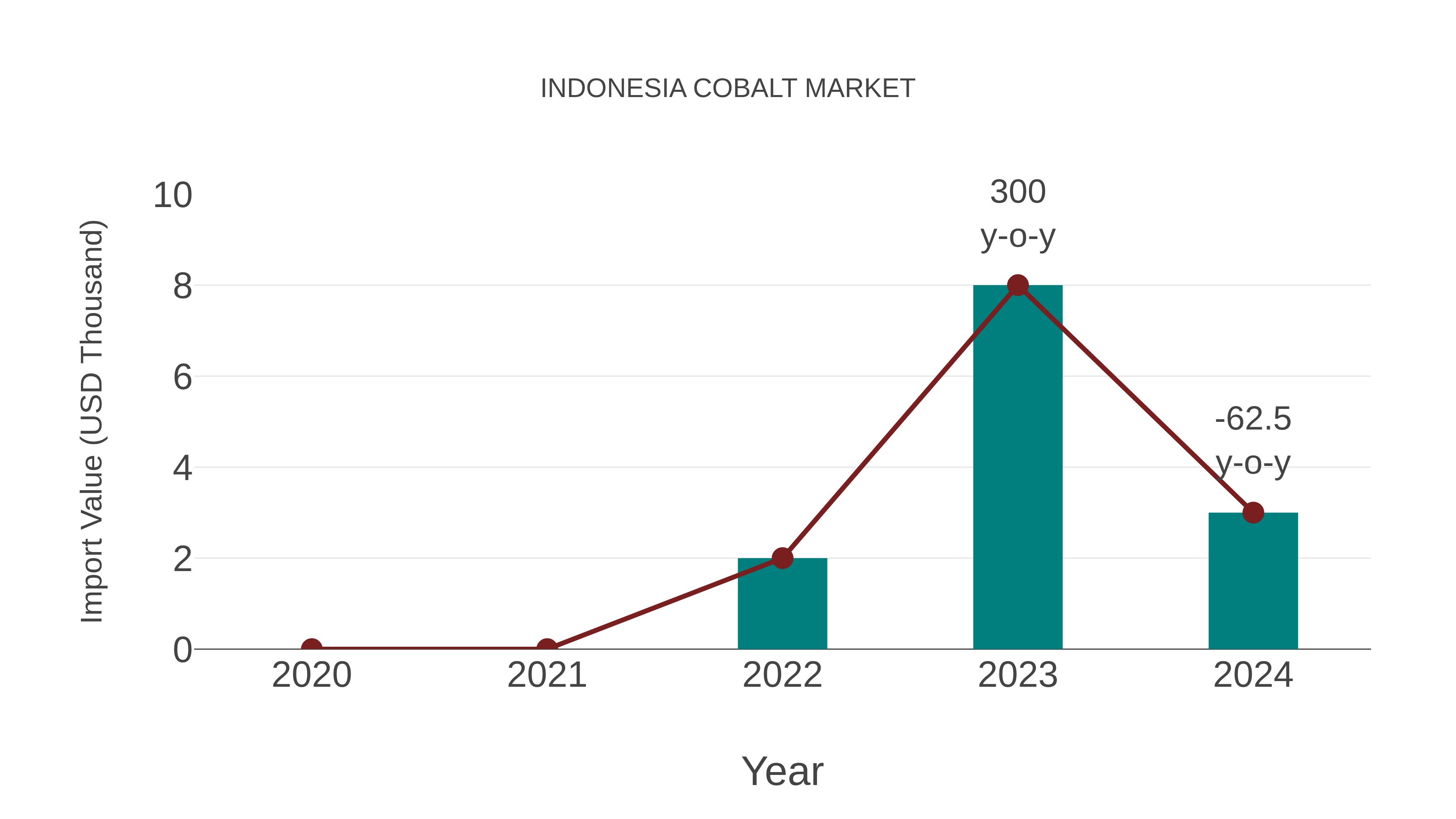
Indonesia`s import trend for the cobalt market showed a notable decline from 2023 to 2024, with a growth rate of -62.5%. However, the compound annual growth rate (CAGR) for the period of 2020-2024 stood at 22.47%. This significant decrease in import momentum can be attributed to shifts in demand dynamics or changes in trade policies impacting market stability.
Cobalt Market: Indonesia vs Top 5 Major Economies in 2027 (Asia)
In the Asia region, the Cobalt market in Indonesia is projected to expand at a growing growth rate of 7.84% by 2027. The largest economy is China, followed by India, Japan, Australia and South Korea.

Indonesia Cobalt MarketSynopsis
Indonesia is the world?s second-largest producer of cobalt, after the Democratic Republic of Congo (DRC). The majority of Indonesia cobalt production comes from its nickel mining operations. According to the 6Wresearch, Indonesia accounted for 11% of global cobalt production with 15kt.
Market Trends
The demand for cobalt continues to rise driven by increased uptake in electric vehicle technology and battery energy storage applications. This has led to an increase in investment into Indonesia nickel mining operations as companies look to capitalize on this increased demand and secure access to a significant portion of global supply.
Market Drivers
The increasing number of electric vehicles being sold around the world is expected to drive up demand for lithium-ion batteries which contain high amounts of cobalt, thus driving higher prices and demand for Cobalt ore mined directly from Indonesia. Additionally, strong government policy initiatives are providing incentives towards renewable energy solutions such as solar power and wind turbines that could also be contributing towards higher prices due their use in Lithium ion batteries used within these technologies respectively.
COVID-19 Impact on the Market
Due to the COVID-19 pandemic, there was a drop in both domestic consumption and exports resulting from weak economic conditions globally which affected pricing across all commodities including Cobalt ore produced by Indonesia. In addition, travel restrictions have impeded exploration activities resulting further disruption within the market.
Challenges of the Market
Both legal issues regarding land rights conflicts and environmental concerns related pollution arise when it comes exploitation or extraction processes involved with Cobalt mining operations primarily located rural areas.In addition, because much competition exists between foreign entities looking exploit resources more efficiently, local firms may struggle compete against larger multinationals who possess more capital invest developing technologies that increase efficiency while minimizing costs.
Industry Key Players
Major players operating in Indonesia cobalts sector include PT International Nickel Indonesia Tbk (INCO), Antam Resources International Pte Ltd., Freeport McMoRan Inc., Vale SA etc.
Key Highlights of the Report:
- Indonesia Cobalt Market Outlook
- Market Size of Indonesia Cobalt Market, 2025
- Forecast of Indonesia Cobalt Market, 2032
- Historical Data and Forecast of Indonesia Cobalt Revenues & Volume for the Period 2022-2032F
- Indonesia Cobalt Market Trend Evolution
- Indonesia Cobalt Market Drivers and Challenges
- Indonesia Cobalt Price Trends
- Indonesia Cobalt Porter's Five Forces
- Indonesia Cobalt Industry Life Cycle
- Historical Data and Forecast of Indonesia Cobalt Market Revenues & Volume By Form for the Period 2022-2032F
- Historical Data and Forecast of Indonesia Cobalt Market Revenues & Volume By Chemical Compound for the Period 2022-2032F
- Historical Data and Forecast of Indonesia Cobalt Market Revenues & Volume By Metal for the Period 2022-2032F
- Historical Data and Forecast of Indonesia Cobalt Market Revenues & Volume By Purchased Scrap for the Period 2022-2032F
- Historical Data and Forecast of Indonesia Cobalt Market Revenues & Volume By Application for the Period 2022-2032F
- Historical Data and Forecast of Indonesia Cobalt Market Revenues & Volume By Battery Chemicals for the Period 2022-2032F
- Historical Data and Forecast of Indonesia Cobalt Market Revenues & Volume By Super Alloy for the Period 2022-2032F
- Historical Data and Forecast of Indonesia Cobalt Market Revenues & Volume By Ceramic & Pigments for the Period 2022-2032F
- Historical Data and Forecast of Indonesia Cobalt Market Revenues & Volume By Hard Metals for the Period 2022-2032F
- Historical Data and Forecast of Indonesia Cobalt Market Revenues & Volume By Magnets for the Period 2022-2032F
- Historical Data and Forecast of Indonesia Cobalt Market Revenues & Volume By Life Science for the Period 2022-2032F
- Historical Data and Forecast of Indonesia Cobalt Market Revenues & Volume By Binder Material for the Period 2022-2032F
- Historical Data and Forecast of Indonesia Cobalt Market Revenues & Volume By End-Users for the Period 2022-2032F
- Historical Data and Forecast of Indonesia Cobalt Market Revenues & Volume By Electronics for the Period 2022-2032F
- Historical Data and Forecast of Indonesia Cobalt Market Revenues & Volume By Automotive for the Period 2022-2032F
- Historical Data and Forecast of Indonesia Cobalt Market Revenues & Volume By Aerospace for the Period 2022-2032F
- Historical Data and Forecast of Indonesia Cobalt Market Revenues & Volume By Medical for the Period 2022-2032F
- Indonesia Cobalt Import Export Trade Statistics
- Market Opportunity Assessment By Form
- Market Opportunity Assessment By Application
- Market Opportunity Assessment By End-Users
- Indonesia Cobalt Top Companies Market Share
- Indonesia Cobalt Competitive Benchmarking By Technical and Operational Parameters
- Indonesia Cobalt Company Profiles
- Indonesia Cobalt Key Strategic Recommendations






































