Indonesia Complex Event Processing Market Size & Growth Rate (2026-2032)
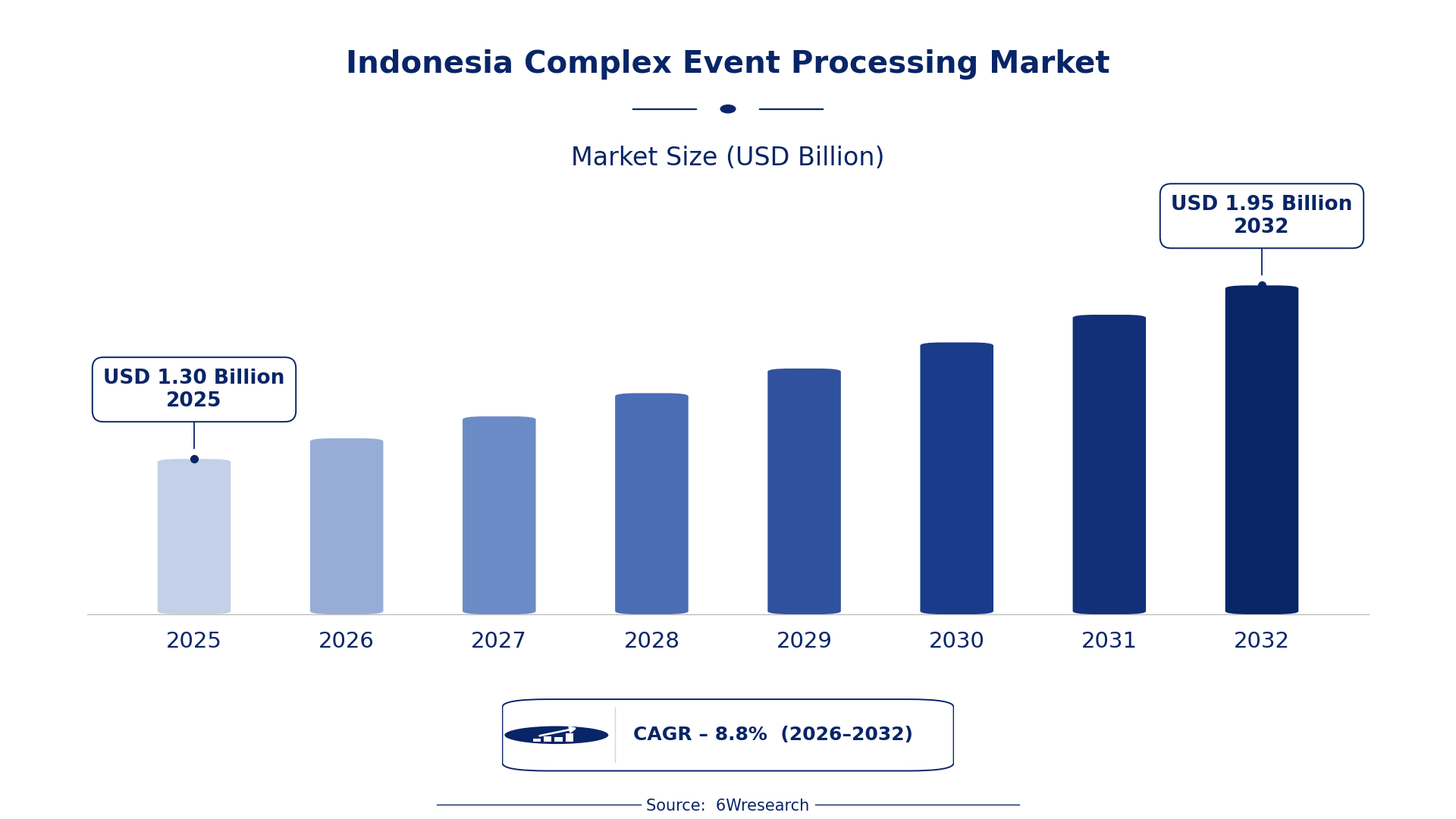
The Indonesia Complex Event Processing Market was estimated at USD 1296 Million in 2025 and is projected to reach USD 1948 Million by 2032, growing at a CAGR of 8.8% from 2026 to 2032.
Indonesia Complex Event Processing Market Synopsis
In Indonesia, the demand for complex event processing (CEP) solutions is rapidly increasing as businesses recognize the need for real-time data analysis across various sectors. Industries such as financial services and logistics are leading this charge, seeking to enhance operational efficiency through timely insights and decision-making.
CEP technology empowers organizations to react to events as they unfold, transforming the way data is processed and utilized. As more companies adopt IoT applications and smart technologies, the reliance on sophisticated data processing tools will only intensify, positioning Indonesia as a key player in the CEP market.
Indonesia Complex Event Processing Market Year-wise Growth Rate and Key Drivers
This graph illustrates the annual growth rates of the Indonesia Complex Event Processing Market from 2021 to 2032, highlighting a steady upward trajectory and projected expansion over the forecast period.
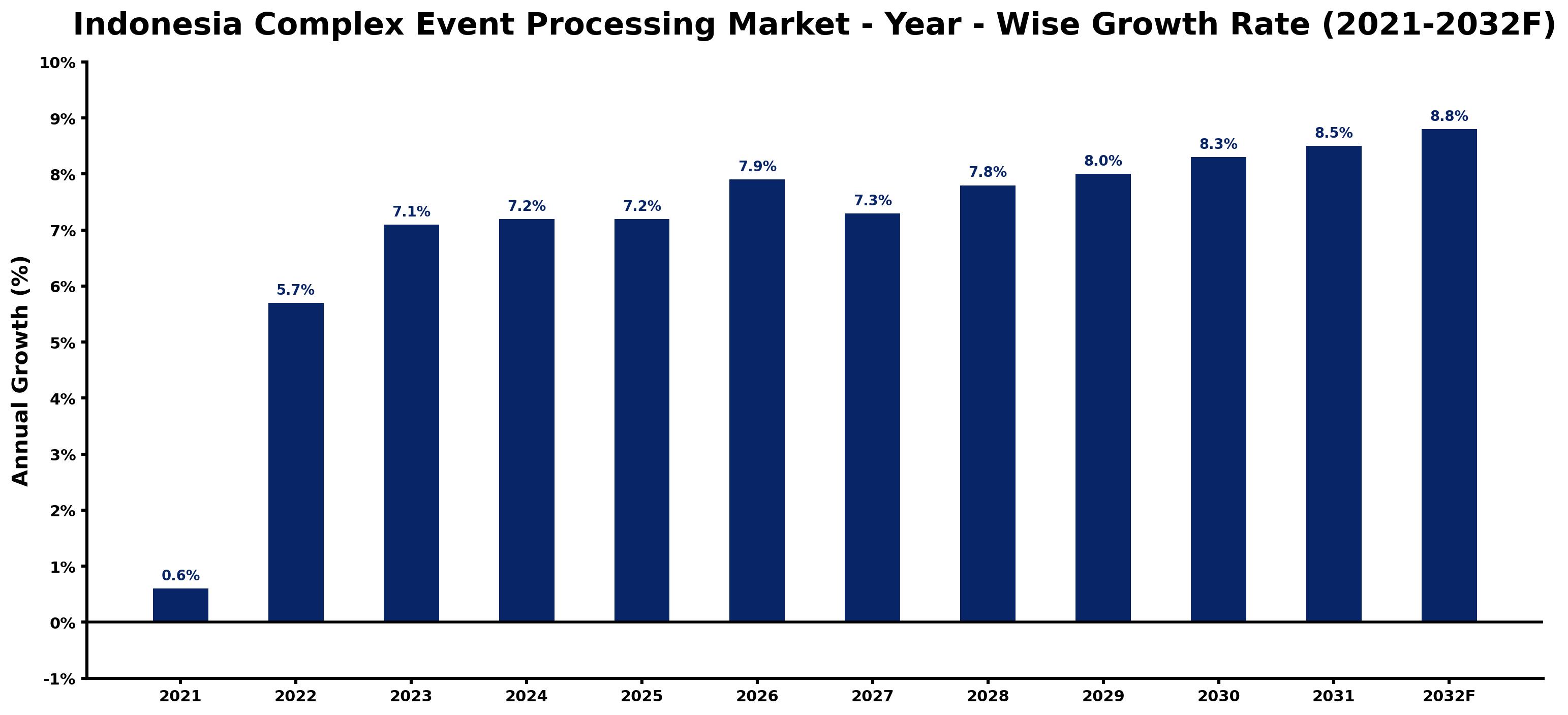
The table below presents the year‑wise growth rates along with the key drivers influencing the market
| Year | Growth Rate | Major Drivers |
| 2021 | 0.6% | Increased adoption of IoT in smart cities initiative. |
| 2022 | 5.7% | BPS regulation supporting data analytics in businesses. |
| 2023 | 7.1% | Growing fintech sector requiring real-time data processing. |
| 2024 | 7.2% | Government digital transformation driving demand for analytics. |
| 2025 | 7.2% | Rising e-commerce activities necessitating event-driven architectures. |
| 2026 | 7.9% | Surge in mobile app development boosting data integration. |
| 2027 | 7.3% | Support for AI applications enhancing data processing capabilities. |
| 2028 | 7.8% | Local tech startups fostering innovative event processing solutions. |
| 2029 | 8.0% | Increased cybersecurity threats demanding advanced monitoring systems. |
| 2030 | 8.3% | Investment in cloud computing accelerating data analysis adoption. |
| 2031 | 8.5% | Telecommunications growth enhancing data event handling needs. |
| 2032 | 8.8% | Regulatory push for real-time compliance reporting in finance. |
Note: Market size estimations and growth projections presented in this report are based on 6Wresearch's proprietary forecasting methodology, utilizing the latest available industry data, government publications, and primary research inputs.
Indonesia Complex Event Processing Market Key Takeaways
Below are some of the specific key takeaways from the market, including:
- Real-time data analysis is critical for competitive advantages in various industries.
- Financial services, supply chain management, and IoT are leading adopters of CEP technologies.
- Infrastructure challenges remain a significant barrier to widespread CEP implementation.
- The COVID-19 pandemic accelerated the need for rapid data processing solutions.
- Key players are investing in advanced technologies to cater to growing market demands.
Evaluation of Restraints in Indonesia Complex Event Processing Market
Despite the momentum in the Indonesia Complex Event Processing Market, several restraints hinder its full potential. The need for advanced infrastructure to support real-time data handling is a critical issue. In sectors like finance, where decisions must be made in milliseconds, the inability to process vast data volumes effectively can lead to missed opportunities. on top of that, budget constraints stemming from the pandemic have left many organizations hesitant to invest in new technologies, which slows down the adoption of CEP solutions.
Indonesia Complex Event Processing Market Trends
The shift towards digital transformation is driving the adoption of CEP solutions in Indonesia. Businesses are increasingly focusing on data-driven decision-making, which is reshaping operational strategies. Additionally, the integration of artificial intelligence and machine learning into CEP platforms is enhancing the ability to analyze complex data streams, providing organizations with deeper insights and more proactive responses to emerging challenges.
Indonesia Complex Event Processing Market Opportunities
The potential for growth in the Indonesia Complex Event Processing Market is substantial. As organizations seek to refine their operational capabilities, there are opportunities for new entrants to provide innovative CEP solutions tailored to local needs. The expansion of IoT applications is another promising area, as businesses recognize the value of real-time analytics for optimizing processes and improving customer experiences.
Government Initiatives in the Indonesia Complex Event Processing Market
Government policies in Indonesia are increasingly favorable towards enhancing data processing capabilities across industries. The focus is on building a strong digital economy, which is crucial for the development of CEP solutions. Regulatory frameworks are being established to support data management, while public-sector initiatives aim to improve technological infrastructure, fostering a conducive environment for CEP market growth.
- A national digital infrastructure upgrade programme launched in early 2023 aims to enhance connectivity across the archipelago.
- Currently ongoing efforts include a regulatory framework introduced in 2024 that mandates data transparency and security for businesses.
- A planned public-private initiative is expected to support the development of smart city projects by 2026, integrating CEP technologies into urban management.
- Government-backed funding initiatives aimed at promoting local tech startups in the CEP space are currently underway.
- Upcoming initiatives focus on enhancing digital literacy and skill development in data analytics by 2025.
Future Insights of the Indonesia Complex Event Processing Market
Looking ahead to 2026-2032, the Indonesia Complex Event Processing Market is set for substantial growth as businesses increasingly prioritize real-time data processing. The integration of advanced technologies, such as AI and machine learning, will redefine how organizations utilize CEP solutions. As a result, we expect to see enhanced efficiencies across sectors, particularly in finance and logistics, driving the overall market forward.
Indonesia Complex Event Processing Market Latest Developments
In the past year, the Indonesia Complex Event Processing Market has seen a flurry of activity as organizations adapt to the increasing demands for real-time data analytics. The focus has been on enhancing existing technologies and exploring new partnerships to strengthen market presence.
- A major technology vendor initiated a partnership in Q2 2025 with local firms to co-develop CEP solutions tailored for the financial sector, enhancing market responsiveness.
- In early 2025, a regional operator launched an upgraded CEP platform designed to process larger data sets, significantly improving operational efficiency.
- Currently ongoing is a pilot project that began in late 2024, aimed at implementing CEP in supply chain management for major manufacturers.
- A rollout of new training programs for data analysts is planned for mid-2026, focusing on CEP technologies to boost local expertise.
- A recent collaboration between academic institutions and tech firms has been established, aiming to foster innovation in CEP applications, with activities expected to ramp up in 2025.
Indonesia Complex Event Processing Market - Key Attractiveness of the Report
- 10 Years of Market Numbers
- Historical Data Starting from 2022 to 2025
- Base Year: 2025
- Forecast Data until 2032
- Key Performance Indicators Impacting the Market
- Major Upcoming Developments and Projects
Key Highlights of the Report:
- Indonesia Complex Event Processing Market Outlook
- Market Size of Indonesia Complex Event Processing Market, 2025
- Forecast of Indonesia Complex Event Processing Market, 2032
- Historical Data and Forecast of Indonesia Complex Event Processing Revenues & Volume for the Period 2022-2032F
- Indonesia Complex Event Processing Market Trend Evolution
- Indonesia Complex Event Processing Market Drivers and Challenges
- Indonesia Complex Event Processing Price Trends
- Indonesia Complex Event Processing Porter's Five Forces
- Indonesia Complex Event Processing Industry Life Cycle
- Historical Data and Forecast of Indonesia Complex Event Processing Market Revenues & Volume By Application for the Period 2022-2032F
- Historical Data and Forecast of Indonesia Complex Event Processing Market Revenues & Volume By Algorithmic Trading for the Period 2022-2032F
- Historical Data and Forecast of Indonesia Complex Event Processing Market Revenues & Volume By Electronic Transaction Monitoring for the Period 2022-2032F
- Historical Data and Forecast of Indonesia Complex Event Processing Market Revenues & Volume By Dynamic Pre-Trae Analytics for the Period 2022-2032F
- Historical Data and Forecast of Indonesia Complex Event Processing Market Revenues & Volume By Data Enrichment for the Period 2022-2032F
- Historical Data and Forecast of Indonesia Complex Event Processing Market Revenues & Volume By Fraud Detection for the Period 2022-2032F
- Historical Data and Forecast of Indonesia Complex Event Processing Market Revenues & Volume By Governance, Risk and Compliance for the Period 2022-2032F
- Historical Data and Forecast of Indonesia Complex Event Processing Market Revenues & Volume By Asset Management and Predictive Scheduling for the Period 2022-2032F
- Historical Data and Forecast of Indonesia Complex Event Processing Market Revenues & Volume By Deployment for the Period 2022-2032F
- Historical Data and Forecast of Indonesia Complex Event Processing Market Revenues & Volume By Cloud for the Period 2022-2032F
- Historical Data and Forecast of Indonesia Complex Event Processing Market Revenues & Volume By On-Premise for the Period 2022-2032F
- Historical Data and Forecast of Indonesia Complex Event Processing Market Revenues & Volume By Service for the Period 2022-2032F
- Historical Data and Forecast of Indonesia Complex Event Processing Market Revenues & Volume By Consulting for the Period 2022-2032F
- Historical Data and Forecast of Indonesia Complex Event Processing Market Revenues & Volume By Installation and Maintenance for the Period 2022-2032F
- Historical Data and Forecast of Indonesia Complex Event Processing Market Revenues & Volume By Training and Support for the Period 2022-2032F
- Historical Data and Forecast of Indonesia Complex Event Processing Market Revenues & Volume By Managed Services for the Period 2022-2032F
- Indonesia Complex Event Processing Import Export Trade Statistics
- Market Opportunity Assessment By Application
- Market Opportunity Assessment By Deployment
- Market Opportunity Assessment By Service
- Indonesia Complex Event Processing Top Companies Market Share
- Indonesia Complex Event Processing Competitive Benchmarking By Technical and Operational Parameters
- Indonesia Complex Event Processing Company Profiles
- Indonesia Complex Event Processing Key Strategic Recommendations






































