Indonesia Compressor Oil Market: Import Trend Analysis
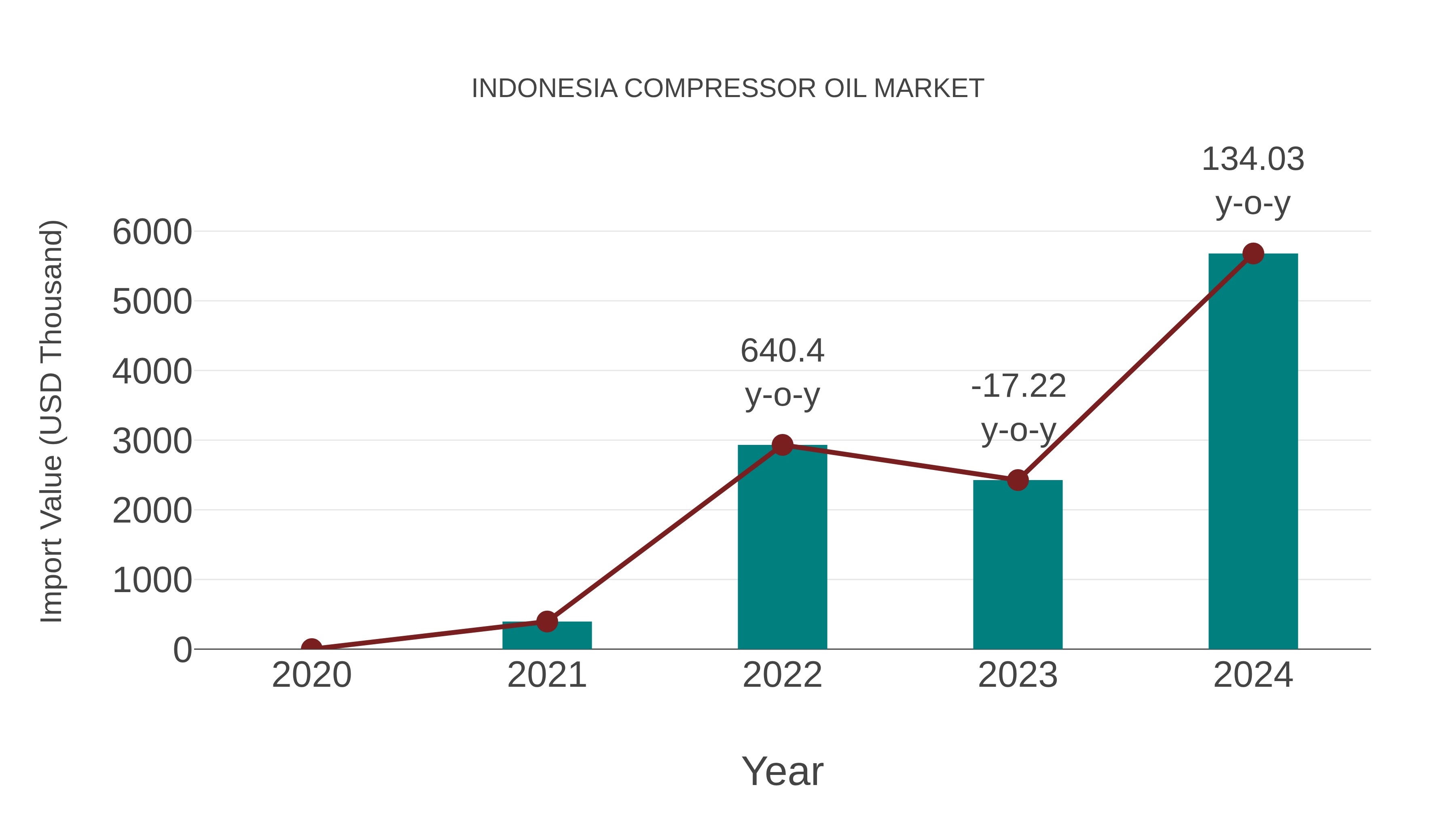
In the Indonesia compressor oil market, the import trend experienced significant growth from 2023 to 2024, with a growth rate of 134.03%. The compound annual growth rate (CAGR) for imports from 2020 to 2024 stood at 142.97%. This surge can be attributed to a notable demand shift towards higher-quality compressor oils, possibly driven by increased industrial activities or a preference for more efficient lubricants in the market.
Indonesia Compressor Oil Market Overview
The compressor oil market in Indonesia is closely associated with the country`s extensive use of compressors in various industries, including manufacturing, oil and gas, and automotive. The need for high-performance compressor oils to ensure smooth operation has led to the market`s expansion.
Drivers of the Market
The compressor oil market is primarily driven by the expansion of manufacturing and the industrial sector in Indonesia. As industrial operations heavily rely on compressors for various applications, the demand for high-quality compressor oils to ensure smooth operation and equipment longevity increases. The country`s infrastructure development projects further contribute to the market.
Challenges of the Market
Challenges in the compressor oil market include the need for oils that can withstand high pressures and temperatures, while also adhering to environmental regulations related to emissions and disposal.
COVID-19 Impacts on the Market
In the compressor oil market, the impact of the pandemic was notable. Compressor oils are crucial for various industrial applications, including refrigeration and air compression systems. The initial phases of the pandemic led to a decrease in industrial activity, causing a decline in compressor oil demand. As industries gradually reopened, the market started to recover. However, manufacturers in Indonesia had to adapt to the evolving energy efficiency and environmental regulations, which are influencing the formulation of compressor oils.
Key Players of the Makret
Key companies in the compressor oil market include PT Pertamina Lubricants and PT Nynas Indonesia.
Key Highlights of the Report:
- Indonesia Compressor Oil Market Outlook
- Market Size of Indonesia Compressor Oil Market, 2025
- Forecast of Indonesia Compressor Oil Market, 2032
- Historical Data and Forecast of Indonesia Compressor Oil Revenues & Volume for the Period 2022-2032F
- Indonesia Compressor Oil Market Trend Evolution
- Indonesia Compressor Oil Market Drivers and Challenges
- Indonesia Compressor Oil Price Trends
- Indonesia Compressor Oil Porter's Five Forces
- Indonesia Compressor Oil Industry Life Cycle
- Historical Data and Forecast of Indonesia Compressor Oil Market Revenues & Volume By Base oil for the Period 2022-2032F
- Historical Data and Forecast of Indonesia Compressor Oil Market Revenues & Volume By Synthetic for the Period 2022-2032F
- Historical Data and Forecast of Indonesia Compressor Oil Market Revenues & Volume By Mineral for the Period 2022-2032F
- Historical Data and Forecast of Indonesia Compressor Oil Market Revenues & Volume By Semi-Synthetic for the Period 2022-2032F
- Historical Data and Forecast of Indonesia Compressor Oil Market Revenues & Volume By Bio-based for the Period 2022-2032F
- Historical Data and Forecast of Indonesia Compressor Oil Market Revenues & Volume By Compressor Type for the Period 2022-2032F
- Historical Data and Forecast of Indonesia Compressor Oil Market Revenues & Volume By Dynamic for the Period 2022-2032F
- Historical Data and Forecast of Indonesia Compressor Oil Market Revenues & Volume By Positive Displacement for the Period 2022-2032F
- Historical Data and Forecast of Indonesia Compressor Oil Market Revenues & Volume By Application for the Period 2022-2032F
- Historical Data and Forecast of Indonesia Compressor Oil Market Revenues & Volume By Gas for the Period 2022-2032F
- Historical Data and Forecast of Indonesia Compressor Oil Market Revenues & Volume By Air for the Period 2022-2032F
- Indonesia Compressor Oil Import Export Trade Statistics
- Market Opportunity Assessment By Base oil
- Market Opportunity Assessment By Compressor Type
- Market Opportunity Assessment By Application
- Indonesia Compressor Oil Top Companies Market Share
- Indonesia Compressor Oil Competitive Benchmarking By Technical and Operational Parameters
- Indonesia Compressor Oil Company Profiles
- Indonesia Compressor Oil Key Strategic Recommendations






































