Indonesia Consumer Battery Market Size, Share & Growth Rate
The Indonesia Consumer Battery Market was estimated at USD 608 Million in 2025 and is projected to reach USD 910 Million by 2032, growing at a CAGR of 5.9% from 2026 to 2032. This promising trajectory is primarily driven by the increasing penetration of portable electronic devices and medical equipment, fueled by a rising urban population and disposable income. Moreover, the growing consumer preference for sustainable energy solutions is shifting the landscape towards advanced battery technologies.
Indonesia Consumer Battery Market Year-wise Growth Rate and Key Drivers
This graph highlights how the Indonesia Consumer Battery Market has steadily grown over the years, supported by major growth factors.
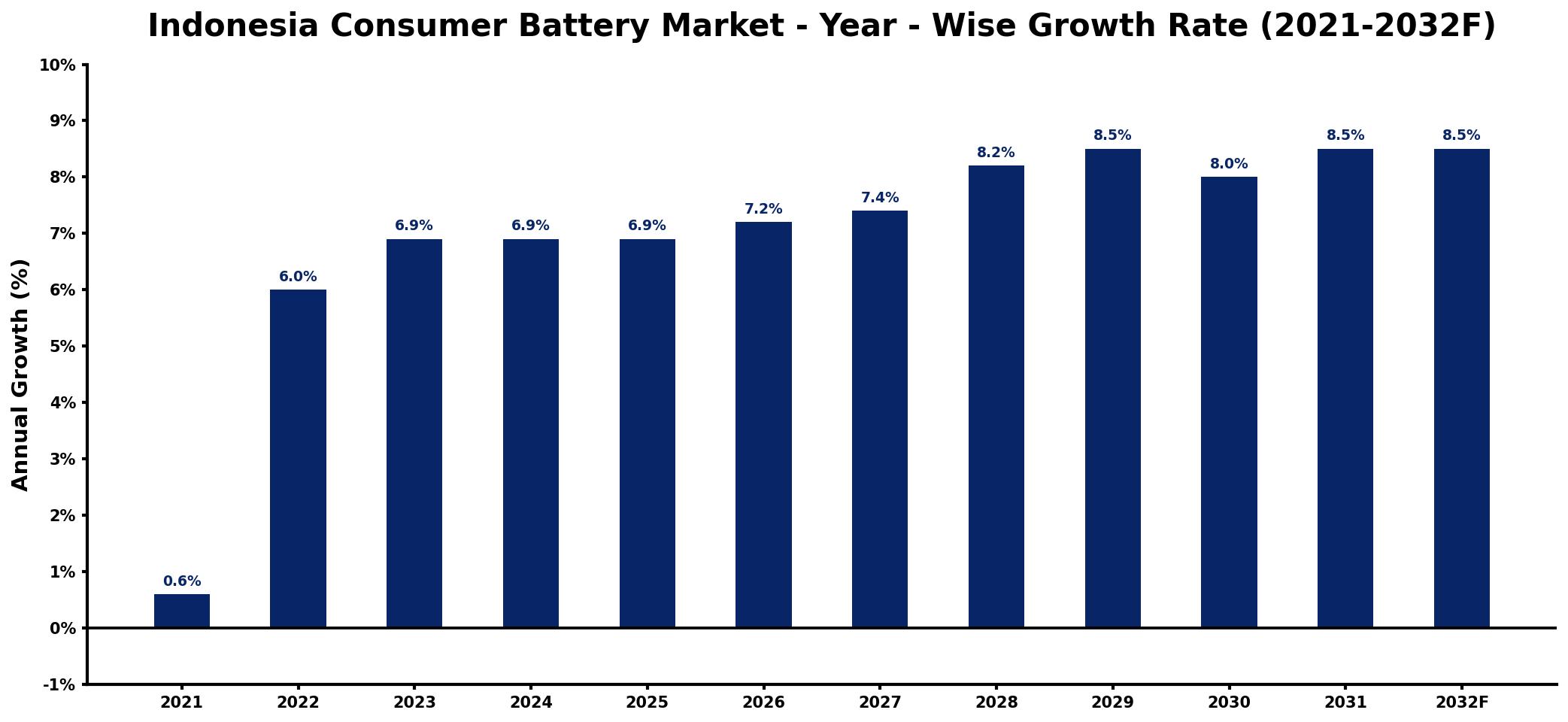
The table below presents the year‑wise growth rates along with the key drivers influencing the market
| Year | Growth Rate | Major Drivers |
| 2021 | 0.6% | Rising demand for portable devices |
| 2022 | 6.0% | Expansion of renewable energy projects |
| 2023 | 6.9% | Increased electric vehicle adoption |
| 2024 | 6.9% | Growth in smart home technologies |
| 2025 | 6.9% | Surge in mobile device usage |
| 2026 | 7.2% | Advancements in energy storage solutions |
| 2027 | 7.4% | Investments in green technology initiatives |
| 2028 | 8.2% | Development of sustainable energy sources |
| 2029 | 8.5% | increased domestic production output |
| 2030 | 8.0% | Emergence of new charging technologies |
| 2031 | 8.5% | Government support for clean energy |
| 2032 | 8.5% | Rise in global energy demands |
Note: Market size estimations and growth projections presented in this report are based on 6Wresearch's proprietary forecasting methodology, utilizing the latest available industry data, government publications, and primary research inputs.
Indonesia Consumer Battery Market Synopsis
The Indonesian consumer battery market is witnessing a surge in demand, particularly for batteries utilized in consumer electronics and medical devices. This uptick is attributed to the proliferation of mobile devices and health monitoring equipment, where reliability is paramount. Additionally, innovative marketing strategies and competitive pricing are enhancing accessibility, allowing a broader range of consumers to invest in advanced battery solutions.
With rising urbanization, the appetite for automated toys and smart home devices is on the rise, necessitating a steady supply of high-performance batteries. Furthermore, manufacturers are increasingly focusing on research and development to introduce eco-friendly and efficient battery options, which align with changing consumer values toward sustainability and environmental responsibility.
Indonesia Consumer Battery Market Key Takeaways
- The market is on an upward trajectory, supported by an increasing adoption of electronic devices.
- Urbanization and higher disposable incomes are significantly driving consumer purchasing behavior.
- Innovations in battery technology and sustainability initiatives are reshaping the product landscape.
- Government policies promoting renewable energy are expected to enhance market growth further.
- There is a noticeable shift toward eco-friendly battery disposal and recycling practices among manufacturers.
Evaluation of Restraints in Indonesia Consumer Battery Market
While the growth prospects for the Indonesia consumer battery market are compelling, several restraints remain. Environmental concerns around battery disposal and the recycling process pose significant challenges. Stricter regulations regarding waste management could necessitate substantial investments in sustainable practices from manufacturers. Consequently, navigating these regulatory landscapes while maintaining product affordability is crucial for companies aiming to thrive in this burgeoning market.
Indonesia Consumer Battery Market Trends
The market is currently experiencing a trend toward hybrid and electric vehicles, which require advanced battery solutions for efficiency. Additionally, the integration of smart technology in household devices is stimulating demand for rechargeable batteries. Companies are increasingly collaborating with tech firms to innovate solutions that cater to these trends. Theres also a growing emphasis on energy storage systems, as consumers become more conscious about renewable energy sources and their applications in everyday life.
Indonesia Consumer Battery Market Opportunities
The growth trajectory of the Indonesia consumer battery market presents numerous opportunities for investment, particularly in the development of green technologies and products. As manufacturers focus on creating environmentally friendly batteries, companies investing in R&D to enhance battery lifecycle and performance stand to gain a competitive edge. Additionally, partnerships with local startups can pave the way for innovative product offerings catering to specific consumer needs.
Government Initiatives in the Indonesia Consumer Battery Market
The Indonesian government is actively promoting initiatives aimed at enhancing the sustainability of the consumer battery market. Policies encouraging renewable energy usage and investments in green technology are gaining momentum. Furthermore, public funding for research in battery recycling processes and waste management strategies is being prioritized, aligning with global environmental standards. Such governmental support will play a critical role in shaping a more sustainable market landscape.
Future Insights of the Indonesia Consumer Battery Market
Looking ahead to 2026-2032, the Indonesia consumer battery market is expected to flourish, driven by continuous technological advancements and heightened consumer awareness regarding energy efficiency. The expansion of electric vehicles and smart devices will further spur demand, while regulatory developments will likely shape sustainable practices. Additionally, as consumers seek more integrated and multifunctional products, the market will adapt, fostering innovation and new business models that align with evolving consumer expectations.
Indonesia Consumer Battery Market Latest Developments (2025 - 2026)
Recent developments in the Indonesian consumer battery market indicate a strategic focus on enhancing battery life and reducing environmental impact. Innovations in battery chemistry and design are being prioritized to cater to the evolving needs of consumers. Additionally, partnerships among technology firms and battery manufacturers are emerging to leverage advancements in smart technology, enabling new applications and functionalities in consumer devices.
Indonesia Consumer Battery Market - Key Attractiveness of the Report
- 10 Years of Market Numbers
- Historical Data Starting from 2022 to 2025
- Base Year: 2025
- Forecast Data until 2032
- Key Performance Indicators Impacting the Market
- Major Upcoming Developments and Projects
Key Highlights of the Report:
- Indonesia Consumer Battery Market Outlook
- Market Size of Indonesia Consumer Battery Market, 2025
- Forecast of Indonesia Consumer Battery Market, 2032
- Historical Data and Forecast of Indonesia Consumer Battery Revenues & Volume for the Period 2022-2032F
- Indonesia Consumer Battery Market Trend Evolution
- Indonesia Consumer Battery Market Drivers and Challenges
- Indonesia Consumer Battery Price Trends
- Indonesia Consumer Battery Porter's Five Forces
- Indonesia Consumer Battery Industry Life Cycle
- Historical Data and Forecast of Indonesia Consumer Battery Market Revenues & Volume By Type for the Period 2022-2032F
- Historical Data and Forecast of Indonesia Consumer Battery Market Revenues & Volume By Lithium-ion Batteries for the Period 2022-2032F
- Historical Data and Forecast of Indonesia Consumer Battery Market Revenues & Volume By Zinc-Carbon Batteries for the Period 2022-2032F
- Historical Data and Forecast of Indonesia Consumer Battery Market Revenues & Volume By Alkaline Batteries for the Period 2022-2032F
- Historical Data and Forecast of Indonesia Consumer Battery Market Revenues & Volume By Nickel Metal Hydride for the Period 2022-2032F
- Historical Data and Forecast of Indonesia Consumer Battery Market Revenues & Volume By Nickel Cadmium for the Period 2022-2032F
- Historical Data and Forecast of Indonesia Consumer Battery Market Revenues & Volume By Others for the Period 2022-2032F
- Historical Data and Forecast of Indonesia Consumer Battery Market Revenues & Volume By End-User for the Period 2022-2032F
- Historical Data and Forecast of Indonesia Consumer Battery Market Revenues & Volume By Residential for the Period 2022-2032F
- Historical Data and Forecast of Indonesia Consumer Battery Market Revenues & Volume By Commercial for the Period 2022-2032F
- Indonesia Consumer Battery Import Export Trade Statistics
- Market Opportunity Assessment By Type
- Market Opportunity Assessment By End-User
- Indonesia Consumer Battery Top Companies Market Share
- Indonesia Consumer Battery Competitive Benchmarking By Technical and Operational Parameters
- Indonesia Consumer Battery Company Profiles
- Indonesia Consumer Battery Key Strategic Recommendations






































